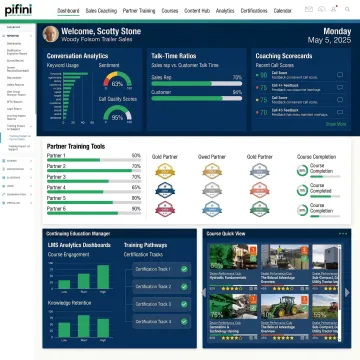
An LMS in sales is a learning management system designed to train sellers, managers, and partners on messaging, products, processes, and certifications. In a modern sales environment, it often goes beyond course delivery by connecting training to coaching, assessments, call performance, and revenue outcomes. That helps teams improve readiness faster and measure whether learning actually influences pipeline and win rates.
How much does an LMS solution cost?
LMS pricing varies widely based on features, user volume, implementation needs, and whether coaching or analytics are included. Pifini.ai offers its platform at $50 per user per year with no add-ons or hidden costs. That includes enterprise LMS capabilities plus AI coaching, call scoring, partner enablement, and analytics, making it significantly more affordable than many legacy platforms charging several hundred dollars per user annually.
What features should a sales LMS include?
A strong sales LMS should include learning paths, certifications, assessments, reporting, integrations, mobile access, and role-based training. For better performance outcomes, it should also support coaching workflows, call analysis, AI guidance, and analytics that connect training to sales results. Pifini.ai combines these capabilities so teams can manage onboarding, reinforcement, partner education, and readiness measurement in one platform.
Can an LMS help improve sales performance?
Yes, when it is tied to real selling behavior rather than course completion alone. An effective sales LMS helps teams ramp faster, reinforce messaging, identify skill gaps, and deliver targeted coaching. Pifini.ai strengthens that impact by linking call scoring, roleplay, certifications, and training analytics to outcomes like deal progression, win rates, and pipeline growth, so improvement is measurable rather than assumed.
Is Pifini.ai built for partner and channel sales training?
Yes. Pifini.ai is purpose-built for partner ecosystems including resellers, distributors, VARs, and alliances. The platform supports partner onboarding, certification management, compliance training, content delivery, AI support, and buyer collaboration. That partner-first design is important because channel teams need different workflows, permissions, and enablement structures than direct sales organizations using generic LMS or sales readiness tools.
How does call scoring work with LMS training?
Call scoring analyzes sales conversations to identify strengths, weaknesses, and missed opportunities. In Pifini.ai, those insights can trigger targeted learning paths automatically, so reps are enrolled in training based on actual performance gaps. This creates a closed-loop system where coaching is informed by real conversations, training is more relevant, and managers can track whether interventions improve future calls and sales outcomes.
Can the platform support certifications and compliance training?
Yes. Pifini.ai includes certification management, assessments, multi-level programs, and compliance tracking for sellers and channel partners. Teams can automate enrollment into required training, monitor completion status, validate mastery through exams, and generate reporting for internal oversight. This is especially useful for organizations that need consistent partner readiness, documented compliance, and scalable certification programs across distributed ecosystems.
How long does it take to implement a sales LMS platform?
Implementation timelines depend on the number of users, integrations, content migration needs, and certification workflows. A focused rollout can begin with core learning paths and expand into coaching, analytics, and partner enablement over time. Because Pifini.ai consolidates multiple functions into one platform, organizations can reduce vendor complexity and launch a more unified enablement system without stitching together several separate tools.