Introduction
Sales leaders face constant pressure to improve team productivity without simply adding headcount. Yet the data that could improve win rates, shorten sales cycles, and sharpen coaching already exists, it's inside the conversations reps have with prospects every single day.
Conversation analytics turns those calls into actionable intelligence, surfacing what top performers do differently, where deals stall, and which coaching interventions actually move the needle on revenue.
Key Takeaways
- Conversation analytics uses AI and NLP to analyze calls, video meetings, and emails, surfacing scored summaries and coaching flags for reps and managers
- Key advantages: data-driven coaching at scale, real-time buying signal detection, and linking call performance directly to targeted training
- Without it, teams rely on instinct over evidence, causing inconsistent performance, missed objections, and slow ramp times
- High-performing teams run conversation analytics continuously to sharpen rep behavior and tie training outcomes to deal results
What Is Conversation Analytics?
Conversation analytics uses AI and natural language processing (NLP) to automatically capture, transcribe, and analyze sales conversations across phone calls, video meetings, chat, and email. The goal: extract structured insights about message content, delivery quality, and deal outcomes.
Forrester defines conversation intelligence as tools that use NLP to capture unstructured data from buying and selling interactions, then apply embedded AI to surface insights that guide reps toward best practices.
Where Conversation Analytics Applies Across the Sales Cycle
Conversation analytics is typically applied across the entire sales cycle:
- Prospecting calls and initial outreach
- Discovery sessions to uncover buyer needs
- Product demonstrations and presentations
- Objection handling and competitive positioning
- Follow-ups and deal progression conversations
- Partner and channel sales interactions where managers have limited direct visibility
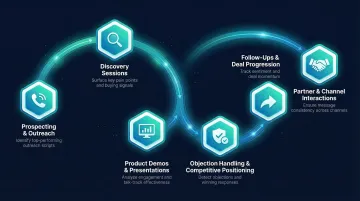
From Raw Conversations to Actionable Sales Insight
Transcripts and dashboards are outputs. The real value is helping sales teams replicate what works, correct what doesn't, and close the gap between insight and action faster. The conversation intelligence market reflects this urgency: growing from $1.6 billion in 2023 to a projected $8.4 billion by 2030, with 81% of sales teams actively investing in AI to solve exactly these challenges.
Key Advantages of Conversation Analytics for Sales Team Productivity
The advantages below focus on measurable, operational impact, not abstract benefits. Each ties directly to outcomes sales leaders track: quota attainment, ramp time, win rate, and coaching efficiency.
Advantage 1: Data-Driven Coaching That Scales Across the Entire Team
Conversation analytics enables sales managers to coach every rep based on actual call evidence, not the handful of calls they happened to observe or the notes reps self-report. The system automatically flags calls that contain specific patterns:
- Excessive monologuing with poor talk-to-listen ratios
- Weak discovery questions that fail to uncover buyer needs
- Missed competitor mentions that signal competitive threats
- Early disengagement signals indicating deal risk
Managers receive a prioritized coaching queue rather than having to manually review recordings. This addresses a critical bottleneck: frontline managers spend only 3–7% of their time coaching and manually review just 5% of calls.
Evidence-based coaching directly narrows the performance gap between your best and worst reps. Research shows an 18–22 percentage point win-rate gap between top and bottom quartile reps at the same company, even within the same organization, selling the same product.
The ramp time impact is equally concrete. Average new B2B rep ramp time has stretched to 4.5–5.7 months, yet organizations using conversation intelligence platforms report reducing onboarding time by up to 50%. Faster identification of skill gaps means faster correction, shorter ramp time for new hires, lower cost of carrying underperformers.
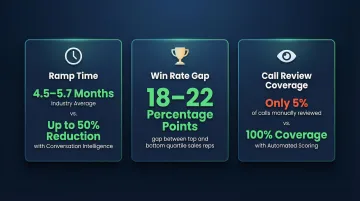
KPIs impacted:
- Average ramp time for new hires
- Call quality scores
- Quota attainment rates
- Manager time spent on coaching prep
- Individual rep performance variance
When this advantage matters most:
Most impactful in organizations with large sales teams, high rep turnover, remote or distributed teams, or channel/partner ecosystems where direct manager observation is limited, any situation where coaching cannot rely on proximity or random sampling.
Advantage 2: Real-Time and Post-Call Detection of Buying Signals, Objections, and Competitive Mentions
Conversation analytics surfaces the moments that actually determine outcomes, when a prospect signals intent, raises a recurring objection, or mentions a competitor. AI models identify sentiment shifts, keyword patterns, and tonal cues in real time or immediately after a call, turning fleeting signals into structured, searchable data.
Knowing which objections recur most often, and at which pipeline stage, lets sales leadership refine messaging, update battlecards, and eliminate the guesswork reps rely on when deals stall.
The numbers make the stakes clear: 64% of lost deals stem from poorly handled objections. Top performers handle objections in an average of 4.3 seconds; average reps take 18+ seconds. Conversation analytics identifies those response-time gaps and makes them coachable rather than invisible.
Competitive intelligence becomes equally actionable. Discussing competitors early in the sales cycle increases the odds of winning an enterprise deal by 32%, while late-stage competitor mentions signal deal risk. Teams using conversational intelligence to track those mentions have reported an 82% lift in win rates.
KPIs impacted:
- Conversion rate at each pipeline stage
- Objection resolution rate
- Competitive win rate
- Average sales cycle length
- Talk-to-listen ratio
When this advantage matters most:
Highest-impact in competitive markets with frequent objections, teams selling complex or multi-stakeholder solutions, and partner or reseller environments where reps are less familiar with end-customer dynamics and need stronger signal detection to compensate.
Advantage 3: Closing the Loop Between Call Performance and Targeted Sales Training
Conversation analytics does not just identify where a rep struggled, when connected to a training and enablement system, it automatically routes that rep into the specific learning content that addresses the identified gap. Call data becomes a continuous improvement engine rather than a one-time data point.
By scoring calls against defined competencies, active listening, discovery depth, value messaging, objection handling, the system builds a skills profile for each rep that updates with every interaction. That profile triggers prescriptive learning automatically, without waiting for a manager to intervene.
Pifini's AI-powered Revenue Enablement Platform operationalizes this by combining call scoring with auto-enrollment into targeted training paths. When a rep shows signs of struggle, in a roleplay, a scored call, or a certification, the system routes them into the relevant learning immediately. Gaps identified on Monday become skills reinforced by Wednesday.
Traditional sales enablement consistently fails at this connection point: training is generic, delivered once at onboarding, and never tied back to how reps actually perform on live calls. The Ebbinghaus Forgetting Curve quantifies the cost, the steepest information loss (30%) happens within the first 24 hours, and within 90 days, reps forget 84–90% of what they learned. In contrast, hybrid coaching that combines AI data with human mentoring yields 37% higher win rates than either method alone.
Linking training to call outcomes also solves a persistent measurement problem: sales leaders can finally show which learning investments produced pipeline growth, not just completion rates.
KPIs impacted:
- Time-to-productivity for new reps
- Training completion rates tied to specific skill gaps
- Win rate improvement post-training
- Sales cycle duration
- Correlation between certification scores and quota attainment
When this advantage matters most:
Most critical for organizations rapidly scaling, onboarding large batches of new reps or partners, or managing channel ecosystems where consistent messaging across distributed sellers directly affects revenue.
What Happens When Conversation Analytics Is Missing or Ignored
Without conversation analytics, sales teams operate with massive blind spots. Only 9% of sales calls are ever reviewed by managers, leaving coaching based on subjective observation or self-reporting rather than evidence. This leads to inconsistent feedback and uneven rep development.
The Consequences of Operating Without Structured Call Data
Three failure modes show up consistently when call data goes uncaptured:
- Objections go untracked: Recurring deal-blockers are never systematically addressed. Without automated pattern recognition, reps guess at what's working rather than knowing.
- Training disconnects from performance: It becomes impossible to tell whether enablement is producing results. Traditional sales training returns just $4.53 for every $1 invested, but most organizations can't even measure that return because they lack the data connecting training to outcomes.
- Management turns reactive: Managers only discover problems after a deal is lost, not while there's still time to intervene. Patterns that span dozens of calls stay invisible because no one has the bandwidth to review them manually.
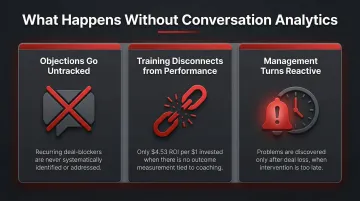
The Compounding Cost Over Time
The numbers reveal the full cost of this gap: 69% of reps are missing quota, with average attainment sitting at just 43.14%. Rep turnover has surged to 36%, and 44% of deals are pushed back from their original forecasted close dates. When deals slip, win rates plummet by 67%.
Without conversation analytics, top performer behaviors stay undocumented and unshareable. Onboarding cycles stretch out with no structured call library to learn from, and the performance gap between your best and average reps keeps growing.
How to Get the Most Value from Conversation Analytics
Conversation analytics delivers its strongest results when it is embedded into the sales workflow rather than treated as a separate review process. Insights need to surface in the tools reps and managers already use daily, CRM, coaching platforms, and learning management systems, so that acting on them requires no extra steps.
Focus on the Right KPIs, Not Volume
The goal is not to analyze every word of every call. The highest-performing teams track a focused set of KPIs:
- Talk-to-listen ratio: While the often-cited "golden ratio" of 43:57 is a useful baseline, recent analysis of 326,000 sales calls reveals that reps in closed-won deals talk 57% of the time versus 62% in closed-lost deals. The true differentiator is consistency, high performers maintain the same ratio whether they win or lose.
- Objection frequency and handling: Which objections recur most, and how quickly are they addressed?
- Competitor mentions: When and how often are competitors discussed?
- Sentiment trend: Are prospects engaged, hesitant, or disengaging?
Act on patterns rather than individual data points. Teams that chase every signal typically scatter their coaching effort and move the needle on nothing.
Treat Conversation Analytics as a Continuous Practice
Three habits separate teams that extract lasting value from those that treat conversation analytics as a one-time audit:
- Managers use it to set coaching priorities weekly: Frequency matters. Reps receiving weekly coaching achieve 76% quota attainment, versus 56% for monthly and 47% for quarterly or less.
- Reps review their own call scores regularly: Reps who track their own scores identify blind spots faster and close skill gaps without waiting for manager feedback.
- Training content is updated based on recurring call data: Enablement becomes evidence-based, built around actual field gaps, not assumptions about what reps need.
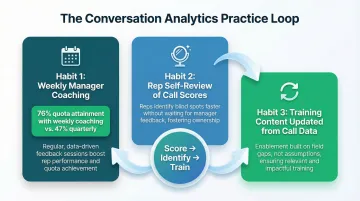
This loop, score, identify, train, works best when it runs automatically. Pifini's Revenue Enablement Platform connects Sales Call Scoring directly to its Enterprise LMS: when a performance gap is detected, the system routes the rep into targeted training without any manual admin step in between.
Conclusion
Conversation analytics improves sales team productivity not by adding more oversight, but by replacing guesswork with evidence. It gives managers the signal they need to coach effectively, gives reps the feedback they need to improve, and gives organizations the closed loop between conversations and training that traditional enablement has always lacked.
That closed loop pays dividends over time. Teams that apply conversation analytics consistently build a growing library of best practices, a continuously updated skills profile for every rep, and a direct line from call quality to pipeline performance.
Organizations using revenue intelligence see an average 15% increase in sales efficiency and a 20% reduction in sales cycle time. A Forrester Total Economic Impact study found 481% ROI over three years for companies implementing conversation analytics.
The teams seeing those results treat conversation analytics as infrastructure, not a quarterly initiative, and the data shows it.
Frequently Asked Questions
What is conversation analytics?
Conversation analytics is the use of AI and natural language processing to automatically capture, transcribe, and analyze sales conversations across calls, video meetings, chat, and email to extract structured insights about rep performance, customer sentiment, and buying signals.
How does conversation analytics improve sales team productivity?
Conversation analytics improves productivity by replacing manual call review with automated insight delivery, enabling managers to coach at scale, helping reps identify and correct gaps faster, and linking call performance directly to targeted training and deal outcomes.
How can managers use conversation analytics to coach sales reps and provide feedback?
Managers can use flagged calls, call quality scores, and competency breakdowns to prioritize coaching sessions and deliver specific, evidence-based feedback rather than general advice. Over time, performance scores show whether coaching is actually working.
How can conversation analytics help train sales reps and improve sales conversations?
Conversation analytics identifies recurring skill gaps across calls, weak discovery questions, poor objection handling, missed buying signals. That data informs or automatically triggers targeted training tied directly to where each rep struggles.
What are the key features and benefits of conversation analytics software for sales teams?
Core features include automatic call transcription, sentiment analysis, buying signal detection, call scoring, and CRM integration. Teams gain faster rep development, higher win rates, and a reliable way to scale top-performer behaviors across the entire sales org.
What methods does conversation analytics use to capture customer conversation data?
The system captures data through automated call recording, real-time speech transcription, and NLP-powered processing of chat and email threads. It integrates with dialers, video conferencing platforms, and CRM systems to pull conversations from wherever your reps work.