Introduction
Enterprise learning is no longer static. Organizations across sales, partner, and channel ecosystems are shifting from fixed course libraries to systems that respond dynamically to individual performance, and they're doing it at scale. 89% of revenue organizations now use AI in some capacity, up from just 34% in 2023.
Most organizations treat AI training tools as content delivery systems, not performance intelligence engines. The most valuable capability, auto-assessing performance and routing learners accordingly, goes largely underused. This guide explains how AI actually reads performance signals, interprets them, and uses that interpretation to route each learner to the right content.
Key Takeaways
- AI monitors quiz results, engagement behavior, call recordings, and skill assessments to build a real-time performance profile
- Detected knowledge gaps auto-trigger targeted training, no manager intervention needed
- Personalization relies on pattern recognition across many data points, making recommendations more accurate
- Performance data feeds content decisions, which loop back to continuously update each learner's profile
- The result: sales teams and channel partners get targeted training tied directly to the behaviors that close deals
What Is AI Performance Assessment in Training?
AI performance assessment in training is the continuous collection, analysis, and interpretation of learner data, across assessments, behaviors, and real-world outputs, to determine what training intervention is needed next.
Traditional training programs are designed once and delivered uniformly. There's no mechanism to detect whether someone is retaining, applying, or struggling. AI performance assessment solves this by making the training system responsive.
This goes beyond automated grading or quiz scoring. AI performance assessment incorporates behavioral signals, engagement patterns, and performance in real-world contexts, sales calls, simulation exercises, and post-training application on the job.
Adults forget 75% of new information within days without active reinforcement, and 87% of training skills are lost within 30 days. For sales teams, those gaps translate directly into missed deals. AI performance assessment catches them early, before they show up in your pipeline.
What Performance Signals Does AI Actually Read?
AI doesn't rely on a single data point. It builds a performance profile from multiple signal categories simultaneously. The more signal types it reads, the more accurate its content recommendations become.
Assessment and Quiz Data
AI reads not just whether an answer was right or wrong, but which specific questions were missed, how many attempts were made, and whether errors cluster around a particular concept. That pattern reveals the depth of a knowledge gap, not just that one exists.
If a learner consistently misses questions about objection handling but aces product features, the system identifies a targeted skill deficiency rather than a general knowledge problem.
Engagement and Behavioral Signals
AI tracks engagement patterns within training content:
- Time spent on a module
- Sections skipped or re-watched
- Drop-off points
- Completion rates
These passive signals often reveal disengagement or confusion that assessment scores alone would miss. A learner who completes a module in half the expected time may not have absorbed the material. Someone who repeatedly rewinds a video segment is signaling confusion.
Sales Call and Roleplay Performance
AI analyzes recorded sales calls or roleplay simulations using natural language processing, scoring responses against defined criteria like objection handling, product knowledge accuracy, or messaging alignment.
Pifini's platform evaluates every call against proven success criteria, analyzing discovery quality, objection handling, product positioning, and closing strength. When the system detects gaps, it automatically routes reps or partners into targeted training modules without manual intervention. That direct link between call behavior and training response is what separates AI-driven enablement from traditional LMS workflows.
CRM and Workflow Data
AI-enabled platforms ingest performance data from CRM systems, such as deal stage progression, win rates, or time-to-close, to identify correlations between specific skill gaps in training and downstream revenue impact.
The numbers back this up:
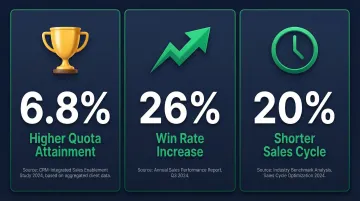
- Quota attainment runs 6.8% higher when enablement tools are integrated with CRM
- Win rates increase ~26% for sellers using conversation intelligence
- Companies using these tools report a 15% win rate lift and a 20% reduction in sales cycle length
Certification and Progression Metrics
AI uses credentialing data, what certifications a learner holds, how long ago they were earned, and how fast they progressed, as indicators of current competency level. This data influences which advanced or remedial content paths are activated.
A rep who earned a certification 18 months ago may need a refresher even if their original score was high, while a partner who completed foundational training ahead of schedule can be moved directly into advanced content.
How AI Converts Performance Data into Personalized Training Content
After assembling a multi-signal performance profile, AI runs this data through a set of matching and routing rules to determine what content to surface, at what difficulty level, and in what format. This process happens in near real-time, not during a quarterly training review.
Gap Detection and Prioritization
AI ranks identified knowledge or skill gaps by severity and urgency, distinguishing between foundational gaps that block progress and peripheral gaps that can be addressed over time.
For example:
- A rep who can't articulate the core value proposition has a foundational gap, it blocks every sales conversation
- A rep missing deep knowledge on a rarely-used feature has a peripheral gap, addressable over time without immediate impact
This prioritization determines the order and intensity of recommended content.
Content Matching and Path Construction
AI maps detected gaps to a content library, selecting modules, microlearning units, simulations, or roleplay scenarios that address the specific deficiency.
This matching relies on metadata tagging of both learner profiles and content objects. Paths restructure dynamically as the learner progresses:
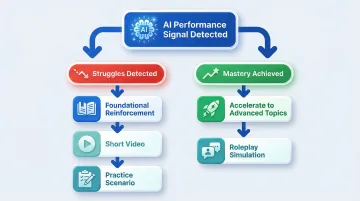
- Mastery on first attempt: system accelerates the learner to advanced topics
- Repeated struggles: system inserts foundational reinforcement before moving forward
Adaptive Difficulty Calibration
AI adjusts the difficulty level of assigned content based on demonstrated performance. Organizations implementing AI-powered sales assistants report 67% faster time-to-competency.
Research shows retrieval practice produces a 50% improvement in long-term retention compared to traditional studying methods. Adaptive systems leverage this by continuously testing and adjusting content difficulty.
Auto-Enrollment and Prescriptive Deployment
AI systems auto-enroll learners into targeted training the moment a performance threshold is crossed, no manager action required.
Pifini's platform exemplifies this approach: the AI evaluates every call, flags skill gaps, and automatically routes reps or partners into targeted training modules based on what it detected. If call scoring reveals weak objection handling, the learner is immediately enrolled in objection handling training without waiting for a manager review.
Format and Modality Personalization
AI can also vary the format of training content, delivering a struggling learner a short video explainer followed by a practice scenario rather than a long written module, based on engagement history and demonstrated learning patterns.
Format personalization increases completion rates and reinforces content through varied repetition. A rep who repeatedly rewinds video explanations gets more video content; one who consistently outperforms in simulations gets routed toward advanced roleplay scenarios.
The Continuous Feedback Loop: From Assessment to Improvement
What distinguishes AI performance assessment from a one-time diagnostic is the feedback loop. Each training interaction generates new performance data, which updates the learner's profile, which adjusts future content recommendations, creating a system that continuously refines itself over time.
This loop enables AI to track improvement velocity, identifying not just where a learner is weak, but whether they are improving, plateauing, or regressing after completing assigned training, and adjust content intensity accordingly.
The business case for this kind of continuous reinforcement is well-documented:
- Organizations with highly effective sales training are nearly 5x more likely to provide ongoing reinforcement than those with lower-performing programs
- Reps receiving weekly coaching show 26% higher performance compared to those coached less frequently
At the organizational level, this loop generates aggregate performance intelligence that managers and L&D leaders can use to spot systemic gaps across a team or partner network, turning individual training data into strategic visibility.
That visibility becomes actionable with the right analytics layer. Pifini connects training completion and certification scores directly to pipeline and win-rate outcomes, so managers can identify which courses drive revenue, not just completion rates.
Where AI Performance Assessment Delivers the Most Impact
This capability is most valuable in high-stakes, fast-changing environments where knowledge gaps directly affect revenue, including new rep onboarding, product launch readiness, and partner/channel enablement. The cost of a knowledge gap in these contexts is a lost deal, not just a missed quiz.
Real-world impact:
- Janssen India reduced rep ramp time by 50% and saw 35% increases in sales performance after a new rep's first six months
- CentiMark cut ramp time to just 8 days using AI-driven enablement
- Dedicated sales coaches achieve 32% higher win rates (29% vs. 22% average close rate) and 28% higher quota attainment (87% vs. 68% of quota)
The Partner and Channel Sales Use Case
Distributed partners don't have daily access to internal coaching. AI-driven performance assessment and auto-enrollment become the primary mechanism for catching and correcting training gaps at scale across reseller or distributor networks.
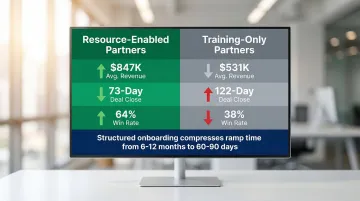
The performance gap between resource-enabled and training-only partners is significant:
- Resource-enabled partners generate 60% higher annual revenue ($847K vs. $531K) and close deals 40% faster (73 days vs. 122 days)
- Competitive win rates reach 64% for resource-enabled partners, versus 38% for training-only partners
- Without structured onboarding, the average channel partner takes 6-12 months to become fully productive, a well-designed program compresses this to 60-90 days
By 2029, Gartner predicts sales organizations with AI-driven enablement functions will achieve 40% faster sales stage velocity than those using traditional enablement approaches.
Conclusion
AI performance assessment treats training as a continuous, data-informed response to demonstrated behavior. The assessment and the intervention are the same system, running in parallel with how people work.
Organizations that understand how AI reads performance signals can configure their platforms to capture the right data, map content to the right competencies, and measure outcomes that connect directly to pipeline and revenue. That's the shift from training as an event to training as an operating system.
Frequently Asked Questions
How should AI be used to enhance training programs?
AI enhances training by continuously analyzing performance signals to detect gaps, automatically personalizing content delivery, and creating a feedback loop that adapts the program in real time. This replaces standardized training programs with a responsive system tied to actual learner behavior.
What types of performance data does AI use to personalize training?
AI uses quiz and assessment results, in-platform engagement behavior, sales call recordings or roleplay scores, CRM performance data, and certification progress. The combination of these signals produces more accurate content recommendations than any single data point alone.
How does AI know when to trigger new training for a learner?
AI triggers training when a learner's performance on an assessment, call evaluation, or engagement metric falls below a defined threshold. This is called prescriptive learning, and it initiates auto-enrollment without manual manager intervention.
Can AI-personalized training improve sales performance, not just learning scores?
Yes. Platforms that connect certification data and training scores to CRM metrics like win rates and pipeline velocity can link learning directly to sales outcomes. This makes it measurable whether a specific training intervention moved the needle for reps in the field.
What is prescriptive learning and how does it differ from adaptive learning?
Adaptive learning adjusts content difficulty as a learner moves through a course. Prescriptive learning goes further, it proactively identifies gaps and auto-routes learners into the right training based on performance signals from assessments, calls, or real-world outputs.
How does AI performance assessment work in partner and channel sales training?
Partners are distributed and rarely receive daily coaching, so AI fills that gap. It monitors training engagement and performance signals, identifies gaps, and auto-enrolls partners in targeted content to maintain consistent competency across the network.