Introduction
Most sales teams don't fail from lack of effort, they struggle from inconsistency in execution. You've seen it: reps who know the product inside and out but can't run a strong discovery. Sellers who communicate well but crumble when prospects push back on pricing. Teams that hit quota one quarter and miss badly the next.
The difference between a rep who closes 30% of their pipeline and one who closes 60% rarely comes down to talent or charisma. It comes down to specific, learnable competencies, applied consistently, not just when conditions are ideal.
This post breaks down the 15 most critical sales competencies, grouped by function, with a focus on how managers can develop them deliberately across their teams.
You'll see which skills drive the biggest performance gaps, how to measure them objectively, and how tools like AI roleplay simulations and call scoring are reshaping how organizations build these capabilities.
Key Takeaways
- Sales competencies are defined skills and behaviors that determine how effectively reps engage buyers and close revenue
- The 15 competencies span five categories: foundational, relational, strategic, performance mindset, and tech/AI fluency
- High-performing orgs build frameworks, assess reps consistently, and use coaching to close gaps, not just generic training
- Reps who partner with AI are 3.7x more likely to meet quota, per Gartner
- Platforms like Pifini connect learning, live coaching, and call performance data to build rep skills faster without added headcount
What Are Sales Competencies (and Why Do They Matter)?
Sales competencies are observable, measurable skills and behaviors that drive consistent selling outcomes, from pipeline creation to deal closure. They're not personality traits or job titles. They're the applied abilities reps demonstrate when qualifying a prospect, handling objections, or navigating a buying committee.
There's an important distinction between a skill and a competency. Knowing three objection-handling techniques is a skill, teachable and specific. A competency is the ability to apply multiple skills with judgment in real buyer situations. Using those techniques confidently in a high-stakes pricing conversation, reading the buyer's hesitation, adapting your response, and closing without discounting, that's a competency.
Competency frameworks matter because they create a shared standard. Managers coach against the same criteria. Reps know what "good" looks like at each stage of the cycle. And organizations can spot training gaps before they show up as missed quota.
According to Salesforce's 2026 State of Sales report, 87% of sales organizations currently use AI for tasks like prospecting and forecasting, but adoption without structured competency development means those tools never reach their full impact. The 15 competencies below give you a framework to close that gap.
The 15 Essential Sales Competencies Every Sales Rep Needs
These 15 competencies are grouped into five functional categories. Reps at every career stage will have strengths in some and gaps in others, the goal is to treat each as a development area, not a fixed trait.
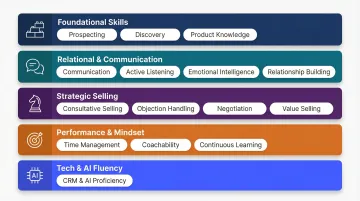
Foundational Skills
Prospecting
Prospecting is the discipline of identifying, researching, and engaging potential buyers who fit your ICP before they're actively looking to buy. Without consistent prospecting habits, reps become pipeline-dependent and quota-vulnerable.
High performers prospect systematically:
- Research accounts before reaching out
- Personalize messaging based on buyer context
- Test multiple channels (email, LinkedIn, phone) to find what resonates
- Track outreach patterns to refine their approach
According to Salesforce, high performers are 1.7 times more likely to use prospecting AI agents than underperformers, using AI to automate research and prioritize accounts.
Discovery
Thorough discovery, asking layered, buyer-centric questions rather than rushing to pitch, helps reps uncover real business pain, map stakeholder dynamics, and qualify more accurately. Discovery is where trust is first built or lost.
Strong discovery reps:
- Ask open-ended questions that reveal urgency and budget reality
- Listen for what's not being said
- Confirm understanding by paraphrasing buyer concerns
- Map decision-makers and influencers early
Discovery isn't a single call. It's a continuous process of uncovering new information as the deal progresses.
Product and Industry Knowledge
Credibility in complex B2B sales requires knowing not just the product but the buyer's industry, challenges, and competitive context. Reps who speak to business outcomes, not just features, win more conversations.
Top reps:
- Study buyer industries to understand market dynamics
- Know how competitors position themselves
- Translate product capabilities into buyer-specific outcomes
- Stay current on regulatory changes and industry trends
The difference between a rep buyers call back and one they ignore usually comes down to this.
Relational and Communication Skills
Communication
Communication is the ability to convey ideas clearly and adapt tone, format, and depth to different buyers and contexts, from a cold email to a C-suite presentation. It's bi-directional and includes knowing when to say less.
Effective communicators:
- Write emails that get opened and responded to
- Adjust their language for technical buyers vs. executives
- Use visuals and stories to make complex ideas simple
- Know when silence creates space for the buyer to process
Active Listening
Active listening goes beyond hearing words, top reps listen for hesitation, urgency, confusion, and emotional subtext. Pausing after pricing, paraphrasing to confirm understanding, and asking follow-up questions rather than filling silence are hallmarks of this competency.
Active listeners:
- Don't interrupt or rush to respond
- Notice tone shifts and verbal cues
- Ask clarifying questions before proposing solutions
- Repeat back what they heard to confirm alignment
Most buyers decide whether a rep is worth their time in the first few minutes, active listening is what earns that trust.
Emotional Intelligence
EQ helps reps manage pressure, read buyer dynamics, handle uncomfortable conversations, and build stronger relationships. Empathy is a measurable behavior, it shows up in how reps respond when a buyer pushes back.
High-EQ reps:
- Stay calm when deals stall or buyers go dark
- Read group dynamics in multi-stakeholder meetings
- Adjust their approach when buyers signal discomfort
- Build rapport without forcing familiarity
Emotional intelligence is especially critical in high-stakes negotiations and long sales cycles.
Relationship Building
Durable sales success depends on a rep's ability to create trust beyond the transaction, following up with value, remembering context, and acting as a genuine advisor. This competency is especially important in accounts with long sales cycles or renewal potential.
Relationship builders:
- Follow up with relevant content, not just check-ins
- Remember details from previous conversations
- Introduce buyers to other stakeholders who can help
- Stay engaged after the deal closes
This competency directly impacts customer lifetime value and referral rates.
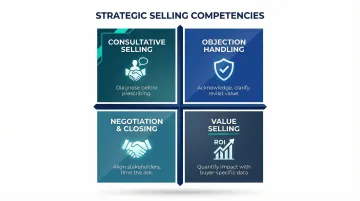
Strategic Selling Skills
Consultative Selling
Consultative selling is the shift from pitching to partnering, reps ask better questions, co-create solutions, and tie product capabilities to specific buyer outcomes. Done well, it reduces deal risk and gives buyers a reason to choose beyond price.
Consultative sellers:
- Diagnose before they prescribe
- Involve buyers in solution design
- Challenge buyer assumptions when appropriate
- Position themselves as partners, not vendors
This competency requires deep discovery and strong product knowledge working together.
Objection Handling
Experienced reps develop a mindset shift, objections signal uncertainty, not rejection. The general approach: acknowledge, clarify, revisit value, and explore trade-offs rather than discounting reflexively or pushing through.
Strong objection handlers:
- Welcome objections as opportunities to clarify value
- Ask questions to understand the real concern
- Address the underlying issue, not just the surface objection
- Use proof points (case studies, data) to reduce perceived risk
Reps who handle objections well protect both the deal and the pricing.
Negotiation and Closing
Closing is not a pressure tactic but a skill of aligning stakeholders, confirming shared value, and timing asks to how buyers make decisions. Reps who close well also summarize conversations accurately and make next steps feel earned, not forced.
Effective closers:
- Confirm decision criteria and timeline early
- Align internal champions before presenting to leadership
- Propose next steps that match the buyer's decision process
- Use trial closes to test readiness without forcing commitment
This competency is the difference between forecast accuracy and missed quarters.
Value Selling
Value selling requires reps to translate product features into quantifiable business outcomes for each specific buyer, revenue impact, time saved, risk reduced. Without this skill, reps compete on price by default.
Value sellers:
- Build business cases that justify investment
- Quantify ROI using buyer-specific data
- Connect product capabilities to strategic initiatives
- Demonstrate cost of inaction, not just benefit of purchase
When reps can show what inaction costs, approval cycles shorten and pricing holds.
Performance and Mindset Skills
Time Management and Prioritization
As pipelines grow, the skill is not just managing time but knowing which deals, accounts, and activities most deserve it. Reps who deprioritize low-probability opportunities protect their productivity and reduce pipeline bloat.
High performers:
- Qualify ruthlessly and disqualify fast
- Focus on accounts with budget, authority, need, and timing
- Block time for high-value activities (discovery, demos, closing)
- Use CRM data to identify which deals need attention
Time allocation is often the hidden variable between two reps with identical pipelines.
Coachability and Self-Awareness
The willingness to receive feedback, reflect honestly, and adjust behavior is a performance multiplier, not a personality trait. Coachable behavior looks like: applying one specific change from a coaching session, not just agreeing with the advice.
Coachable reps:
- Ask for feedback proactively
- Review call recordings to identify improvement areas
- Test new approaches based on coaching input
- Admit when they don't know something
Managers can offer the best coaching in the world, coachability determines whether it sticks.
Continuous Learning and Adaptability
High-performing reps treat learning as a system, testing new approaches in small ways, reviewing wins and losses, and staying current on buyer behavior and market shifts. Agility is built through reflection, not just training attendance.
Continuous learners:
- Review every lost deal to understand why
- Study competitors and market trends
- Experiment with new messaging and objection responses
- Share what works with their team
The reps who improve every quarter aren't luckier, they review, adjust, and apply more consistently than peers who don't.
Tech and AI Fluency
CRM and AI Tool Proficiency
Modern B2B selling requires reps to consistently log activity, use enablement tools to prepare for conversations, and increasingly leverage AI to analyze call patterns, flag deal risks, and rehearse objections before key meetings.
According to Salesforce, sellers currently spend 60% of their time on non-selling tasks, but AI agents are expected to cut prospect research time by 34% and email drafting by 36%.
Tool overwhelm, though, is a real counter-force: 42% of reps feel overwhelmed by the number of tools they use, and overwhelmed sellers are 45% less likely to hit quota.
AI-fluent reps:
- Use AI to automate research and data entry
- Review call scoring insights to improve execution
- Practice objection handling in AI roleplay simulations
- Leverage AI copilots for real-time coaching during calls
Organizations must consolidate tools and train reps on AI workflows, not just give them more software.
How to Build a Sales Competency Framework for Your Team
A competency framework starts with defining what "good" looks like at each stage of the buyer journey, not generic excellence, but specific, observable behaviors tied to revenue outcomes. Managers should map each of the 15 competencies to the selling stages where they matter most. That process typically runs through three steps: defining what good looks like, diagnosing where gaps exist, and building targeted development plans.
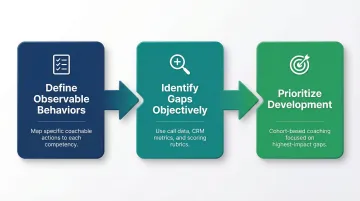
Define Observable Behaviors
Translate each competency into specific, coachable behaviors, not vague qualities like "good listener" but concrete actions a manager can observe on a call:
- Discovery: "Asks open-ended questions, pauses after buyer answers, confirms understanding before pitching"
- Objection handling: "Acknowledges concern, asks clarifying question, revisits value with proof point"
- Value selling: "Quantifies ROI using buyer-specific data, connects product to strategic initiative"
Identify Gaps Objectively
Pair manager observations with call analysis, CRM data, and structured rubrics, not gut feel or rep self-assessments. Self-assessments often reflect confidence, not actual competence. Behavioral data produces sharper, more actionable coaching decisions.
Sources worth pulling from:
- Call recordings scored against competency rubrics
- CRM data showing pipeline velocity and conversion rates
- Buyer feedback on rep performance
- AI call scoring to surface behavioral patterns across the team
Prioritize Development
Once you know where gaps cluster, resist the impulse to run the same training for everyone. Group reps by shared skill gaps (cohort-based coaching), match coaches to the right competencies, and build plans that target the highest-impact gaps first.
If five reps struggle with discovery, run a cohort workshop on questioning techniques with live practice calls. If three reps are losing deals at negotiation, run targeted roleplay simulations, not a general "sales skills" refresher that covers ground they've already mastered.
Developing Sales Competencies at Scale
Individual coaching alone won't develop competencies across an entire team. Organizations need structured reinforcement, spaced practice, and real-time feedback loops that connect training to actual selling behavior. The "learning-to-action" gap is real: many reps complete training but fail to retain or apply it without consistent follow-through.
AI-Powered Enablement
Today's enablement platforms automate what manual coaching can't scale:
- AI roleplay tools let reps rehearse discovery calls, objection scenarios, and closing conversations before real meetings
- Call scoring surfaces behavioral patterns across the team, showing which competencies need development
- Prescriptive learning automatically routes reps into targeted training when gaps are detected
Pifini combines AI coaching, call scoring, roleplay simulations, and an enterprise LMS in a single platform, linking training completions and competency scores directly to deal outcomes and win rates.
The data backs it up: across 436 training sessions with 18 partner companies, Pifini's courses achieved a 46.1% training success rate and an average sales performance improvement of 16.7%.
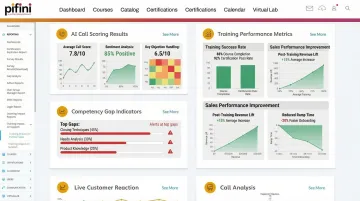
Reinforcement in the Flow of Work
Playbooks, coaching prompts, and practice tools need to live inside the CRM and daily workflow, not in a separate LMS reps visit once a quarter. Guidance that isn't accessible at the moment of need rarely changes behavior.
Pifini's live AI call copilot addresses this directly:
- Surfaces objection responses and content recommendations during active calls
- Delivers coaching cues in real time, without pulling reps out of their workflow
Coach the Coaches
Managers are central to competency development and often share the same gaps as their teams. Coaching effectiveness should be assessed and developed, not assumed.
Conclusion
The 15 competencies in this post are not a checklist to complete, they are a development map that improves with consistent practice, coaching, and performance data. Reps at every stage will have different gaps, and a framework gives managers somewhere specific to start.
The organizations that consistently develop these competencies across their full sales teams, including partner channels, not just direct reps, will outperform those that rely on individual talent alone. Start by assessing where your team sits today and identify one category to focus on first.
That assessment is where Pifini becomes useful. The platform is built to turn gap analysis into action:
- Surfaces competency gaps using AI call scoring and training data
- Deploys targeted simulations and roleplay to close specific weaknesses
- Auto-enrolls reps into training when performance signals flag a problem
- Links training completion to pipeline metrics, not just course completion rates
See how Pifini connects rep development to revenue outcomes.
Frequently Asked Questions
What core competencies should be assessed for sales reps?
The most commonly assessed categories include discovery, objection handling, communication, value selling, and pipeline management. Effective assessments measure observable behavior in realistic selling situations, not self-reported confidence, which often reflects optimism more than actual skill.
What competencies should be included in a sales manager competency framework?
Manager frameworks typically include coaching effectiveness, performance analysis, team development, pipeline management, and cross-functional communication. Managers should also be assessed on the competencies they coach: discovery, objection handling, and value-selling guidance.
What are common sales rules (3-3-3, 10-3-1, 70/30) and what do they mean?
The 3-3-3 rule recommends 3 touches in 3 days across 3 channels. The 10-3-1 rule sets a pipeline ratio: 10 prospects yield 3 conversations and 1 close. The 70/30 rule targets 70% listening and 30% talking on calls. All three are starting benchmarks, not fixed formulas, actual ratios vary by role and market.
What is the difference between a sales skill and a sales competency?
A skill is a specific, teachable behavior, for example, writing a compelling subject line. A competency is the ability to apply multiple skills with situational judgment in real buyer interactions. Competency shows up in outcomes (closed deals, advanced conversations), not just activity (emails sent, calls made).
How do you measure sales competencies across your team?
The most reliable measurement approaches include behavioral observation on calls (manual or AI-scored), structured rubrics applied consistently, CRM-based deal analysis, and buyer feedback on rep performance. Self-assessments alone are insufficient because reps often overestimate their competence in areas where they lack awareness.