The stakes have never been higher. Channel partners influence 75% of B2B transactions, yet only 33% of companies have formal partner education programs. Meanwhile, sales reps take an average of 3-6 months to reach full productivity, with some organizations reporting ramp times exceeding seven months.
Not all simulations solve this problem equally. The difference between a simulation that changes behavior and one that gets clicked through without impact comes down to specific, evidence-backed design principles. This article unpacks what makes immersive simulations effective: the cognitive science behind their success, the design elements that separate high-impact programs from low-ROI ones, and how AI is raising the ceiling on what simulations can achieve.
Key Takeaways
- Simulations work because they activate retrieval practice, emotional encoding, and consequence-based learning, technology alone doesn't drive retention
- Branching scenarios, immediate feedback, and deliberate practice separate effective simulations from passive click-throughs
- Highest-impact use cases: sales roleplay, safety protocols, onboarding, and complex product training
- AI-enhanced simulations adapt in real time, surface skill gaps, and route learners into targeted follow-up modules
- Prove ROI by linking simulation scores directly to business outcomes like win rates, ramp time, and deal velocity
What Makes a Training Simulation Truly Immersive
Immersion isn't about VR headsets. It's about psychological presence, the learner feels the stakes, their decisions matter, and the scenario mirrors their real work closely enough to trigger authentic responses. Lombard and Ditton (1997) define presence as "the perceptual illusion of nonmediation," where the medium becomes invisible and learners respond to scenarios as if they were physically present.
Immersive technologies exist on a spectrum:
- AI-powered conversation simulations - Accessible, scalable, ideal for sales and customer-facing skills
- Branching video scenarios - Interactive decision-based learning without hardware requirements
- AR overlays - Real-world augmentation for field training and technical tasks
- Full VR environments - Highest fidelity, higher cost, best for high-stakes physical simulations
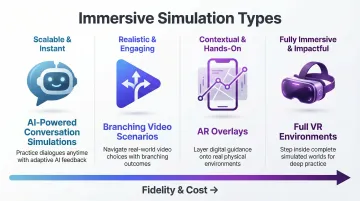
The right choice depends on the skill being trained. For sales teams practicing objection handling or discovery conversations, AI-powered simulations often deliver faster ROI than hardware-dependent VR, they're more accessible and far easier to scale across distributed partner networks.
Immersive Simulation vs. Passive eLearning
A simulation requires learners to make decisions, experience consequences, and adapt, a standard eLearning module just delivers information. The difference maps directly onto cognitive architecture: eLearning builds declarative knowledge (knowing that), while simulations build procedural knowledge (knowing how). Only procedural knowledge transfers to on-the-job performance.
This distinction has real consequences for sales training. Research on cognitive productions, mappings of situational states to correct actions, shows that reps need repeated practice against realistic scenarios, not one-time content exposure.
That's where AI-powered roleplay simulations close the gap. Rather than memorizing scripts, sellers practice real conversations until the responses become instinctive. Pifini's roleplay simulations put sellers in front of lifelike AI-driven buyers, running discovery calls, handling objections, and closing deals in a safe environment before they ever engage an actual prospect.
The Science Behind Why Immersive Simulations Work
Active Retrieval and Decision-Making
Roediger and Karpicke (2006) demonstrated that taking a memory test enhances later retention, the "testing effect." Students who took an initial test recalled 56% of material after one week, while a restudy group recalled only 42%. Making decisions and retrieving information under simulated pressure encodes knowledge more deeply than reading or watching.
Emotional Encoding and Stakes
Simulations that create emotional engagement, social pressure, consequences of wrong decisions, activate the amygdala alongside the prefrontal cortex, making learning more memorable. PwC's 2020 VR study found VR learners were 3.75x more emotionally connected to content than classroom learners and 2.3x more connected than e-learners.
Psychological Safety Enables Risk-Taking
Building on that emotional engagement, simulations give learners permission to fail without real consequences, reducing a fight-or-flight response and encouraging experimentation, the cognitive state most conducive to skill acquisition. Edmondson (1999) defines team psychological safety as a shared belief that the team is safe for interpersonal risk-taking, which directly correlates with learning behavior.
Spaced Repetition in Action
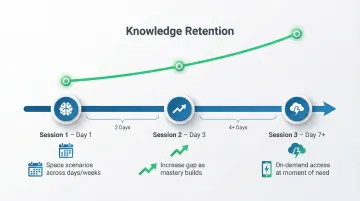
Psychological safety also makes learners more willing to return to practice, which matters, because repetition is where retention actually happens. Cepeda et al.'s meta-analysis (2006) confirmed that distributed practice produces reliably better learning than massed practice. The practical implication for sales training is direct:
- Space simulation scenarios across days or weeks, not a single session
- Increase the gap between practice rounds as reps demonstrate mastery
- Use on-demand access so reps can re-engage at the moment of need
Design Principles That Separate Effective Simulations from Forgettable Ones
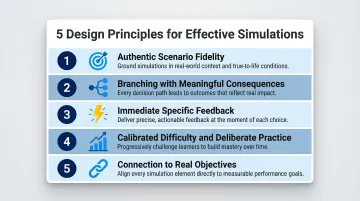
Five principles consistently separate simulations that change behavior from those that get clicked through and forgotten.
Principle 1: Authentic Scenario Fidelity
The simulation must closely mirror real situations learners face. For sales teams, this means realistic buyer personas, common objection patterns, and industry-specific language, not generic roleplay scripts. When the scenario feels artificial, the skill transfer doesn't happen.
Platforms that allow organizations to upload industry-specific playbooks, competitor battlecards, and messaging guides create simulations grounded in actual business conditions rather than hypothetical ones.
Principle 2: Branching with Meaningful Consequences
Effective simulations are non-linear. Each decision should change the trajectory of the scenario, so learners experience the downstream effects of poor choices in a safe environment. Linear "click next" simulations don't replicate the complexity of real interactions.
A randomized controlled trial replacing linear paper cases with dynamic web-based virtual patients (branching scenarios) found the branching group performed statistically significantly better on related exam questions, with effect sizes exceeding 0.6.
Principle 3: Immediate, Specific Feedback
Feedback must be delivered at the moment of decision, not at the end of the module. Delayed feedback breaks the learning loop. Granular coaching, flagging specific phrases, missed cues, tone issues, builds skills faster than pass/fail scoring alone.
Real-time feedback on tone, clarity, objection handling, and messaging accuracy allows learners to adjust their approach immediately, reinforcing effective behaviors before moving forward.
Principle 4: Calibrated Difficulty and Deliberate Practice
Effective simulations apply progressive challenge, starting with guided, lower-stakes scenarios and increasing complexity as competence builds. Ericsson et al. (1993) established that expert performance results from prolonged deliberate practice, not innate talent. Simulations are one of the few training formats that can put this principle into practice across an entire sales team simultaneously.
Principle 5: Connection to Real Objectives
Simulations should be explicitly mapped to skills and behaviors that drive measurable outcomes, handling a pricing objection, navigating a multi-stakeholder sale, not built around content that's convenient to simulate but irrelevant to actual performance gaps.
The clearest signal that a simulation is working: reps who complete it handle those specific scenarios differently in live calls. If you can't trace the simulation back to a skill gap and forward to a performance metric, it's content for its own sake.
Where Immersive Simulations Deliver the Greatest Impact
Sales and Partner Training
Scenario-based roleplay simulations for objection handling, discovery conversations, and product positioning allow sales reps and channel partners to build muscle memory before engaging real customers. This is especially critical for distributed partner ecosystems where training consistency is harder to maintain.
Partners who complete training earn 6x more revenue than those who don't. Partner-attributed deals close 2.8x more often and are 32% larger. Yet only 33% of companies have formal partner education programs, leaving massive performance gaps.
New Hire Onboarding and Ramp Acceleration
Simulations compress the time it takes for new employees or partners to reach competence by replacing shadow-learning (watching others) with guided practice. The results are measurable:
- AI-assisted onboarding cuts time-to-productivity by 42% and reduces manager workload by 70%
- Reps get certified 2.4x faster using AI simulations than traditional roleplay
- Sales reps trained this way are 3.7x more likely to hit quota
High-Stakes and High-Complexity Skills
Industries like healthcare, defense, and manufacturing have used simulations longest because the cost of on-the-job mistakes is highest. A meta-analysis of surgical simulation found simulation-trained participants scored 0.42 points higher on standardized scales and were 44% faster than control groups.
The same logic applies in sales and partner environments. A failed enterprise demo, a compliance misstep, or a mishandled escalation each carry real costs, and simulation training is one of the few ways to reduce that risk before it happens in front of a customer.
How AI Is Elevating Simulation-Based Training
AI doesn't just automate simulation delivery, it changes what simulations can do. Four capabilities are driving the most meaningful improvements in training outcomes.
Adaptive Simulations
Traditional simulations follow fixed scripts. AI-powered simulations respond dynamically to what the learner says or does, creating more realistic and personalized practice experiences. This matters most for conversation-based skills like sales, negotiation, and customer service.
Wang et al.'s 2024 meta-analysis found AI-enabled adaptive learning systems have a medium to large positive effect size (g = 0.70) on cognitive learning outcomes compared to non-adaptive interventions.
AI-Driven Performance Analysis
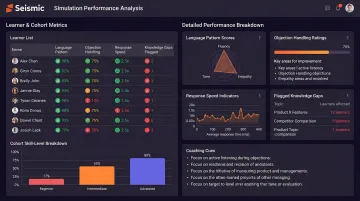
AI evaluates not just whether the learner completed the scenario but how they performed. That means specific, measurable coaching cues rather than a pass/fail completion score:
- Language patterns and word choice under pressure
- Missed buying signals or objection handling gaps
- Response speed and hesitation points
- Recurring knowledge gaps across attempts
Closed-Loop Learning Model
AI can automatically route learners who underperform in a simulation into targeted microlearning or remediation, closing the gap between assessment and instruction without manual intervention. When a seller stumbles in a roleplay or call simulation, the system flags the gap and routes them into the relevant training path.
Pifini's prescriptive learning engine does exactly this: it triggers auto-enrollment based on specific performance gaps identified during simulations, not broad assessment scores.
Scalability and Consistency
AI-powered simulation means every learner gets high-quality, consistent, on-demand practice regardless of geography, manager quality, or cohort size, a major advantage for enterprises and partner networks operating across multiple regions.
Measuring the Real ROI of Immersive Simulations
Define the Right Leading Indicators
Simulation completion rates and assessment scores are proxies. The real metrics are behavioral change indicators like pre/post assessment deltas, time-to-competency reduction, and manager-observed behavior change.
PwC's VR study found VR learners completed training 4x faster than classroom learners (29 minutes vs. 2 hours) and were 275% more confident to act on what they learned. At scale (10,000 learners), VR training costs were 64% less than classroom training.
Connect Simulation Data to Business Outcomes
The strongest ROI case comes from correlating simulation performance, scores, completion, scenario outcomes, with downstream results: win rates, ramp time, deal size, or partner-sourced pipeline.
Platforms like Pifini connect training readiness scores, roleplay performance, and call scoring data directly to sales outcomes. The Training Impact Analysis module pulls data from CRM, PRM, and learning systems to identify which courses correlate with faster close rates, higher renewal revenue, and increased deal size.
Organizations with formally aligned sales processes and training consistently outperform those without, posting win rates of 51% vs. 39%, with lower turnover to boot.
Avoid the Vanity Metrics Trap
Measuring hours of training consumed or completion rates in isolation gives a false sense of effectiveness. The right questions to ask:
- Did time-to-competency decrease for new hires or partners?
- Did win rates improve for cohorts that completed simulations?
- Did average deal size increase for simulation-trained reps?
- Did support tickets decrease as product knowledge improved?
- Are close rates trending up since objection handling simulations rolled out?
When these numbers move, you have proof, not just participation data, but evidence that training is driving real business results.
Frequently Asked Questions
What is immersive training?
Immersive training uses technologies like VR, AR, mixed reality, and AI-driven simulations to place learners in realistic, interactive scenarios where they must make decisions and experience consequences. Unlike passive formats like video or reading, immersive training builds hands-on skills through active practice.
What are the 5 steps of simulation?
The typical simulation design lifecycle follows five steps:
- Define objectives and target behaviors
- Design realistic scenarios and decision trees
- Develop and test the simulation environment
- Deploy and run the simulation with learners
- Assess performance and iterate using data
Each phase keeps the simulation tied to real-world outcomes rather than training for its own sake.
What are the 5 types of VR?
The five VR types most relevant to training:
- Non-immersive, desktop-based simulations
- Semi-immersive, projection systems or large screens
- Fully immersive, headset VR (Oculus, HTC Vive)
- Augmented reality (AR), digital overlays on real environments
- Mixed reality (MR), blends physical and digital worlds
Choice depends on skill complexity, budget, and how accessible the training needs to be.
What's the best VR training program for immersive learning?
The right program depends on the skill being trained, audience size, and budget. For sales and partner teams, AI-powered conversation simulations often deliver faster ROI than hardware-dependent VR, they're scalable, accessible, and require no headsets. Full VR excels for physical tasks, spatial skills, and high-stakes safety training.
How do you measure the effectiveness of immersive training simulations?
Track pre/post knowledge assessments, time-to-competency, behavioral observation, and, most critically, correlation between simulation scores and real-world performance outcomes like win rates or ramp speed. Completion rates and hours logged tell you activity happened, not whether behavior or performance actually changed.
Are immersive training simulations worth the investment for sales teams?
Yes, when designed correctly. The ROI case is strongest when simulations target specific, high-frequency skills, objection handling, discovery, and outcomes are tracked against actual sales performance, not just completion rates. At scale across partner ecosystems, simulations that cut ramp time or lift win rates pay for themselves quickly.