Introduction
Reps are losing deals because they can't get the right answer to a tough buyer question at the right moment. No competitive context, no confident response, no second chance, especially in partner and channel ecosystems where your sellers may not even be your direct employees.
According to HubSpot's sales research, 61% of lost deals involve buyer indecision, often linked to reps who couldn't provide timely, confident answers when it counted. The market has responded: the global sales enablement platform market grew from $5.23 billion in 2024 to a projected $12.78 billion by 2030, a 16.3% CAGR driven by organizations closing this readiness gap.
This guide covers how sales readiness platforms and competitive intelligence tools work together to equip teams with the training, content, and live coaching needed to win. You'll also find a curated list of top solutions that connect readiness directly to revenue growth.
Key Takeaways
- Sales readiness platforms equip reps and partners with training, coaching, and competitive intelligence needed to close deals consistently
- Top platforms combine AI coaching, real-time call support, gamified learning, and analytics tied to revenue outcomes, not just completion rates
- Legacy tools like Seismic, Mindtickle, and Highspot cost $90K–$500K+ annually, with slow implementations and weak partner-ecosystem support
- Pifini.ai offers an all-in-one, partner-first alternative at $50/user/year with AI coaching, built-in LMS, and content management in a single platform
- When evaluating platforms, prioritize AI coaching, partner/channel readiness, CRM integration, revenue-linked analytics, and total cost of ownership
What Are Sales Readiness Platforms and Competitive Intelligence Tools?
Sales readiness platforms are digital systems that equip sellers with the skills, content, coaching, and knowledge required to engage buyers confidently at every stage of the deal. They blend training, roleplay, content delivery, and analytics into a single workflow, ensuring reps aren't just certified once during onboarding, but continuously coached and evaluated against real performance metrics.
Competitive intelligence tools surface real-time insights about competitors, win/loss patterns, objection handling, battlecards, often embedded directly into sales calls or content libraries. This means reps can respond to competitive pressure without leaving the conversation, equipped with the right talking points, case studies, or differentiators they need in the moment.
Why These Two Categories Are Converging
Modern platforms increasingly combine both into one system, so reps aren't just trained in isolation but coached in context. Forrester's Q3 2024 Wave notes that "readiness providers have developed content management capabilities, and content platforms now offer readiness features", creating a category where training, content, and competitive intelligence work together to drive wins.
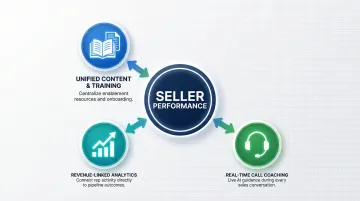
The result is a more integrated approach to seller performance:
- Training and competitive content live in the same system, not siloed tools
- Reps receive coaching triggered by actual call behavior, not scheduled calendar events
- Managers see which knowledge gaps connect to lost deals, and can act on them
Best Sales Readiness Platforms & Competitive Intelligence Tools
The platforms below were selected based on five criteria: AI capabilities, partner/channel readiness support, ease of use, pricing transparency, and the ability to link training activity to measurable revenue results.
Pifini.ai
Pifini.ai is an AI-driven revenue enablement platform built specifically for partner and channel sales ecosystems. It unifies training (via enterprise LMS), content management, AI sales coaching, and buyer engagement analytics in a single platform at $50/user/year, a fraction of legacy pricing.
The platform's core differentiators:
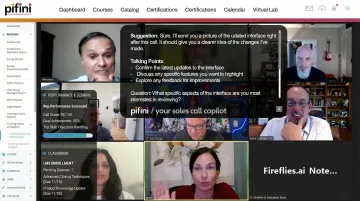
- Live AI coaching during calls surfaces objection handling and competitive talking points in real time
- Prescriptive LMS auto-enrolls reps into targeted training when performance gaps appear
- AI call scoring flags skill gaps and routes users directly into relevant learning paths
- Gamification and microlearning drive partner adoption at scale
- Buyer engagement analytics connect content interactions to deal outcomes
No add-ons, no hidden costs. Trusted by AMD, Blue Cross, Hexagon, and Sabre.
| Key Features | Pricing | Best For |
|---|---|---|
| All-in-one: training, content, AI coaching, call scoring, partner engagement; Live AI call guidance; Prescriptive LMS with auto-enrollment; Gamification, microlearning, simulations; Buyer engagement analytics | $50/user/year, no add-ons | Partner-first orgs (resellers, distributors, alliances), SaaS companies, enterprise teams |
Mindtickle
Mindtickle is a well-established sales readiness platform focused on rep performance measurement, onboarding, gamified training, and AI-assisted call coaching. It's widely used by global enterprise sales organizations that need a comprehensive readiness system with strong analytics and role-specific training paths.
Readiness scoring that links training to quota attainment and AI role-play with automated grading are genuine strengths. The tradeoffs: an estimated $90K+ annual minimum, heavy admin overhead for integrations and content governance, and limited partner-channel functionality that typically requires add-ons for full content management.
| Key Features | Pricing | Best For |
|---|---|---|
| Readiness Index scoring; AI role-play with automated grading; Gamified learning and leaderboards; Conversation intelligence with MEDDPICC/CHAMP scoring; Sales capability heatmaps | Custom; estimated $90K+ annually | Large enterprise teams (200+ reps) with dedicated enablement staff |
Highspot
Highspot is a legacy sales enablement platform known for its strong content management, AI-powered search, guided selling, and rep scorecards. It serves mid-to-large enterprise teams that need one home for sales assets, training, and analytics, with deep CRM integrations (Salesforce, Dynamics).
Content governance and AI-powered content recommendations are where Highspot earns its reputation. The limitations matter, though: deal rooms are basic, the LMS is lightweight compared to dedicated learning platforms, and contracts typically start at $50K+ annually with a 4+ month implementation cycle.
| Key Features | Pricing | Best For |
|---|---|---|
| AI-powered content search and recommendations; Guided selling with SmartPages; Live call guidance with talking points; Rep scorecards and performance tracking; CRM integrations (Salesforce, Dynamics) | Custom; estimated $50K+ annually | Mid-to-large teams (50–500 sellers) where the bottleneck is content discoverability and governance |
Gong
Gong is the market-leading revenue intelligence and conversation analytics platform that records, transcribes, and analyzes sales calls to surface deal risks, competitive mentions, coaching opportunities, and pipeline forecasting based on actual buyer signals.
Gong functions as a diagnostic and competitive intelligence layer rather than a full enablement platform, it reveals what's happening in deals so enablement teams can act, but requires pairing with a separate LMS or coaching platform to prescribe training. Pricing is high at $1,200–$1,600/user/year plus platform fees ranging from $5,000 to $50,000+ annually.
| Key Features | Pricing | Best For |
|---|---|---|
| Call recording, transcription, and analysis; Deal risk scoring and forecasting; Competitive intelligence tracking (win/loss, mentions); Coaching snippets and talk track libraries; Pipeline and rep performance dashboards | $1,200–$1,600/user/year + $5,000–$50,000 annual platform fee | Mid-to-enterprise teams (50+ reps) needing conversation intelligence to complement an existing enablement platform |
Seismic
Seismic is one of the original enterprise sales enablement platforms, best known for deep content automation (LiveDocs), strict governance workflows, compliance infrastructure, and the recently announced merger with Highspot, creating the largest legacy content management entity in the market.
Seismic's strength is serving Fortune 500 organizations with complex content governance needs. For most teams, the drawbacks are significant: contract minimums starting at $100K+, 6+ month implementations, heavy admin overhead, AI features added as overlays rather than integrated natively, and no meaningful partner-channel focus.
| Key Features | Pricing | Best For |
|---|---|---|
| LiveDocs auto-personalized sales content; AI-powered content recommendations (Seismic Aura); Compliance controls and approval workflows; LMS with certifications; Basic digital sales rooms | Custom; $50K+ mid-market, $100K+ enterprise | Global enterprises (500+ sellers) with content ops teams, compliance requirements, and large budgets |
How We Chose the Best Sales Readiness Platforms
Every platform on this list was evaluated against six criteria:
- AI capability depth and practical implementation
- Ease of use and rep adoption rates
- Partner and channel sales support
- Pricing transparency and scalability
- CRM integration quality
- Ability to connect training activity to actual revenue outcomes, not just completion rates
The most common mistakes buyers make when evaluating these platforms:
Choosing on brand recognition alone. Platforms like Seismic and Mindtickle carry strong names but often come with high total cost of ownership. Salesforce reports that 42% of reps feel overwhelmed by too many tools, and overwhelmed sellers are 45% less likely to hit quota. Consolidating your sales tech stack with AI can cut costs by 30–40%.
Ignoring partner and channel ecosystem needs. Forrester (2025) found that 67% of B2B decision-makers expect indirect revenue to grow more than 30% year-over-year. Most legacy platforms were built for direct sales teams only, so partner adoption ends up clunky and expensive.
Stacking point solutions instead of consolidating. Harvard Business Review found that workers toggle between apps nearly 1,200 times per day, roughly 4 hours per week lost to reorientation. Data silos and app-switching kill rep productivity faster than most teams realize.
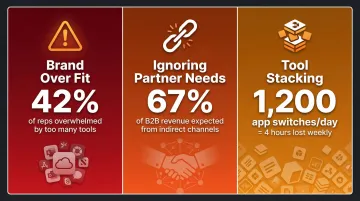
These patterns point to what actually matters in a platform. Look for prescriptive learning that auto-routes reps into training based on performance gaps, AI coaching that works during live calls, and analytics that tie enablement activity directly to pipeline movement and win rates.
Conclusion
The shift is clear: sales teams no longer need five separate tools for coaching, content, LMS, call recording, and partner enablement. The best platforms unify all of these into one system, and the market has caught up to that reality.
Choose the right platform based on your team's specific needs:
- Team structure: direct sales vs. partner/channel ecosystems have different requirements
- Size and scale: headcount affects per-user pricing and admin overhead
- Tech stack: look for CRM, PRM, and video integrations before committing
- Budget: higher price doesn't mean better outcomes
The data backs this up. 84% of sales teams without an all-in-one platform plan to consolidate their technology, and sellers using AI tools are 3.7 times more likely to hit quota than those who don't.
For organizations running partner or channel sales ecosystems and looking for an all-in-one solution that won't break the budget, Pifini.ai combines AI sales coaching, prescriptive learning, content management, and buyer engagement analytics into a single platform, at $50/user/year. Request a demo to see how it connects training directly to revenue growth.
Frequently Asked Questions
What is the best competitive Q&A or sales enablement software to improve sales team readiness?
The best platforms combine competitive intelligence (battlecards, win/loss tracking) with readiness training in a unified system. Point solutions typically cover one or the other. Platforms like Pifini.ai deliver both alongside AI coaching and prescriptive learning, so reps are prepared before competitive moments happen.
What is the difference between a sales readiness platform and a competitive intelligence tool?
Sales readiness platforms focus on training, coaching, onboarding, and rep skill development, building foundational capabilities over time. Competitive intelligence tools focus on surfacing competitor data, win/loss patterns, and battlecards in real time. Modern platforms increasingly combine both, ensuring reps are trained and equipped with competitive insights during live deals.
How do sales readiness platforms improve win rates?
These platforms improve win rates by ensuring reps are consistently trained on messaging and objection handling, coached via AI on live calls, and provided with the right content at the right deal stage. A 2019 CSO Insights study found that organizations with sales enablement reported an average win rate of 49.0%, which was 6.5 points higher than those without, a gap that modern AI-powered platforms are widening further.
What should I look for in a sales readiness platform for partner ecosystems?
Look for these capabilities specifically:
- Multi-org support with tiered partner management
- Easy external partner onboarding and certifications
- Gamification tools tied to deal activity and engagement
- Partner performance tracking linked to revenue outcomes
Platforms built for direct sales often lack these features, leading to poor partner adoption.
How much does a sales readiness platform typically cost?
Pricing varies widely: unified platforms like Pifini.ai start at $50/user/year, while mid-market tools run $10K–$50K annually. Legacy enterprise platforms like Seismic and Mindtickle often start at $90K–$100K+, with implementation costs adding another $20K–$100K on top.
Can AI replace traditional sales coaching and training programs?
AI handles scale, scoring calls, flagging skill gaps, routing reps into targeted training, while human managers focus on relationship coaching, career development, and culture. Salesforce reports that 75% of sales reps are more likely to hit targets with a coach or mentor. The strongest platforms integrate both for maximum impact.