Introduction
Sales conversations have always been the engine of revenue growth, but for most organizations, the insights trapped inside those calls go unanalyzed. With increasing pressure to scale revenue consistently across direct and partner teams, relying on manual call reviews and manager intuition is no longer viable. Research shows managers spend 30-60% of their time on administrative work and meetings, leaving minimal capacity for coaching, and as a result, only 9% of sales calls are ever reviewed.
AI call analytics delivers measurable outcomes for sales leaders: shorter ramp times, higher win rates, and more consistent rep performance across the team. This article breaks down how it works in practice, the operational advantages it creates and the performance gaps it actually closes.
Key Takeaways
- AI call analytics automatically transcribes, analyzes, and surfaces performance insights from every sales conversation
- Key advantages: scalable coaching, live deal visibility, and a direct link between call performance and targeted rep training
- Without it, teams spot skill gaps only after deals are lost, coaching based on a fraction of actual calls
- Value compounds over time when insights are acted upon consistently, not just collected
- Teams that connect call analytics to training outcomes see the strongest impact on revenue performance
What Is AI Call Analytics?
AI call analytics is the process of using artificial intelligence to automatically capture, transcribe, and analyze sales calls to surface insights about rep behavior, buyer sentiment, and conversation quality, in real time or post-call. Unlike traditional call recording, which simply stores audio files for future reference, AI call analytics actively extracts behavioral patterns, deal signals, and coaching opportunities from each conversation.
It applies across the entire sales cycle, from cold outreach and discovery calls to demos, objection handling, and renewals. Different roles use it differently:
- Sales managers use it to identify coaching gaps and review rep performance at scale
- Revenue leaders rely on it for more accurate forecasting and pipeline visibility
- Reps use it for self-review and targeted skill improvement between calls
The goal isn't data collection, it's turning every conversation into specific, usable insight that changes how reps sell, how managers coach, and how leadership forecasts. Done right, it makes improvement continuous rather than episodic.
Key Advantages of AI Call Analytics for Sales Teams
The advantages below focus on measurable, operational outcomes rather than abstract technology benefits. Each is tied to metrics that sales leaders and revenue teams track directly, including rep performance consistency, deal velocity, win rates, and coaching efficiency.
Advantage 1: Scalable, Objective Coaching Without Manager Bottlenecks
AI automatically scores and reviews every sales call against defined criteria, eliminating the bottleneck where managers can only review a fraction of calls manually, leaving most rep behavior unobserved and uncoached.
How It Works:
AI applies consistent scoring rubrics to 100% of calls rather than a sampled few. Every rep receives feedback on:
- Talk-to-listen ratio
- Objection handling quality
- Discovery question depth
- Sentiment response
- Playbook adherence
Without AI, a manager with 8 reps running 6 calls per week faces 48 calls to review, a mathematical impossibility. Only about 8% of a manager's typical workload focuses on coaching delivery, and as a result, the vast majority of rep conversations are never evaluated.
Manual call review is not only time-intensive but inherently inconsistent. Managers bring different standards and biases to their evaluations, AI replaces subjectivity with objective, repeatable evaluation that treats every rep fairly and surfaces the same signals across all calls.
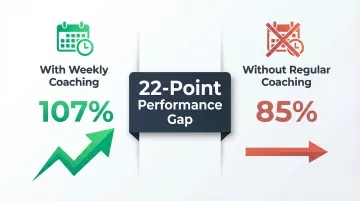
Consistent feedback on every call accelerates skill-building in a way that once-a-week or once-a-month reviews cannot. Reps who receive weekly coaching hit 107% of their quota compared to just 85% for those without regular coaching, a 22-point gap that translates to millions in lost revenue for an enterprise team.
KPIs Impacted:
- Rep ramp time
- Call quality scores
- Coaching session frequency
- Number of calls reviewed per rep per month
- Performance consistency across the team
When This Advantage Matters Most:
This is most impactful for fast-growing teams adding reps quickly, distributed or remote sales organizations, and partner/channel ecosystems where managers have limited visibility into rep conversations across multiple selling entities.
Advantage 2: Real-Time Deal Intelligence and Improved Forecast Accuracy
AI detects buying signals, objection patterns, sentiment shifts, and engagement cues during or immediately after calls, giving revenue leaders deal-level intelligence that makes pipeline health assessments measurably more accurate.
How It Works:
AI analyzes conversational dynamics and aggregates patterns across hundreds of calls, identifying which deals show genuine momentum and which carry hidden risk. It evaluates:
- Tone changes at pricing discussions
- Engagement levels throughout the call
- Competitor mentions
- Unresolved objections
- Commitment language and next-step clarity
All of this happens automatically, without manual inspection. The system surfaces deal health signals rooted in actual conversation data, not just rep-reported optimism.
Traditional pipeline reviews rely on rep-reported data, which is optimistic by nature. 72% of sales organizations report forecast accuracy below 80%, largely driven by unreliable, manually entered CRM data. Only 35% of sales professionals completely trust their pipeline data.
AI introduces an objective, conversation-grounded signal layer that reveals what prospects actually said, how they responded, and whether engagement is accelerating or cooling. Leaders can then allocate coaching resources, executive involvement, and deal support to the opportunities that need it most, before it's too late.
KPIs Impacted:
- Forecast accuracy
- Pipeline coverage ratio
- Deal velocity
- Average days in stage
- Win rate
- At-risk deal identification rate
When This Advantage Matters Most:
This advantage is highest-impact for complex B2B sales cycles with multiple stakeholders, organizations running quarterly forecasting under board-level scrutiny, and channel or partner sales environments where direct deal visibility is limited.
Advantage 3: Closing the Loop Between Call Performance and Rep Enablement
Most platforms stop at analysis. AI call analytics goes further, identifying specific skill gaps from a rep's calls and feeding that intelligence directly into personalized training, creating a continuous improvement cycle rather than a one-time data capture.
How It Works:
By evaluating calls against playbook adherence, handling patterns, and messaging consistency, the system flags where individual reps are struggling, then connects that signal to targeted coaching content, training modules, or role-play scenarios.
Pifini.ai takes this further by automatically routing reps into prescriptive learning paths when call performance signals a gap. When a rep struggles with objection handling across multiple calls, the system auto-enrolls them into targeted training, no manual admin work required. The result is a direct link between observed behavior and skill development, with training ROI tied to actual deal performance.
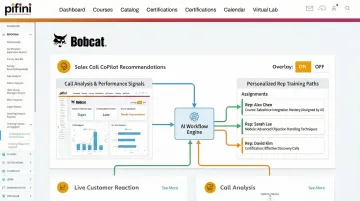
Most organizations still treat call analysis and sales training as separate functions. Insights from calls rarely flow into enablement programs in real time, meaning reps repeat the same mistakes across multiple deals before a manager intervenes.
Traditional training delivers 70% knowledge loss within one week because it's generic, abstract, and delayed. When analytics automatically triggers the right training at the right moment, reps improve deal by deal rather than quarter by quarter.
Organizations that connect coaching to enablement see a 19% improvement in win rates and a 21.3% improvement in quota attainment, compounding gains that come from replacing reactive intervention with a proactive performance loop.
KPIs Impacted:
- Training completion rates tied to call performance triggers
- Win rate improvement post-training
- Certifications linked to deals closed
- Rep performance consistency over time
- Time-to-proficiency for new hires
When This Advantage Matters Most:
This loop is most critical for onboarding new reps at scale, managing large partner or reseller ecosystems where centralized coaching is impossible, and organizations with high rep turnover or rapidly changing messaging requirements.
What Happens When AI Call Analytics Is Missing or Ignored
Without AI call analytics, sales organizations default to a reactive model. Performance gaps surface only after deals are lost, coaching goes to the reps managers have time for rather than the reps who need it most, and the intelligence locked inside hundreds of weekly calls goes entirely untapped.
Specific Operational Consequences:
- Rep performance stays inconsistent: Without objective call review, top performers' behaviors are never captured or replicated. The gap between high and low performers widens, and revenue outcomes become harder to predict.
- Coaching stays reactive: Managers identify problems only after they've cost deals, not early enough to course-correct an active opportunity. The result is a cycle of firefighting rather than prevention.
- Forecast accuracy suffers: Pipeline reviews rely on rep optimism instead of conversation-level deal intelligence. Companies with consistent sales coaching see nearly 30% lower voluntary turnover. Without it, reps leave, and replacing a B2B sales rep runs $115,000 to $200,000 once recruiting, onboarding, and ramp-period pipeline loss are factored in.
- Scaling becomes harder, not easier: As teams grow, the absence of automated analysis means more calls go unreviewed. The blind spot widens with every new hire, making it nearly impossible to maintain performance consistency across distributed teams or partner ecosystems.
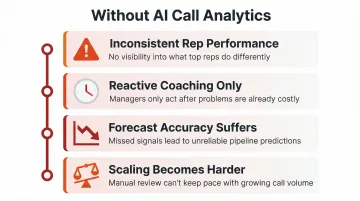
Taken together, these gaps compound quarter over quarter. Win rates, ramp times, and at-risk deals all suffer in ways that are entirely preventable, the data exists in every call; it just isn't being used.
How to Get the Most Value from AI Call Analytics
AI call analytics delivers the strongest return when applied consistently across all calls, not just flagged or difficult ones. Patterns only emerge and become actionable at scale. Selectively analyzing calls introduces the same sampling bias that manual review creates.
To turn that data into consistent performance gains, build these practices into your workflow:
- Incorporate insights into weekly coaching rhythms, pipeline reviews, and enablement planning, not quarterly dashboard check-ins
- Treat call analytics as an ongoing operational practice, not a one-time implementation
- Connect call data to training outcomes and track how coaching influences win rates over time
- Continuously refine scoring criteria as your playbook evolves
When sales teams integrate call analytics into their enablement workflows, every conversation becomes a compounding asset. Reps sharpen their approach with each call. Managers coach on objective evidence rather than gut instinct. Revenue leaders forecast with confidence rooted in actual buyer engagement signals, not assumptions.
Conclusion
AI call analytics gives sales leaders objective visibility into what is actually happening in their team's conversations, across every rep, every call, and every deal stage, replacing the guesswork and sampling bias of manual review.
Its advantages compound over time Organizations that connect call analytics to coaching, training, and pipeline intelligence build a performance system that gets smarter with every conversation.
AI call analytics works best when embedded into how teams coach, forecast, and enable, treated as an ongoing practice, not a one-time setup. Teams that commit to it don't just measure performance; they systematically raise the floor on what good looks like.
Frequently Asked Questions
How to use AI to improve sales performance?
AI analyzes every rep's calls to surface skill gaps, surface winning behaviors from top performers, and route those insights into targeted coaching. The result is a continuous improvement loop that replaces reactive, manager-driven reviews with a system that consistently accelerates skill-building and win rates.
What is AI call analytics and how does it work?
AI call analytics automatically records, transcribes, and analyzes sales conversations using natural language processing and machine learning. It surfaces insights like sentiment, talk-to-listen ratios, objection patterns, and buying signals that would be impossible to capture manually at scale.
What metrics does AI call analytics track?
Key metrics include talk-to-listen ratio, sentiment and tone shifts, objection frequency, competitor mentions, call scoring against playbook criteria, and engagement signals. All of these connect to business outcomes like win rate, deal velocity, and forecast accuracy.
How does AI call analytics improve sales coaching?
Instead of relying on the handful of calls a manager can personally review each week, AI call analytics evaluates 100% of conversations objectively, flagging exactly where each rep needs improvement and enabling coaching based on actual behavior rather than gut instinct.
What is the difference between AI call analytics and traditional call recording?
Traditional call recording captures audio for future reference. AI call analytics actively analyzes those conversations to extract behavioral patterns, deal signals, and coaching opportunities, making recordings actionable rather than archival.
Can AI call analytics work for partner and channel sales teams?
AI call analytics is particularly valuable for partner and channel ecosystems because it provides sales leaders with visibility into rep conversations they cannot directly observe. It enables consistent coaching, playbook adherence, and performance tracking across distributed selling teams without requiring centralized manager oversight.