AI-powered LMS content creation changes the equation. It embeds artificial intelligence directly into the learning management system, allowing course authors to generate outlines, assessments, and personalized learning paths in minutes rather than weeks, while maintaining quality through human oversight.
This guide covers what AI actually does inside an LMS, why it matters specifically for sales and partner training, and a practical step-by-step approach to using it effectively.
Key Takeaways
- AI compresses course development from weeks to hours, turning outline and assessment drafts into minutes of work
- AI accelerates instructional designers' work by creating drafts they refine, not replacing their expertise
- For partner ecosystems, AI adapts content to different roles and skill gaps in real time, making personalized training scalable across the channel
- Success requires treating AI as a starting point and applying rigorous human review before content goes live
What Is AI-Powered LMS Content Creation?
AI-powered LMS content creation integrates generative AI, natural language processing, and machine learning directly into LMS workflows. Instead of building every course manually from scratch, authors input learning objectives or source material and the platform generates outlines, summaries, quizzes, and learning paths, all within a single workflow.
This differs from traditional LMS platforms, which store and track content humans built elsewhere. An AI-powered LMS actively assists in creating, tagging, translating, and personalizing content, cutting the cycle from idea to live course in a fraction of the time.
Key distinction: Standard LMS = storage and tracking. AI-powered LMS = creation assistance at scale.
That speed advantage matters most for extended enterprise teams. L&D teams managing large partner networks can meet higher content volume demands without adding headcount or stretching budgets.
Why AI-Powered LMS Content Creation Matters for Partner and Sales Training
The Scale Challenge Is Unsustainable
Partner and channel ecosystems face a unique scale problem. Organizations training resellers, distributors, and alliance partners across multiple product lines and varying skill levels cannot sustain manual course production at the required volume. Trained partners generate 6x more revenue than untrained partners, and partner-attributed deals close 2.8x more often, yet producing the training to achieve those outcomes manually is prohibitively slow and expensive.
AI Cuts Production Time Dramatically
AI-powered content generation reduces course outlining and drafting from 8-12 hours to 15-30 minutes. Organizations using AI authoring tools report reducing average development time from 80 hours to 18 hours per course, a 77% time savings that makes high-volume partner training achievable.
Rather than starting from a blank page, instructional designers input existing source material, product documentation, sales playbooks, call transcripts, and receive first-draft outlines, module summaries, and assessment questions. This frees designers to focus on quality, strategy, and refinement rather than low-level content assembly.
The Personalization Gap in Partner Training
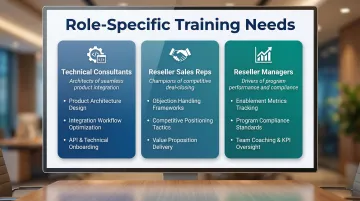
Different partner roles need different content. Static, one-size-fits-all modules fail to engage any of them effectively:
- Technical consultants need product architecture details and integration workflows
- Reseller sales reps need objection handling and competitive positioning
- Reseller managers need enablement metrics and program compliance
AI makes role-specific variation achievable without multiplying production effort, generating tailored versions from the same source material or routing learners to different modules based on role, performance data, or prior knowledge.
Direct Connection to Revenue Outcomes
Unlike generic employee training, partner and sales training has a measurable line to revenue. Faster ramp times, higher win rates, and better product knowledge translate directly to bookings and pipeline growth. AI-powered LMS content that adapts to actual performance data, quiz scores, call coaching flags, pipeline activity, ensures training always closes the right gaps at the right time.
Pifini's enterprise LMS takes this further with prescriptive learning that auto-enrolls partners and sellers into targeted modules when AI coaching flags a skill gap during sales calls. Rather than relying on manual assignments, the system connects real-world performance directly to content delivery, closing skill gaps before they affect pipeline.
Key AI Content Creation Capabilities to Look For in a Modern LMS
AI Course and Module Generation
Most AI-enabled platforms let you input a learning objective, topic, or source document and get back a full course outline, section summaries, and draft content. Output quality depends on prompt specificity and how rich your source materials are.
What to look for: Platforms that accept multiple input types (PDFs, playbooks, transcripts) and allow iterative refinement of generated outlines before full content creation.
AI Assessment and Quiz Creation
AI generates multiple-choice questions, scenario-based assessments, and knowledge checks aligned to specific learning objectives, reducing one of the most time-consuming parts of course authoring.
What to look for: Systems that align generated questions to competency levels or Bloom's Taxonomy, ensuring assessments measure intended knowledge and skill outcomes rather than superficial recall.
AI Translation and Localization
AI translation tools translate a single master course in multiple languages quickly, a practical necessity for global partner networks. Modern neural metrics like XCOMET and MetricX-24-Hybrid outperform legacy translation evaluation methods, improving output quality.
What to look for: Platforms with built-in translation that flag high-stakes content for human review, balancing speed with accuracy.
Personalized Content Recommendations and Adaptive Enrollment
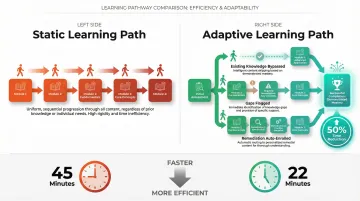
Static learning paths push every learner through the same sequence regardless of what they already know. AI-driven adaptive paths fix this by recommending next content based on quiz performance, engagement patterns, or role. Adaptive learning can reduce time-to-competency by 50%, from 45 minutes to 22 minutes per course, by allowing learners to bypass content they already know.
What to look for: Systems that auto-enroll learners into remediation or advanced content without waiting for an admin to intervene, using real-time performance data as the trigger.
Auto-Tagging and Content Organization
AI analyzes uploaded content and automatically applies metadata tags, skill labels, and categories, no manual input required. Organizations with strong metadata strategies cut information search times by up to 50%, which matters more as your course catalog grows.
What to look for: Platforms that analyze video, text, and interactive content to generate accurate, consistent tags without manual input.
How to Build AI-Powered LMS Training Content: A Step-by-Step Approach
Step 1: Establish Your Source Material and Learning Objectives
AI content generation is only as good as the inputs. Before prompting any tool, document the specific learning objective, target audience (role, experience level), and the source material you'll draw from, product documentation, sales playbooks, SME interviews, or previous course content.
Critical rule: Garbage in, garbage out applies strongly here. Vague prompts produce vague content. Specific learning objectives written in action-focused language (aligned to Bloom's Taxonomy when possible) produce focused, measurable training outcomes.
Step 2: Generate a Draft Structure, Then Refine It
Input your learning objective and source material into the LMS's AI authoring tool. Review the suggested course outline and module summaries for accuracy, tone, and coverage gaps. Refine the structure before moving to content generation.
Typical workflow:
- Upload source documents or input topic/objective
- Receive AI-generated course outline and section summaries
- Review for logical flow, completeness, and alignment to objectives
- Edit structure, add or remove sections, adjust sequence
- Approve structure before generating detailed content
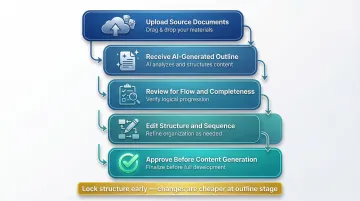
Locking down structure before generating content saves significant rework, changes to sequence or scope are cheap at the outline stage and expensive after content is written.
Step 3: Generate Content, Assessments, and Visuals in Parallel
Once the structure is approved, AI tools can generate section content, quiz questions, and (on some platforms) visual assets or image suggestions simultaneously, cutting the back-and-forth between tools.
Review every AI-generated assessment item before it goes live. LLM-generated questions can confidently surface incorrect information. They also often fail to produce plausible wrong-answer options (distractors) for multiple-choice items, a human check is required to ensure assessment validity.
Step 4: Apply Human Review, Brand Governance, and Compliance Checks
Every AI-generated course should pass through a defined human review process before going live. This covers:
- Verify factual claims against trusted internal or external sources
- Confirm content matches your organization's brand voice and tone guidelines
- Check compliance requirements, especially critical in regulated industries
- Validate accessibility against WCAG standards before publishing
This review step is where human judgment protects what AI can't self-audit: accuracy, relevance, and legal exposure.
Actionable step: Build a one-page review checklist as part of your standard operating procedure. Assign a subject matter expert or instructional designer to sign off before any AI-generated content is published.
Common Mistakes to Avoid with AI-Generated LMS Content
Publishing Without Human Review
LLMs can confidently generate inaccurate facts, outdated information, or generic phrasing that undermines learner trust. Commercial LLMs exhibit baseline hallucination rates of 15% to 52%, with real-world conversational interactions showing 31.4% hallucination prevalence.
What to do instead: Establish a mandatory review gate where a subject matter expert or instructional designer signs off before any AI-generated content is published. Restrict AI to grounded summarization of approved source documents rather than open-ended generation.
Using AI Without Clear Learning Objectives
Prompting an AI tool without a defined learning objective produces vague, unfocused content that doesn't drive measurable behavior change.
How to prevent this: Always start with "By the end of this module, the learner will be able to…" before generating any content. Write action-focused objectives that specify observable skills or knowledge outcomes.
Neglecting Content Maintenance
Getting content created is only half the challenge, keeping it current is the other. Training content in sales and partner ecosystems goes stale quickly as products change and markets shift. Models trained on static datasets show hallucination rates increase by approximately 20% when asked about recent events.
The fix: Build a review calendar into your content governance plan and use AI's speed to keep updates timely and consistent:
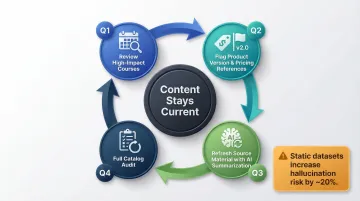
- Schedule quarterly reviews of high-impact courses
- Flag content referencing specific product versions or pricing for immediate updates when changes occur
- Use AI-assisted summarization to refresh approved source material quickly
Frequently Asked Questions
What types of content can AI generate inside an LMS?
AI can generate course outlines, module text, quiz and assessment questions, summaries, learning objectives, translations, and basic visual assets. The quality varies by platform, leading systems produce structured, ready-to-review drafts that need refinement rather than complete rewrites.
How long does it take to create a course using AI in an LMS?
AI can generate a first-draft course structure in 15-30 minutes, while a complete, reviewed, and published course typically takes hours rather than days or weeks. Organizations report reducing development time from 80 hours to 18 hours per course using AI authoring tools.
Do I need technical expertise to use AI content creation tools in an LMS?
Most modern AI-powered LMS platforms are built with non-technical users in mind. Instructional designers and L&D admins can use natural language prompts to generate content without writing code or managing AI infrastructure. Platforms like Docebo Creator offer user-friendly, drag-and-drop interfaces, and SAP Litmos features simple AI content authoring tools built directly into the LMS.
Can AI-created LMS content be personalized for different learner roles?
Yes. AI can generate role-specific content variations or use adaptive learning logic to route learners to different modules based on their role, performance data, or prior knowledge. This makes personalization scalable across large partner ecosystems without building separate courses for every audience segment.
How do I ensure AI-generated training content is accurate and on-brand?
Establish a content review checklist covering factual accuracy, brand voice, compliance requirements, and accessibility. Feed the AI tool existing product docs, brand guidelines, or SME notes to anchor outputs in accurate, on-brand information. Always assign a subject matter expert to verify claims and alignment to organizational standards before publishing.
How does AI-powered LMS content creation support partner and channel training specifically?
AI enables partner training at scale in three concrete ways: it generates role-specific content faster, auto-enrolls partners into targeted training when call scoring or quiz results flag skill gaps, and keeps materials current as product lines evolve. The result is less manual overhead managing training across reseller and distributor networks, while keeping every module tied to real revenue outcomes.