Introduction
Most sales managers are running the same impossible calculation: hit quarterly revenue targets, develop distributed teams across time zones, and deliver consistent coaching, all with shrinking budgets and calendars that are already overbooked. Traditional coaching models weren't built for this. At $244 to $288 per hour, they limit coaching access to senior executives while leaving frontline managers to figure it out on their own.
AI leadership coaching changes that equation. When every manager, not just the top tier, gets development support exactly when they need it, the downstream effects show up in team consistency, pipeline performance, and the ability to scale leadership quality without scaling headcount. Organizations that delay this shift tend to see the same pattern: performance gaps widen across teams, and coaching becomes a quarterly event instead of an ongoing discipline.
The cost of that gap compounds quickly.
This article breaks down what AI leadership coaching actually does in practice, the operational advantages that matter, and the measurable outcomes organizations report when they implement it consistently.
Key Takeaways
- AI leadership coaching delivers personalized, on-demand guidance to managers at scale, replacing sporadic sessions with continuous support
- Key advantages include scalable availability, real-time feedback, and data-driven insights that tie coaching directly to business outcomes
- Organizations report measurable gains in manager effectiveness, employee engagement, and retention rates
- Without consistent coaching infrastructure, companies face leadership inconsistency and struggle to scale management capability
What Is AI Leadership Coaching?
AI leadership coaching uses artificial intelligence to deliver personalized, real-time coaching guidance to managers, helping them build leadership skills, navigate difficult situations, and develop their teams without the scheduling and cost constraints of traditional human coaching.
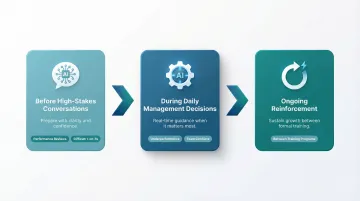
It's typically applied at three critical moments:
- Before high-stakes conversations (performance reviews, difficult 1-on-1s, feedback sessions)
- During daily management decisions (handling underperformance, resolving team conflicts)
- As ongoing reinforcement between formal training programs
The practical value shows up in outcomes: faster manager development, more consistent leadership behavior, and team performance that scales across the organization. Unlike traditional coaching that reflects on situations after the fact, AI platforms deliver guidance when the situation is live, so managers can adjust their approach in the moment rather than weeks later.
Key Advantages of AI Leadership Coaching
These advantages focus on operational, measurable impact: retention rates, productivity metrics, manager readiness scores, and revenue performance. Each advantage below ties directly to outcomes that sales leaders, HR leaders, and revenue organizations track and are held accountable for.
Advantage 1: Scalable, On-Demand Coaching That Eliminates the Access Gap
AI coaching makes high-quality, consistent leadership development available to every manager in an organization, not just senior executives, regardless of team size, geography, or budget.
How AI creates this advantage:
Coaching sessions happen at any time without scheduling, without hourly rates, and without geographic limitation. Traditional executive coaching costs range from $10,000 to $60,000 for 6-12 month programs. AI coaching platforms reduce these costs by approximately 80%, making comparable guidance accessible at a fraction of the price.
Why this matters:
In organizations with large sales teams or partner ecosystems spanning multiple regions, coaching access has historically been rationed to top performers or senior leaders. 60% of frontline managers receive no formal leadership training, while investment concentrates on middle managers, executives, and high potentials. AI removes that rationing, ensuring frontline sales managers receive the same quality of development support as VPs.
When more managers are better equipped, performance consistency improves across the entire team, onboarding accelerates, and fewer mistakes require escalation.
KPIs impacted:
- Manager ramp time
- Coaching coverage rate (percentage of managers receiving regular development)
- Time-to-productivity for new managers
- Training cost per head
When this advantage matters most:
Highest impact occurs in organizations with large, distributed sales teams or channel partner ecosystems where a small L&D staff cannot realistically support hundreds of managers with individualized attention.
Advantage 2: Personalized, Real-Time Feedback That Builds Skills in the Moment
Unlike traditional coaching that reflects on situations after the fact, AI coaching delivers personalized guidance when the situation is live, helping managers adjust how they give feedback, handle objections, or navigate underperformance conversations in real time.
How AI creates this advantage:
AI coaching platforms analyze individual manager behavior, flag recurring patterns (avoiding difficult conversations, inconsistent feedback delivery, over-coaching on process versus outcomes), and offer contextually relevant guidance tailored to that manager's goals, experience level, and team challenges. This differs in practice from generic training modules.
Why this matters:
Generic training degrades quickly. Learners forget approximately 42% of learned material within 20 minutes, 56% within an hour, and up to 79% within 31 days without reinforcement. AI coaching embeds development into the flow of work so that learning is applied immediately and reinforced continuously.
A manager who receives immediate, situationally relevant coaching is more likely to handle performance conversations effectively, give clearer feedback, and make better in-the-moment people decisions. That matters financially: replacing a single employee can cost 33% or more of their annual salary when factoring in hiring, training, and lost productivity.
KPIs impacted:
- Employee engagement scores
- Manager effectiveness ratings (360 feedback)
- Quality of feedback delivered (employee-reported clarity)
- Team retention rates
When this advantage matters most:
This advantage is most critical during high-pressure periods, performance review cycles, sales quarter-ends, onboarding surges, or organizational changes, when managers need guidance most but have the least bandwidth to schedule formal coaching sessions.
Advantage 3: Data-Driven Insights That Connect Coaching to Business Outcomes
AI coaching platforms aggregate behavioral data across coaching sessions, identify patterns (recurring skill gaps, common manager struggles, team-level trends), and produce insights that help both individual managers self-correct and organizational leaders make evidence-based decisions about where development investments are actually needed.
How AI creates this advantage:
AI synthesizes performance data, call recordings, learning completion, and coaching interaction history into a structured view of where each manager is growing and where gaps remain. This replaces anecdotal performance impressions with objective behavioral data.
For sales leaders and revenue organizations, that means linking coaching and certification progress directly to deal win rates, pipeline contribution, and quota attainment. Pifini's analytics layer connects training scores to actual revenue results, identifying which coaching interventions drive team performance improvements and which don't.
The business case:
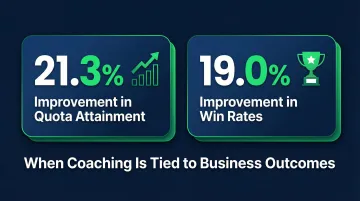
Without this data layer, leadership development operates on assumption, organizations invest in training programs without knowing which capabilities are actually missing or whether interventions are working. Dynamic sales coaching showed double-digit improvements in sales performance on both quota attainment (21.3%) and win rates (19.0%) when tied to business outcomes.
KPIs impacted:
- Coaching ROI (development spend versus revenue or retention outcomes)
- Manager effectiveness scores correlated with team performance
- Deal win rates and quota attainment
- Employee engagement scores over time
When this advantage matters most:
Highest impact for revenue organizations and channel sales teams where leadership effectiveness is directly traceable to financial performance, being able to show that better-coached managers run higher-performing teams creates the business case for sustained investment in leadership development.
What Happens When AI Leadership Coaching Is Missing or Ignored
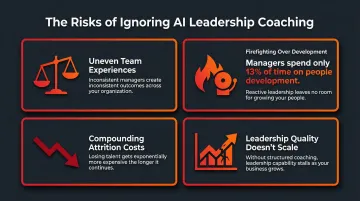
Organizations that rely solely on infrequent scheduled coaching or ad hoc manager development face predictable, compounding consequences.
Core consequences:
- Uneven team experiences: Manager quality varies dramatically without ongoing coaching, feedback, clarity, and development support differ sharply from one team to the next.
- Firefighting over development: With no system prompting reflection or growth, managers default to reactive problem-solving. Deloitte research shows managers spend nearly 40% of their time on administrative tasks and solving today's problems, with only 13% on developing their people.
- Compounding attrition costs: Poor management is the primary driver of turnover. Gallup research identifies a supervisor perceived as blocking growth as the strongest predictor of turnover intent, costs that add up well before they show in attrition reports.
- Leadership quality that doesn't scale: Every new manager added to a growing organization increases the coaching burden, with no proportional increase in capacity to support them.
How to Get the Most Value from AI Leadership Coaching
AI leadership coaching delivers its strongest results when treated as an ongoing system embedded into management workflows. Use it once during onboarding and set it aside, and you'll see little lasting change. Three conditions separate organizations that get measurable impact from those that don't.
Apply it consistently, not just at peak moments
Coaching cadence matters more than coaching intensity. Organizations that integrate AI coaching into regular 1-on-1 preparation, feedback delivery, and goal-setting rhythms see measurable skill gains quarter over quarter. Those that activate it only during performance review cycles or crises see limited retention of new behaviors.
Close the loop between coaching insights and action
AI coaching generates data on skill gaps and behavioral patterns. That data is only valuable if leadership teams act on it. Organizations should use aggregated coaching insights to:
- Inform targeted development programs
- Adjust training priorities based on real skill gap data
- Identify managers who need additional human coaching support
- Link learning activity directly to performance outcomes
Platforms like Pifini take this further by connecting training scores and call assessments to pipeline metrics, so coaching decisions are grounded in revenue data rather than guesswork.
Pair AI coaching with human judgment for high-stakes decisions
AI handles the volume, consistency, and data aggregation. Human coaches and HR leaders handle the nuance, sensitive conversations, and strategic career decisions. This hybrid model preserves the efficiency of AI while retaining the emotional intelligence and accountability that only human relationships provide.
Conclusion
AI leadership coaching delivers real, measurable returns: faster manager readiness, stronger team performance, and coaching coverage that scales without adding headcount. Those advantages compound when the insights are used consistently, to adjust priorities, close skill gaps, and hold managers accountable across quarters.
The outcomes worth tracking include:
- Manager readiness scores improving before gaps surface in team results
- Coaching frequency increasing without adding L&D budget
- Leadership skill gaps identified and addressed at the individual level
- Business outcomes, retention, performance ratings, promotion velocity, shifting as coaching matures
Treat AI leadership coaching as a permanent part of how your organization develops managers, not a pilot program or a one-time rollout. Organizations that embed it into their operating rhythm now will carry a measurable leadership quality advantage over those still dependent on infrequent, high-cost coaching that only reaches a fraction of their managers.
Frequently Asked Questions
How is AI leadership coaching different from traditional executive coaching?
Traditional coaching is scheduled, human-led, and expensive ($10,000 to $60,000 for 6-12 month programs). AI coaching is on-demand, always available, and far more affordable, making it accessible to managers at all levels, not just senior executives, and delivering personalized guidance in the moment rather than retrospectively.
Can AI coaching fully replace human coaches?
Human coaches remain essential for emotionally complex situations, sensitive conversations, and strategic career planning, AI can't replicate that. Where AI excels is volume, consistency, and the data layer of day-to-day manager development. The most effective organizations use both.
What measurable business outcomes can organizations expect from AI leadership coaching?
Organizations typically see measurable improvements in employee engagement, manager effectiveness ratings, and retention. For sales teams, better-coached managers correlate with higher quota attainment and lower seller turnover, with results varying by implementation quality and consistency.
How does AI leadership coaching support remote or distributed sales teams?
AI coaching removes geographic constraints, managers anywhere in a distributed team can access the same quality of coaching without needing to be co-located with an L&D team or coach. This is especially valuable for channel partner ecosystems and global sales organizations where coaching access has historically been uneven.
Is AI leadership coaching effective for first-time or newer managers?
AI coaching is particularly well-suited for new managers because it provides guidance exactly when they need it, before a first performance conversation, during early 1-on-1s, or when navigating a team conflict, without waiting for a scheduled session or exposing skill gaps to their own manager.
How long does it take to see results from AI leadership coaching?
Initial behavior changes, feedback quality, conversation confidence, can appear within weeks. The broader gains, improved team engagement, reduced attrition, stronger performance consistency, typically become measurable over a full coaching cycle of 3-6 months with consistent platform use.