Introduction
Most sales conversations happen once and vanish. Revenue teams across industries lose millions in pipeline because scattered CRM notes, incomplete summaries, and missed follow-ups create invisible performance gaps. Research shows managers review less than 1% of all sales calls, while B2B SDRs average 44-45 dials daily, generating thousands of unreviewed conversations monthly.
The core problem is coverage. Sales managers rely on random call samples, coaches review a fraction of conversations, and critical insights stay buried in unstructured interactions.
The downstream costs are real: poor data quality costs organizations an average of $12.9 million per year, and 92% of reps quit following up after just four attempts despite 80% of deals requiring five or more touches.
AI call analysis addresses this directly. By turning every business conversation into structured, actionable data, it closes gaps in coaching, quality assurance, and customer intelligence. This article covers what AI call analysis is, why revenue teams are adopting it, how it works, and how to put it to work for measurable results.
Key Takeaways
- AI call analysis automatically transcribes and scores every conversation, detecting sentiment, flagging topics, and applying performance frameworks without manual review
- 100% call coverage replaces manual sampling, closing blind spots in coaching and compliance
- Delivers faster sales coaching, reduced documentation time, stronger compliance visibility, and improved revenue performance
- Real-time mode provides live coaching during calls; post-call mode generates summaries, scores, and training assignments
- Pifini.ai links call scoring to prescriptive training at $50/user/year, turning every flagged call into a targeted coaching action
What Is AI Call Analysis?
AI call analysis is the automated process of capturing, transcribing, and interpreting business conversations using artificial intelligence to surface insights on performance, sentiment, compliance, and buyer behavior. It replaces manual review methods with scalable, consistent analysis across your entire conversation footprint.
Where It Applies:
- Sales discovery and closing calls
- Partner onboarding conversations
- Customer support interactions
- Compliance-sensitive calls in regulated industries
- Coaching and training sessions
Two Operating Modes:
AI call analysis works in two distinct modes. Post-call analysis generates automated summaries, scoring, and training triggers after the conversation ends, ideal for performance reviews and trend identification. Real-time analysis delivers live coaching prompts and alerts during active calls, helping reps respond with confidence in the moment.
Enterprise platforms now offer both modes together, so insights from completed calls feed directly into coaching for the next one.
That capability aligns with how Forrester defines the category: conversation intelligence tools "use natural language processing to capture unstructured data from spoken, written, and video conversation channels between buying and selling groups. Embedded AI analyzes the data and surfaces insights to guide representatives in adopting best practices, informing sales coaching/enablement, and supporting decision-making."
Currently, 87% of sales organizations use some form of AI for prospecting, forecasting, lead scoring, or drafting emails, showing rapid adoption across revenue teams.
Why AI Call Analysis Is Critical for Revenue Teams
Traditional QA teams review only a fraction of calls, often less than 10% of total volume, which means most performance issues, coaching opportunities, and customer signals go undetected. Decisions get made based on incomplete data, creating blind spots that cost revenue.
Business Impact of 100% Call Coverage:
Moving from sampling to complete coverage transforms every dimension of revenue operations:
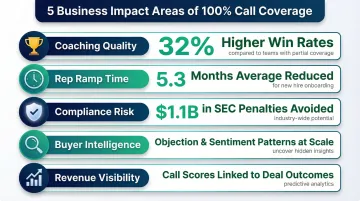
- Every rep receives feedback based on actual call data, not random selection, organizations with dedicated coaches achieve 32% higher win rates and 28% higher quota attainment than player-coach models
- New sellers and partners get targeted coaching tied to real gaps in their calls. The average rep takes 5.3 months to reach full productivity, AI-driven coaching compresses that timeline
- Risk phrases and non-compliant language surface automatically before they become liabilities, the SEC charged 16 Wall Street firms with recordkeeping failures, resulting in $1.1 billion in combined penalties
- Repeated objections, frequently raised topics, and sentiment patterns reveal what buyers actually care about, at scale, not just anecdotally
- Call quality scores link directly to deal outcomes, giving revenue leaders a concrete view of which behaviors drive closed business
The Compounding Cost of Inaction:
Without AI call analysis, revenue teams pay hidden costs daily. Sales reps spend 60% of their time on non-selling tasks, including manual post-call documentation that AI could automate. Yet 48% of reps never make a second follow-up attempt, often because incomplete call notes don't surface clear next steps. These gaps accumulate into millions in lost pipeline.
How AI Call Analysis Works – Step by Step
Most organizations implement transcription and stop there. The real value comes from completing the full workflow, from capture through coaching. Here's how each step builds on the last to create measurable outcomes:
Step 1 – Capture and Transcribe
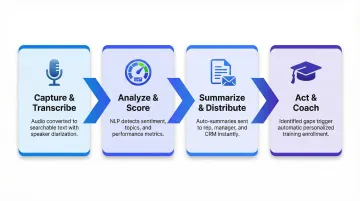
The AI records and transcribes the call in real time or post-call, converting spoken language into searchable, structured text. Modern systems use speaker diarization to identify who spoke when, segmenting audio and assigning labels to each participant automatically.
Quality Considerations:
Transcription accuracy matters. For sales calls where precise details drive decisions, organizations should aim for 90%+ accuracy. Challenges include accents, background noise, multi-speaker conversations, and language switching, factors that separate enterprise-grade platforms from basic tools.
This step directly affects data completeness, review speed, and how quickly teams can search across call libraries.
Step 2 – Analyze and Score
AI applies natural language processing models to detect sentiment (buyer tone, frustration, enthusiasm), identify topics (objections raised, competitor mentions, pricing discussions), and score the call against predefined performance frameworks.
Performance Indicators Evaluated:
- Talk-to-listen ratio: Gong Labs data shows the average B2B sales call runs 60% talking to 40% listening, with high performers maintaining consistency regardless of deal outcome
- Question quality: How effectively reps probe buyer needs
- Objection handling: Response quality when challenges arise. Top performers are 843% more likely to overcome objections than average performers
Scoring at this stage drives coaching accuracy, performance consistency, and QA coverage across the team.
Step 3 – Summarize and Distribute
AI generates structured call summaries, key discussion points, next steps, commitments made, and delivers them to relevant stakeholders (rep, manager, CRM). This removes post-call documentation burden and improves follow-up speed.
Forrester research shows each sales rep saves 490 hours per year with generative AI outreach and reporting automation, with daily reporting saving 35-45 minutes per day alone.
The downstream impact: faster CRM data entry, cleaner records, and follow-ups that happen while the conversation is still fresh.
Step 4 – Act and Coach
Insights from call analysis feed into coaching workflows, managers review scored calls with context, identify skill gaps, and either provide direct feedback or route reps into targeted training modules.
Most organizations stop at the insight. The measurable gains come from closing the loop, connecting what the call revealed to what happens next in training.
Pifini.ai handles this automatically: when call scoring flags a skill gap, the platform auto-enrolls the rep into a targeted training module. No manual manager intervention required. The result is faster time-to-improvement, more consistent coaching quality, and accelerated rep development across the team.
AI Call Analysis in Action – A Sales Scenario Walkthrough
Consider a sales rep at a software company completing a discovery call with a mid-market prospect. The call is recorded and processed by AI call analysis tools.
Within minutes, the AI surfaces a full picture of what happened:
- Full transcript generated, searchable by topic and timestamp
- Sentiment analysis flags the prospect's tone shifting from engaged to neutral the moment pricing came up
- Topic detection identifies two implementation complexity objections the rep never addressed
- Call score lands below team benchmark on objection handling and buyer engagement
The rep receives an AI-generated summary with specific feedback: "Implementation complexity objection raised at 18:42 and 24:15, not addressed. Buyer sentiment dropped 22% during pricing discussion. Recommended action: review objection handling framework."
The manager reviews only the flagged moments rather than replaying the full 45-minute recording. Based on the call score, the rep is automatically enrolled into a training module on handling implementation objections, no manual routing required.
Compare that to the old approach. A manager randomly sampling this call on a Friday afternoon, if they sampled it at all among hundreds of weekly calls, would have missed the insight entirely. The rep would have kept repeating the same gap across future calls with no correction, compounding the damage across every future deal.
That speed and scale is what separates AI-driven analysis from manual review. Companies providing real-time, deal-specific sales coaching increased revenue by 8.4% year-over-year, a 95% improvement over companies without that level of coaching.
How Pifini.ai Can Help
Pifini.ai connects live call scoring, real-time coaching, and post-call analysis directly to prescriptive training. Every conversation feeds a feedback loop that turns performance data into targeted skill development, automatically.
Key Differentiators for Call Analysis:
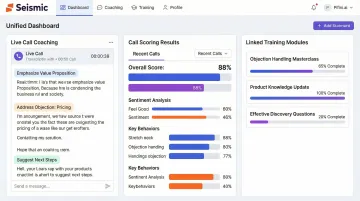
- Live call coaching: The AI listens during active conversations and delivers real-time prompts, objection responses, content recommendations, next steps, so reps can adjust while the deal is still open.
- Call scoring that triggers training: Every call is evaluated against proven success criteria. Reps and partners with performance gaps are automatically routed into targeted training modules, not left waiting for a manager review.
- Unified environment: Call insights, training, content, and partner engagement all live in one platform. No tab switching, no disconnected data. Includes an Enterprise LMS, Digital Sales Rooms, and AI roleplay simulations.
- $50 per user per year: Pifini.ai delivers capabilities comparable to legacy platforms priced at $300–$600 per user per year, built for direct sales teams and extended partner ecosystems (resellers, distributors, alliances) alike.
Frequently Asked Questions
What is AI call analysis?
AI call analysis is the automated process of transcribing, scoring, and interpreting business calls using artificial intelligence. It replaces manual call review with 100% coverage and structured insights, surfacing sentiment, topics, and performance metrics at scale.
How does AI call analysis improve sales coaching?
AI-generated call scores and transcripts give managers specific, evidence-based feedback to share with reps, replacing subjective impressions from occasional call shadowing. Weekly coaching drives 26% higher performance than monthly coaching, and AI makes that cadence consistent across every conversation.
Can AI analyze calls in real time, or only after the call ends?
Both modes exist. Post-call analysis produces summaries and scores after the conversation, while real-time analysis delivers live coaching prompts and alerts during the call itself. Most modern platforms, including Pifini, support both modes within a single system.
What is the difference between AI call analysis and traditional call recording?
Traditional recording only stores conversations for manual playback. AI call analysis automatically extracts sentiment, topics, scores, and summaries, so managers can search, filter, and act on findings without sitting through hours of recordings.
How does AI call scoring work?
AI scores calls by measuring performance indicators such as talk-to-listen ratio, objection handling, adherence to sales frameworks like MEDDIC or Challenger, and buyer sentiment. It benchmarks results against team or role-specific performance standards to identify gaps.
How does AI call analysis connect to sales training?
Call analysis gaps, identified through scoring, can trigger automatic enrollment into targeted training modules. This ties skill development to real conversations rather than scheduled calendars, so reps improve faster and managers see measurable results sooner.