Introduction
Organizations invest millions in training and enablement programs annually, yet 74% of companies report they cannot keep up with the demand for new skills. The problem isn't a lack of content, it's the persistent "knowing-doing gap" that prevents employees from translating what they learn into consistent on-the-job performance.
This gap hits sales teams and partner networks hardest. While 64% of sales leaders believe they're spending more time coaching, 41% of reps report being rarely or never coached. Traditional learning management systems track completion rates, but they don't drive behavior change.
Infrequent manager check-ins can't scale across distributed workforces. Training investments end up delivering activity metrics instead of revenue outcomes.
AI coaching platforms solve this disconnect by delivering personalized, real-time guidance across distributed teams, connecting learning directly to behavior change and measurable business results. This guide explores what AI coaching platforms are, how they work, which use cases they solve best, and how to evaluate, implement, and measure their impact on workforce performance.
TLDR:
- AI coaching platforms deliver personalized guidance at scale, closing the gap between training and on-the-job performance
- Core capabilities: adaptive learning paths, AI roleplay, real-time call coaching, and prescriptive training triggers
- Sales and partner teams benefit most, reducing ramp time by 28% and lifting quota attainment by 21%
- Choose platforms based on measurable outcomes (win rates, ramp time) rather than feature lists
- ROI requires linking coaching engagement to business metrics like quota attainment and deal velocity
What Are AI Coaching Platforms?
AI coaching platforms use machine learning, natural language processing, and behavioral analytics to deliver personalized guidance, feedback, practice opportunities, and nudges to employees, on demand and at scale. Unlike traditional learning management systems that focus on content delivery and completion tracking, AI coaching platforms target behavior change and skill transfer.
How AI Coaching Differs from Traditional Approaches
Traditional LMS platforms measure success by tracking who completed which courses and when. They excel at compliance training and content distribution but struggle to demonstrate whether employees actually apply what they've learned. Human coaching, on the other hand, delivers high-value personalized development but cannot scale organization-wide, managers average just 36 minutes per week in one-on-one coaching per rep.
AI coaching platforms bridge this gap by:
- Analyzing performance signals and behavioral data to build individualized development plans
- Delivering real-time guidance during actual work moments, not just in training sessions
- Providing instant, objective feedback that employees can act on immediately
- Scaling personalized coaching across hundreds or thousands of employees without proportional increases in manager headcount
The Three-Tier Coaching Model
Many HR leaders are adopting a three-tier coaching model that maximizes both reach and depth:
- AI coaching handles everyday skill-building at scale, sales objection handling, product knowledge, compliance, and communication, delivering consistent feedback to every employee regardless of manager bandwidth.
- Human coaching is reserved for situations that require judgment, empathy, and context: executive development, career transitions, and sensitive organizational dynamics.
- Hybrid models combine both, AI surfaces insights and flags development priorities, while human coaches direct their limited time toward high-leverage conversations informed by that data.
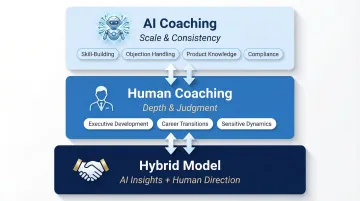
AI coaching augments human expertise rather than replacing it, freeing managers to focus on strategic development and relationship-building instead of repetitive coaching tasks.
How Fast Is the AI Coaching Market Growing?
Enterprise investment in AI coaching is accelerating sharply across every segment:
| Market Segment | 2023/2024 Size | Projected Size (2030-2034) | CAGR |
|---|---|---|---|
| AI in Sales | $24.64B | $145.12B | 22.2% |
| AI in HR | $3.25B | $15.24B | 24.8% |
| AI Career Coach | $4.2B | $23.5B | 18.7% |
| Sales Enablement Platforms | $5.23B | $12.78B | 16.3% |
Source: Grand View Research (2024), Market.us (2025)
The AI in Sales segment leads on both size and growth rate, reflecting how much enterprise revenue teams are betting on AI to improve performance, not just track training completion.
Core AI Coaching Capabilities That Drive Workforce Performance
Personalized Learning Paths and Adaptive Coaching
AI analyzes performance signals, assessment scores, call recordings, CRM activity, and behavioral data, to build individualized development plans for each employee. Rather than pushing the same content to everyone, adaptive systems identify specific skill gaps and surface relevant micro-learning at the moment of need.
Platforms like Pifini.ai use prescriptive learning engines that automatically enroll users into targeted training when performance data reveals specific struggles. For example, when a sales rep consistently scores poorly on objection handling during call reviews, the system routes them into focused objection-handling modules without manager intervention.
The result: skill development tied directly to performance data, not assumptions about what employees need.
AI Roleplay and Conversation Simulations
Simulation technology lets employees practice high-stakes scenarios (objection handling, difficult conversations, product pitches, compliance topics) in a safe environment before attempting them live. AI-powered roleplay provides instant, objective feedback on structure, tone, and content quality, creating an iterative practice loop that accelerates skill transfer.
Research shows that retention from active practice averages around 75%, compared to just 5% for passive lecture-style learning. Sellers who regularly roleplay close 20-45% more deals than those who don't.
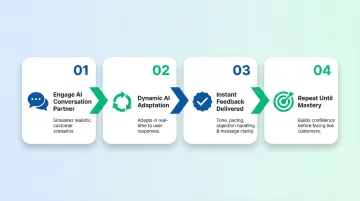
How AI roleplay works in practice:
- Users engage with AI-driven conversation partners that simulate realistic customer scenarios
- The AI adapts responses based on what the user says, creating dynamic, unpredictable interactions
- Instant feedback highlights what worked well and what needs improvement, tone, pacing, objection handling, message clarity
- Users can repeat scenarios until they master the skill, building confidence before engaging real customers
A 2019 meta-analysis of virtual simulations in health professions found that virtual simulations significantly improved skills outcomes compared to traditional education, particularly compared to passive formats like reading or lectures.
Real-Time Call Coaching and Live Performance Support
Some platforms now analyze live conversations as they happen, surfacing talking points, competitor mentions, sentiment cues, or compliance flags in real time. This shifts coaching from a retrospective activity, reviewing recordings after the call, into active guidance during the interaction itself.
Pifini.ai's live AI sales call copilot exemplifies this capability. During customer calls, the AI listens and provides real-time prompts, guidance, and content recommendations, helping reps respond confidently without stepping away from the conversation. The system flags objections, suggests relevant case studies, and nudges sellers on tone and pacing as the call unfolds.
This in-the-moment support is especially valuable for new hires who are still ramping or for complex sales scenarios where reps need immediate access to competitive intelligence or technical details.
Behavioral Nudges and Prescriptive Learning Triggers
AI platforms monitor performance data and automatically enroll users in targeted training when they exhibit specific gaps or struggle with certain skills. Development is driven by real evidence, not a manager's best guess about who needs what.
For example:
- A rep who repeatedly fails to ask discovery questions gets auto-enrolled in a discovery methodology course
- A partner who hasn't completed required certifications receives automated reminders and learning nudges
- A manager whose team shows declining call quality receives coaching recommendations and best-practice resources
Coaching reaches the right people at the right time, before performance gaps turn into lost deals or churned partners.
Analytics and Skill Proficiency Tracking
AI coaching platforms move beyond completion rates to track actual behavior change. Rather than reporting how many people finished a course, these systems measure:
- Skill assessment scores over time, are employees actually getting better?
- Coaching engagement frequency, how often do reps practice and seek feedback?
- Call quality trends, are conversations improving based on objective criteria?
- Correlation to business outcomes, does coaching translate into quota attainment and deal velocity?
Platforms like Pifini.ai correlate training progress, call scoring, and deal outcomes to show which coaching interventions actually drive revenue. This readiness-to-revenue visibility lets organizations invest in the coaching programs that move the numbers, and cut the ones that don't.
AI Coaching for Sales Teams and Partner Ecosystems
Why Sales and Partner Organizations Face Unique Coaching Challenges
Sales reps are often remote, geographically distributed, or part of a partner/reseller network where a direct manager is not available. Coaching consistency breaks down at scale.
The numbers reveal the structural problem:
- 77% of firms believe their sales force receives too little coaching
- Managers average just 36 minutes per week coaching each direct report
- Only 2 in 10 employees say they received meaningful feedback in the past week
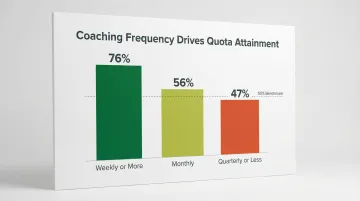
Yet coaching frequency directly correlates with quota attainment. In teams where reps are coached weekly or more, 76% hit quota. When coaching drops to monthly, attainment falls to 56%, and at quarterly or less, it sinks to 47%.
How AI Coaching Closes the Partner Enablement Gap
Channel partners, resellers, distributors, and alliances, are consistently hard to train and coach because they sit outside the direct organization. Traditional enablement approaches require dedicated training headcount for each partner tier, which doesn't scale economically.
AI coaching platforms built with a partner-first architecture solve this problem by:
- Automatically deploying guided learning journeys tailored to partner roles and regions
- Tracking certification progress across the entire ecosystem from a single dashboard
- Delivering coaching support 24/7 without requiring human intervention for routine questions
- Providing multi-language support so global partners receive consistent enablement
The cost of poor partner enablement is steep. According to a 2025 study by The Channel Company, 70% of partners either ended their relationship with a vendor or ceased selling the vendor's products within the prior 12 months. Effective AI coaching reduces partner churn by ensuring they feel supported, competent, and confident representing your products.
Linking Coaching to Revenue Outcomes
Unlike general L&D use cases, sales coaching platforms must connect training scores and certification completions directly to pipeline growth, win rates, and deal size. This requires integrating coaching platforms with CRM systems to correlate learning activities with revenue data.
Prescriptive analytics identify which reps or partners are at risk of underperformance and route them into coaching before results decline. When CRM data shows a rep's average deal size dropping or their close rate declining, the system triggers targeted coaching on negotiation skills or value articulation.
Pifini.ai builds this connection into its core platform, linking certifications and training scores directly to deals closed, win rates, and pipeline growth for both direct teams and partner networks. That readiness-to-revenue visibility tells sales leaders exactly which coaching investments move the number.
Gamification and Engagement Mechanics for Distributed Teams
Closing the revenue gap requires sustained participation, and revenue data alone won't keep distributed learners engaged. Remote and partner audiences disengage from traditional training quickly. AI coaching platforms embed gamification, leaderboards, badges, progress streaks, and achievements, to sustain engagement across distributed ecosystems where learners juggle competing priorities.
Gamification creates competition and social motivation that traditional training lacks. Partners can see how they rank against peers, earn recognition for certifications, and track progress streaks that reward consistent participation. These mechanics drive steady involvement without requiring constant manager follow-up.
Ramp Time Acceleration
AI coaching shortens the time-to-productivity for new sellers and partner reps by replacing lengthy onboarding programs with guided, hands-on learning the platform automatically deploys and sequences by role and proficiency level.
Industry benchmarks reveal significant opportunity:
- Average SDR ramp time is 3.0-3.2 months
- Highly rated onboarding programs reduce average ramp time from 9.1 to 5.7 months
- AI-coached onboarding reduces ramp-up time by 28% (from 4.7 to 3.4 months) and decreases first-year attrition by 39%
Platforms that combine prescriptive learning paths, real-time call coaching, and roleplay practice enable new reps to reach full productivity in weeks rather than months, turning hiring investments into revenue contribution measurably faster.
How to Choose the Right AI Coaching Platform
Must-Have Features Checklist
When evaluating AI coaching platforms, prioritize capabilities that drive measurable workforce improvement:
- Real-time AI feedback during live calls, not just post-call analysis, guiding behavior in the moment delivers the highest value
- Customizable roleplay simulations built around your products, competitors, objections, and sales methodology (generic scenarios add little)
- Prescriptive training enrollment that automatically routes users into targeted learning when performance data reveals specific gaps
- Manager dashboards that surface which reps need coaching and on which skills, highlighting gaps, engagement trends, and performance outliers
- CRM and LMS integrations that eliminate data silos, allowing the platform to analyze pipeline activity and tie coaching to revenue outcomes
Pricing Models and Total Cost of Ownership
Common pricing structures include per-seat annual licensing, module-based add-ons, and tiered enterprise agreements. Organizations must calculate total cost of ownership including implementation, integration, and ongoing support, not just license fees.
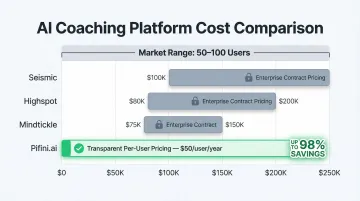
Enterprise sales enablement platforms vary dramatically in cost:
| Platform | Pricing Model | Market Range (50-100 users) |
|---|---|---|
| Seismic | Per-user, annual quote | $100K-$250K |
| Highspot | Per-user, annual quote | $80K-$200K |
| Mindtickle | Per-user + modules | $75K-$150K |
| Pifini.ai | Per-user, all-inclusive | $50/user/year |
Sources: Vendr, Seismic, Vendr, Mindtickle
Platforms at vastly different price points claim similar capabilities, so buyers should demand proof of outcomes, not feature demos. Enterprise capabilities are now available at accessible price points, Pifini.ai delivers unified LMS, AI coaching, call scoring, and partner enablement at $50/user/year, compared to legacy competitors charging $300-$600/user/year.
Hidden costs often include:
- Onboarding and implementation fees ($10K-$50K+)
- Premium support contracts (10-20% of annual contract value)
- Integration development for non-standard systems
- Per-module or per-feature add-ons beyond the base platform
Questions to Ask Vendors
Bring these questions to vendor evaluations to separate genuine capabilities from marketing claims:
How does your platform connect training to business outcomes? Demand specific examples linking coaching engagement to quota attainment, win rates, or deal velocity, engagement statistics alone don't prove ROI.
Does your AI coaching support partner and channel networks? Partner enablement requires different architecture than internal training. Verify external user support, multi-language coaching, and partner-specific learning journeys.
Show me what prescriptive enrollment looks like when a rep underperforms. Ask for a live demonstration of how the system identifies gaps and routes users into targeted training automatically, without manual intervention.
What does implementation actually involve? Timelines range from weeks to months. Understand what internal resources you'll need to commit and what support the vendor provides during rollout.
Avoiding the "Feature vs. Outcome" Trap
Many platforms compete on feature lists, video roleplay, AI chat, badges, but few can demonstrate measurable behavior change or revenue impact. Prioritize vendors who present data on ramp time reduction, performance consistency improvements, or deal velocity changes from real customer implementations.
When vendors can't produce this evidence, push for:
- Case studies with quantified business outcomes, not just testimonials
- Customer references you can contact directly
- Baseline and post-implementation metrics showing actual performance lift
- Analyst validation, Forrester Total Economic Impact studies are a reliable benchmark
If a vendor resists any of these requests, that resistance is itself a data point worth weighing.
Implementing AI Coaching: From Pilot to Full Deployment
Pilot Design and Change Management
Design an effective pilot by selecting a high-impact, measurable audience, such as new partner reps or a specific sales region, and defining behavior-change metrics and baselines before launch. Measure performance indicators like average deal size, time-to-close, or certification completion rates before the pilot begins so you can demonstrate improvement.
Secure executive sponsorship early. Visible leadership endorsement matters, and so does a clear communication plan that explains the "why" to employees and managers. Both are critical for adoption.
Projects with excellent change management meet or exceed objectives 88% of the time, compared to only 13% for those with poor change management. That gap is significant, and McKinsey's research on why 70% of transformations fail points to the same root cause: underinvesting in change management while ignoring employee concerns about new technology.
Embedding Coaching in the Flow of Work
The biggest adoption killer is positioning coaching as an extra task. Integrate AI coaching nudges and practice sessions into existing workflows:
- Before customer calls, trigger roleplay practice or talking point reviews
- After deal losses, automatically enroll reps in competitive positioning or objection-handling modules
- During onboarding, deploy guided learning journeys that adapt based on proficiency assessments
Platforms that connect to calendar, CRM, or communication tools consistently outperform standalone learning portals. When coaching appears at the moment of need rather than requiring users to log into a separate system, engagement increases and behavior change accelerates.
Scaling from Pilot to Organization-Wide Deployment
Once a pilot demonstrates behavior change and business impact, expand audiences while customizing AI models with organization-specific language and scenarios. From there, three priorities drive a successful rollout:
- Optimize with analytics, use dashboards to identify which coaching interventions are actually moving performance metrics
- Build employee feedback loops, let reps flag irrelevant or unhelpful suggestions so the AI refines its recommendations over time
- Customize at scale, train models on organization-specific language, objections, and scenarios to increase relevance as you expand
The organizations that see the most sustained improvement treat deployment as an iterative process, not a one-time launch.
Measuring the ROI of AI Coaching Platforms
Leading Indicators to Track Early
Before business results move, monitor these early signals of program effectiveness:
- Engagement rates with coaching prompts and nudges
- Roleplay completion frequencies and score improvements
- Skill assessment score changes week-over-week
- Manager dashboard utilization, are managers acting on the insights?
If these signals are flat after 30 days, the program isn't taking hold, that's the time to adjust prompts, nudges, or manager accountability before revenue results suffer.
Business Outcomes to Connect to Coaching
The most compelling ROI narrative links coaching platform investment to metrics revenue leaders already track:
- Quota attainment rate
- Average deal size
- Time-to-close (sales cycle length)
- Partner-generated pipeline and revenue contribution
- Certification-to-win-rate correlation
The data behind those metrics is compelling. Firms that provide optimal coaching realize annual revenue growth 16.7% higher than firms that provide none. Dynamic sales coaching yields a 21.3% improvement in quota attainment and a 19.0% improvement in win rates.
Forrester Total Economic Impact studies provide standardized ROI models:
| Platform | ROI | Net Present Value | Key Outcomes |
|---|---|---|---|
| Salesloft | 236% | $26.69M (3 years) | 32% improved coaching productivity; 12% higher win rate |
| Gong | 481% | $10.0M (3 years) | Reduced onboarding time; increased manager productivity |
| Seismic | 578% | $20.7M (3 years) | 85% productivity gains; 15% revenue lift from existing customers |
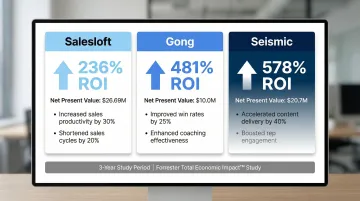
Sources: Forrester TEI - Salesloft (2025), Forrester TEI - Gong (2021), Forrester TEI - Seismic (2016)
Building the Attribution Case
Practical attribution models make it possible to connect coaching activity to revenue outcomes, even without a controlled experiment. Three approaches work well in practice:
- Cohort comparisons, Compare coached vs. non-coached reps in the same region or product line, controlling for tenure and territory to isolate coaching impact.
- Pre/post skill assessments, Measure skill scores before and after interventions, then correlate improvements with changes in deal velocity or win rate.
- Certification milestone benchmarking, Track revenue performance for certified vs. non-certified partners or reps to confirm whether certification translates into closed deals.
Define measurement frameworks before launch, not after, so the data is captured cleanly from day one.
Frequently Asked Questions
What is the best AI coaching platform for workforce improvement?
The best platform depends on your use case, leadership development, sales enablement, and partner ecosystem coaching each have different requirements. Evaluate on measurable outcomes (ramp time, win rates), integration depth with your CRM, LMS, and PRM, and real-time coaching capabilities rather than feature lists.
How is AI used in workforce management?
AI in workforce management spans scheduling and capacity planning, performance analytics, personalized learning and coaching, and skills gap identification. In coaching specifically, AI analyzes behavioral and performance data to deliver targeted, on-demand development at a scale no human coaching team can match.
How do you integrate AI with HR?
Connect AI coaching platforms to your HRIS for user data, LMS for learning records and certifications, and CRM for performance signals like deal progression and call activity. Platforms with pre-built connectors to Workday, Salesforce, and similar systems reduce implementation complexity significantly.
What is the 70/30 rule in coaching?
The standard model is the 70-20-10 framework: 70% of development comes from on-the-job experience, 20% from coaching and mentoring, and 10% from formal training. AI coaching platforms enhance the 70% zone by embedding guidance directly into real work moments rather than separating learning from application.
Can AI coaching replace human coaches entirely?
AI coaching delivers broad-based skill development at scale but cannot replicate human judgment for sensitive situations, executive development, or complex organizational dynamics. The optimal model is hybrid: AI handles volume and consistency, humans handle depth and nuance.
How do you measure the ROI of an AI coaching platform?
Start with pre-defined baselines, then track leading indicators (engagement rates, skill score gains) alongside lagging outcomes (quota attainment, ramp time, win rates). Linking certification completions and coaching engagement to pipeline data via CRM integration produces the clearest financial case.