Introduction
Every sales leader knows the sting of a failed new hire. Research shows that 84% of sales reps missed their quota last year, and the industry average attrition rate for new sales representatives in the first 90 days sits at 28%. When you factor in recruitment costs, training expenses, and lost revenue, replacing a single sales rep costs between $100,000 and $200,000.
The difference between reps who ramp fast and those who struggle rarely comes down to natural talent. It comes down to training quality. Companies with structured onboarding programs improve new-hire productivity by 70% and retain new reps at 50% higher rates than those without.
These numbers make a strong case for getting onboarding right. This article covers 10 proven best practices organized into three phases: building the foundation before Day One, training for real-world selling through deliberate practice, and using technology to accelerate and sustain performance.
Key Takeaways
- Map a 30-60-90 day plan with clear milestones and performance gates before building any content
- Start pre-boarding before Day One to reduce overwhelm and accelerate early momentum
- Create role-specific tracks: SDRs, AEs, and channel reps need different onboarding paths
- Train on customer knowledge and ICP, not just product features
- Use AI-powered role-play simulations to build confidence before real calls
- Build soft skills alongside hard selling tactics, EQ consistently separates top performers from average ones
- Assign mentors and buddies to transfer institutional knowledge and create psychological safety
- Gamification and microlearning boost engagement and long-term retention
- AI coaching delivers real-time feedback and automatically flags skill gaps
- CRM and tool proficiency training shortens ramp time, cover the full stack from day one
Practices #1–3: Build the Foundation Before Day One
Most sales onboarding fails before it starts. Organizations dive into training content without clear goals, defined timelines, or understanding of what new hires actually need to know. These first three practices address the planning and structural decisions that determine whether everything downstream succeeds.
Practice #1: Conduct a Needs Analysis and Map a 30-60-90 Day Plan
Training without a needs analysis is guesswork. Before building a single module, identify:
- Skills gaps within your current sales team
- Specific demands of each sales role
- Knowledge areas where new hires consistently struggle based on past performance data
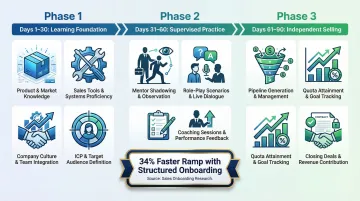
A well-designed 30-60-90 day plan breaks onboarding into three distinct phases:
Days 1-30: Learning Foundation
- Company culture, values, and organizational structure
- Product fundamentals and competitive positioning
- Tool access and basic CRM navigation
- Customer personas and ideal customer profiles (ICP)
Days 31-60: Supervised Practice
- Shadowing top performers on live calls
- Conducting supervised outreach with coaching oversight
- Role-play scenarios covering discovery, objections, and demos
- Refining messaging based on real-world feedback
Days 61-90: Independent Selling
- Managing their own pipeline with coaching support
- Running full sales cycles with milestone check-ins
- Refining negotiation and closing skills
- Performance evaluation against quota benchmarks
Some organizations use a "3-3-3" framework (3 days, 3 weeks, 3 months) for faster-paced environments. This compressed timeline accelerates each phase but maintains the same learning-practice-independence progression.
The impact of structured planning is measurable: organizations with formal onboarding programs have ramp-up times that are 34% faster than those without. Even more striking, structured, practice-based certification programs yield 62% higher first-year quota attainment compared to traditional knowledge-based approaches.
Practice #2: Start Pre-Boarding Before Day One
Pre-boarding, giving new hires access to resources before their official start date, dramatically reduces Day One overwhelm and accelerates early momentum. Research shows that 20% of employee turnover happens within the first 45 days, making the pre-boarding period critical for early engagement.
Effective pre-boarding includes:
- Welcome video from the hiring manager introducing the team and company culture
- LMS access to foundational courses (company overview, product basics)
- Sales playbook and messaging guides for early familiarization
- Team directory with photos and contact information
- First-week agenda so new hires know what to expect
Pre-boarding builds early connections and reduces new hire anxiety before Day One even arrives. When reps show up already familiar with core concepts, you can skip generic orientation and move directly into meaningful skill development.
Practice #3: Build Role-Specific Learning Tracks
One-size-fits-all onboarding is a costly mistake. An SDR focused on cold outreach needs entirely different training than an AE closing enterprise deals or a channel partner managing resellers.
Role-based tracks should address:
- SDRs: High-volume prospecting, email sequencing, cold calling scripts, qualification frameworks
- Account Executives: Discovery methodologies, complex negotiation, multi-stakeholder selling, contract navigation
- Channel Partners: Partner program structure, co-selling motions, deal registration, marketing development funds
Role-specific tracks make content immediately relevant, which improves retention and shortens time-to-first-sale. Reps trained on work that mirrors their actual day-to-day absorb material faster and apply it sooner.
Platforms like Pifini enable organizations to create distinct role-based learning tracks through prescriptive learning paths that automatically enroll users based on performance data, role identification, and skill gaps. Each rep gets precisely the training they need, with no manual routing required.
Practices #4–7: Train for Real Selling, Knowledge, Skills, and Practice
The most common onboarding failure is training reps on product features without teaching them to have real sales conversations. These four practices address the content and delivery methods that actually prepare reps to sell.
Practice #4: Go Beyond Product, Train on Customer Knowledge and ICP
New hires need to understand more than what they're selling, they need to understand who buys it and why.
In modern B2B selling, buyers fully define their purchase requirements 83% of the time before speaking with sales. Reps who only know features get outpaced by buyers who already know what they want, training must close that gap with customer pain points, buying triggers, and stakeholder-specific messaging.
Training must cover:
- Buyer personas and ideal customer profiles (ICP)
- Customer pain points and business challenges
- Buying committee dynamics (CFO vs. Sales Manager vs. IT Director)
- Industry-specific use cases and outcomes
Companies with a clearly defined ICP achieve 68% higher win rates, yet 68% of B2B companies lack one, which is the most common root cause of wasted pipeline.
Include recordings of successful customer calls during training so new hires hear how experienced reps connect product value to customer outcomes, not just features to specs. Real conversations teach more than any slide deck.
Practice #5: Use Role-Play and Sales Simulations
Structured role-plays covering discovery calls, objection handling, product demos, and closing build the confidence and instincts that no slide deck can replicate. Practice must happen in a safe environment before reps face real prospects.
Best practices for role-play:
- Use realistic buyer personas with standardized scoring rubrics so feedback is objective and actionable
- Score performance across tone, clarity, objection handling, and messaging accuracy
- Provide instant feedback so reps understand what worked while the conversation is fresh
- Create a library of scenarios covering common objections and challenging situations
Research backs the approach: learners using simulation-based training are 275% more confident in applying what they learned and complete training four times faster than those in traditional classroom settings.
AI-powered simulations compress that timeline even further. AI-driven 30-60-90 day ramp plans reduce average time-to-quota from 112 days to 37 days, a 67% improvement, with 81% of reps hitting quota within 90 days.
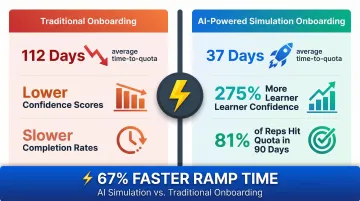
Pifini's AI-powered roleplay module enables new hires to practice with lifelike AI-driven buyers in realistic scenarios tailored to their upcoming meetings. The system scores performance in real time across tone, clarity, objection handling, and messaging accuracy, then routes reps into targeted training when gaps are detected.
Practice #6: Build Soft Skills Alongside Hard Sales Skills
Communication, active listening, empathy, and negotiation separate average reps from top performers. 90% of top sales performers possess high emotional intelligence, yet 31% of sales leaders point to soft skills as a weak spot in their current training efforts.
That gap is costly: sales teams that receive soft skills coaching close 13% more deals than those who don't.
Key soft skills to develop:
- Active listening and questioning techniques
- Empathy and emotional intelligence
- Negotiation and conflict resolution
- Communication clarity and executive presence
Soft skills training is often cut from onboarding programs when time gets tight. That's a mistake most teams pay for later.
In complex B2B deals with multiple stakeholders, the ability to read the room, build rapport, and navigate organizational politics often determines outcomes more than product knowledge does.
Practice #7: Assign Mentors and Create a Buddy System
Formal mentorship delivers dual value: senior mentors transfer institutional knowledge, sales methodology, and cultural context, while peer "buddies" provide psychological safety, making new hires more likely to ask questions and absorb information faster.
The retention numbers tell the story: organizations with mentorship programs see 72% retention rates for mentees, compared to just 49% for those without. Separately, 56% of new hires say having a buddy or mentor is very important when getting started.
Structure the mentor relationship with:
- Weekly check-ins with clear agendas
- Joint call attendance (new hire shadows mentor, then mentor shadows new hire)
- Recorded call reviews with specific, actionable feedback
- Milestone-based coaching conversations (Day 7, Day 30, Day 60, Day 90)
Don't leave mentorship to chance. Assign mentors formally, set expectations for both parties, and track engagement to ensure the relationship delivers value.
Practices #8–10: Use Technology to Accelerate and Sustain Learning
The best training design in the world is undermined if reps are bored, disengaged, or unsupported when they hit a stumbling block. These final three practices use technology to keep engagement high and close skill gaps in real time.
Practice #8: Incorporate Gamification and Microlearning
Gamification, leaderboards, badges, points, and milestone rewards, taps into the competitive nature of sales professionals. Gamified learning can increase engagement by up to 150%, boosting training completion rates and knowledge retention.
Combine gamification with microlearning for maximum impact. Microlearning delivers content in short, focused bursts of 3-7 minutes, allowing learners to retain 25–60% more information than traditional methods.
Deploy microlearning just-in-time:
- Surface a 5-minute objection handling module before a rep's first discovery call
- Deliver a quick pricing negotiation refresher when a deal reaches the proposal stage
- Push competitive battlecards when a rep logs activity against a specific competitor
Pifini includes leaderboards, achievements, and certifications as core gamification mechanics within its sales roleplay training module. Bite-sized modules keep completion rates high while reinforcing the skills reps need most at each stage of ramp.
Practice #9: Leverage AI Coaching and Real-Time Feedback
Traditional call shadowing and manager-reviewed recordings provide delayed feedback. New hires can practice the wrong behaviors for days before anyone catches it.
AI-powered coaching changes this by analyzing calls in real time, scoring conversations against best practices, and routing reps into targeted training the moment a gap is identified.
The impact is measurable: sellers who effectively partner with AI tools are 3.7 times more likely to meet quota. In a specific enterprise case, ComplyAdvantage used conversation intelligence to decrease new rep ramp time by 50%.
AI coaching delivers:
- Real-time call analysis scoring discovery, objection handling, and closing strength
- Contextual content recommendations during live calls (case studies, ROI data, product sheets)
- Instant objection handling prompts when tough questions arise
- Automated gap detection that routes reps into prescriptive training
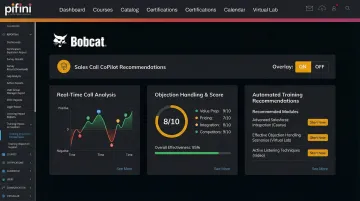
Pifini combines live AI sales coaching, role-play simulations, and automated call scoring, and auto-enrolls reps into prescriptive training paths the moment a gap is detected. Performance data and learning paths stay connected, so remediation happens in hours, not weeks.
Practice #10: Train Reps on Tools, CRM, and Their Full Tech Stack
Proficiency with the tech stack, CRM, dialer, sequencing tools, proposal software, directly affects how quickly a rep can execute. Yet 42% of sales reps feel overwhelmed by too many tools, and without structured onboarding, that overwhelm translates directly into slower ramp times.
When used correctly, CRM proficiency drives results: businesses using CRM report a 29% increase in sales revenue and a 34% improvement in sales productivity.
Hands-on tool training should cover:
- CRM navigation and data entry workflows
- Activity logging and pipeline management
- Email sequencing and automation tools
- Proposal and contract software
- Video conferencing and screen sharing tools
Tool training works best as a structured onboarding component, not something reps figure out on their own mid-quarter. Schedule guided walkthroughs, create quick-reference guides, and assign practice exercises that mimic real workflows. Reps who know their stack from day one spend more time selling and less time troubleshooting.
Reinforce Learning Long-Term and Measure Training ROI
Training isn't a 90-day event, it's a continuous system. The Ebbinghaus forgetting curve shows that without ongoing reinforcement, employees forget 84% of sales training content within three months.
Effective long-term reinforcement includes:
- Spaced repetition modules that resurface key concepts at optimal intervals
- Refresher training triggered by performance data (missed quota, declining call quality)
- Regular coaching checkpoints at Day 7, 30, 60, 90, and 180
- Continuous skill development programs that build advanced competencies
Reinforcement only delivers value if you can measure it. Track these metrics to evaluate onboarding effectiveness:
- Time-to-first-sale: How quickly new hires close their first deal
- Quota attainment at 90 and 180 days: Percentage of new hires hitting revenue benchmarks
- Ramp time vs. industry benchmarks: Whether your timeline is competitive or lagging
- 12-month rep retention: Whether strong training reduces early attrition
The ROI for sales training is substantial: for every dollar spent on training, companies receive about $4.53 back, a 353% return. Organizations with continuous training programs also see a 50% increase in net sales per employee.
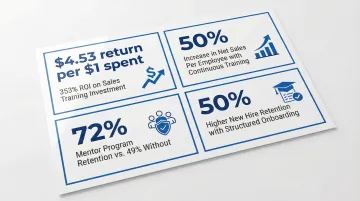
Platforms like Pifini connect certifications and training scores directly to deal outcomes, pipeline contribution, and win rates, giving revenue leaders concrete evidence of what learning investments actually produce.
With measurement in place, close the loop. Pulse surveys to reps, manager check-ins, and regular performance data reviews give you the signal to refine the program continuously, so training stays relevant as your sales motion evolves.
Common Mistakes That Undermine New Sales Hire Training
Even well-intentioned onboarding programs fail when organizations make these critical mistakes. Most problems fall into four categories: overloading new hires early, leaving performance expectations undefined, cutting training off too soon, and applying a one-size-fits-all approach to different rep types.
Information Overload in the First Week
Cramming too much content too fast leads to cognitive shutdown, not readiness. New hires can't absorb 40 hours of product training in Week One. Spread foundational knowledge across the full 30-60-90 timeline and prioritize what reps need to know now versus what can wait until Week Four.
No Clear Milestones or KPIs
If reps and managers don't know what "ready" looks like, nobody can course-correct. Define specific performance gates at each phase, for example, "By Day 30, complete product certification and shadow 10 calls." Without measurable milestones, onboarding becomes a vague exercise rather than a structured program.
Treating Onboarding as a 2-Week Event
Training that ends at Day 14 leaves reps underprepared for the objections, negotiations, and deal complexity they'll face at Day 60. Onboarding must extend through the full ramp period, with coaching and support scaling down gradually as reps gain independence.
Applying the Same Program to Direct Reps and Channel Partners
Partners have different motivations, product fluency gaps, and selling contexts than direct employees. A channel partner selling your product alongside five competitors needs different enablement than a dedicated internal AE. Tailor content, pacing, and support structures to match each group's reality.
Here's a quick summary of what each mistake costs you:
Even well-intentioned onboarding programs fail when organizations make these critical mistakes. Most problems fall into four categories: overloading new hires early, leaving performance expectations undefined, cutting training off too soon, and applying a one-size-fits-all approach to different rep types.
Information Overload in the First Week
Cramming too much content too fast leads to cognitive shutdown, not readiness. New hires can't absorb 40 hours of product training in Week One. Spread foundational knowledge across the full 30-60-90 timeline and prioritize what reps need to know now versus what can wait until Week Four.
No Clear Milestones or KPIs
If reps and managers don't know what "ready" looks like, nobody can course-correct. Define specific performance gates at each phase, for example, "By Day 30, complete product certification and shadow 10 calls." Without measurable milestones, onboarding becomes a vague exercise rather than a structured program.
Treating Onboarding as a 2-Week Event
Training that ends at Day 14 leaves reps underprepared for the objections, negotiations, and deal complexity they'll face at Day 60. Onboarding must extend through the full ramp period, with coaching and support scaling down gradually as reps gain independence.
Applying the Same Program to Direct Reps and Channel Partners
Partners have different motivations, product fluency gaps, and selling contexts than direct employees. A channel partner selling your product alongside five competitors needs different enablement than a dedicated internal AE. Tailor content, pacing, and support structures to match each group's reality.
Each of these mistakes shares the same root cause: treating onboarding as a fixed event rather than a managed process. The practices in the next section address each one directly.
| Mistake | What It Costs You |
|---|---|
| Information overload in Week 1 | Cognitive shutdown; reps retain less, ramp slower |
| No milestones or KPIs | No visibility into readiness; problems surface too late |
| Cutting training at Day 14 | Reps hit Day 60 unprepared for complex deals |
| One program for all rep types | Channel partners disengage; misaligned enablement |
Frequently Asked Questions
What is the typical onboarding timeline for training new sales hires (30-60-90 and 3-3-3)?
The 30-60-90 day framework breaks onboarding into learning (product/tools), supervised practice (shadowing/role-play), and independent selling phases. The 3-3-3 model (3 days, 3 weeks, 3 months) is a faster-paced variation used in high-velocity sales environments. Actual length depends on product complexity and sales cycle.
What topics should be covered when training new sales hires?
Key topics include company and product knowledge, customer profiles and ICP, sales process and methodology, tools and tech stack, soft skills, and objection handling. Adjust the mix based on the rep's role and prior experience.
How long does it typically take a new sales hire to become fully productive?
According to SalesHood ramp-up research, the average ramp time is 5.7 months for Account Executives and 3.2 months for Sales Development Representatives. Organizations with structured onboarding programs consistently reduce this timeline by up to 34%, while enterprise B2B sales may require 9-12 months due to long cycles and complex negotiations.
What is the difference between sales onboarding and ongoing sales training?
Onboarding is the foundational, time-bound process for bringing a new hire to baseline competency. Ongoing sales training is the continuous development system that builds advanced skills, adapts to market changes, and reinforces earlier learning over the long term.
How can AI improve training for new sales hires?
AI accelerates new hire development through real-time call coaching, automated performance scoring, personalized learning path recommendations, and prescriptive enrollment, flagging skill gaps immediately and routing reps into the right training before bad habits form.