Introduction
Enterprise revenue leaders are navigating a harsh operational reality. Buying committees now average 6-11 stakeholders per B2B purchase, according to Gartner research, stretching sales cycles from months to quarters. Meanwhile, every go-to-market investment demands clear ROI proof, forcing sales organizations to operate with surgical precision rather than hopeful experimentation. For most revenue teams, this pressure is constant.
Yet many enterprise organizations still treat sales enablement as ad hoc training: one-off sessions, generic onboarding decks, and reactive coaching after deals slip away.
The gap between structured enablement and improvised approaches shows up directly in results, missed quotas, new hires taking 6+ months to ramp, and inconsistent rep performance that makes revenue forecasts unreliable.
Here's what enterprise sales enablement actually requires, and what it costs to get it wrong.
Key Takeaways
- Enterprise sales enablement equips reps, partners, and customer-facing teams with content, training, coaching, and tools needed to win complex, high-value deals
- It's a continuous system aligning people, processes, and technology, not generic onboarding
- Core advantages: scalable team performance, faster deal velocity, and data-driven coaching that closes skill gaps
- Without it, organizations face inconsistent results, rising sales costs, and stalled enterprise growth
- Done right, enablement compounds over time, turning average performers into reliable revenue contributors
What Is Enterprise Sales Enablement?
Enterprise sales enablement is the system that equips sales reps, managers, and partner-facing teams with the resources, skills, and insights needed to engage enterprise buyers and close complex deals efficiently.
How Enterprise Enablement Differs from Standard Sales Training
Standard sales enablement can address any selling motion, transactional deals, short sales cycles, or single-decision-maker scenarios. Enterprise sales enablement operates at a different scale entirely. Research from Gartner shows typical B2B enterprise deals involve 6-11 stakeholders, each with distinct priorities and objections.
That complexity introduces challenges that quarterly training sessions simply can't address:
- Sales cycles stretch 6-18 months, requiring sustained rep readiness
- Cross-departmental decision-making means reps must navigate multiple buying agendas simultaneously
- Indirect sales motions through resellers and distributors add another layer of coordination
This demands a more structured, scalable approach, one built for consistency across long, multi-stakeholder deals.
The Connective Layer Between Strategy and Execution
Enterprise sales enablement is the ongoing infrastructure that turns a sales methodology into repeatable behaviors that produce revenue. It operates between strategy and execution, ensuring what leadership designs actually shows up in customer conversations. Without it, strategy stays theoretical, documented in decks but disconnected from deals.
That gap is where most enterprise revenue programs break down, and where a well-built enablement system pays for itself.
Key Advantages of Enterprise Sales Enablement
The advantages below map directly to performance indicators that revenue leaders actively track and report on. Each one represents measurable operational impact, not theoretical outcomes.
Advantage 1: Scalable, Consistent Performance Across Reps and Partners
Enterprise sales enablement systematically raises the performance floor rather than relying on a handful of top performers. Every rep, new hire, and channel partner operates with the same messaging, process knowledge, and product fluency.
How enablement creates this operationally:
- Structured onboarding programs that reduce new hire ramp time from 6+ months to 3-4 months through role-specific learning paths
- Automated learning workflows that adapt to individual skill gaps rather than delivering one-size-fits-all content
- Prescriptive training enrollment that routes struggling reps into targeted courses before gaps impact deals
Industry data shows that the average frontline sales manager now oversees 9.7 direct reports, up from 7.5 in 2022. This expansion dilutes coaching capacity, making structured enablement systems essential to maintain performance consistency.
Performance consistency is critical in enterprise sales because a single poorly executed interaction with a stakeholder can stall or kill a deal worth hundreds of thousands of dollars. Research indicates that in most sales organizations, the top 20% of reps carry a disproportionate share of revenue, a risk that compounds as teams scale.
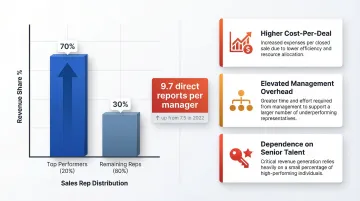
Inconsistent performance drives higher cost-per-deal, elevated management overhead, and greater dependence on expensive senior talent to rescue struggling opportunities.
KPIs impacted and when this matters most:
- Quota attainment rate
- New hire ramp time
- Training completion and retention
- Performance consistency across territories
This advantage has highest impact during rapid headcount growth, product launches, or expansion into new enterprise market segments.
Advantage 2: Faster Deal Velocity Through Smarter Buyer Engagement
Enterprise sales cycles are long by nature, but enablement reduces unnecessary drag. Reps enter each conversation prepared, equipped with the right content for the right stakeholder, and capable of navigating objections without escalation.
How enablement drives faster deal progression:
- Centralized, stage-aligned content libraries that eliminate time spent searching for assets
- Buyer engagement tools that track how prospects interact with materials, revealing what resonates and what gets ignored
- Playbooks that guide reps through multi-stakeholder dynamics, ensuring no critical decision-maker is overlooked
Sales reps spend only 28% of their time actually selling, according to Forrester research analyzing revenue organizations. The rest disappears into administrative tasks, content searches, and meeting preparation.
In enterprise deals, delay compounds. A week of stalled follow-up can shift procurement cycles, introduce new stakeholders, or give competitors a window to gain influence. Reps who deliver personalized, stage-relevant content consistently outperform those using generic outreach, and the time saved flows directly back into active selling.
Shorter sales cycles free up rep capacity for more pipeline, improve forecast accuracy, and reduce the cost of sale as a percentage of contract value.
KPIs impacted and when this matters most:
- Sales cycle length
- Win rate
- Buyer content engagement rate
- Deal stage progression velocity
This advantage is most pronounced in organizations managing 6-18 month enterprise sales cycles or running complex multi-threaded deals across five or more stakeholder contacts.
Advantage 3: Data-Driven Coaching That Closes the Skills Gap in Real Time
Traditional sales coaching relies on manager observation and intuition. Enterprise sales enablement replaces guesswork with performance data, making coaching targeted, timely, and tied to specific deals at risk.
How enablement creates this operationally:
- AI conversation intelligence analyzes sales calls, flags messaging gaps, and auto-enrolls reps into targeted training when patterns indicate skill deficiencies
- Prescriptive learning triggers route a rep struggling with pricing objections into relevant coaching before the next deal cycle, not after another loss
- Live AI coaching tools like Pifini.ai score calls in real time and trigger learning paths without requiring manager intervention
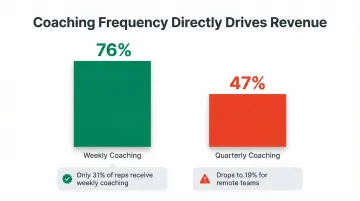
In enterprise organizations, frontline managers are stretched thin. As noted earlier, the average manager oversees 9.7 direct reports, and only 31% of reps report receiving weekly coaching. That drops to 19% for remote and distributed teams.
Yet coaching frequency directly impacts quota attainment. Reps receiving weekly coaching achieve 76% quota attainment, compared to just 47% for those coached quarterly. The gap between consistent coaching and reactive feedback is the difference between hitting plan and explaining missed targets.
Research from CSO Insights reveals that organizations employing "dynamic coaching", where coaching is formally defined and aligned to enablement services, see a 27.9% improvement in quota attainment and a 32.1% increase in win rates compared to random coaching approaches.
KPIs impacted and when this matters most:
- Coaching frequency per rep
- Call quality scores
- Deal risk identification rate
- Pipeline accuracy
This advantage is most critical in large, distributed sales organizations where managers cannot maintain one-on-one coaching cadences across large teams.
What Happens When Enterprise Sales Enablement Is Neglected
Neglecting structured enablement doesn't leave teams in a neutral state. It creates a specific set of compounding problems that grow harder and more expensive to reverse over time.
- Top performers carry the team while mid-tier reps and new hires are left to figure out enterprise sales on their own, driving unpredictable revenue and high seller attrition.
- Without relevant content, clear playbooks, or consistent messaging, reps waste time reinventing materials and navigating stakeholder complexity without structure.
- Coaching becomes reactive: problems surface after lost deals rather than before, meaning organizations absorb the cost twice, lost revenue plus the time spent diagnosing what went wrong.
- As headcount grows and partner ecosystems expand, informal knowledge transfer breaks down entirely. Onboarding slows, messaging becomes inconsistent, and the enterprise buyer experience degrades.
How to Get the Most Value from Enterprise Sales Enablement
Enterprise sales enablement produces compounding returns when built as a continuous system rather than a series of disconnected initiatives. Three conditions separate high-performing enablement programs from those that plateau.
1. Apply it consistently across every role and channel
Enablement should cover not just direct sales reps but also partner-facing teams, channel managers, and resellers. Inconsistent application is one of the leading reasons enterprise enablement programs underdeliver. Research shows that when organizations take a formal approach to sales enablement, 56.9% also take a formal approach to sales coaching, demonstrating the value of system-wide consistency.
2. Close the loop between training and revenue outcomes
The most effective programs track whether training completion, certification scores, and coaching frequency correlate with actual deal performance. That connection is what turns enablement from a cost center into a measurable revenue investment. Platforms like Pifini.ai are built specifically for this purpose, linking learning data directly to pipeline metrics and win rates at the individual rep and partner level.
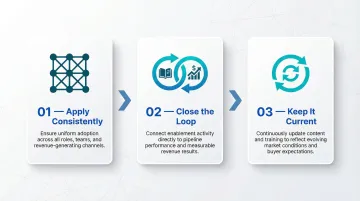
3. Keep it current, not just launched
Buyer needs, competitive landscapes, and product positioning change. Enablement teams should regularly review, update, and test content, playbooks, and coaching programs against current field conditions to remain effective.
Conclusion
Enterprise sales enablement's value lies in the control it gives revenue leaders over performance outcomes. It replaces variability with a repeatable system that prepares reps, engages buyers, and surfaces the insights needed to act before deals stall or close lost.
The advantages compound over time. Organizations that invest in enablement early see shorter ramp times, higher win rates, and greater consistency across their teams and partner ecosystems. Those that delay pay a growing cost in lost deals, high turnover, and reactive management that consumes resources without improving results.
Enterprise sales enablement is the infrastructure that makes growth scalable, not a project with an end date, but a system that compounds in value as buying complexity increases. The organizations that build it now will be far better positioned to execute as the next wave of enterprise deals demands more from every rep, partner, and channel.
Frequently Asked Questions
What is enterprise sales enablement?
Enterprise sales enablement is the system that equips sales reps, managers, and partner-facing teams with the content, training, coaching, and technology needed to engage large-account buyers and close complex, multi-stakeholder deals. Unlike standard enablement, it's built around scale, longer sales cycles, and buying committees that often include 6–11 decision-makers.
How is enterprise sales enablement different from standard sales enablement?
Enterprise sales enablement is designed for high-value accounts with longer cycles, larger buying committees (often 6–11 stakeholders), and channel or partner complexity. Standard enablement addresses general selling motions, enterprise enablement adds the structure and scalability those deals require.
What is sales enablement software?
Sales enablement software gives sales teams a single place to access content, complete training, receive coaching, and track performance. Enterprise-grade platforms extend this to partners and distributed teams, and typically include AI capabilities like call scoring, personalized learning paths, and buyer engagement tracking.
What is the best sales enablement tool for enterprises?
The right tool depends on your organization's size, partner ecosystem complexity, and budget. Look for a platform that covers content management, training, AI coaching, and analytics without requiring multiple add-ons. Pricing varies widely, legacy platforms like Seismic or Mindtickle run $300–$600/user/year, while newer entrants offer comparable capabilities for significantly less.
What metrics should I track to measure enterprise sales enablement success?
Track quota attainment rate, new hire ramp time, sales cycle length, win rate, content engagement rate, and training completion. The highest-maturity programs also track the direct correlation between specific enablement activities and deal outcomes.
How does AI improve enterprise sales enablement?
AI automates coaching at scale by analyzing sales calls, flagging skill gaps, recommending relevant content in context, and routing reps into targeted training, all without requiring manual manager review. The result is continuous, consistent development across large and distributed teams.