Introduction
Organizations are scaling their sales teams, partner networks, and reseller ecosystems faster than ever, but training hasn't kept up. The same course gets pushed to hundreds of learners with wildly different roles, experience levels, and knowledge gaps. A veteran reseller with five years of product knowledge receives identical training to a newly onboarded distributor, wasting time on material they already know while missing what actually matters to their role.
Adaptive microlearning closes that gap by combining personalized learning paths with short, targeted content. Each learner gets routed to exactly what they need, when they need it, in sessions short enough to fit a busy daily workflow.
This article breaks down how adaptive microlearning works, why it outperforms traditional training for distributed teams, and what to look for when choosing a platform to deploy it at scale.
Key Takeaways
- Adaptive microlearning combines focused lessons under 10 minutes with AI-driven personalization, closing individual knowledge gaps efficiently
- Traditional training fails retention by treating everyone the same; adaptive microlearning routes each learner only to what they actually need
- Works especially well for sales teams, channel partners, and resellers who need fast ramp-up without workflow disruption
- Learning paths adjust continuously based on real performance signals, not just test scores
- Linking learning to measurable outcomes (win rates, deal velocity, partner adoption) separates adaptive microlearning from conventional eLearning
What Is Adaptive Microlearning?
Microlearning: Short, Focused, and Built for Retention
Microlearning delivers content in modules typically under 5–10 minutes, each targeting a single concept or skill. According to the Association for Talent Development (ATD), practitioners consider 13 minutes the maximum duration for microlearning, with 10 minutes being ideal and 2 to 5 minutes most effective. These sessions fit into the flow of work rather than pulling learners away from it, a sales rep can complete a module between calls, a partner can refresh knowledge before a customer meeting.
Spaced repetition and frequency matter more than session length. Brief, repeated exposures encode information in long-term memory more effectively than one-time training events. Each micro-session targets a single skill or concept, preventing cognitive overload while reinforcing what matters most.
Adaptive Learning: Personalization Driven by Data
Adaptive learning uses algorithms to continuously assess each learner's knowledge state, identify gaps, and serve content targeting those specific gaps. Brandon Hall Group defines adaptive content as tailoring the learning experience to individual needs, preferences, and pace by analyzing data on learner interactions and progress.
Unlike linear LMS courses where everyone follows the same path regardless of what they already know, adaptive systems route each person to what they actually need. An experienced rep who's mastered product positioning but struggles with objection handling gets training focused on objections, not redundant product lessons. The system adjusts in real time based on performance data.
The Combined Definition: Adaptive Microlearning
Adaptive microlearning is the intersection of the two: short-form content that is dynamically sequenced and personalized for each learner based on ongoing performance data, not just their initial profile or a one-time assessment.
In practice, this means:
- Each session targets that individual's current knowledge gap, not a generic topic
- Delivery intervals are optimized for retention, not trainer convenience
- Sequencing updates automatically as the learner's skills progress
- No two learners follow the same path, even through identical content libraries
The result is training that stays relevant as skills evolve, without requiring manual curation for every role or region.
How Adaptive Microlearning Works: The Technology Behind Personalized Training
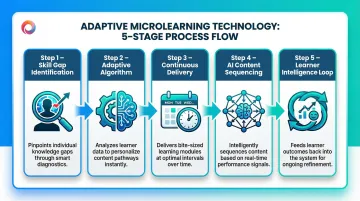
Adaptive microlearning doesn't deliver the same training to everyone, it builds a unique learning path for each person based on what they already know, how they perform, and what they're likely to forget. Here's how the underlying technology makes that work:
Skill Gap Identification: When a learner begins, the system benchmarks existing knowledge through short quizzes or scenario-based questions. This identifies what they already know versus where gaps exist, so they skip irrelevant content from day one.
Adaptive Algorithm: Once gaps are identified, the system determines how often, in what sequence, and in what format each concept should be redelivered. Spaced repetition, the practice of re-exposing learners to content at intervals just before they're likely to forget it, drives this approach. Research shows that optimal spacing between study sessions increases as the desired retention interval increases, which is why the algorithm spaces reviews further apart as mastery builds.
Continuous Delivery: Rather than one large training event, adaptive microlearning delivers 2–5 minute daily or weekly learning moments. Each session adapts based on how the learner performed previously, more reinforcement on weak areas, less on mastered ones.
AI Content Sequencing: Modern platforms use machine learning to factor in performance data beyond training scores, call outcomes, deal progression, behavioral signals, and automatically update which content gets prioritized for each person.
Learner Intelligence Loop: Every interaction refines the system's model of each learner. Administrators and L&D leaders gain visibility into knowledge growth trends at individual, team, and cohort levels, not just completion rates. That shift from tracking completions to tracking competency is where adaptive microlearning separates itself from traditional training approaches.
Why Traditional Training Fails at Scale, and What Adaptive Microlearning Does Differently
Assign the same course to a veteran reseller and a new-hire distributor, and you've already lost both of them. That's the core problem with scaling traditional training, it wasn't built for diversity of experience, role, or readiness.
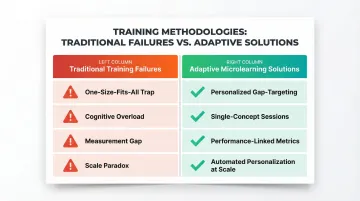
Four structural failures explain why it breaks down:
The one-size-fits-all trap. Hermann Ebbinghaus's 1885 research showed that roughly one-third of information is forgotten within 24 hours, with retention declining exponentially without reinforcement. Generic content accelerates that curve, when training has no personal relevance, learners have no reason to encode it.
Cognitive overload. Long-form courses, even when broken into modules, push too many concepts through working memory at once. John Sweller's Cognitive Load Theory established that overloaded learners make more mistakes and retain less. Adaptive microlearning counters this by limiting each session to one high-priority concept matched to the learner's current gap.
The measurement gap. Most LMS platforms track completion rates and pass/fail scores, neither of which tells you whether behavior actually changed. Adaptive microlearning links knowledge growth directly to performance indicators: win rates, deal velocity, ramp time.
The scale paradox. The larger the team or partner network, the less feasible manual personalization becomes. Adaptive systems resolve this by automating how training is personalized, 500 learners each follow a different path, with no manual configuration required from a training administrator.
Key Benefits of Adaptive Microlearning for Sales and Partner Teams
Faster Ramp Time: Companies customizing skills practice to specific roles and gaps have reduced time-to-competence by 40% to 60% compared to standardized approaches. Adaptive microlearning makes this possible by eliminating content experienced learners already know and routing them directly to the gaps that matter now.
Higher Knowledge Retention: Research by Roediger and Karpicke shows that retrieval practice outperforms restudying for long-term retention. Brief, repeated exposures through spaced retrieval encode information in long-term memory far more effectively than one-time training events.
No Administrative Overhead at Scale: Adaptive algorithms handle routing, sequencing, and reinforcement automatically. L&D managers don't need to build separate learning paths for each role or region, the platform adapts dynamically using performance data.
Improved Engagement Through Relevance: Learners disengage when content feels generic. Adaptive microlearning keeps each session directly relevant to the individual, not the team average. Gamification elements (points, streaks, badges) reinforce daily engagement habits without extra management.
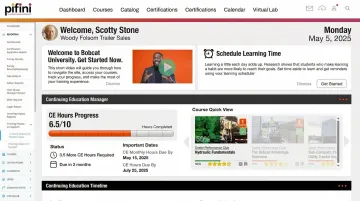
Prescriptive Auto-Enrollment Tied to Performance Signals: Platforms like Pifini connect training directly to real-world performance data. When AI detects a gap, flagged through call scoring, deal loss patterns, or certification scores, it automatically routes the learner into targeted microlearning, delivering personalized learning at scale without waiting for a manager to intervene.
Organizations using decentralized, individualized onboarding programs have achieved approximately 23.5% higher sales performance compared to centralized programs, a direct case for connecting personalized learning to measurable revenue results.
How to Implement Adaptive Microlearning at Scale
Content Design Principles
Effective adaptive microlearning requires content to be modular and mapped to specific, measurable outcomes, not broad topics. Each module should address a single concept and double as a performance support resource, something learners can reference in the moment, not just during a training session.
Design for retrieval practice, not passive review. Include scenario-based questions, simulations, and real-world applications that force learners to recall and apply information rather than simply recognize it.
Platform and Integration Requirements
Look for platforms with these core capabilities:
- Adaptive algorithm capability that personalizes content sequencing
- Integration with CRM or sales performance data to inform learning paths
- Analytics that go beyond completion rates to measure knowledge growth and business impact
- Mobile-first delivery that fits into daily workflows
Integration complexity is often the primary barrier to adoption. A unified platform combining LMS, content, analytics, and AI coaching in one environment removes that friction entirely.
Pifini delivers exactly that: Enterprise LMS, microlearning, gamification, and AI-driven performance analytics at $50 per user per year, 10x more affordable than legacy platforms like Seismic ($300–$500+/user/year) or Bigtincan ($300/user/year).
Measurement and Iteration
Implementation doesn't end at launch. Establish baseline knowledge assessments before training begins, track knowledge growth over time (not just completion), and link learning metrics to sales performance data, deal velocity, win rate, partner certification scores, to demonstrate and optimize ROI.
Data feedback loops make iteration systematic. Use them to:
- Identify which content drives the strongest performance improvements
- Flag learners who need additional support before gaps widen
- Refine the adaptive algorithm based on real-world outcomes
Programs that follow this cycle consistently see compounding returns, each iteration makes the next one faster and more effective.
Frequently Asked Questions
What is adaptive microlearning?
Adaptive microlearning combines short-form, focused learning content (typically 2–10 minutes per session) with AI-driven personalization that continuously adjusts what content each learner receives based on their unique knowledge gaps and performance data. The result is a training path that's unique to each learner, not a one-size-fits-all sequence.
What does it mean to be an adaptive learner?
An adaptive learner actively responds to feedback, adjusts their approach based on what they don't yet know, and treats learning as a continuous process rather than a one-time event. Adaptive microlearning platforms reinforce this behavior through data-driven personalization and spaced repetition.
What is an example of adaptive microlearning?
A reseller logs in for their daily 3-minute session. The system detects from recent quiz performance that they're weak on handling pricing objections and serves them a short scenario-based exercise on that topic, skipping product positioning content they've already mastered. The next session adjusts based on their performance.
How is adaptive microlearning different from traditional eLearning?
Traditional eLearning delivers the same content to all learners in a fixed sequence and measures completion. Adaptive microlearning personalizes the path for each individual and continuously measures knowledge growth, which means less time on content learners already know, and more time closing actual knowledge gaps.
What role does AI play in adaptive microlearning?
AI powers the personalization engine: it analyzes performance data, predicts knowledge decay, and sequences content delivery automatically. In advanced platforms like Pifini, AI also connects training triggers to real-world signals like call outcomes or deal results, eliminating the manual configuration that burdens traditional LMS admins.
How does adaptive microlearning scale across large partner or sales ecosystems?
Because personalization is automated by algorithms rather than manually configured, adaptive microlearning scales without proportional increases in administrative effort, making it viable for organizations training hundreds or thousands of partners, resellers, or distributed sales reps at once.