Introduction
Organizations are pouring resources into AI sales coaching, expecting fast, measurable returns, but many are seeing disappointing results or no measurable improvement at all. According to Salesforce's 2026 State of Sales report, 87% of sales organizations currently use some form of AI. Yet Forrester research reveals only 13% report positive EBITDA impact from their AI investments.
The tools aren't the problem. The deployment strategy is.
The mistakes covered here aren't about selecting the wrong platform. They're about how sales leaders misuse or under-configure even excellent AI coaching tools, eroding ROI before it's ever realized.
These errors affect direct sales teams, channel partners, resellers, and distributors alike, often leaving revenue leaders with mounting costs and no results to show for them.
Each of the five mistakes below includes diagnostic signals and practical fixes you can act on now.
Key Takeaways
- Onboarding-only AI coaching causes skill decay within weeks, reinforcement must be continuous, not one-time
- New reps, veterans, and channel partners need different learning paths; a single program serves none of them well
- AI cannot replace human coaches, emotional intelligence, motivation, and nuanced support still require a human
- Coaching metrics disconnected from revenue make ROI impossible to prove and budgets easy to cut
- Low adoption follows passive rollouts; active management and visible progress tracking are non-negotiable
Mistake #1: Treating AI Coaching as a One-Time Onboarding Event
Many sales organizations deploy AI coaching intensively during onboarding ramp periods, then taper it off once reps are "certified" and the calendar moves on. After initial training ends, coaching cadence disappears, replaced by quarterly training sprints or ad-hoc sessions tied to product launches.
This pattern creates compounding ROI damage. A peer-reviewed replication of the Ebbinghaus forgetting curve confirms steep early knowledge loss following initial learning. Without continuous reinforcement, skills decay rapidly.
Research published in Psychological Science found that optimal retention requires spaced repetition at 10-20% of the target retention interval. If you want knowledge to last six months, reinforcement needs to happen every two to four weeks.
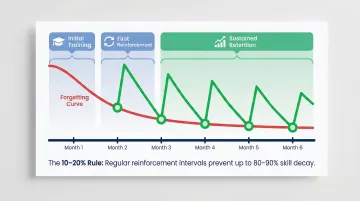
The problem hits channel partners even harder. Resellers and distributors typically receive less ongoing coaching than internal reps, and partner performance visibility is limited. Skill decay goes undetected until it shows up in lagging revenue numbers, by which point, months of ROI are already gone.
The fix is shifting from event-based to always-on coaching. AI platforms handle continuous, self-paced reinforcement without consuming manager time, making them the right tool for this job. The goal is microlearning loops: short, frequent practice sessions tied to real deal scenarios rather than calendar events.
Pifini.ai supports this with:
- Automated microlearning modules that convert campaign materials into bite-sized training
- Live AI call support that delivers real-time coaching during actual customer conversations
- Performance triggers that push training based on rep behavior, not scheduled dates
Diagnostic signal for sales leaders: If reps only engage with coaching content during onboarding or right before product launches, your program is in reactive mode. True continuous coaching means reps interact with training multiple times weekly, driven by performance data rather than the calendar.
Mistake #2: Using a One-Size-Fits-All Coaching Approach
The mistake: A single coaching playbook deployed across all reps, regardless of tenure, role, performance tier, or specific skill gaps. This happens when AI coaching is configured once and left to run without personalization logic.
Why this fails: A uniform program hits differently depending on who's taking it:
- New reps need foundational skill building before anything else
- Experienced reps need targeted gap-filling, not basics they already know
- Channel partners need product and positioning fluency built around how they sell, not how your direct team does
The result: content that's too elementary for some, too advanced for others, and irrelevant for many, low engagement and zero behavior change.
The data backs this up. Highspot's 2025 State of Sales Enablement report found that teams using AI-powered training are 35% more likely to report increased average deal size, while teams with AI-powered coaching are 36% more likely to report higher win rates. The differentiator? Prescriptive learning platforms that trigger training based on actual performance data, not manual enrollment.
Resellers and distributors bring their own sales motions and customer relationships. Generic training built for direct reps fails to resonate with them, producing low completion rates and zero field application. Partners don't have time to hunt through irrelevant content. They need training built around how they actually sell.
The fix: Configure AI coaching platforms to use performance data for auto-routing. Platforms should analyze call scoring results, assessment outcomes, and CRM activity to automatically enroll reps into targeted modules targeting actual skill gaps, not where a manager guesses they exist.
Pifini.ai takes this approach with its prescriptive learning engine: every call gets evaluated, skill gaps get identified, and users are automatically routed into the right training. For partner ecosystems, this removes the administrative burden of managing separate tracks for dozens of resellers.
When a partner struggles with objection handling, the platform catches it through call scoring and enrolls them in the relevant module, no channel manager intervention required.
Mistake #3: Replacing Human Coaching Entirely with AI
Some organizations, drawn by cost efficiency and scalability, eliminate or drastically reduce human coaching investment, treating AI as a full replacement rather than a complement.
Research from Allego, based on a neuroscience study with Dr. Carmen Simon, found that AI-delivered feedback improved 48-hour information retention by 50% compared to human feedback. Yet reps anticipating human coaching showed greater emotional well-being, motivation, and "approach behavior", the drive to engage positively with development. These are not interchangeable tools. They trigger fundamentally different responses in the brain.
What gets lost without human coaches:
- Emotional intelligence and real-time reading of hesitation or confidence levels
- Personalized encouragement tailored to individual circumstances
- The ability to reframe setbacks and build resilience
- Nuanced support during complex deal strategy discussions
AI can identify that a rep fumbled an objection. What it can't do is recognize that the same rep is battling low confidence after three consecutive lost deals. That context requires human insight.
The hybrid model that maximizes ROI: AI handles scale, consistency, and initial feedback, every rep, every call, every time. Human coaches use AI-generated data and flags to prioritize their limited time on reps who need the most nuanced, relational support. This prevents manager burnout while ensuring no rep slips through the cracks.
Structural fix, assign ownership clearly:
- AI handles: Post-call scoring, skill gap identification, practice repetitions, structured feedback delivery
- Coaches focus on: Debrief conversations, career development, emotional support, complex deal strategy, motivation during slumps
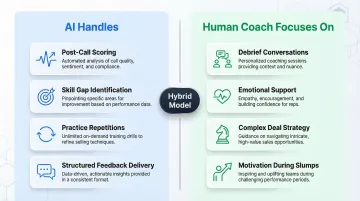
Treat AI as the prep coach and humans as the head coach. Pifini.ai's Manager Coaching Portal is built around this division: managers review AI-scored calls, access flagged performance data, leave personalized feedback, and track rep improvement over time, without wading through calls that don't need their attention.
Mistake #4: Failing to Link Coaching Activity to Revenue Outcomes
Organizations track coaching metrics in isolation, module completion rates, roleplay scores, call scores, but never connect these inputs to the revenue outcomes they're supposed to drive. Without this linkage, calculating ROI or proving business impact to leadership becomes impossible.
CSO Insights' 2019 Sales Enablement Study demonstrated that dynamic, formalized coaching improves win rates by 19.0% and quota attainment by 21.3% over average performance. Yet only 25% of learning leaders track business outcomes, according to ATD research.
When coaching is treated as a cost center with no visible revenue connection, it becomes the first budget line cut. Sales leaders need to show that reps who completed specific training, or hit certain coaching scores, produced measurable gains in win rate, quota attainment, or deal velocity.
The fix: Configure AI coaching platforms to surface performance correlation data, linking certifications, training scores, and coaching participation to CRM pipeline outcomes. Two frameworks help structure this: the Kirkpatrick Model's Level 4 measures targeted organizational results, while the Phillips ROI Model adds cost-benefit analysis to quantify monetary impact.
Pifini.ai's Training Impact Analysis module connects training scores and certifications directly to CRM outcomes. Organizations can use it to:
- Identify which courses correlate with increased revenue and higher win rates
- Rank training modules by ROI percentage to prioritize future investments
- Project the annual revenue impact of ongoing coaching programs
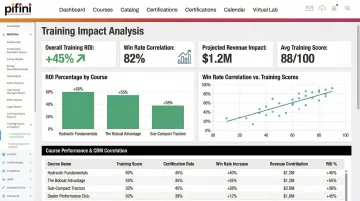
This makes the ROI case concrete and defensible when presenting to executive leadership.
Mistake #5: Deploying the Tool but Ignoring Adoption
The platform is purchased, configured, and launched, but no structured adoption strategy exists. Reps receive login credentials and are expected to self-motivate. Engagement drops within weeks. When ROI doesn't materialize, leaders blame the technology rather than the deployment strategy.
While the widely cited "70% of change initiatives fail" statistic lacks empirical evidence, verified Gartner research from 2025 shows only 32% of business leaders report achieving "healthy change adoption" by employees. Passive rollouts consistently fail.
The fix: Treat adoption as an active, ongoing initiative with defined milestones, not a one-time launch event. That means building in:
- Sales leaders reference coaching data in one-on-ones, signaling the tool has real weight
- Gamification and leaderboards: Harvard Business School research found gamified training increased sales by 27.1% to 35.8%, but only when leaders actively participated as role models
- Executive sponsorship that's visible, when leadership engages with the platform, teams follow
- Feedback loops so reps see their own progress over time and stay motivated
- Rep involvement in tool selection or configuration, which consistently drives higher adoption rates
Pifini.ai supports adoption through several built-in features: prescriptive learning paths that automatically assign relevant training, an AI CAM (Channel Avatar Manager) providing 24/7 partner support, and real-time dashboards showing progress and impact.
The platform's structured four-phase rollout methodology, Evaluation & Migration, Integration Setup, Rollout & Adoption, and Continuous Optimization, treats adoption as a managed process with clear accountability at every stage.
Frequently Asked Questions
Frequently Asked Questions
What is the 30% rule for AI?
The 30% rule holds that AI performs best handling roughly 30% of tasks, specifically repetitive, analytical, or structured work like call scoring and initial feedback, while humans own the remaining 70%: coaching conversations, judgment calls, and relationship development.
How do you measure ROI on AI sales coaching?
Link coaching participation and certification scores to CRM outcomes: win rates, quota attainment, ramp time, and deal velocity. The most credible approach compares reps who actively used coaching against those who didn't, isolating the coaching variable to make the ROI case concrete.
What is the most common reason AI sales coaching programs fail?
The most common failure point is treating AI coaching as a one-time onboarding event rather than a continuous performance system. Once reps complete initial training, the coaching cadence disappears and skills decay rapidly without reinforcement, eliminating ROI before it's realized.
How often should AI sales coaching sessions happen for best results?
Frequent, short sessions beat infrequent long ones. Microlearning interactions of 10–15 minutes several times per week outperform monthly training blocks because they align with how skills are built and retained through spaced repetition.
Can AI sales coaching work effectively for channel partners and resellers?
Yes, but only when coaching is tailored to partner-specific selling motions and product knowledge. Generic programs built for internal direct reps frequently fail in partner ecosystems because the context, buyer relationships, and sales motion differ significantly. Prescriptive learning that adapts to partner performance is essential.
How do you get sales reps to actually use AI coaching tools?
Adoption requires active management, not passive rollout. Involve reps in the selection process, make progress visible through leaderboards and gamification, tie coaching completion to team rituals like deal reviews, and ensure managers reference coaching data in one-on-ones to signal that the tool matters.