Introduction
Sales coaching is breaking. Management layers are thinning, team sizes are ballooning, and mentorship time is vanishing, yet quota expectations haven't budged. In late 2024, average B2B quota attainment crashed to roughly 43%, with 67% of reps not expecting to hit their annual target.
The coaching data is equally stark. While 64% of sales leaders believe they're spending more time coaching, 41% of reps report being rarely or never coached. That disconnect between manager perception and rep experience is where deals are getting lost.
Closing that gap is exactly where AI coaching is proving its value. Enterprises like ServiceNow are already cutting onboarding time from three months to six weeks using AI-powered role-play simulations. The technology has moved well past pilot programs and is now accessible to organizations of all sizes.
This post covers five practical, revenue-focused AI coaching strategies that sales leaders, managers, and partner ecosystem teams can implement in 2026 to close the coaching gap and drive consistent performance across their teams.
Key Takeaways
- AI fills coaching gaps created by leaner management structures and larger teams
- Objective performance scoring replaces inconsistent manager evaluations
- Real-time AI coaching during live calls directly impacts win rates
- Role-play simulations cut seller ramp time dramatically
- Partner ecosystems represent AI coaching's next scalability frontier
Replace Subjective "Vibe Checks" with Quantifiable AI Performance Scoring
Traditional sales coaching relies heavily on a manager's gut feel about a rep's readiness. That approach is inconsistent, unscalable, and prone to bias. When managers oversee 12+ reps, up from 10.9 just two years ago according to Gallup research, the "vibe check" model breaks down. There simply isn't enough bandwidth to observe enough calls, review enough demos, or hold enough one-on-ones to form accurate readiness assessments across an entire team.
How AI Performance Scoring Works:
AI coaching tools replace subjective evaluation with measurable, rubric-based scoring that tracks specific behaviors consistently across every rep:
- Questioning technique - Are reps asking open-ended discovery questions or jumping straight to product pitches?
- Objection handling - Do they acknowledge concerns before responding, or do they get defensive?
- Pacing and talk-listen ratio - Are they dominating the conversation or creating space for buyer input?
- Filler words and confidence indicators - Excessive "ums," "likes," and hedging language signal readiness gaps
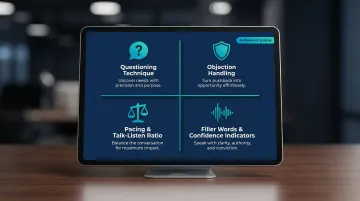
That scoring produces repeatable performance data managers can actually trust, which changes how coaching time gets spent.
ServiceNow Cut Onboarding Time in Half:
ServiceNow deployed an AI sales coach across roughly 8,000 sellers, moving from subjective readiness checks to quantifiable skill metrics. Since introducing the tool, onboarding time dropped from three months to six weeks, a 50% reduction that translates directly to faster revenue contribution.
The downstream benefit extends beyond speed. When performance is quantified, managers spend less time diagnosing what's wrong and more time coaching on strategy, relationship-building, and the nuanced judgment calls AI can't replicate. CSO Insights research found that dynamic, formal coaching approaches deliver 21.3% improvement in quota attainment and 19.0% improvement in win rates, compared to informal, inconsistent methods.
That gap has real consequences. When 39% of reps feel their coaching is too generic and 29% say it lacks actionable advice, you're not just wasting coaching time, you're driving turnover and leaving revenue on the table.
Bring AI Coaching Into Live Sales Calls, Not Just After Them
Traditional post-call review arrives after the deal moment has passed. A rep fumbles an objection on Tuesday, receives feedback on Friday, and applies the lesson on next week's call, after the opportunity has already advanced or stalled. Real-time AI coaching flips this model by delivering in-the-moment prompts, suggested talk tracks, and flagged signals while the call is still happening.
How Real-Time AI Coaching Works:
The system listens to the call, analyzes speech patterns and content against trained models, and delivers relevant cues to the rep during the conversation:
- Flags competitor mentions in real time and suggests positioning language before the conversation moves on
- Triggers relevant ROI frameworks or case studies when budget comes up
- Prompts reps to circle back on objections the buyer raised but didn't get addressed
- Recommends talk tracks proven in similar deals when the conversation hits familiar territory
Performance Impact:
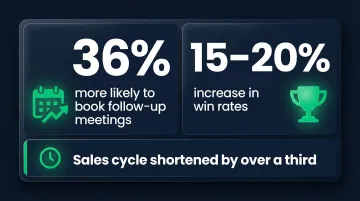
Reps don't just learn from calls retrospectively, they perform better on the call itself, which directly moves outcomes. Research shows that reps using AI assistance during calls are 36% more likely to book follow-up meetings compared to those without real-time support. Teams using AI for objection handling have seen win rates increase by 15-20% and sales cycles shorten by over a third.
Platforms like Pifini bring this capability to market at scale. The system scores every call automatically, flags specific skill gaps, and routes reps into targeted training based on what the call revealed. Call performance triggers targeted learning, which improves the next call, and the one after that.
Addressing Adoption Concerns:
Privacy and rep buy-in are legitimate concerns. AI listening tools require thoughtful rollout, be transparent with reps and frame the tool as a performance amplifier, not surveillance. The easiest analogy: it's the same real-time support a manager would offer if they could sit on every call. Reps who see it that way adopt faster and get more out of it.
Run AI Role-Play Simulations to Cut Seller Ramp Time
AI role-play allows reps to interact with AI buyer personas trained on specific industries, buyer types, and objection patterns. They receive immediate scored feedback and repeat exercises until they hit target performance thresholds, all without consuming manager time or requiring peer coordination.
How AI Role-Play Works in Practice:
Sales training firm Braintrust used the Yoodli platform to create an AI oncologist persona for a pharmaceutical client. The AI buyer persona simulated realistic clinical conversations, asked challenging medical questions, and evaluated whether reps could personally connect while discussing complex diagnostics. Within three months, the team's ability to "personally connect" rose from 10% to 84%, a 740% improvement in a critical soft skill that traditional training struggles to develop.
The "Safe to Fail" Advantage:
Practicing with AI removes the social stakes of performing in front of peers or managers. Reps experiment with new approaches, make mistakes, and refine their technique in a low-stakes environment. Learning psychology research confirms that corrective feedback is highly effective for enhancing the learning of new skills, and simulations enable risk-free learning where trainees can fail and iterate without real-world consequences.
Measurable Ramp Time Reduction:
Sales reps using simulation training achieve quota 34% faster than traditional methods, and video-based role-play platforms reduce new hire ramp time by an average of six weeks.
When you're scaling a sales team or onboarding partner organizations, that acceleration has a direct dollar value: reps contribute sooner, deals close faster, and quota attainment improves across hiring classes.
Consistent Evaluation at Scale:
Platforms that score role-play performance against rubrics provide another advantage: repeatability. Every rep gets evaluated on the same criteria, managers can benchmark performance objectively, and training gaps become visible across the entire team.
Auto-Route Reps into Targeted Training Based on Performance Gaps
Prescriptive learning upgrades reactive training by eliminating guesswork. Instead of reps manually selecting courses or managers assigning generic modules, the AI system identifies specific gaps from call scores or simulation results and automatically enrolls the rep in the right training at the right time.
How Prescriptive Learning Creates a Continuous Improvement Loop
When a rep struggles with objection handling during a scored call, the system immediately enrolls them in a targeted objection-handling course. After completing the training, their next calls are scored again, if performance improves, monitoring continues; if gaps persist, additional training is triggered.
This creates compound skill improvement over time, connecting training activity directly to revenue outcomes rather than treating learning as a disconnected compliance exercise.
Why Personalized Learning Outperforms Generic Training
Targeted, just-in-time learning consistently outperforms scheduled generic training, and the data backs this up. Microlearning can boost knowledge retention by 25% to 60% compared to traditional longer formats, because learners absorb more when content arrives in focused, bite-sized chunks.
Combine adaptive learning with microlearning and the numbers get sharper:
- Knowledge retention increases by up to 60% compared to traditional formats
- Training time drops by as much as 87% when content is personalized and adaptive
- Microlearning completion rates average ~80%, versus roughly 20% for conventional long-form eLearning
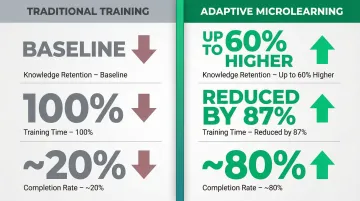
Reps actually finish training when it's relevant, short, and triggered by their real performance needs, not pushed out on a quarterly schedule.
Revenue Impact of Personalized Training
Companies with formalized education programs see 6.2% increases in revenue and 11.6% increases in customer satisfaction. When training is prescriptive and automated, those gains scale across hundreds or thousands of sellers without requiring proportional increases in coaching headcount.
Scale AI Coaching Across Partner and Channel Ecosystems
Most AI coaching discussions focus exclusively on direct sales teams, but organizations with resellers, distributors, and channel partners face a bigger challenge: coaching reach drops dramatically outside the four walls of your company. Partners often receive little to no structured coaching, creating performance inconsistency that undermines your entire revenue strategy.
The Revenue Case for Better-Enabled Partners
The numbers make a clear argument. Partner-sourced deals are 53% more likely to close and close 46% faster than direct deals. In mature programs, partners contribute 28% of revenue versus 18% from paid digital advertising. Despite this, 36% of marketing professionals cite co-selling effectiveness through partner enablement as their foremost challenge.
Better-enabled partners also cut operational costs. When partners understand your products deeply, they escalate fewer support issues, churn less frequently, and need less hand-holding from internal teams. AI coaching scales this enablement without scaling headcount, you support hundreds of partners with the same resources previously allocated to a fraction of that number.
With 67% of B2B organizations planning for indirect revenue to grow above 30%, scalable partner coaching is no longer a nice-to-have, it's core infrastructure for revenue growth.
What to Look for in an AI Coaching Platform in 2026
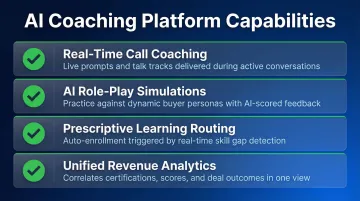
Not all AI coaching platforms deliver the same capabilities. When evaluating solutions, focus on these core features that separate serious platforms from surface-level tools:
Core Capabilities That Matter
- Delivers in-the-moment prompts, talk tracks, and flagged signals during live conversations, not just post-call summaries
- Lets reps practice against AI buyer personas and receive immediate, objective feedback on specific competencies
- Auto-enrolls reps into targeted training when call scores or simulation results reveal skill gaps
- Shows direct correlations between certifications, call scores, and deal outcomes in a single dashboard
The Total Cost of Ownership Trap
Many enterprise platforms charge separately for LMS, coaching tools, content management, and analytics, add-ons that push the true cost 5-10x above the advertised base rate. Seismic runs $630/user/year for base content modules, while Mindtickle ranges from $360-$600/user/year with average contracts around $92,000 annually. Implementation fees add another $15,000 to $45,000 on top.
Fragmented tech stacks compound this with a hidden "integration tax", $40,000-$120,000 annually in development and maintenance. The human cost is just as steep: 70% of sellers feel overwhelmed by the number of tools required to do their work, making them 45% less likely to hit quota.
Unified platforms like Pifini deliver 30-50% lower total cost of ownership by combining content, training, AI coaching, and analytics in one system at a transparent $50/user/year. When evaluating options, request a full-feature quote that includes implementation, integrations, and add-ons, not just the per-seat headline number.
The Human-AI Balance
The best platforms amplify manager coaching, not eliminate it. Look for tools that free managers from repetitive assessment work so they can focus on high-judgment mentoring, the relationship, strategic, and emotional dimensions of development that AI cannot replicate.
AI handles the scalable, repeatable tasks: scoring calls, running simulations, identifying gaps, and routing reps to the right training. Managers focus on career development, deal strategy, and building the trust that drives long-term performance.
Frequently Asked Questions
What is AI sales coaching and how does it differ from traditional coaching?
AI sales coaching uses technology to simulate buyer interactions, score performance against standardized rubrics, and deliver feedback at scale. Unlike manager-led coaching, which is limited by time and prone to inconsistency, AI coaching provides repeatable, objective evaluation across every rep and every call.
Can AI coaching replace sales managers or human coaches?
No. AI handles repetitive assessment, practice, and gap identification, but human managers remain essential for high-judgment mentoring, strategic guidance, and the relational dimensions of development that AI cannot replicate. The best approach uses AI to free managers for higher-value coaching.
How does AI coaching work for channel partners and resellers?
AI coaching platforms deploy simulations, scored onboarding paths, and performance tracking across partner networks, no dedicated coaching headcount required at each partner organization. The result: consistent quality scaled across hundreds of partners simultaneously.
How do I measure the ROI of AI sales coaching?
Focus on four metrics: onboarding ramp time, call score trends, win rate changes, and whether certifications correlate with deals closed. Platforms with unified analytics link these directly, making readiness-to-revenue impact visible.
How quickly can AI coaching tools improve sales performance?
Early improvements in specific skill areas like communication and objection handling can appear within weeks of consistent practice. Measurable win rate and revenue impact typically emerge over 2–6 months as reps apply learned skills across multiple deal cycles.
What's the biggest risk of relying too heavily on AI for sales coaching?
Over-relying on AI can standardize skill practice while neglecting the curiosity, contextual judgment, and emotional intelligence that complex deals demand. Managers who disengage from coaching leave critical gaps unfilled, AI should enable more effective human coaching, not replace it.