Introduction
Sales leaders face a frustrating paradox: reps who know the product inside and out but consistently miss quota, struggle to convert qualified leads, or take six months or longer to hit full productivity. Your team isn't lacking intelligence or motivation, they're caught in the gap between potential and performance. The root cause is almost always a training design problem, not a talent problem.
Traditional one-off sales training events create temporary knowledge spikes that fade within weeks without reinforcement. Reps attend workshops, absorb the material, then return to the field and revert to old habits, because nothing reinforces what they learned in the context of real buyer conversations. The gap between what reps learn in training and what they execute in the field represents millions in lost revenue.
That gap is solvable. This article breaks down what sales enablement training actually is, the six strategies that consistently drive results, and how to measure effectiveness using revenue outcomes, not just course completions. The focus throughout is on modern, AI-assisted approaches that connect learning directly to pipeline growth and closed deals.
What Is Sales Enablement Training?
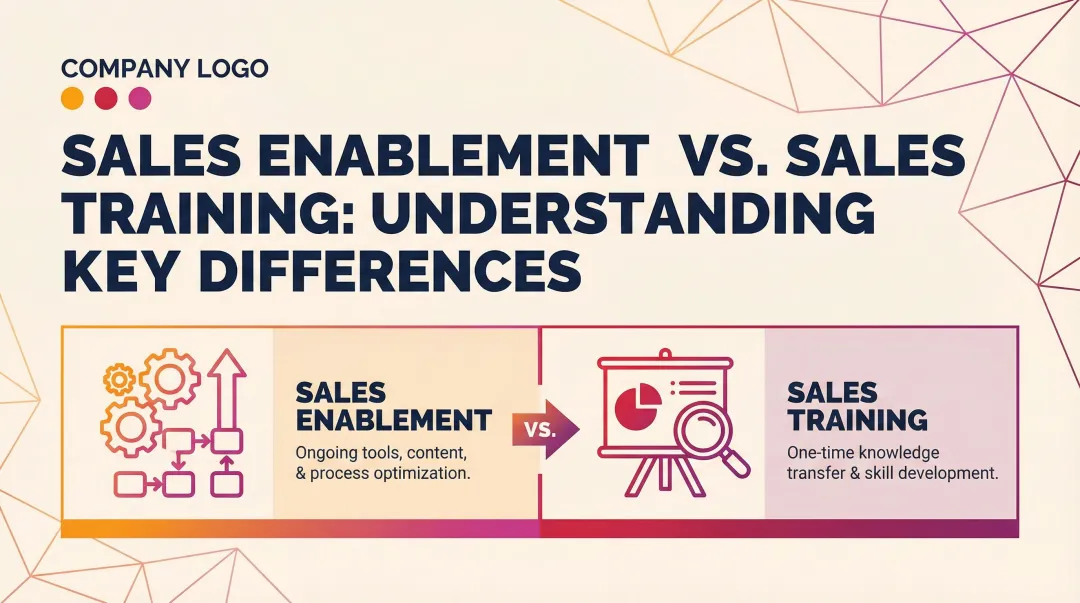
Sales enablement training is a structured, ongoing program that equips sales reps with the skills, knowledge, tools, and resources they need to engage buyers effectively and close more deals. It's distinct from one-off sales training events that deliver information in isolated workshops or annual kickoffs.
Sales training teaches reps how to sell. Sales enablement training ensures they keep selling well, and improves when they don't. That means providing:
- Product knowledge, messaging, and buyer personas
- Objection handling frameworks and competitive battlecards
- Content libraries and CRM workflow proficiency
- Continuous coaching tied to real performance data
When a rep struggles with a specific skill, enablement training routes them into targeted learning immediately, not at the next scheduled session.
The difference is like teaching someone to drive versus giving them a live GPS that updates with road conditions and recalculates the fastest route. One builds the skill; the other keeps it sharp.
Why Sales Enablement Training Matters
The Retention Crisis: Knowledge Decay Without Reinforcement
The concept of training retention loss is rooted in the Ebbinghaus Forgetting Curve, which describes how information is lost exponentially over time without reinforcement. A 2015 peer-reviewed replication study by Murre and Dros successfully confirmed the exponential shape of this curve for meaningless material, demonstrating significant forgetting over intervals ranging from 20 minutes to 31 days.
While you may have heard the claim that "87% of sales training is forgotten in just 30 days," this specific statistic is unverifiable and lacks a primary scientific source. What is scientifically confirmed: without structured reinforcement, spaced repetition, follow-up modules, ongoing assessments, and manager coaching touchpoints, knowledge retention decays rapidly, often within weeks. This makes ongoing enablement critical, not optional.
Accelerating Ramp Time and Time-to-Revenue
Structured sales enablement programs significantly reduce the time it takes for new hires to reach full productivity. According to Highspot's State of Sales Enablement Report (2024), organizations using analytics to measure training effectiveness are 36% more likely to decrease seller ramp time.
Industry benchmarks for 2025 indicate that average ramp-up time for SaaS companies is 5.7 months, while Enterprise B2B sales require 9-12 months due to long cycles and complex negotiations. Structured enablement cuts this timeline by delivering:
- Role-specific learning paths tailored to each rep's stage and function
- Prescriptive content enrollment that auto-assigns training based on performance gaps
- Continuous coaching touchpoints that reinforce skills between formal training sessions
Driving Measurable Business Outcomes
Faster ramp time is only part of the picture, structured enablement also moves the revenue metrics that matter most. CSO Insights (2019) found that organizations with formal sales enablement reported an average win rate of 49.0%, 6.5 percentage points higher than those without enablement (42.5%). Furthermore, Highspot's 2023 report notes that organizations with dedicated enablement efforts report a 9-percentage-point increase in average win rates compared to those without.
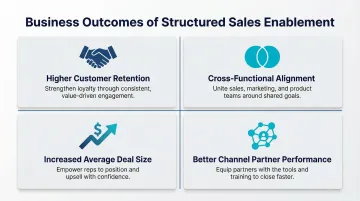
Win rates are just the starting point. Enablement also drives:
- Higher customer retention through better consultative selling and relationship management
- Improved cross-functional alignment between sales and marketing teams on messaging, content, and buyer journey mapping
- Increased average deal size as reps become more confident navigating complex negotiations and selling higher-value solutions
- Better channel partner performance by reducing ramp time and improving messaging consistency across distributed ecosystems
Sales Enablement Training Strategies to Elevate Your Team
These six strategies consistently produce measurable improvements in sales performance when applied within a structured program. They represent the tactical core of modern enablement, combining behavioral science, technology, and data-driven personalization. Each one addresses a distinct failure point in how most teams currently train.
Microlearning and Mobile-First Delivery
Microlearning delivers training in short, focused modules tied to a single topic, objection handling for a specific competitor, a new product feature walkthrough, or closing techniques for enterprise deals. Each module takes 3-7 minutes to complete, fighting information overload and fitting into the daily workflow of on-the-go sales reps who can access content between calls or immediately before a client meeting.
Microlearning achieves 80–90% completion rates compared to roughly 30% for traditional long-form eLearning. Training delivered through mobile devices improves retention rates by 45% over traditional learning methods. In 2025, 6% of all corporate training hours were delivered via mobile devices, a figure that continues to grow as remote and hybrid selling becomes the norm.
Why it works: Reps don't have time for two-hour courses. They need just-in-time learning that solves an immediate problem, how to handle a pricing objection they'll face in 30 minutes, or how to position a new feature they're demoing this afternoon.
Personalized, Role-Based Learning Paths
Different reps have different gaps. A new BDR needs foundational discovery skills and product knowledge; a seasoned account executive requires advanced negotiation training and strategic account planning; a channel partner needs messaging consistency and deal registration workflows. Generic one-size-fits-all programs fail because they don't address these role-specific needs.
Personalized, role-based learning paths with adaptive content enrollment (triggered by performance data) consistently outperform generic training. A Harvard Business School study (2023) examining a gamified, role-based training platform at KPMG found that implementation increased sales by 35.8%, the number of clients by 16.3%, and the number of engagements from new clients by 22.3%.
Platforms like Pifini.ai use prescriptive learning automation to automatically enroll reps in targeted courses when performance data reveals specific gaps, routing a rep into objection handling training after a lost deal, or enrolling a new hire into product fundamentals based on role and tenure.
AI-Powered Coaching and Real-Time Call Feedback
AI coaching tools analyze sales calls in real time, flag skill gaps, score performance across critical dimensions (tone, clarity, objection handling, messaging accuracy), and route reps into targeted training automatically. This makes coaching scalable without requiring a 1:1 manager for every rep, essential for distributed teams and channel partner ecosystems.
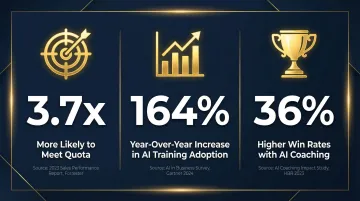
Gartner (2024) research reveals that sellers who effectively partner with AI tools are 3.7 times more likely to meet quota than those who do not. Highspot's 2025 report notes a 164% year-over-year increase in companies using AI in their sales training programs, with teams utilizing AI-powered coaching 36% more likely to report higher win rates.
Pifini.ai connects this loop end-to-end: live AI coaching during calls feeds directly into prescriptive LMS enrollment, auto-assigning training when a rep struggles with a specific skill and closing the gap between what happens in the field and what gets addressed in training.
Gamification and Competitive Incentives
Gamification works because it gives reps something sales culture already rewards: visible progress, public recognition, and a clear score. Elements like leaderboards, badges, points, timed challenges, and certifications drive engagement with training content by making skill-building feel like competition. eLearning courses with gamified elements achieve a 90% completion rate, compared to 25% for courses without gamification. Gamification also increases motivation to learn by up to 83%, while reducing reported boredom to just 10%.
Key tactics:
- Public leaderboards showing top performers by certification completion, roleplay scores, or training modules completed
- Team-based incentives that balance competition with collaboration (top-performing region, best team completion rate)
- Time-bound challenges that create urgency ("Complete these three modules this week to unlock the advanced sales playbook")
- Certification badges that reps can display on LinkedIn or email signatures
Gamification works because it provides immediate feedback, visible progress, and social recognition, all powerful behavioral motivators for sales teams.
Social Learning and Peer Collaboration
Collaborative learning environments, peer call reviews, mentor/mentee pairings, team roleplay, and shared discussion of real deals, accelerate skill development faster than self-paced solo training alone. This is particularly effective for handling novel objections or complex buyer situations that don't fit standard playbooks.
Effective social learning formats:
- Peer call reviews: Small groups listen to recorded calls together, identifying what worked and what didn't, with structured feedback frameworks
- Mentor/mentee pairings: Pairing new reps with top performers for ongoing guidance and shadowing
- Team roleplay sessions: Group practice of challenging scenarios with live feedback from peers and managers
- Deal post-mortems: Collaborative analysis of won and lost deals to extract lessons and refine approach
Social learning creates psychological safety for reps to practice, fail, and improve without the pressure of a live customer interaction. It also spreads best practices organically across the team.
Continuous Reinforcement to Combat the Forgetting Curve
Without structured reinforcement, knowledge is lost rapidly. A meta-analysis by Cepeda et al. (2006) found that distributed practice (spacing learning episodes) yields an average benefit of 15% over massed practice (single-session training) for long-term retention. The optimal interval between learning sessions increases as the duration over which information needs to be retained increases.
What a reinforcement cadence looks like:
- Spaced re-tests: Quizzes or knowledge checks delivered at increasing intervals (1 week, 1 month, 3 months) after initial training
- Just-in-time microlearning refreshers: Short modules triggered by calendar events (quarterly business reviews, product launches) or performance gaps (lost deal with pricing objection triggers pricing training)
- Manager coaching touchpoints: Structured 1:1s focused on applying trained skills in real scenarios, with managers using call recordings and CRM data to identify coaching opportunities
- Ongoing assessments: Regular skills evaluations that identify knowledge decay and route reps into refresher content automatically
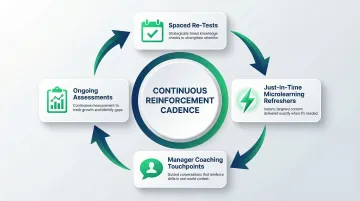
Continuous reinforcement shifts training from a one-time event to an ongoing performance support system.
What to Include in Your Sales Enablement Training Program
Every sales enablement training program must address four core knowledge domains:
Product Knowledge and Competitive Positioning
Reps need deep product expertise, plus competitive intelligence that positions your solution against alternatives. That means going well beyond feature lists:
- Features, benefits, and common use cases
- ROI models and typical implementation timelines
- Battlecards for head-to-head competitor comparisons
- Objection responses and positioning frameworks
Buyer Personas and the Customer Journey
Knowing who your buyers are and how they make decisions shapes every conversation a rep has. Training should map each persona to buying stages, covering:
- Common pain points at each stage of the journey
- Key stakeholders and their decision criteria
- Typical objections and how to address them
- Signals that indicate a deal is progressing or stalling
Core Sales Skills
The skill set every rep needs goes beyond product knowledge:
- Objection handling and active listening
- Discovery questioning and closing techniques
- Negotiation and pipeline management
These skills must be practiced through roleplay and reinforced continuously, not just covered once in a slide deck.
Sales Methodology Alignment
Whether your organization follows MEDDIC, Challenger, SPIN, or another framework, the entire team needs to work from the same playbook. Without methodology alignment, reps improvise, and that inconsistency shows up directly in forecast accuracy and close rates.
Soft Skills: The Human Advantage
Soft skills, communication, empathy, storytelling, trust-building, are as critical as product and process knowledge. According to Salesforce's State of the Connected Customer report, 86% of business buyers are more likely to buy if companies demonstrate an understanding of their goals. Yet 59% of business buyers say most sales interactions feel transactional, pointing to a widespread soft skills gap that training programs rarely address directly.
That gap has consequences. Skills like these separate high-performing sellers from the rest:
- Consultative listening, understanding buyer goals before pitching solutions
- Empathy, recognizing where buyers are in their decision process, not just the sales stage
- Trust-building, creating relationships that outlast a single transaction
- Storytelling, framing value in terms that resonate with specific buyer challenges
This isn't just a current gap, it's a growing competitive differentiator. Gartner predicts that by 2030, 75% of B2B buyers will prefer sales experiences that prioritize human interaction over AI. Sales teams that develop these skills now will be better positioned as AI handles more of the transactional work.
Tools and Workflow Training: Eliminating Productivity Drains
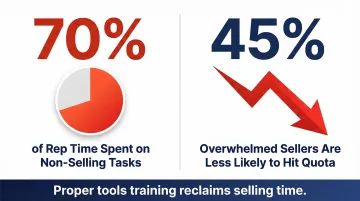
Reps who cannot confidently navigate their CRM, content management system, or sales engagement platform lose time and miss opportunities. Salesforce's State of Sales report finds that sales reps spend 70% of their time on non-selling tasks, data entry, admin work, and switching between tools.
Sellers use an average of 8 tools to close deals, and 42% feel overwhelmed by the volume. According to Salesforce's 2026 State of Sales report, overwhelmed sellers are 45% less likely to hit quota.
Training must address:
- CRM proficiency (logging activities, managing pipeline, running reports)
- Content management (finding and sharing sales collateral quickly)
- Sales engagement platforms (cadences, email sequences, call automation)
- Integration workflows (how data flows between systems)
When reps stop wrestling with tools, they spend that time selling, and the quota numbers follow.
How to Build a Sales Enablement Training Program
Step 1: Establish a Charter and Structure
Define who owns the program, who the stakeholders are (sales, marketing, L&D, product), and create a written plan with curriculum scope, delivery format, and feedback mechanisms. CSO Insights (2019) found that only 15.8% of organizations had a formal enablement approach that included a charter, and organizations with an informal approach suffer win rates 3.1 points lower and quota attainment 3.6 points lower than average.
A written charter creates clear accountability, it keeps the program tied to revenue goals instead of drifting into ad hoc requests.
Step 2: Conduct a Needs Assessment
Survey reps, review call recordings, analyze win/loss data, and run skill assessments to identify where performance gaps actually exist before designing content.
Key questions to answer:
- Where in the sales cycle do reps most commonly stall or lose deals?
- What objections do reps struggle to handle effectively?
- Which product features do reps misposition or fail to communicate clearly?
- What skills differentiate top performers from average performers?
Step 3: Map Training to the Buyer Journey and Sales Cycle
Align content and skills to the specific stage where reps most commonly stall or lose deals. If deals die during discovery because reps fail to uncover pain points, prioritize discovery training. If opportunities stall during negotiation, focus on pricing and concession frameworks, not a generic skills curriculum.
Step 4: Build in a Review and Iteration Loop
Evaluate the program quarterly using performance KPIs, rep feedback, and sales outcome data. Adjust content, delivery methods, and learning paths based on what the data reveals, not assumptions.
Critical review metrics:
- Are reps completing training, or are completion rates dropping?
- Are trained reps performing better than untrained reps in the same role?
- Which training modules correlate with improved win rates or deal velocity?
- What feedback are reps providing about relevance and quality?
Programs that skip this loop tend to calcify, training built for last year's buyers rarely works on this year's deals.
Measuring the Impact of Sales Enablement Training
Shift from Activity Metrics to Outcome Metrics
Most sales teams measure training by completion rates and test scores. The problem: those numbers don't tell you whether revenue moved. Real enablement measurement connects your LMS or training platform data to CRM and revenue data, so you can see what actually changed.
Activity metrics tell you what happened:
- 85% of reps completed objection handling training
- Average certification score: 87%
- 1,200 training hours delivered this quarter
Outcome metrics tell you what moved:
- Reps who completed objection handling training win 12% more deals
- Certified reps close 18 days faster than non-certified peers
- Trained reps hit 94% of quota vs. 78% for untrained reps
Core KPIs to Track
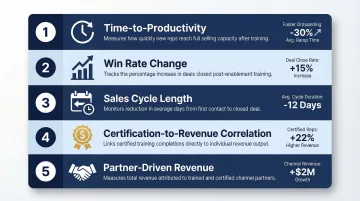
Once you've established the measurement framework, these five KPIs give you the clearest picture of training's revenue impact:
- Time-to-Productivity: How long until a new hire hits 50%, 75%, and 100% of quota? Track by cohort and compare trained vs. untrained groups.
- Win Rate Change: Measure win rate shifts for reps who complete specific modules. Control for territory and experience to isolate the training effect.
- Sales Cycle Length: Track average days from opportunity creation to close for trained vs. untrained reps, shorter cycles signal stronger enablement.
- Certification-to-Revenue Correlation: Which certifications link to higher deal values or faster close rates? The answer tells you which training content is actually worth building.
- Partner-Driven Revenue: For channel programs, compare revenue from certified vs. non-certified partners to quantify the value of your partner enablement investments.
Connecting Training to Revenue: The Pifini.ai Approach
Most sales teams track training completion. Few can answer what that training actually produced in revenue. Pifini.ai closes that gap by connecting certifications and training scores directly to pipeline growth, deals closed, and win rates, correlating learning activity to real sales outcomes.
Pifini.ai's Training Impact Analysis connects learning data to CRM and revenue systems, showing:
- Which courses correlate with increased revenue
- How training completion impacts win rates and quota attainment
- Projected annual revenue impact from top-performing courses
- Performance improvement percentages tied to specific training modules
Revenue leaders can walk into budget conversations with specific numbers, which courses drove quota attainment, which reps improved after which modules, and what the projected annual revenue impact looks like.
Training as Investment, Not Cost Center
A common misconception frames training as a cost center, an expense that must be minimized rather than an investment that drives returns. The average ROI for a mature enablement program is 4 to 1, and for sales training specifically, the documented return is $4.53 per dollar spent. CSO Insights (2019) found that organizations investing more than $2,500 per seller per year in training achieved significantly higher win rates (50.2%) compared to those investing less than $500 (42.8%).
Those numbers make the case directly. When training connects to measurable revenue outcomes, win rate improvements, ramp time reduction, quota attainment increases, it stops being a line item and becomes a strategic lever for growth.
Key metrics that shift when training investment increases:
- Win rates, from 42.8% to 50.2% with higher per-seller spend
- Ramp time, faster seller readiness reduces revenue lag
- Quota attainment, consistent training correlates with consistent performance
Frequently Asked Questions
How do you enable your sales team?
Enabling a sales team means giving reps ongoing access to the right training, content, tools, and coaching, structured as a continuous program tied to performance data rather than periodic one-off events. Effective enablement connects learning to real sales conversations and routes reps into targeted training when they struggle with specific skills.
What are the 5 P's of sales?
The 5 P's of sales are Preparation, Probing, Presentation, Persuasion, and Post-sale. Each covers a distinct stage, from researching prospects and running discovery calls to handling objections, closing, and expanding after the deal. Sales enablement training addresses each P through role-specific content and practice scenarios.
What is the difference between sales training and sales enablement training?
Sales training focuses on teaching techniques, how to handle objections, how to close, how to qualify leads. Sales enablement training is broader, encompassing training plus tools, content, coaching, technology, and continuous reinforcement aligned to revenue outcomes. Enablement ensures reps have everything they need to keep selling well, not just the knowledge taught in a workshop.
How do you measure the effectiveness of sales enablement training?
Measure effectiveness through outcome metrics: win rate improvement, ramp time reduction, quota attainment, sales cycle length, and the ability to correlate training completion and certification scores directly to pipeline growth and closed deals. Platforms that integrate LMS data with CRM and revenue systems enable this measurement.
What topics should be covered in a sales enablement training program?
A well-rounded program covers six core areas:
- Product knowledge and competitive positioning
- Buyer personas and customer journey mapping
- Core sales skills: objection handling, closing, negotiation, and discovery
- Sales methodology alignment
- Soft skills: empathy, communication, and storytelling
- Tools proficiency: CRM, content management, and sales engagement platforms
How long does it take to see results from sales enablement training?
Initial improvements in ramp time and rep confidence can appear within 30–60 days of launching structured training. Measurable revenue impact, win rates, quota attainment, and deal velocity, typically shows up over a full quarter. That timeline holds when training is continuous, reinforced, and tied to performance data rather than delivered as isolated events.