
Introduction
Compliance training failures rarely stem from a lack of courses. Organizations struggle because they can't prove who completed what, when, and under which requirements. Regulatory bodies, auditors, and leadership demand documented evidence, not just delivery receipts. Without that proof, compliance programs fail before they start.
Most organizations still rely on manual tracking methods. Spreadsheets, email follow-ups, and scattered records create audit risk and waste admin hours. Research shows 40% of compliance teams still run processes with basic tools like spreadsheets, and 94% of those spreadsheets contain critical errors.
This article covers the specific LMS features that make compliance tracking auditable, automated, and defensible, and the operational cost of running without them.
Key Takeaways
- LMS tracking features deliver real-time visibility into who has completed what, automate accountability across teams, and produce audit-ready evidence without manual effort
- Critical features include real-time dashboards, automated alerts, version-controlled audit trails, and auto-enrollment that routes learners into training without waiting for manager intervention
- Without them, organizations end up with scattered records, failed audits, and no clear line between training activity and business results
- Compliance tracking requires continuous monitoring, not a scramble that starts the week before an audit
- In partner ecosystems, connecting certification data to revenue outcomes makes compliance a performance driver, not just an audit requirement
What Is LMS Tracking for Training Completion and Compliance?
LMS tracking is the set of platform capabilities that record, monitor, and report on whether learners have completed required training, and whether that training meets regulatory, organizational, or role-specific standards. The real function is creating defensible proof: confirming which individuals completed which training version, and when, a record that holds up under audit.
This matters across a range of training programs, including:
- Employee onboarding and role-specific curricula
- Mandatory regulatory training (OSHA, HIPAA, GDPR)
- Certification and recertification management
- Partner and channel enablement programs
Anywhere proof of training is required by policy or law, tracking is non-negotiable.
The goal isn't to track for tracking's sake. It's to reduce audit risk, enforce accountability, and connect training completion to measurable business performance. The features covered below show exactly what that looks like in practice.
Key Advantages of LMS Features for Tracking Training Completion and Compliance
The advantages below focus on operational and business impact, not theoretical benefits. Each feature ties directly to outcomes that compliance leaders, L&D teams, and revenue organizations track: audit readiness, risk exposure, admin efficiency, and performance consistency.
Advantage 1: Real-Time Completion Tracking and Automated Alerts
Real-time tracking means administrators can see who has completed training, who is overdue, and what the current compliance status is across every learner, at any moment, without manual data pulls. Dashboards update instantly as learners complete modules, assessments, or certifications. Alert systems send reminders ahead of deadlines and escalate to managers when training remains incomplete.
Why this matters:
Proactive visibility eliminates last-minute scrambles before audit deadlines. Compliance gaps surface weeks before audit deadlines, not the day before. Transitioning to an automated LMS increased compliance training completion rates from 85% to 95%, according to a 2024 Forrester Total Economic Impact study.
Automated escalation workflows mean that an overdue training record triggers a manager notification, creating documented accountability automatically. Research shows that personalized email reminders increased the probability of students being on time with coursework by 14 percentage points compared to general reminders.
KPIs impacted:
- On-time completion rate
- Percentage of overdue learners by department
- Number of audit findings
- Admin hours spent on compliance follow-up
Real-time tracking delivers especially high impact in large or distributed organizations, and in partner/channel ecosystems where dozens or hundreds of external learners must meet compliance requirements simultaneously.
Advantage 2: Audit-Ready Reporting and Version Control
An LMS with strong reporting and version control can produce exportable, timestamped records that show exactly who completed which version of a course, when, and under what requirements, the exact evidence auditors demand. Compliance reports can be filtered by department, role, regulation, or date range and exported in formats auditors accept (PDF, CSV, Excel). Version control logs every update to a course and tags each learner's completion to the version they saw.
Why this matters:
Without version control, organizations can't prove a worker completed the correct, current version of a policy or safety module, a critical failure point in regulatory audits for industries such as healthcare, finance, and manufacturing.
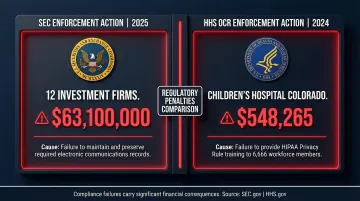
Consider the enforcement landscape:
| Regulator | Entity Penalized | Penalty Amount | Documentation Failure |
|---|---|---|---|
| SEC (2025) | 12 Investment Firms | $63.1M Combined | Failures to maintain and preserve electronic communications |
| HHS OCR (2024) | Children's Hospital Colorado | $548,265 | Failure to provide HIPAA training to 6,666 workforce members |
Compliance officers who previously spent days compiling evidence from spreadsheets and email threads can now generate audit-ready documentation in minutes. Manual evidence gathering can take 1-2 weeks, whereas automated collection reduces this to 1-2 hours, a 99% time savings.
KPIs impacted:
- Audit preparation time
- Number of documentation errors or discrepancies found during inspections
- Compliance report turnaround time
This advantage delivers the highest impact in regulated industries, healthcare, financial services, and manufacturing, where compliance requirements recur annually and course content must stay current.
Advantage 3: Prescriptive Enrollment and Performance-Linked Analytics
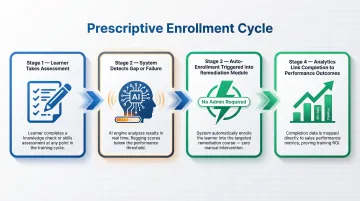
Beyond passive tracking, advanced LMS platforms use performance data, assessment scores, knowledge gaps, call behavior, or certification status, to automatically re-enroll learners into targeted training when they fall short.
When a learner fails an assessment, scores below a threshold, or demonstrates a knowledge gap (identified through AI evaluation), the system triggers auto-enrollment into a remediation module, no admin intervention required. Analytics dashboards then link certification and training data to downstream performance outcomes such as deal win rates, partner revenue, and sales cycle length.
Why this matters:
Tracking completion alone doesn't guarantee competence or business impact. Prescriptive enrollment ensures that low completion or low assessment scores trigger a specific corrective action, transforming compliance tracking from a record-keeping function into a continuous performance improvement system.
Pifini's enterprise LMS, for example, connects training completion and certification data directly to partner sales metrics, allowing organizations to see how certified partners perform versus non-certified ones in terms of win rates and pipeline contribution.
Organizations with sales enablement report an average win rate of 49.0%, compared to 42.5% for those without. That gap only widens when training is untethered from performance data, which is exactly why 90% of learning leaders call impact measurement critical, yet only 25% are actually tracking business outcomes. Prescriptive enrollment is how organizations close that gap.
KPIs impacted:
- Assessment pass rates
- Re-enrollment and remediation completion rates
- Partner certification rates tied to revenue contribution
- Training ROI (pipeline/deals attributed to certified learners)
What Happens When LMS Compliance Tracking Is Missing or Ignored
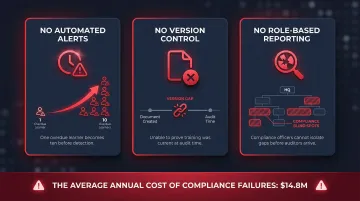
Relying on manual or fragmented tracking creates severe consequences. Records scattered across emails and spreadsheets create data inconsistencies, missed deadlines, and the inability to produce clean evidence under audit pressure. Compliance failures cost organizations an average of $14.8 million annually in fines, legal fees, and reputational damage.
Those gaps compound fast:
- No automated alerts: One overdue learner becomes ten before anyone notices
- No version control: Organizations can't prove training was current at the time of an audit
- No role-based reporting: Compliance officers can't isolate gaps quickly enough to act before auditors arrive
These risks scale dramatically for organizations managing partner or external learner ecosystems. Without centralized LMS tracking, enforcing compliance consistency across hundreds of non-employee users becomes nearly impossible, raising both legal exposure and operational risk.
How to Get the Most Value from LMS Compliance Tracking Features
LMS compliance features generate the most value when they are configured from day one, not bolted on before an audit. This means establishing role hierarchies, setting automated alert cadences, and defining which training modules require version tracking and mandatory re-assessment before deployment.
Three practices consistently separate organizations that stay audit-ready from those that scramble:
- Act on insights: Dashboards only improve compliance when managers review them regularly and treat overdue alerts as operational priorities, not administrative noise.
- Automate where possible: Platforms like Pifini that auto-enroll learners when gaps are detected remove the dependency on manual follow-through, keeping compliance improvement continuous.
- Audit your LMS configuration quarterly: Check that role mappings are current, expiry alerts are calibrated to renewal windows, and reporting filters reflect any organizational changes.
The financial case for this approach is clear. Organizations transitioning from periodic audits to continuous compliance monitoring yield payback periods of 8 to 18 months and a three-year ROI exceeding 285%. That return depends on doing the operational work, not just buying the platform.
Conclusion
LMS features for tracking training completion and compliance are operational necessities. They protect organizations from regulatory risk, cut audit overhead, and give L&D and compliance teams the visibility to act before problems surface.
The benefits of real-time tracking, audit-ready reporting, and prescriptive enrollment build over time. Each quarter of clean records and proactive remediation shortens the next audit, smooths the next compliance cycle, and makes future training investments easier to justify to leadership.
The organizations that see the best audit outcomes are the ones that run compliance tracking year-round, not just when an inspection is imminent. Treat it as infrastructure, and it pays back in every cycle that follows.
Frequently Asked Questions
What is LMS tracking and completion?
LMS tracking refers to the platform's ability to monitor, record, and report on learner progress, course completions, assessment scores, and certification status, giving administrators real-time visibility into who has met training requirements and who hasn't.
How do you maintain accurate, accessible LMS records for audit readiness?
Keep role hierarchies current, enable automated completion timestamping, use version control on all course updates, and configure exportable compliance reports so evidence can be retrieved instantly, rather than compiled under audit pressure.
What is LMS-ready content?
LMS-ready content refers to training materials formatted to work within an LMS (typically SCORM, xAPI, or AICC standards), which allows the system to track learner interactions, completion status, and assessment results automatically.
What happens if training completion records are incomplete during an audit?
Incomplete records can result in regulatory fines, failed audit findings, and reputational damage. Auditors typically treat gaps in documentation as evidence of non-compliance, even if the training itself occurred.
How does automated LMS tracking reduce compliance risk?
Automation eliminates the human error and delay inherent in manual tracking. Overdue learners are flagged immediately, expiring certifications trigger renewal workflows, and every record is timestamped and stored in one auditor-accessible location.
Can LMS tracking features support partner and external learner ecosystems?
Modern LMS platforms can extend tracking to external users such as resellers, distributors, and channel partners, allowing organizations to enforce consistent certification standards, monitor completion rates across the partner ecosystem, track certification renewal units for industry accreditation programs, and link partner training status to sales performance data.