Introduction
Organizations pour millions into sales training through Learning Management Systems, yet 42% still miss revenue targets. The problem isn't bad content, it's that training exists in a silo, disconnected from the tools, signals, and workflows that actually close deals.
Most sales teams juggle a standalone LMS for training, a CRM for pipeline data, separate content libraries, and coaching tools that never communicate. Even when reps complete every required course, managers can't connect completion rates to win rates, cycle length, or quota attainment. Training becomes a compliance checkbox rather than a performance driver.
This guide breaks down what true LMS integration looks like: which systems must connect, how AI closes the learning-performance gap, and what revenue metrics actually prove it's working.
TLDR:
- Standalone LMS platforms track completions but can't prove training improves win rates or shortens ramp time
- True integration means bidirectional data flow across LMS, CRM, content, and coaching tools
- AI makes training performance-triggered, routing reps into courses based on live deal signals and call gaps
- Measure success with revenue KPIs: ramp time, win rate lift, and cert-to-closed-deal correlation
- Unified platforms eliminate integration complexity by connecting LMS, content, and coaching natively
Why a Standalone LMS Falls Short for Modern Sales Teams
Built for Compliance, Not Revenue
Traditional LMS platforms were designed for compliance training and structured coursework, not the real-time, contextual demands of modern sales. When a rep faces a stalled deal at the negotiation stage, they need objection-handling guidance immediately, not a certification reminder for next quarter.
The mismatch is operational: sales reps spend 70% of their time on non-selling tasks and use 8 to 10 disconnected tools, leaving 42% feeling overwhelmed. A standalone LMS adds to this fragmentation rather than solving it.
The Data Fragmentation Problem
Standalone LMS platforms track course completions and quiz scores, but they can't answer the questions that matter:
- Did training reduce ramp time for new hires?
- Are certified reps closing deals faster than untrained peers?
- Which courses correlate with higher win rates?
When CRM integration is absent, pipeline data remains invisible to the LMS. Skill gaps surfaced on live calls never trigger targeted training because conversation intelligence has nowhere to feed. Organizations end up unable to prove ROI or identify what's actually broken.
Only 33% of companies rate their sales training as highly effective, and 40–60% of new reps fail to achieve quota due to ineffective onboarding. These failures rarely trace back to poor content, they trace back to disconnected systems that prevent training from responding to individual performance signals.
What LMS Integration with Sales Enablement Really Means
Beyond API Connections
Real LMS integration creates a bidirectional ecosystem where performance data shapes learning, and learning progress informs coaching and strategy. Connecting two tools through an API is just the starting point.
The Four Pillars of Integrated Enablement:
- Structured training delivery via the LMS (certifications, onboarding, compliance)
- Sales content management (battle cards, product sheets, objection guides)
- CRM and pipeline performance data (deal stage, win rates, velocity)
- Real-time coaching and conversation insights (call scoring, skill gap identification)
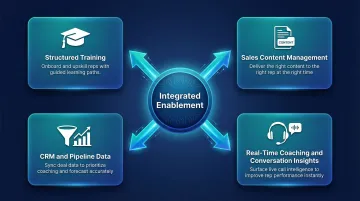
Gartner defines this as a Revenue Enablement Platform (REP): systems that unite sales enablement and revenue functions, integrating content management, learning, coaching, and CRM to provide guided selling and buyer engagement analytics.
Prescriptive Learning: Training Triggered by Performance
In a standalone LMS, training follows a calendar schedule. Managers assign courses quarterly, regardless of individual readiness or performance gaps.
In an integrated system, training is prescriptive, automatically triggered by performance signals:
- A rep has three deals stalled at the negotiation stage → system assigns objection-handling training
- Call scoring flags weak discovery questions → system enrolls rep in consultative selling modules
- Quiz scores fall below threshold → system routes rep into remedial content
This shift from calendar-driven to signal-driven training ensures learning meets reps where they struggle, not where the schedule dictates.
Extending Integration to Partners and Channels
Prescriptive training solves the internal rep problem, but for organizations selling through resellers, distributors, and alliances, the same logic has to extend further. Channel partners need the same product knowledge, certifications, and sales resources as internal reps, tracked through the same system.
Platforms like Pifini are built specifically for this extended enterprise model, connecting LMS training, content, and AI coaching across both direct and partner ecosystems in a single data layer. This means consistent enablement quality whether a deal closes through a direct rep or a distributor's sales team.
Integrated vs. Consolidated: Why Architecture Matters
Not all "integrations" are equal. The architecture underneath determines whether data actually flows, or just syncs on a schedule.
Bolted-together consolidation connects separate tools through APIs, but data still lives in silos. Each system maintains its own database, requiring constant synchronization and manual workarounds when connections break.
A unified platform shares one data layer across all components. Training completion, call scores, CRM deal stages, and content engagement flow through a single source of truth, eliminating data friction and enabling real-time prescriptive actions without administrative overhead.
The Critical Integration Points Every Sales Org Needs
CRM Integration
CRM integration enables the LMS to read pipeline signals and automatically assign targeted training. Common triggers include:
- A rep has multiple opportunities stuck at the demo stage → system detects the pattern and assigns product demonstration training
- Win rates drop below team average → system enrolls rep in competitive positioning courses
- Deal velocity slows in the negotiation phase → system surfaces pricing and negotiation content
- New territory assigned → system auto-enrolls rep in relevant vertical or product certification
Organizations that integrate enablement technologies into their CRM report quota attainment rates 6.8% higher than those using standalone systems.
Training data should also flow back into the CRM. Completion rates, certification status, and assessment scores appearing alongside deal data let managers correlate rep preparation with pipeline outcomes, answering questions like:
- Do certified reps close at higher rates than uncertified peers?
- Does completing objection-handling training shorten sales cycles?
- Which certifications predict quota attainment?
Content Management Integration
Integrating content management with the LMS allows the system to surface the right sales collateral, battle cards, product sheets, objection-handling guides, directly within the learning workflow. Reps don't just read about handling objections; they practice with the actual battle cards they'll use in customer calls.
Version control is where this integration pays a less obvious dividend. When product information changes, training content and sales assets update simultaneously. Without that connection:
- Reps complete training on outdated product specs
- Current assets live in a separate repository reps have to hunt down
- The gap between what was trained and what's in the field erodes credibility on calls
Conversation Intelligence Integration
From Call Score to Training Assignment
Conversation intelligence tools record and score sales calls based on defined competency frameworks. Feeding those scores back into the LMS creates a direct link between observed skill gaps on live calls and targeted training assignments.
The workflow:
- AI scores a discovery call and flags weak needs analysis questions
- Call score triggers automatic enrollment in consultative selling training
- Rep completes targeted modules
- Next call is scored again to measure improvement
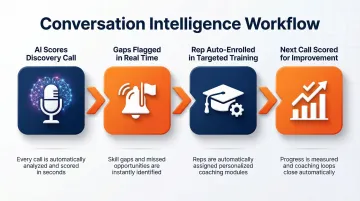
Reps who receive weekly coaching hit 107% of quota compared to 85% for those who don't, yet 73% of managers lack time to coach consistently. Conversation intelligence integration automates coaching triggers, ensuring gaps don't go unaddressed.
Partner Portal and Ecosystem Integration
For channel-heavy organizations, LMS integration must extend to partner portals. Resellers and distributors need to complete required certifications, access updated product training, and receive the same quality of enablement as internal teams.
Without integration, partner training becomes a separate, underfunded initiative. With integration, partners access the same LMS, content library, and AI coaching tools through a unified partner enablement hub.
Pifini's Partner Enablement Hub is built specifically for this model, connecting training, certifications, and real-time AI coaching across both direct sales teams and the broader partner ecosystem in a single platform.
How AI Transforms the LMS-Sales Enablement Loop
From Calendar-Driven to Performance-Driven Learning
Traditional learning assignment is static: managers assign courses on a calendar schedule, initiated quarterly or during onboarding. Everyone receives the same training regardless of individual performance gaps.
AI-driven dynamic learning paths respond to real-time performance signals:
- Call scoring identifies weak objection handling → system routes rep into targeted objection modules
- Quiz scores fall below threshold → system auto-enrolls rep in remedial content
- CRM shows stalled deals at negotiation stage → system surfaces pricing and negotiation training
Gartner predicts that by 2029, sales organizations with AI-driven enablement will achieve 40% faster sales stage velocity than those using traditional methods.
AI Call Coaching: Identifying Gaps and Routing Training
In an integrated system with AI call coaching, the loop runs without manager intervention:
- Every call is automatically scored against competency frameworks (discovery, objection handling, product positioning, closing)
- Gaps are flagged in real time based on call transcripts and scoring
- The system routes specific reps into exact training modules designed to address flagged gaps
- No manager intervention required, the loop operates automatically
For example, if a rep consistently scores low on objection handling across multiple calls, the system doesn't wait for a quarterly review. It immediately enrolls the rep in objection-handling simulations and micro-courses, closing the gap before it costs more deals.
AI call coaching is associated with 35% faster rep ramp time, and companies integrating AI roleplay report SDRs reaching quota readiness 40% faster.
Prescriptive Auto-Enrollment: Struggling Moments Become Learning Moments
When a rep's quiz scores, call performance, or deal conversion data falls below a threshold, the system automatically enrolls them in the appropriate micro-course or simulation. Delays between identifying a gap and delivering training disappear entirely.
Consider a new rep who completes onboarding but struggles on their first five discovery calls. Call scoring detects low scores on needs analysis and immediately assigns a three-module discovery skills course. The rep completes it within 48 hours, and the next round of calls shows measurable improvement, no review cycle required.
The Closed-Loop Effect: Why It Matters for Revenue Performance
- Performance data surfaces a gap (low call score, stalled deals, failed assessment)
- AI routes the rep into targeted training
- Improved behavior is observed on subsequent calls or deals
- Updated performance data confirms improvement
- The loop repeats at scale across every rep in the ecosystem
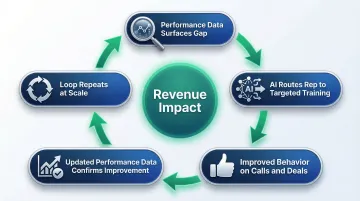
The result is a direct, traceable line from training to behavior change to revenue outcomes, something traditional calendar-driven programs can't provide.
Best Practices for a Successful LMS-Sales Enablement Integration
Define Success Metrics Before Deploying
Integration should be measured against revenue-linked KPIs, not just training completion rates:
- Track ramp time reduction, how fast new hires reach full quota productivity
- Measure win rate improvement across trained versus untrained rep cohorts
- Monitor deal velocity to see whether training shortens average cycle length
- Correlate certification completion to closed deals and quota attainment
Completion rates signal engagement, but they don't confirm impact. The real measure is whether finishing training changed rep behavior and moved revenue metrics.
Ensure True Bidirectional Data Flow from the Start
With success metrics defined, the next question is whether your integration can actually generate them. The most common failure here is a one-way data push: the LMS sends completion data to the CRM, but the CRM never sends performance signals back.
Successful integration requires:
- CRM signals (deal stage, win/loss, velocity) feeding into the LMS to trigger training
- Content engagement data (what assets reps use most) informing content strategy
- Coaching outcomes (call scores, roleplay results) refining learning paths
Without bidirectional flow, the system cannot adapt to individual performance gaps.
Invest in Change Management and Rep-Level Adoption
Even a technically sound integration stalls without rep buy-in. Frame the rollout around what it offers each individual rep:
- Faster access to the right content when they need it
- Training that responds to their specific gaps, not generic schedules
- Coaching that improves their deal outcomes and quota attainment
Avoid positioning the integration as a management monitoring tool, which drives resistance. Instead, emphasize productivity benefits, personalized support, and career development.
According to Showpad's sales enablement research, when adoption rates of enablement services exceed 90%, performance outcomes improve significantly across the board. Reaching that threshold requires embedding tools directly into the seller's workflow, reducing friction at every step rather than adding another system to manage.
How to Measure the ROI of Your Integrated System
Core Metrics That Demonstrate Integration Impact
Four metrics give the clearest picture of integration ROI:
- Time-to-full-productivity: Average ramp time is 5.3 months; formal enablement programs reduce this by 33%, bringing new hires to quota readiness in roughly 3.5 months.
- Win rate lift: Organizations with formal sales enablement achieve a 49% win rate on forecasted deals, versus 42.5% for those without, a gap that widens as training scales.
- Certification-to-close correlation: Identify which certifications predict higher close rates. This separates training that drives revenue from training that's just a compliance checkbox.
- Sales cycle length: Track whether training shortens time from first contact to close by linking completion dates to CRM deal timelines.
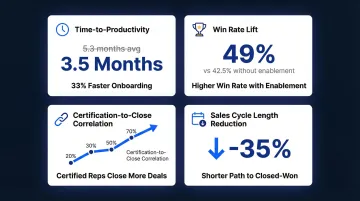
The challenge is that most standalone LMS tools don't connect these data points. That's where an integrated system changes what's measurable.
Pifini's Training Impact Analysis: Connecting Learning to Revenue
Pifini's platform connects training certifications and scores directly to deals closed, win rates, and pipeline growth. The Training Impact Analysis dashboard shows:
- Training success rates and average performance improvements
- Top-performing courses by effectiveness and ROI
- Projected annual revenue impact from high-performing training programs
- Individual performance improvements tied to specific courses
This enables sales leaders to generate clear ROI reports that show how learning investment translates to measurable revenue outcomes, with enough specificity to justify budget, prioritize programs, and course-correct underperforming training before it costs pipeline.
Frequently Asked Questions
What is the difference between an LMS and a sales enablement platform?
An LMS manages structured course delivery, tracking completion and compliance. A sales enablement platform covers the broader ecosystem of content, coaching, and performance tools that drive sales execution, and the most effective modern systems unify both, connecting learning directly to revenue outcomes.
What systems should an LMS integrate with for effective sales enablement?
The four critical integration points are: CRM (for pipeline and deal-stage signals), content management systems (for surfacing the right assets), conversation intelligence tools (for call coaching feedback), and partner portals (for channel ecosystems). Together, these connections link training activity directly to sales outcomes.
How does LMS integration reduce sales rep ramp time?
Integration enables targeted onboarding where new reps are automatically enrolled in role-specific training based on their onboarding stage and performance signals, not a static schedule that ignores individual readiness. This closes skill gaps faster and accelerates time-to-productivity.
Can an LMS support channel and partner sales enablement?
Yes. When an LMS integrates with partner portals and supports multi-audience training, it equips resellers, distributors, and alliances with the same certifications, sales training, and updated content as the direct sales team. That consistency is what keeps your full go-to-market motion aligned.
What role does AI play in LMS-sales enablement integration?
AI enables prescriptive learning by reading performance signals from CRM, call scoring, and assessment data, then automatically routing reps into targeted training, replacing calendar-driven course assignments with real-time, gap-based learning.
How do you measure the success of an integrated LMS and sales enablement system?
Success is measured by revenue-linked KPIs: ramp time reduction, win rate lift in trained versus untrained cohorts, certification-to-closed-deal correlation, and sales cycle length. Completion rates are a starting point, quota attainment, deal velocity, and win rates are the real scorecard.