Introduction
Between 80 and 90 percent of sales training investments fail to produce lasting behavior change. The programs themselves aren't the problem, organizations deploy them without the infrastructure to reinforce learning, track adoption, or connect training to real deal outcomes. According to Gartner research on the Ebbinghaus forgetting curve, B2B sales reps forget 70% of what they learn within a week, and 87% within a month.
The gap between learning and execution is where most training initiatives die, buried under competing priorities, absent manager reinforcement, and no clear connection to pipeline performance.
This post covers a curated shortlist of sales training programs that translate into measurable pipeline results, the criteria used to evaluate them, and what high-growth teams need beyond the training itself to ensure their investment shows up in revenue results.
Key Takeaways
- Effective programs combine skill-building, behavioral reinforcement, and alignment to real selling scenarios, not classroom theory alone
- Top programs are evaluated on methodology depth, audience fit, measurable behavior change, and revenue impact
- Challenger, Sandler, RAIN Group, Richardson, and Korn Ferry consistently appear on shortlists for B2B and enterprise teams
- Without reinforcement, training doesn't stick: platforms that track learning, flag skill gaps, and connect completion to pipeline data close the execution gap
- Choose based on your team's specific gaps: onboarding, prospecting, negotiation, consultative selling, or leadership development
What Is a Sales Training Program, and Why Most Fail to Deliver
A sales training program is a structured curriculum designed to build specific selling behaviors, not transfer knowledge alone. Knowledge-based training tells reps what to do. Behavior-based training builds the muscle memory to do it consistently, under pressure, in complex deals, and across varying buyer contexts. That gap is what separates effective programs from expensive ones.
The failure rate is staggering: 80 to 90 percent of sales training produces no lasting impact when deployed without competency diagnosis and sustained reinforcement. Three root causes show up repeatedly: managers aren't coaching to the methodology after training ends, learning stays disconnected from live pipeline activity, and one-time workshop formats never create habit loops. Training becomes a checkbox exercise rather than a performance driver.
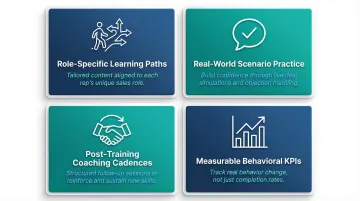
Programs that actually drive revenue share these characteristics:
- Role-specific learning paths tailored to rep tenure, deal complexity, and skill level
- Real-world scenario practice that mimics actual buyer conversations and objections
- Post-training coaching cadences where managers reinforce behaviors in live deals
- Measurable behavioral KPIs tied to deal progression, win rates, and sales cycle length
The sections below break down each of these elements, and what it takes to build a program that changes how reps sell, not just what they know.
Top 5 Sales Training Programs That Drive Revenue Growth
These programs were selected for their proven track records, methodology depth, measurable behavior change outcomes, and suitability for B2B and enterprise selling environments. Each addresses different aspects of the modern sales process and fits specific organizational needs.
The Challenger Sale
The Challenger Sale methodology originated from Corporate Executive Board (CEB) research analyzing approximately 6,000 sales reps across multiple industries. The study identified that the "Challenger" profile comprises the largest share of top performers in complex B2B sales. The methodology teaches reps to lead with insight, reframe buyer assumptions, and differentiate through commercial teaching rather than relationship-building alone.
Challenger equips sellers to challenge status quo thinking, control the narrative in high-stakes conversations, and deliver tailored messages that drive urgency. It's particularly effective for enterprise SaaS and solution selling where buyers face multiple alternatives and organizational resistance to change.
| Focus Area | Best For | Format & Length |
|---|---|---|
| Insight selling, commercial teaching, challenger mindset | Mid-to-senior B2B reps in complex, competitive deals | Workshop + reinforcement modules; multi-day program |
Sandler Training
Founded in 1967 by David H. Sandler, the Sandler Selling System was developed as a consultative, non-traditional approach to overcome high-pressure closing tactics. The methodology emphasizes the "Success Triangle" of Attitude, Behavior, and Technique, focusing on long-term habit formation over one-time skill transfer.
Sandler's emphasis on behavior change over skill acquisition, combined with a 6–12 month program duration, builds genuine habits rather than temporary knowledge. The global franchise network of over 230 locations in 30 countries makes it well-suited for distributed or channel sales forces needing consistent methodology.
Manager coaching accountability is built into the program structure, supported by AI roleplay coaches and CRM-embedded guidance.
| Focus Area | Best For | Format & Length |
|---|---|---|
| Sandler Selling System, qualification discipline, behavior change | All levels; teams needing a repeatable, scalable sales framework | Workshops + ongoing reinforcement; 6–12 months |
RAIN Group Sales Training
RAIN Group is a consultative selling specialist offering modular programs covering prospecting, discovery, storytelling, negotiation, and closing. The company is known for its proprietary What Sales Winners Do Differently research, which analyzed over 700 B2B purchases representing $3.1 billion in purchasing power. RAIN Group has been recognized as a Training Industry Top 20 company and won Gold for Sales Training Provider of the Year in the 2024 Stevie Awards.
Key differentiators:
- Insight-first approach builds credibility before pitching value
- Research-backed curriculum grounded in real purchase data
- 85+ modular blocks let teams target specific skill gaps without overhauling their entire program
- Manager coaching integration through programs like "Coaching for Action and Accountability"
| Focus Area | Best For | Format & Length |
|---|---|---|
| Consultative selling, storytelling, negotiations, closing | B2B sales reps and managers targeting complex, multi-stakeholder deals | Workshops, eLearning, coaching; multi-day with sustainment cycles |
Richardson Sales Performance
Richardson is a global sales training firm, and since acquiring Challenger in September 2024, one of the most comprehensive methodologies under one roof. Its Connected Selling Curriculum™ blends consultative, challenger, and agile selling methods across live, virtual, and digital modalities. Richardson is consistently recognized as a Leader in the Gartner Magic Quadrant for Sales Training Service Providers.
Reinforcement runs through the Accelerate Sales Performance System™, built on four components:
- Insights, aggregates data across the RevTech stack to identify skill gaps tied to business metrics
- Learn, structured curriculum delivered in the modality that fits each team
- Live, application through practice, roleplay, and coaching
- Flow, embedded in daily workflows for continuous reinforcement
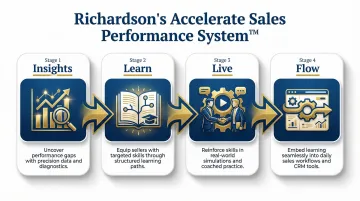
This makes Richardson especially effective for organizations that want to connect training directly to pipeline quality, with analytics to track adoption at every stage.
| Focus Area | Best For | Format & Length |
|---|---|---|
| Consultative selling, agile negotiation, virtual selling | Sales reps, account teams, and enablement leaders in enterprise B2B | Live workshops, virtual training, blended digital journeys; multi-week with sustainment |
Korn Ferry (Miller Heiman Group)
Korn Ferry's sales training offering, built on the legacy of Miller Heiman Group, acquired in November 2019, is an enterprise-grade program focused on sales leadership development, sales transformation strategy, and global methodology standardization. The offering is anchored by Strategic Selling® (managing complex sales with multiple decision-makers) and the Large Account Management Process® (LAMP®).
What separates Korn Ferry from pure training providers is its consulting depth. Key differentiators:
- Combines organizational consulting with immersive learning
- Covers rep-level skills and leadership coaching in a single program
- Includes frameworks for scaling consistent selling behavior across regions
- Korn Ferry Sell captures sales data directly into Salesforce and Dynamics to drive manager coaching
This makes it a strong fit for enterprise organizations or channel ecosystems with distributed teams that need methodology alignment at scale.
| Focus Area | Best For | Format & Length |
|---|---|---|
| Sales leadership, transformation strategy, global methodology alignment | Enterprise sales forces, sales managers, and revenue leadership | Workshops, virtual classrooms, consulting-led programs; multi-month |
How We Chose These Programs
The evaluation criteria focused on five factors:
- Proven methodology with a clear behavior-change mechanism
- Breadth of audience fit, from individual reps to leadership
- Ability to customize around specific skill gaps
- Post-training reinforcement structure and accountability
- Evidence of measurable business outcomes, not just participant satisfaction scores
The most common buyer mistake: choosing based on brand recognition or price alone, without diagnosing which competency gaps are limiting revenue performance. Skipping that diagnostic step typically leads to organizational misalignment and low ROI.
Letting vendors drive the discovery process compounds the problem. When sellers control scoping conversations, they introduce bias and prevent clear outcome definition before a contract is signed.
Format and accessibility matter as much as content. 93 percent of organizations with highly effective sales training programs include an in-person, instructor-led component in their blended training mix. A great program delivered in a format that doesn't fit team schedules or roles will see low adoption. Match format (in-person, virtual, blended, self-paced) to your team's selling context, geographic distribution, and workflow constraints.
The Missing Layer: Why Training Alone Isn't Enough to Drive Revenue
The highest-performing sales organizations treat training as an input, not an outcome. The real revenue impact comes when training connects to an enablement layer that tracks behavior change, surfaces coaching gaps, and links learning completion to pipeline metrics like win rates and deal velocity. According to CSO Insights research, organizations with dynamic coaching approaches aligned to their enablement framework improve win rates by 19.0% and quota attainment by 21.3%.
The modern approach uses platforms that evaluate real sales calls with AI, automatically enroll reps into targeted training when skill gaps are detected, and show leadership exactly which training modules correlate with closed deals. Gartner predicts that by 2029, sales organizations using AI-driven enablement will achieve 40% faster sales stage velocity than those using traditional methods.
Conversation intelligence validates training adoption by measuring how sellers actually execute on calls. AI-powered roleplay extends that loop, providing safe, scalable practice with immediate feedback before reps enter live deals.
Pifini's revenue enablement platform connects every layer of this system. Core capabilities include:
- Prescriptive LMS, auto-enrolls reps into targeted learning when performance gaps are detected
- Live AI call copilot, delivers real-time guidance during active sales conversations
- Call scoring, evaluates every interaction against defined criteria
- Training impact analysis, links certifications and training scores to deals closed, win rates, and pipeline growth
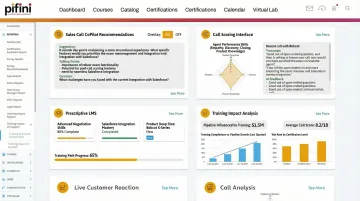
The platform also projects revenue impact from training investments, showing which courses generate the highest ROI. At $50/user/year, Pifini delivers these capabilities at roughly one-sixth the cost of platforms like Seismic or Mindtickle ($300–$600/user/year).
Conclusion
The five programs covered represent proven frameworks for building the skills, habits, and mindset that high-growth sales teams need. But selecting the right one starts with honestly diagnosing where your team's gaps are, not chasing what's trending. Is your challenge ramping new hires faster? Improving discovery discipline? Winning competitive deals? Navigating complex stakeholder environments? Match the program to the gap.
When evaluating programs, look beyond curriculum quality. The factors that determine whether training actually sticks include:
- Reinforcement mechanisms, spaced repetition, coaching cadences, practice opportunities
- Manager enablement, tools and guidance so managers coach to the methodology
- Workflow integration, reps can access training in the flow of work, not as a separate event
- Feedback loops, visibility into which behaviors actually move deals forward
The best training fails without these. If managers don't coach to it and reps can't apply it in context, the investment evaporates.
That's where Pifini fits in. Pifini links training directly to revenue outcomes, auto-enrolling reps into targeted learning when call scoring flags a gap, tracking readiness against pipeline performance, and giving managers real-time visibility into what's working. If you're investing in sales training, Pifini ensures that investment shows up in your numbers. See how it works.
Frequently Asked Questions
What are the 3 C's in sales?
Based on RAIN Group's Insight Selling research, the 3 C's that separate sales winners are Connect (connecting dots between needs and solutions, and connecting personally), Convince (proving maximum return and acceptable risk), and Collaborate (bringing new ideas and working as a team).
What is the 70/30 rule in sales?
The 70/30 rule suggests prospects should talk 70% of the time while reps talk 30%, emphasizing discovery-first selling. Gong's analysis of 326,000 calls tells a different story: reps on closed-won deals talked 57% of the time. Balanced dialogue outperforms the old rule.
What is the 3 3 3 rule in sales?
The 3 3 3 rule is a prospecting and outreach framework typically defined as making 3 phone calls, sending 3 emails, and performing 3 social touches over a 3-week period. This systematic follow-up cadence supports consistent pipeline-building behavior by ensuring multiple touchpoints across different channels without overwhelming prospects.
What is the 10 3 1 rule in sales?
The 10 3 1 rule is a pipeline conversion ratio framework suggesting that 10 prospects lead to 3 qualified opportunities, which result in 1 closed deal, representing a 10% close rate. Originally from life insurance sales, it's useful for baseline activity planning and forecasting, though calibrate it against your own CRM data for accuracy.
How do you measure the ROI of a sales training program?
Training ROI tracks behavioral adoption rates, win rate changes, deal velocity, and quota attainment, then links those to specific training completions over time. CSO Insights found effective training drives an 18.4% higher win rate, yet only 29% of enablement teams can directly connect programs to revenue impact.
What is the difference between sales training and sales coaching?
Sales training is structured curriculum that builds foundational skills and knowledge, teaching what to do and how to do it. Sales coaching is ongoing, personalized guidance tied to live deals and rep-specific performance gaps, reinforcing application in real selling scenarios. Both are needed for lasting revenue impact: training builds the foundation, while coaching ensures it translates into consistent behavior under pressure.