Introduction
In luxury retail, a single associate interaction can determine whether a €15,000 handbag leaves the boutique or remains on the shelf. Poor inventory visibility and demand signal failures carry massive financial consequences, between 2.5 billion and 5 billion items of excess stock were produced by fashion brands in 2023, resulting in up to $140 billion in lost sales. For luxury houses , LVMH and Kering recorded excess inventory of almost €5 billion combined in 2023.
That gap is exactly what ERP analytics tools are built to close. These platforms connect inventory, client data, associate activity, and sales trends into unified dashboards, helping luxury brands prevent stockouts, catch demand signals before collections sell through, and track the behaviors that convert appointments into five-figure transactions.
The revenue math is unforgiving: top-tier clients comprising less than 1% of the market generate 23% of luxury value, while conversion rates jump from 10–30% for walk-ins to 60–70% for appointment-based selling. Missing the data that powers these interactions means missing revenue.
Key Takeaways
- ERP analytics tools unify inventory, sales, and client data into a single operational view for luxury retail
- Top platforms include SAP S/4HANA with SAP Analytics Cloud, Microsoft Dynamics 365 with Power BI, Oracle Retail Analytics, Salesforce Commerce Cloud with CRM Analytics, and Infor CloudSuite Retail
- Luxury-ready platforms go beyond general retail tools with clienteling analytics, omnichannel reporting, and seasonal demand forecasting built in
- Analytics alone don't drive results; connecting insights to sales team behavior closes the loop between data and revenue
What Is ERP Analytics and Why Does Luxury Retail Need It?
ERP analytics transforms raw enterprise data, inventory, transactions, financials, customer records, into structured dashboards, forecasts, and decision-support tools. Luxury retail demands a more specialized version than general retail. The data models, decision cadences, and stakeholder priorities operate differently at every level.
What makes luxury retail analytically distinct:
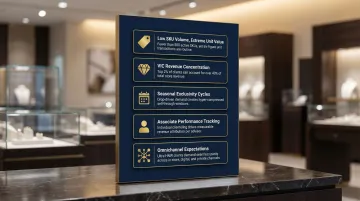
- Low SKU volume, extreme unit value, A boutique might carry 200 SKUs at individual retail values above $5,000. Item-level tracking precision matters here in a way mass retail simply doesn't require
- At Mytheresa, roughly 4% of active customers generate nearly 40% of revenue at average annual spends above €20,000, analytics must map preferences, purchase history, and associate touchpoints at the individual level
- Seasonal exclusivity cycles, Limited-run collections run on fixed calendars with no replenishment. Demand forecasting must account for trend velocity and style-level sell-through, not just aggregate volume
- Associate performance tracking, Appointment-based selling converts at 60–70% versus 10–30% for walk-ins. Associate activity data is a direct revenue signal, not a secondary metric
- Omnichannel expectations across a small, high-value base, Online holds a steady 20–21% share of the luxury market, yet VICs expect continuity across boutique, digital, and private client channels simultaneously
The platforms reviewed below were selected based on how well they handle these specific requirements, not just general analytics capability.
Best ERP Analytics Tools for Luxury Retail Sales Performance
Each platform below was shortlisted on four criteria: ERP depth, luxury or premium retail applicability, analytics capabilities, and proven deployment in high-value retail environments. What follows is a practical breakdown of what each tool does well, and which type of luxury operation it suits best.
SAP S/4HANA with SAP Analytics Cloud
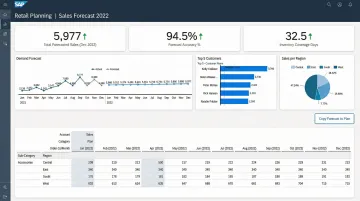
SAP S/4HANA serves as the ERP backbone for some of the world's largest luxury conglomerates, and SAP Analytics Cloud (SAC) extends it into a live analytics and planning environment for retail finance, merchandise, and sales operations.
Why it stands out for luxury retail:
Native integration eliminates data silos between supply chain, financials, and boutique-level sales, critical when a single inventory gap can cost a VIC relationship. Moët Hennessy (LVMH) migrated to S/4HANA to improve logistics across its complex network, while Richemont digitally transformed its external manufacturing supply chain using SAP Business Network.
SAC's Smart Predict feature uses machine learning to explore datasets and build predictive scenarios for time-series forecasting across seasonal collections. Pre-built retail planning templates reduce deployment time for luxury brands managing complex assortment hierarchies across global boutique networks.
| Attribute | Details |
|---|---|
| Best For | Large luxury houses and conglomerates with global boutique networks already invested in the SAP ecosystem |
| Key Analytics Features | Integrated merchandise planning, live sales dashboards, Smart Predict AI forecasting, scenario planning for seasonal collections |
| Pricing / Deployment | Custom enterprise pricing; available in Cloud Public Edition, Cloud Private Edition, and on-premises deployments. Implementation timelines vary by scope, though accelerated cloud deployments have been completed in as little as four weeks for specific use cases |
Microsoft Dynamics 365 with Power BI
Microsoft Dynamics 365 combines ERP and CRM in one platform, and when paired with Power BI, it delivers configurable retail analytics across sales performance, clienteling, and inventory. The platform has seen notable adoption in mid-to-large luxury and premium retail through partners like Hitachi Solutions.
Why it stands out:
Power BI's flexibility allows luxury retailers to build boutique-level associate performance dashboards, loyalty tier analytics, and product velocity tracking without heavy data engineering. Natuzzi implemented Dynamics 365 Customer Insights, Marketing, and Sales to unify data from its POS and ERP systems (project started January 2021, went live April 2021). Dynamics 365 Commerce covers omnichannel retail natively, while the strong partner ecosystem provides luxury retail-specific deployment templates. Azure Machine Learning integration enables custom demand planning algorithms that communicate through batch or pipeline endpoints.
| Attribute | Details |
|---|---|
| Best For | Luxury retailers seeking an integrated ERP + CRM + analytics stack with strong customization and Microsoft ecosystem compatibility |
| Key Analytics Features | Sales associate performance dashboards, omnichannel transaction analytics, inventory and supply chain visibility, AI-infused forecasting via Azure ML |
| Pricing / Deployment | Power BI Pro: $14/user/month; Power BI Premium Per User: $24/user/month; Dynamics 365 Commerce: $210/user/month (billed annually). Implementation typically requires certified partners for retail-specific configurations |
Oracle Retail Analytics
Oracle Retail Analytics is part of Oracle's purpose-built retail cloud suite, offering deep merchandise analytics, demand forecasting, and assortment planning capabilities used by major enterprise retailers including luxury brands.
Why it stands out:
Oracle's size-profile optimization and style-color forecasting are highly relevant to luxury fashion's complex SKU management. The AI Foundation determines the best size ratio for buys by understanding true demand, accounting for stockouts, then extracts item attributes to apply to demand transference and customer decision trees.
Versace leveraged Oracle Retail Xstore POS and Order Broker to determine inventory availability across the enterprise, increasing orders from 3,400 to 26,700. The platform's ability to drill from chain-level performance down to individual store or SKU provides the granularity luxury operations teams need for seasonal planning.
| Attribute | Details |
|---|---|
| Best For | Enterprise luxury retailers running Oracle's ecosystem, particularly in fashion and lifestyle categories with complex assortment planning needs |
| Key Analytics Features | Demand forecasting by style and size profile, markdown optimization analytics, seasonal assortment planning, store-level performance reporting |
| Pricing / Deployment | Custom enterprise pricing; utilizes flexible three-tier logical architectures. Implementation timelines vary based on retailer's specific hardware and software requirements |
Salesforce Commerce Cloud with CRM Analytics
Salesforce Commerce Cloud handles unified commerce for luxury and premium brands, and when paired with Salesforce CRM Analytics (formerly Tableau CRM / Einstein Analytics), it creates a dedicated layer for tracking client journeys, associate performance, and sales pipeline intelligence alongside ERP-connected inventory data.
Why it stands out:
Luxury retail's reliance on high-touch clienteling makes Salesforce's customer-360 approach particularly valuable. CRM Analytics provides AI-powered, actionable insights including next-best-action recommendations and prescriptive guidance. Sales analytics tied to individual client profiles, purchase history, and associate interactions support appointment-based selling environments where conversion rates exceed 60%. Strong integration with third-party ERPs enables unified reporting, luxury retailer SMCP (Sandro, Maje) used MuleSoft to connect customer data in Salesforce CRM with inventory in their ERP, achieving real-time data exchange through API-led connectivity.
| Attribute | Details |
|---|---|
| Best For | Luxury retailers prioritizing clienteling-driven sales performance, especially brands with digital commerce presence or appointment-based boutique selling |
| Key Analytics Features | Clienteling performance dashboards, customer lifetime value analytics, associate activity tracking, AI-driven next-best-action recommendations |
| Pricing / Deployment | CRM Analytics Growth: $140/user/month; CRM Analytics Plus (includes Einstein Discovery): $165/user/month; Revenue Intelligence: $220/user/month (billed annually). Commerce Cloud pricing requires custom quote. ERP integration typically requires middleware like MuleSoft |
Infor CloudSuite Retail
Infor CloudSuite Retail is an industry-specific cloud ERP with embedded analytics capabilities, designed for specialty and premium retailers who need tight integration between merchandise operations, financials, and sales performance reporting without enterprise-suite overhead.
Why it stands out:
Infor's retail-native data models include pre-built hierarchies for fashion and luxury merchandise, reducing configuration time. Embedded analytics cover sell-through rates, gross margin return on investment (GMROI), and promotional effectiveness out of the box. Anne Fontaine switched to CloudSuite Fashion ERP to modernize its supply chain and introduce Order Management System functionalities. Lower implementation complexity than SAP or Oracle makes it accessible to mid-market luxury brands expanding globally. The platform is available as a complete SaaS application in a true multi-tenant cloud environment, eliminating on-premises infrastructure requirements.
| Attribute | Details |
|---|---|
| Best For | Mid-market luxury and premium specialty retailers seeking purpose-built retail ERP analytics without enterprise-scale complexity and cost |
| Key Analytics Features | Sell-through analytics, GMROI reporting, markdown tracking, real-time inventory visibility, sales by associate and location |
| Pricing / Deployment | Custom pricing for SaaS subscriptions; cloud-native deployment eliminates on-premises infrastructure. Implementation timelines vary based on scope but are generally shorter than mega-suite alternatives |
Key Features to Look for in a Luxury Retail ERP Analytics Tool
Luxury retail ERP analytics isn't a one-size-fits-all category. The features that matter most are directly tied to how revenue actually flows in this sector, through associates, limited inventory, and clients who expect a frictionless experience across every channel.
Clienteling and Associate Performance Analytics
The ability to link individual sales associate activity to revenue outcomes is non-negotiable. This means tracking client visit history, surfacing next-best-action recommendations, and connecting those actions to ERP inventory data.
Conversion rates reach 60-70% for appointment-based selling, identifying which associates drive those outcomes (and which don't) is where meaningful performance improvement starts.
Real-Time Inventory and Merchandise Visibility
When a sales associate tells a client a piece is available and it isn't, trust erodes fast. Real-time item-level visibility reduces carrying costs and gives associates instant access to product locations, less time searching, more time selling.
Omnichannel Sales Reporting
Luxury clients move between boutique, digital, and private client channels without thinking twice. The analytics layer has to follow them. A unified view of sales performance across touchpoints eliminates the siloed reporting that lets ecommerce and in-store numbers contradict each other.
Omnichannel fulfillment models like ship-from-store and BOPIS require highly accurate inventory tracking, which makes this a data quality issue as much as a reporting one.
Demand Forecasting and Seasonal Planning
Luxury collections run on defined seasonal calendars with limited production runs. The right ERP analytics tool should support AI-driven demand signals that account for trend momentum, historical sell-through by style, and channel-specific buying patterns.
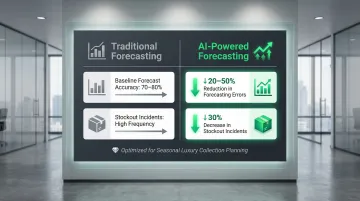
Modern AI forecasting achieves a 20-50% reduction in demand forecasting errors and a 30% decrease in stockout incidents compared to traditional methods, a meaningful advantage when you can't reorder mid-season.
Customizable Dashboards for Every Stakeholder Level
Each level of the organization needs different data:
- Store managers: boutique-level associate activity and inventory status
- Regional directors: comparative store performance across locations
- C-suite: margin, sell-through rates, and global revenue trends
The right tool supports all three views without requiring separate systems or custom development for each.
How We Chose These Tools
Each platform on this list was evaluated against four criteria specific to luxury retail operations:
- ERP integration depth, native connectors or purpose-built modules, not standalone analytics bolt-ons
- Luxury retail applicability, existing deployments or retail modules designed for premium assortments
- Analytics maturity, support for both operational dashboards and predictive demand planning
- Scalability, viable from single-boutique operations through global multi-brand networks
All selected vendors have been recognized as Leaders in major analyst reports:
- SAP, 2024 Gartner Magic Quadrant for Financial Planning Software
- Microsoft, 2024 Gartner Magic Quadrant for Analytics and BI Platforms
- Oracle, 2025 IDC MarketScape for AI-Driven Retail Assortment Planning
- Salesforce, 2024 Forrester Wave for B2B Commerce Solutions
- Infor, 2025 Gartner Magic Quadrant for Cloud ERP for Product-Centric Enterprises
Common mistakes buyers make when choosing ERP analytics for luxury retail:
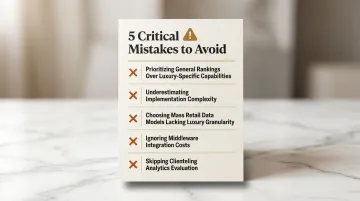
- Prioritizing general analytics rankings over luxury-specific capabilities
- Underestimating implementation complexity and change management requirements
- Selecting tools that excel at mass retail data models but lack the granularity needed for low-volume, high-value luxury assortments
- Ignoring integration costs, particularly middleware requirements for connecting commerce platforms to backend ERPs
- Skipping clienteling analytics evaluation until post-purchase, when VIC relationship tracking gaps are already a problem
Conclusion
The right ERP analytics tool for luxury retail aligns with both the operational scale of the brand and the high-touch nature of luxury sales. A tool that captures what's selling is valuable, but one that also explains why, and connects that intelligence to associate-level decisions, delivers meaningfully better outcomes.
Evaluate tools not just on feature lists. When assessing vendors, prioritize:
- Integration with existing ERP and POS infrastructure
- Support for luxury-specific data models (clienteling, seasonal planning, VIC tracking)
- Insight delivery at the speed boutique decisions require
- Proof of deployment in luxury or premium retail environments
- Associate-level performance dashboards
- Real-time inventory visibility down to item-level granularity
ERP analytics provide the data layer that reveals demand signals, inventory gaps, and performance trends. Data alone doesn't change outcomes. Acting on it does. Platforms like Pifini.ai help sales leaders close this loop by connecting performance data to AI-powered coaching. When analytics reveal that associates struggle with high-value conversions or that certain product categories underperform, Pifini's Training Impact Analysis links those signals to targeted coaching. Its Live AI Call Copilot then provides real-time guidance during client interactions, helping teams respond to ERP insights rather than simply report on them.
Frequently Asked Questions
What is the best ERP for retail?
Leading options include SAP S/4HANA, Microsoft Dynamics 365, Oracle Retail, and Infor CloudSuite Retail. The best fit depends on scale, existing tech stack, and whether the retailer is mid-market or enterprise. Luxury retail demands deeper clienteling and merchandise analytics than mass retail, granular client preference tracking and seasonal assortment planning matter more than raw volume throughput.
What are the 4 types of analytics?
According to Gartner's framework: Descriptive analytics answers "what happened?" using BI dashboards; diagnostic drills into "why did it happen?"; predictive forecasts "what is likely to happen?" using probabilities; and prescriptive calculates "what should be done?" through optimization. Strong ERP analytics for luxury retail combines all four across sales performance, demand forecasting, and associate coaching.
What features should a luxury retail ERP analytics tool include?
Non-negotiables include:
- Clienteling analytics tracking individual client preferences and full purchase history
- Real-time inventory visibility at the SKU and location level
- Omnichannel sales reporting unifying boutique and digital channels
- Associate performance tracking linking individual activity to revenue outcomes
- Demand forecasting that accounts for seasonal exclusivity cycles and trend velocity
How do ERP analytics tools improve sales associate performance in luxury retail?
By surfacing client purchase history, product availability, and behavioral signals in real time, ERP analytics tools help associates personalize interactions and prioritize outreach. When an associate knows a VIC's past purchases, preferred styles, and shopping patterns before the appointment begins, they can curate product selections that convert at 60-70% rates. Analytics also identify which associates consistently achieve these outcomes, enabling managers to replicate best practices across the boutique network.
Can mid-sized luxury retailers afford enterprise ERP analytics platforms?
SAP and Oracle carry high implementation costs requiring custom quotes and extensive partner involvement. Platforms like Infor CloudSuite and Microsoft Dynamics 365 offer more accessible entry points with transparent per-user pricing. Cloud deployment has lowered the barrier significantly, a Forrester study on SAP Cloud ERP showed a three-year ROI of 275% with $8.9 million in annual benefits for a composite organization, factoring in implementation and licensing.