
Introduction
Most sales coaching still happens after deals are won or lost. By the time a manager reviews a recorded call and schedules feedback, the opportunity has passed. The rep has already moved on to new conversations, and what could have been a timely course correction arrives too late to influence outcomes.
For sales leaders, this isn't just inefficient, it's costly. Inconsistent rep performance, extended ramp times, and missed quotas are often symptoms of a coaching model that's always one step behind.
Real-time coaching changes this by delivering guidance during live conversations, so reps can course-correct while deals are still in motion.
This guide covers what real-time sales coaching is, how it fundamentally differs from traditional coaching approaches, the best practices for implementation, and how AI-powered tools scale coaching across teams, so you can stop managing performance in hindsight and start influencing outcomes in the moment.
Key Takeaways
- Real-time sales coaching delivers guidance during live calls, not hours or days after
- Feedback given during a conversation can change its outcome; feedback given afterward can only change the next one
- AI-powered tools scale coaching beyond manager bandwidth through live call analysis, behavioral prompts, and automated scoring
- Effective programs use playbook-aligned prompts, brief nudges, one skill at a time, and direct links to training workflows
- Leading indicators, talk-to-listen ratio, prompt adoption, objection handling, reveal impact before win rates shift
What Is Real-Time Sales Coaching?
Real-time sales coaching provides guidance, prompts, or feedback to a sales rep during an active customer conversation, not before or after it. This can involve a manager listening live and sending discreet messages, or AI-powered tools surfacing behavioral nudges directly in the rep's interface as the conversation unfolds.
How It Differs from Traditional Coaching
Traditional coaching methods, call reviews, weekly 1:1s, role-play sessions, build long-term skills but cannot influence a deal in motion. They teach the playbook and reinforce habits over time, but when a rep freezes during a high-stakes objection, that coaching arrives too late.
Real-time coaching activates the playbook at the exact moment it's needed. Instead of reviewing what went wrong after the call ends, reps get the right prompt while the deal is still winnable.
The Adoption Trend
The market is moving fast. 81% of sales teams are experimenting with or have fully implemented AI, and 36% of teams with AI agents use them specifically for coaching, facilitating roleplays and providing real-time feedback. For sales leaders, these numbers signal something practical: coaching that happens during the conversation consistently outperforms coaching that happens after it. The rest of this guide covers how to put that principle to work.
Real-Time vs. Post-Call Coaching: Why Timing Changes Everything
The Memory and Momentum Problem
By the time a manager reviews a recording and schedules feedback, the rep has already moved on to new deals. The correction arrives too late to change the outcome it was meant to address. Research on feedback timing confirms that immediate feedback outperforms delayed feedback for skill retention and behavioral change.
The gap isn't abstract. A rep who hears three days later that they should have asked a deeper discovery question can't go back and save that deal, they can only hope the advice surfaces when a similar situation arises.
Practical Differences Across Key Scenarios
Real-time guidance changes the outcome in three common scenarios:
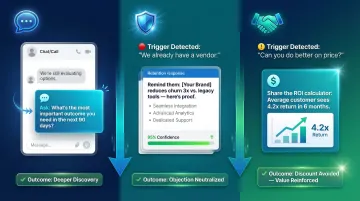
- Discovery calls: When a rep accepts a vague answer like "we're looking to improve efficiency," a live nudge suggests following up with "What does efficiency mean specifically in your role?" That one question unlocks qualification data that shapes the entire sales cycle.
- Objection handling: When a prospect says "we're happy with our current vendor," the next 30 seconds decide whether the conversation continues. A battlecard trigger surfacing a retention-focused response keeps the deal alive before the prospect disengages.
- Late-stage negotiations: A real-time prompt reminding the rep to quantify ROI before discussing discounts shifts the conversation from cost to investment, protecting margin and deal integrity.
The Disruption Concern
Well-designed systems deliver brief, context-aware prompts, not lengthy instructions. They surface only when triggered by specific keywords, sentiment shifts, or behavioral signals. The goal is a subtle nudge, not a running commentary. Research on interruptions shows that contextual cues provided during task transitions reduce recovery time and cognitive load, supporting the principle that timing and brevity minimize disruption.
Post-Call vs. Real-Time Coaching Comparison
| Dimension | Post-Call Coaching | Real-Time Coaching |
|---|---|---|
| Feedback Timing | Hours or days later | During the conversation |
| Memory Gap | High, rep recalls conversation imperfectly | None, feedback applies immediately |
| Manager Dependency | Requires manual call review | AI-driven, scales automatically |
| Deal Impact | Influences future calls only | Can change current outcome |
| Scalability | Limited by manager bandwidth | Covers every call |
Best Practices for Real-Time Sales Coaching
Anchor Coaching to Your Sales Playbook
Real-time coaching is only as useful as the playbook it references. Prompts that aren't grounded in your actual sales methodology, your ideal discovery questions, objection responses, and closing language, create noise instead of guidance.
How to translate playbook elements into coaching triggers:
- Identify the 5–7 moments in a typical call where rep behavior most significantly influences outcome
- Map each moment to a specific prompt or cue
- Align prompts with your methodology (MEDDIC, Challenger, SPIN, etc.)
Example mapping:
- Opening (first 60 seconds): Trigger prompt if rep doesn't establish permission or agenda
- Discovery: Surface deeper questions if prospect gives surface-level answers
- Objection ("current vendor"): Display battlecard with retention-focused response
- Closing: Prompt next-step confirmation if rep doesn't secure commitment
Keep Prompts Short, Specific, and Non-Intrusive
Design principles for effective prompts:
- Fires one action per prompt, one sentence maximum
- Tied to a detected keyword or behavior, not generic advice
- Surfaced before the critical moment passes, not after
Good prompt example: "Ask: What's the cost of not solving this?"
Bad prompt example: "It would be beneficial at this stage to consider exploring the financial implications and opportunity costs associated with maintaining the status quo, as this can help the prospect better understand the urgency."
Cognitive load research shows that even perceived interruptions create resumption lag, so minimalism isn't optional, it's essential to avoid degrading call performance while trying to improve it.
Coach One Skill at a Time
Effective real-time coaching doesn't try to fix everything simultaneously. Managers and tools should focus on a single skill area per rep per coaching cycle:
- Talk-to-listen ratio
- Discovery depth
- Objection acknowledgment
- Closing language
This isolation allows feedback to accumulate into lasting behavioral change rather than momentary corrections. Narrowing focus also matters neurologically: when people are close to achieving a goal, a single goal path provides greater motivation and simplifies pursuit, reinforcing that concentrated effort drives mastery faster than scattered improvement.
Create a Post-Call Reinforcement Loop
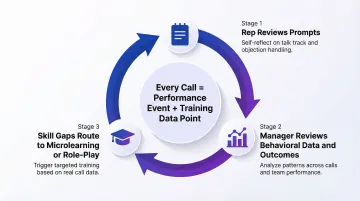
Real-time coaching compounds in value when it feeds into structured post-call review:
- Rep reviews prompts surfaced during the call
- Manager reviews behavioral data alongside outcomes
- Identified skill gaps route the rep into targeted microlearning or role-play practice
This closes the loop between in-the-moment intervention and long-term skill development. Each call becomes both a performance event and a training data point.
Make the framing clear from the start. Reps must perceive coaching prompts as support tools, not surveillance. When employees perceive electronic performance monitoring as developmental rather than preventative, it fosters trust, self-efficacy, and innovative behavior.
Managers should position real-time coaching as a performance amplifier, prompts exist to back reps up in high-pressure moments, not to catch mistakes.
How AI Powers Real-Time Sales Coaching at Scale
The Scalability Problem AI Solves
Only 9% of sales calls are ever reviewed by managers, and 73% of sales managers report they cannot coach their teams consistently due to time constraints. With spans of control widening to over 12 reps and only 10-40% of manager time available for coaching, the traditional model is mathematically broken.
AI removes this bottleneck. Live transcription and natural language processing let AI tools analyze calls as they happen, detecting sentiment shifts, filler words, keyword triggers, talk-time imbalance, and missed objection acknowledgments. When a behavioral signal appears, the system surfaces a context-aware prompt in the rep's interface without interrupting the call.
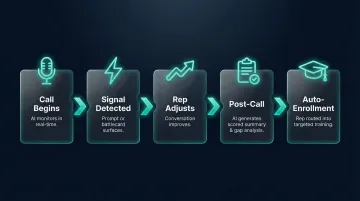
The AI Coaching Workflow End-to-End
- Call begins → AI monitors in real-time
- Behavioral signal detected → Prompt or battlecard surfaces
- Rep adjusts → Conversation improves
- Post-call → AI generates scored summary with gap analysis
- Auto-enrollment → Rep is routed into relevant training if skill score threshold isn't met
This automation turns every call into a coaching moment without requiring a manager to be present. Pifini's platform exemplifies this workflow: its live AI call support evaluates every call, flags skill gaps, and routes reps into targeted training automatically, connecting coaching and learning in one place.
Pattern Recognition at the Team Level
That same data doesn't stay at the individual level. AI can surface which objections are being handled inconsistently across the team, which playbook elements see the lowest adoption, and which rep behaviors correlate with higher win rates. This gives managers a clear evidence base for coaching conversations rather than relying on intuition or selective call reviews.
Example insights AI provides:
- "Price objections are handled successfully 68% of the time by top performers but only 41% by the broader team"
- "Reps who ask three or more discovery questions in the first five minutes have a 34% higher close rate"
- "The 'current vendor' objection is triggering battlecards, but only 52% of reps are using the suggested language"
The Shift in Manager Role
When AI handles routine call analysis and basic behavioral feedback, managers redirect their time toward high-impact activities:
- Strategic deal coaching
- Rep career development
- Team-wide pattern analysis
Managers currently spend roughly 13 hours per week coaching reps, but much of that time is consumed by manual call review. AI frees up that capacity. Managers can then focus on the judgment calls that require human expertise, navigating complex enterprise politics, positioning against a specific competitor, or developing a rep's long-term skills.
Measuring the Impact of Real-Time Coaching
Leading vs. Lagging Indicators
Leading indicators measure behaviors during or immediately after coaching:
- Talk-to-listen ratio improvement
- Prompt adoption rate
- Objection handling score
- Playbook adherence rate
Lagging indicators reflect coaching impact over time:
- First-call-to-meeting conversion
- Win rate
- Average sales cycle length
- Rep ramp time
Tracking leading indicators is critical, they allow managers to identify whether coaching is working before it shows up in revenue numbers. If prompt adoption is low, the intervention isn't reaching reps. If objection handling scores improve but win rates don't, the prompts may be addressing the wrong moments.
Establishing a Baseline
Before deploying real-time coaching, document current performance on 3–5 key metrics per rep. Measure against those baselines at 30, 60, and 90-day intervals post-implementation.
Example baseline tracking:
- Day 0: Rep averages 62% talk time, handles objections successfully 48% of the time
- Day 30: Talk time drops to 55%, objection success rises to 61%
- Day 60: Talk time stabilizes at 53%, objection success reaches 68%
This progression reveals both immediate behavioral shifts and sustained improvement, making it clear whether the coaching investment is paying off.
What Success Looks Like
The data makes a strong case:
- Reps who receive weekly coaching hit 107% of quota vs. 85% for those who do not
- Organizations with a dynamic coaching approach achieve an average win rate of 55.2%, which is 13.4 points higher than those with a random approach
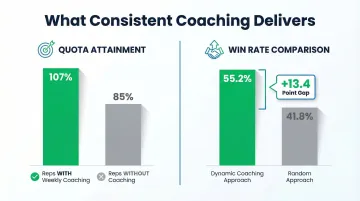
Real-time coaching accelerates these outcomes by shrinking the feedback loop from days to seconds.
Building a Closed-Loop Coaching System
Organizations that move from reactive, post-call coaching to proactive, real-time coaching, supported by AI and connected to training workflows, are building a durable performance infrastructure.
When evaluating your current tools, ask whether they can truly close the loop between a coaching moment and a learning action:
- Automatically route reps who struggle with objections into targeted microlearning modules
- Surface real-time prompts aligned with your specific playbook
- Give reps visibility into their own performance trends so coaching becomes self-directed
Pifini's revenue enablement platform unifies real-time AI coaching, call scoring, and prescriptive learning in a single system, delivering this closed-loop capability at $50 per user per year, a fraction of legacy competitors' cost.
Frequently Asked Questions
What is the 70 30 rule in coaching?
The 70/30 rule refers to the ideal balance of a coaching conversation: the coach speaks roughly 30% of the time while the coachee speaks 70%. This prioritizes active listening and self-reflection over top-down instruction, producing more durable behavioral change than directive coaching.
What is the difference between real-time coaching and post-call coaching?
Real-time coaching delivers guidance during a live sales interaction, allowing reps to adjust their behavior and potentially change the outcome of the conversation. Post-call coaching provides feedback after the fact and can only influence future interactions, not the deal already in progress.
How does AI enable real-time sales coaching?
AI uses live transcription and natural language processing to detect behavioral signals (sentiment shifts, keyword triggers, talk-time imbalance) and surface prompts during calls. Post-call, it generates automated scoring and skill gap identification that feeds directly into training workflows.
What metrics should I track to measure real-time coaching effectiveness?
Track leading indicators like talk-to-listen ratio, prompt adoption rate, playbook adherence, and objection handling score for early visibility. Pair these with lagging indicators like win rate, ramp time, and cycle length to measure long-term impact.
How do I implement real-time coaching without distracting my sales reps?
Keep prompts short and single-action, trigger them only at behaviorally significant moments, allow reps to customize notification settings, and pilot the system with a small group before full rollout. Well-designed prompts feel like helpful nudges, not intrusive interruptions.
How does real-time coaching apply to partner and channel sales teams?
Partner reps (resellers, distributors) typically receive less direct coaching than internal teams, making AI-powered real-time coaching especially valuable. It maintains messaging consistency and playbook adherence across a distributed, indirect sales ecosystem, ensuring every partner rep has access to expert-level guidance regardless of location or time zone.