Introduction
As sales ecosystems grow more complex, with distributed partners, remote sellers, and expanding product lines, content scattered across email threads, shared drives, and siloed platforms creates measurable operational drag. Sales reps waste an average of 440 hours annually searching for or recreating content. Meanwhile, partners struggle with outdated materials, messaging diverges across channels, and marketing teams produce assets that never reach buyers.
Centralizing content is often treated as an IT initiative, but its real impact shows up in sales cycle length, partner consistency, and onboarding speed. When sellers and partners can't find approved materials, they default to self-created content, increasing compliance risk and eroding buyer trust.
69% of B2B buyers report inconsistencies between vendor websites and information provided by sales reps. That gap creates mistrust that puts transactions at risk.
Key Takeaways
- A central content repository is a single, organized platform where all sales and partner-facing content lives, eliminating version confusion and wasted search time
- Accelerates seller and partner ramp-up by 40-50% through immediate access to the right assets for each selling situation
- Organizations gain visibility into which content actually drives deals, transforming enablement from guesswork into a measurable revenue function
- Without it, teams face rising enablement costs, inconsistent buyer experiences, and missed optimization opportunities
- Value compounds over time as consistent use sharpens analytics and tightens content-to-revenue alignment
What Is a Central Content Repository
A central content repository is a unified platform where all revenue-enabling content, product collateral, sales playbooks, training modules, partner kits, lives in one searchable, permission-controlled location. It serves sales teams, channel and partner organizations, marketing, and revenue enablement functions, ensuring the right content reaches the right person at the right deal stage.
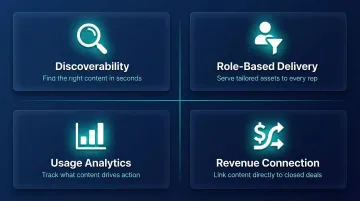
Where general document management systems stop at file storage, a sales enablement content repository is built to drive revenue action. Content repositories designed for sales and partner teams prioritize:
- Discoverability, sellers find what they need without digging through folders
- Role-based delivery, partners and reps see only the content relevant to their role and stage
- Usage analytics, teams know which assets get used and which get ignored
- Revenue connection, content performance ties back to pipeline and closed deals
Key Advantages of a Central Content Repository
Each advantage below ties directly to outcomes that revenue and enablement leaders track: time-to-productivity, deal velocity, content utilization, partner engagement, and enablement ROI.
Single Source of Truth for Sales and Partner Messaging
In organizations with multiple sales channels, direct reps, resellers, distributors, alliances, content fragmentation is a daily problem. Different teams use different deck versions, outdated battlecards circulate, and messaging diverges at the point of buyer conversation.
A central repository solves this by enforcing a single, authoritative version of every asset. Role-based access ensures each seller or partner gets content relevant to their audience, stage, and region. This control prevents the chaos of competing narratives and ensures every customer interaction reflects current, accurate positioning.
Why this matters:
Inconsistent messaging directly undermines buyer confidence and extends sales cycles. When a partner rep presents different product positioning than a direct seller, trust erodes. 60-70% of B2B marketing content goes completely unused due to findability and relevance issues. Sellers who use current, approved content win more because buyers receive a coherent, accurate narrative.
KPIs impacted:
- Content utilization rate
- Deal win rate
- Partner compliance with approved messaging
- Onboarding time to first use of content
When this advantage matters most:
Organizations managing large partner ecosystems feel this most acutely, content reaches buyers through intermediaries the company cannot directly supervise. Without centralized control, messaging consistency becomes impossible to enforce.
Faster Seller and Partner Ramp-Up
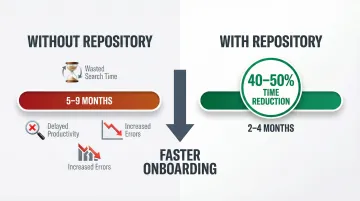
One of the highest-cost problems in sales enablement is ramp time, the weeks or months it takes a new rep or partner to become productive. Industry benchmarks place average B2B sales ramp time at 5-9 months, during which sellers generate little to no revenue.
A central repository accelerates ramp by giving new sellers and partners immediate, structured access to the exact content they need for each selling situation:
- Objection handlers organized by product line and buyer persona
- Competitive battlecards with current positioning
- Demo scripts tailored to specific use cases
- Product overviews filtered by role and region
Organizations with formal enablement programs and centralized content reduce onboarding time by 40-50%. When sellers find the right content in seconds rather than asking colleagues or digging through shared drives, they spend more time selling and less time searching.
KPIs impacted:
- Time to first deal closed
- Content search-to-find time
- Partner activation rate
- Seller productivity in first 90 days
When this advantage matters most:
The impact compounds at scale: organizations onboarding dozens of partners per quarter, or running large direct sales teams where individualized content coaching is not feasible, see the fastest returns.
Content Performance Visibility and Enablement ROI
A central repository doubles as a performance data source. When all content interaction runs through one system, organizations can see which assets are actually being used, by whom, in which deal stages, and whether that usage correlates with wins.
This visibility enables enablement and marketing teams to:
- Double down on high-performing content
- Retire outdated assets that dilute search results
- Connect content creation directly to revenue outcomes
- Demonstrate enablement's direct contribution to pipeline and closed revenue
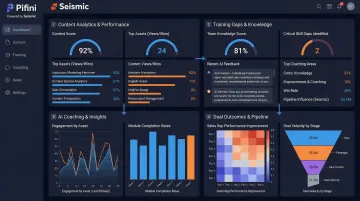
Platforms like Pifini extend this further by linking content usage to training gaps, AI coaching, and actual deal outcomes in one unified system. Content analytics feed directly into seller readiness scores and coaching priorities, so every insight drives a specific next action.
Why this matters:
Without content analytics, marketing and enablement teams create blind, producing assets that may never reach buyers or influence deals. Forrester's Total Economic Impact study found organizations using enablement platforms achieved a 578% ROI over three years, driven by 85% productivity gains and a 15% increase in new business revenue.
KPIs impacted:
- Content engagement rate by deal stage
- Asset influence on closed-won deals
- Enablement content ROI
- Time from content creation to active use
When this advantage matters most:
Revenue and enablement teams under pressure to prove business impact benefit most here, particularly where partner content distribution needs to tie directly to partner performance metrics.
What Happens When a Content Repository Is Missing or Ignored
Without a central content repository, several measurable breakdowns occur:
- Outdated, inconsistent content reaches buyers, 55% of marketing leaders report negative outcomes from "rogue content," including damaged reputations, weaker sales effectiveness, and legal exposure.
- High-performing content stays invisible. Reps recreate assets from scratch, wasting time and introducing inconsistency. Sales teams spend approximately 30 hours a month