Introduction
Sales training has historically been episodic, inconsistent, and hard to scale, particularly for distributed teams, new hires, and channel partners spread across time zones. In 2026, this matters more than ever: sales managers spend an average of 13 hours per week on coaching, yet 73% report they cannot coach their teams consistently due to time constraints. The result? Only 9% of sales calls are ever reviewed by managers, leaving most reps without the feedback they need to improve.
AI avatars are changing that. These digital personas turn static training content into interactive, on-demand experiences that reps actually engage with, simulating realistic buyer conversations, delivering real-time feedback, and running 24/7 without manager availability. Adoption is accelerating across enterprise and SaaS sales organizations because the outcomes are measurable: reps receiving weekly coaching achieve 107% quota attainment, compared to 85% for those coached infrequently.
This guide covers six specific ways sales leaders and enablement teams are deploying AI avatars in training workflows, each with documented performance outcomes.
Key Takeaways
- AI avatars simulate realistic buyer conversations so reps can practice objection handling and discovery anytime, without waiting on a manager
- They deliver consistent onboarding, product knowledge, and playbook training across distributed or partner-channel teams at scale
- Proving ROI means connecting avatar activity, scores, completions, attempts, to sales metrics like ramp time and win rate
- The six uses covered: role-play simulations, new hire onboarding, microlearning, playbook reinforcement, channel and partner training, and call coaching feedback loops
What Are AI Avatars for Sales Training?
AI avatars are AI-generated digital personas that simulate buyer conversations, deliver training content, and provide feedback in real time. Unlike pre-recorded videos or static e-learning modules, they respond dynamically and adapt to a rep's inputs, creating a practice environment that mirrors live selling scenarios.
What makes them well-suited to sales training, versus generic corporate learning, comes down to specificity. AI avatars can:
- Replicate real buyer types and personas
- Inject realistic objections during practice conversations
- Score rep responses against defined criteria
- Run 24/7 without a manager or coach present
Reps can practice discovery calls, objection handling, and closing conversations with lifelike AI-driven buyers, building confidence before they ever pick up the phone with a real prospect.
6 Ways to Use AI Avatars for Sales Training in 2026
The following use cases represent how leading sales organizations are embedding AI avatars directly into their training workflows, not as standalone experiments, but as systematic approaches to building rep readiness at scale.
AI Role-Play Simulations for Objection Handling
AI avatars can be configured to play specific buyer personas aligned to your ICP, including personality traits, objections, and conversational style, giving reps a safe, repeatable environment to practice responses before live calls.
Unlike manager-led role-play, AI role-play removes scheduling friction entirely. Reps can run the same scenario repeatedly, building confidence progressively without waiting for a coaching session. The advantages are concrete:
- Attempt any scenario on demand, as many times as needed
- Receive instant feedback on tone, clarity, objection handling, and messaging accuracy
- Identify and close gaps before they surface on live calls
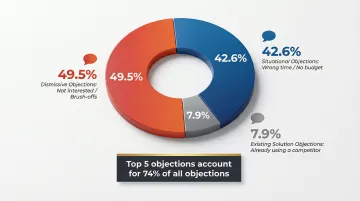
The most impactful implementations include scenario libraries mapped to real objections your team faces most often. An analysis of 300 million cold calls found that the top five most common objections account for 74% of all objections, falling into three main categories: dismissive objections (49.5%), situational objections (42.6%), and existing solution objections (7.9%). Organizations that build AI roleplay scenarios around these specific objection types report a 61% improvement in objection handling skills with AI training.
Platforms like Pifini allow organizations to upload custom roleplay scripts, including industry-specific playbooks and competitor battlecards, so the avatar can simulate real sales challenges. The system automatically flags missed opportunities and provides detailed feedback after each attempt, then routes struggling reps into focused learning modules based on performance gaps.
New Hire Onboarding and Product Knowledge Training
AI avatar-led video modules deliver consistent onboarding content across all new hires regardless of location, hiring cohort, or manager bandwidth, covering product knowledge, messaging frameworks, and persona training without relying on senior reps' time.
A key advantage: unlike live sessions that happen once, avatar-based onboarding modules can be revisited by reps at any point during ramp. The average Account Executive ramp time is 4.4 to 5.7 months, while SDR ramp time is 3.0 to 3.2 months. AI-assisted onboarding has demonstrated up to a 50% reduction in ramp time, RadNet reduced onboarding from 6-8 weeks to 4-6 weeks, and JumpCloud's reps reached their first meeting in 11 working days versus a previous maximum of 70 days using AI roleplay during onboarding.
Completion tracking and comprehension scoring give managers visibility into where new hires are struggling before it shows up on live calls. Pifini's Enterprise LMS takes this further with:
- Real-time progress monitoring and certification tracking
- Automatic gap detection that enrolls struggling users into targeted modules
- Zero manual administrative work required from managers
When new hires show early signs of struggle, in content, roleplay, or call scoring, the system responds immediately.
Microlearning and Just-in-Time Coaching
AI avatars are well-suited to short-form, scenario-specific coaching videos (2-5 minutes) that reps access at the point of need, before a competitive deal, ahead of a pricing conversation, or when encountering an unfamiliar buyer type.
These bite-sized avatar modules function as "on-demand battle cards", covering competitive differentiation, discovery question frameworks, or specific talk tracks, without requiring reps to search through long recordings or documentation. 65% of B2B sales content goes unused due to relevance, accessibility, or awareness issues. Microlearning solves this by delivering only what's needed, when it's needed.
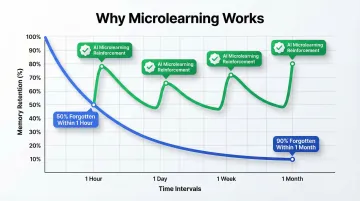
The science supports this approach. According to Ebbinghaus' forgetting curve, people tend to forget up to 50% of what they learn within an hour and 90% within a month without reinforcement. AI avatar modules enable spaced repetition and just-in-time reinforcement exactly when reps need it most, right before they enter a critical conversation.
Sales Playbook Reinforcement and Methodology Training
Sales leaders use AI avatars to roll out new methodologies, updated messaging, or revised sales plays across the team in a consistent, engaging format, rather than relying on slide decks or written memos that rarely get absorbed.
Avatar-delivered playbook updates can include worked examples (e.g., how a discovery question should sound in practice) and be embedded into onboarding sequences or quarterly refresh campaigns. Highly effective sales teams are 4.8 times more likely to provide ongoing reinforcement training compared to less effective teams.
A case study from ComplyAdvantage implementing the MEDDICC sales methodology using Gong to track and reinforce qualification-specific wording increased adherence from 2% to 17%. AI avatars can deliver similar reinforcement by modeling how specific methodology frameworks sound in live conversations, then scoring reps on whether they applied the methodology correctly during practice scenarios.
Pifini's platform embeds avatar-delivered messaging updates directly into onboarding sequences or quarterly refresh campaigns, so every rep, regardless of tenure or region, receives the same playbook revision at the same time.
Channel and Partner Sales Training at Scale
Resellers, distributors, and alliance partners don't sit inside your four walls. They handle multiple vendors, have limited bandwidth for training, and rarely attend live enablement sessions, making consistent skill-building nearly impossible through traditional methods.
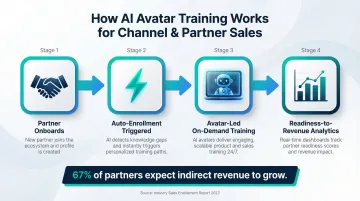
67% of surveyed B2B partner ecosystem and channel marketing decision-makers plan for their indirect revenue to grow above or significantly above that of last year's. Yet partners often receive fragmented, inconsistent training that doesn't translate to revenue outcomes. The revenue multiplier effect is significant: AWS Partners can achieve up to $7.13 in services revenue for every $1 of AWS technology sold.
AI avatar training closes this gap. Partners access on-demand avatar-led modules covering your product positioning, competitive differentiation, and objection handling on their own schedule, in a format that feels engaging rather than obligatory.
Pifini is built specifically for this challenge. Its partner-first design auto-enrolls partners into targeted training when performance gaps appear, in content mastery, roleplay, or call scoring. Readiness-to-revenue analytics then connect training progress directly to deal outcomes, so organizations can demonstrate the ROI of partner enablement in concrete terms.
Pifini's AI CAM (Channel Account Manager) avatar acts as a 24/7 concierge inside partner programs, instantly answering questions about tier qualification, certification deadlines, deal registration, and program benefits, freeing channel managers for strategic relationship work.
Call Coaching and Skill Gap Feedback Loops
AI avatars can be used as part of a continuous improvement loop: the system evaluates actual sales calls, identifies where reps are struggling (e.g., failing to handle a specific objection, skipping discovery steps), and automatically routes those reps into targeted avatar-based practice scenarios.
Three things make this more effective than periodic manual coaching:
- Operates at full team scale, not just the reps who get manager attention
- Every rep receives personalized feedback, not just top performers
- Creates a direct link between training activity and call performance data
When go-to-market teams used AI conversation intelligence functionality to surface key moments, risks, and competitive insights, their win rate was 35% higher. AI coaching platforms solve the capacity problem by reviewing 100% of calls automatically, reviewing 10x more calls than any manager could handle manually.
Pifini's call scoring module analyzes every sales call against proven success criteria, evaluating discovery effectiveness, objection handling, product positioning, and closing strength. When the system detects a performance gap, it automatically enrolls that rep into a targeted practice scenario.
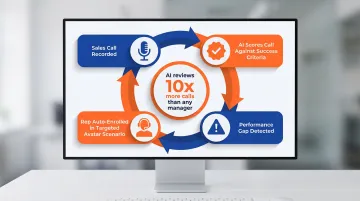
Reps then work through AI-driven avatar simulations covering the exact skill where they struggled, receiving real-time feedback on tone, clarity, and messaging accuracy until performance improves.
How to Measure the Impact of AI Avatar Training
The two-tier measurement framework:
First, track training engagement metrics across your team:
- Module completion rates across cohorts
- Role-play attempt frequency per rep
- Scenario scores and progression over time
- Time-to-competency benchmarks (days from hire to first certification)
- Average performance improvement percentage
Then connect those metrics to downstream sales outcomes:
- Rep ramp time to first deal closed
- Win rate by training completion tier (e.g., certified vs. uncertified reps)
- Objection handling score vs. deal close rate correlation
- Pipeline conversion rates for trained vs. untrained cohorts
- Average deal size and sales cycle length by training engagement level
The most mature implementations tie avatar-based training certifications directly to CRM pipeline data, so enablement teams can demonstrate that trained reps outperform untrained ones.
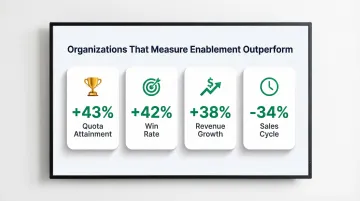
Only 29% of sales enablement teams can directly tie their programs to revenue impact, but organizations that measure and track enablement produce better results: quota attainment improves by 43%, win rates by 42%, revenue by 38%, and sales cycles shorten by 34%.
Pifini's Training Impact Analysis dashboard correlates training scores with pipeline and win rates by integrating data from CRM, PRM, and the learning system. Instead of reporting on activity (completions), enablement teams can tie training directly to revenue outcomes. Specifically, the dashboard lets teams:
- Identify which courses correlate with closed revenue
- See how training completion affects sales cycle length
- Model how broader adoption would affect overall quota attainment
Best Practices for Implementing AI Avatars in Sales Training
Start with the Highest-Friction Scenarios
Identify the top 3-5 situations where reps consistently underperform, a specific objection, a competitive displacement scenario, a stalled discovery call, and build avatar role-plays around those before expanding to a broader curriculum. This ensures early ROI and builds internal buy-in.
Pifini's platform surfaces these high-friction areas automatically through call scoring and gap detection. It analyzes performance data from CRM and call recordings to pinpoint where individuals or cohorts are struggling, then triggers focused learning modules as interventions. Start by building avatar scenarios around the objections or discovery gaps that appear most frequently in your call data.
Align Avatar Personas to Your Actual ICP
The closer the avatar's personality, vocabulary, and objection style matches the buyers your reps actually encounter, the more that practice transfers to live calls. Generic personas don't move the needle.
Use CRM data and win/loss analysis to inform persona configuration. If your top accounts are enterprise IT decision-makers who prioritize security and compliance over price, configure the avatar to reflect exactly those priorities and objection patterns.
Integrate Avatar Training into Existing Workflows
Treat avatar simulations as part of your workflow, not a separate tool reps have to remember to use. Practical ways to embed them:
- Tie scenario assignments directly to call coaching reviews
- Add role-play modules to LMS onboarding sequences
- Surface training inside the tools reps use daily
Pifini supports 100+ integrations with CRM, PRM, LMS, and video platforms. Its auto-enrollment logic triggers targeted avatar scenarios based on performance signals from call scoring, roleplay results, and CRM data, so training reaches the right rep at the right moment without manager intervention.
Frequently Asked Questions
Frequently Asked Questions
What is AI sales training?
AI sales training uses artificial intelligence to simulate sales conversations, deliver coaching feedback, and personalize learning paths, giving reps a way to build skills through realistic practice rather than passive content consumption. Reps can develop on demand, without waiting on manager availability.
How to use AI for sales reps?
AI can simulate buyer conversations for practice, score call performance, and route reps into targeted training. It also delivers personalized microlearning and just-in-time coaching before high-stakes conversations. The key is embedding these tools into daily workflows rather than treating them as separate activities.
Which is the best AI for training?
The best AI training platform depends on team size, whether you sell through direct or partner channels, and what integrations you need. Evaluate platforms based on role-play realism, feedback quality, LMS integration, and how well the tool connects training data to sales outcomes.
Can AI avatars replace live sales coaches?
AI avatars handle the scalable, repeatable layer of coaching, practice scenarios, baseline skill building, and 24/7 availability, while human coaches are still best suited for high-context feedback, strategic deal coaching, and developing emotional intelligence skills. Think of it as division of labor: AI handles volume, humans handle nuance.
How do AI avatars help with sales onboarding?
AI avatars enable new hires to access consistent product knowledge, messaging, and objection-handling practice from day one without depending on manager availability. Completion tracking gives leaders visibility into readiness gaps before reps hit live calls, cutting ramp time in the process.
Are AI avatar sales training tools expensive to implement?
Costs vary widely, traditional enterprise platforms can run hundreds of dollars per user annually, while newer AI-native platforms like Pifini offer full-feature enablement at $50 per user per year. The ROI calculation should factor in reduced ramp time, lower coaching burden, and improved win rates rather than just software cost.