Introduction
Shoppers expect immediate, relevant answers—not generic deflections. When someone asks, "Does this jacket work for hiking in sub-zero temperatures?" they don't want a link to the FAQ page. They want a specific, confident answer grounded in product specs, materials data, and real usage context. Yet most e-commerce sites still deploy chatbots that fumble these moments, triggering the exact friction that sends 80% of shoppers elsewhere after just three bad experiences.
Unstructured, poorly grounded AI is the real culprit. A chatbot that guesses or deflects is worse than no chatbot at all—which is why 79% of Americans prefer interacting with a human over an AI agent. A content-powered AI concierge—grounded in your brand's product catalog, policies, and documentation—pulls precise answers from structured sources and delivers them in context, rather than generating plausible-sounding guesses.
This article explains what separates a content-powered AI concierge from a standard chatbot, why content architecture determines answer quality, and how e-commerce brands can reduce friction and increase conversions by treating content as the foundation of intelligent customer assistance.
TLDR
- AI concierges pull answers from structured brand content, not generic training data
- Answer quality depends entirely on content completeness, organization, and currency
- Key use cases: guided product discovery, complex technical questions, cart recovery, contextual upsells, and post-purchase support deflection
- Measure ROI through funnel-stage metrics—PDP-to-cart rate, assisted conversions—not chat volume
- Unanswered queries expose content gaps, making the concierge a built-in content audit tool
What Is a Content-Powered AI Concierge?
An AI concierge in the e-commerce context is a conversational assistant that understands shopper intent, maintains context across a session, and guides customers through their purchase journey—not just answering isolated questions. According to the Journal of Service Management, an AI concierge is "a dedicated entity overseeing the entirety of the customer journey," designed to meet psychological, emotional, and physical customer needs through proactive engagement.
The "content-powered" distinction separates useful from unreliable. Where generic AI assistants pull from untrained, unverified sources, a content-powered concierge is grounded in the brand's own approved content: product specifications, compatibility data, return policies, FAQs, and warranty documentation.
That grounding is what keeps answers brand-accurate and resistant to hallucinations — the confidently wrong responses that undermine trust in generic AI deployments.
How It Differs from a Standard Chatbot
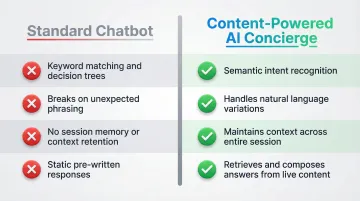
A chatbot follows rules and scripts. It matches keywords to canned responses, breaks when phrasing changes, and lacks memory beyond a single exchange. A content-powered AI concierge infers intent, adapts to session context, accesses live content repositories, and brings forward the most decision-helpful information at each stage of the shopper's journey.
Standard chatbot:
- Keyword matching and decision trees
- Breaks on unexpected phrasing
- No session memory or context retention
- Static, pre-written responses
Content-powered AI concierge:
- Semantic intent recognition
- Handles natural language variations
- Maintains context across entire session
- Retrieves and composes answers from live content
How Content-Powered Answering Works in Practice
Content Ingestion and Knowledge Base Architecture
The concierge works by indexing and organizing the brand's structured content sources into a retrievable knowledge base. This includes:
- Product catalogs (specs, attributes, pricing, materials)
- Size charts and fit guides
- Compatibility matrices
- Return and shipping policies
- Customer reviews and Q&A
- Warranty documentation
- Installation and care instructions
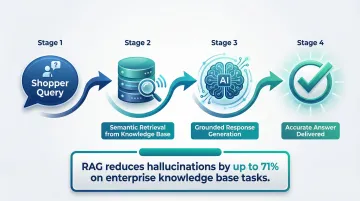
The more complete and well-organized these inputs, the more accurate the retrieval and the more useful the answers. Content-powered concierges typically use Retrieval-Augmented Generation (RAG), which grounds AI responses in curated, authoritative content rather than allowing free-form generation.
Industry benchmarks show that RAG can reduce hallucinations by up to 71% on enterprise knowledge base tasks. In medical research, RAG reduced hallucination rates from approximately 40% (conventional chatbots) to 0-6% when using reliable information sources.
Intent Recognition and Semantic Retrieval
When a shopper submits a query—text, conversational, or behavior-triggered—the AI interprets semantic intent, not just keywords. It retrieves the most relevant content chunks from its knowledge base to construct a response.
Why this matters:
- "Is this waterproof?" and "Can I wear this in the rain?" retrieve the same product specifications
- "What's your return policy?" and "Can I send this back if it doesn't fit?" access the same policy documentation
- The same question phrased differently yields consistent, accurate answers rather than lookup failures
Context-Awareness and Session Memory
A content-powered concierge maintains context across a session. If a shopper said "I need something for outdoor use under $150" earlier, every subsequent response factors in that constraint without requiring the shopper to repeat it. Shoppers experience fluid, personalized assistance rather than a scripted Q&A loop.
Session memory enables:
- Progressive narrowing of product recommendations
- Constraint-aware responses (budget, size, use case)
- Continuity across multiple questions
- Proactive suggestions based on stated needs
Real-Time Content Synchronization
The content powering the concierge must stay in sync with live inventory, pricing, and policy updates. An AI concierge pulling from stale or inconsistent content will give wrong answers and erode trust — a failure of both technical integration and content governance.
In Moffatt v. Air Canada, an airline's chatbot provided an outdated bereavement fare policy. The court found the airline liable for negligent misrepresentation, rejecting the argument that the chatbot was a separate entity.
Avoiding that exposure means keeping every content source current:
- Live PIM (Product Information Management) sync
- Real-time inventory and pricing updates
- Policy change propagation
- Seasonal promotion alignment
The Content Gap Feedback Loop
Every unanswered, poorly answered, or frequently asked question the concierge encounters is a signal about a gap in the brand's content. This feedback loop is the most overlooked operational benefit of deploying a concierge—it becomes a continuous content audit, surfacing exactly what shoppers need that existing documentation doesn't cover.
What to track:
- Most frequent queries with no matched content
- Questions that trigger low-confidence responses
- Session abandonment patterns after specific query types
- Repeated reformulations of the same question
Top Use Cases for AI Concierge in E-Commerce
Guided Product Discovery
Shoppers don't always know what they want. A content-powered concierge can ask clarifying questions—budget, use case, size, preferences—and match them to the most relevant SKUs by cross-referencing product attributes in the catalog.
A shopper asks for "a biodegradable phone case under $100." The concierge translates that into specific filters—material type (plant-based, compostable), price ceiling ($100), and product category (phone cases)—without the shopper needing to browse manually.
Research from Baymard Institute uncovered more than 700 search-specific usability issues across 19 leading e-commerce sites. McKinsey reports that 71% of consumers expect personalized interactions, and 76% get frustrated when this doesn't happen.
Handling Complex Product Questions
Some purchase decisions require technical depth that static product detail pages and FAQs can't deliver interactively—compatibility questions, spec comparisons, regulatory details. A content-powered concierge retrieves this from structured documentation in real time and delivers it conversationally.
Where this adds the most value:
- Technical products (electronics, software, industrial equipment)
- B2B e-commerce (compliance, integration requirements)
- High-consideration purchases (appliances, furniture, outdoor gear)
- Regulatory-sensitive categories (medical, safety equipment)
The buyer needs confidence, not a link to a PDF.
Abandoned Cart Recovery
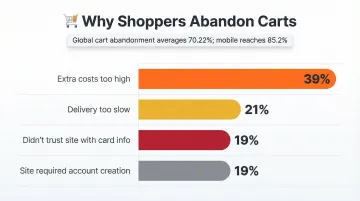
Global cart abandonment averages 70.22%, with mobile abandonment reaching 85.2%. The top reasons (excluding "just browsing") are:
- Extra costs too high (shipping, tax, fees): 39%
- Delivery was too slow: 21%
- Didn't trust the site with credit card info: 19%
- Site wanted me to create an account: 19%
A content-powered concierge reads hesitation signals—repeated product views, extended dwell on shipping/returns pages, exit intent—and steps in with targeted answers: shipping timelines, return windows, warranty details, pulled directly from brand policy content.
This is different from generic discount pop-ups. Instead of guessing that price is the problem, the concierge addresses the actual objection.
Upsell and Cross-Sell Through Contextual Recommendations
The concierge can surface add-on products, bundles, or complementary items by matching what's in the shopper's cart against product relationship data in the catalog.
Three factors drive effectiveness here:
- Frame recommendations as "useful completions" to the shopper's goal, not random extras
- Catalog content must include pairing logic and use-case associations
- Recommendations should appear conversationally, not as static "you might also like" modules
McKinsey research shows that personalization most often drives a 10 to 15% revenue lift, with product recommendations accounting for up to 31% of e-commerce site revenues in some implementations.
Post-Purchase and Support Deflection
Content-powered concierges handle post-purchase interactions—order status, return initiation, product usage questions—by drawing from order management integrations and support documentation. This deflects repetitive support tickets while improving the customer's experience.
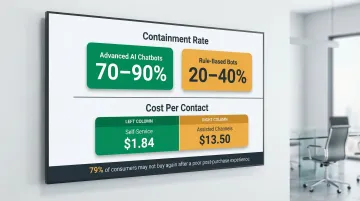
Gartner found that only 14% of customer service issues are fully resolved in self-service, with 43% of customers failing because they couldn't find relevant content. The median cost per contact is $1.84 for self-service versus $13.50 for assisted channels.
Advanced AI chatbots can achieve 70-90% containment rates in e-commerce, compared to 20-40% for basic rule-based bots. Well-handled post-purchase interactions build loyalty and reduce return rates—79% of consumers may not buy again after a poor post-purchase experience.
Why Content Quality Makes or Breaks Your AI Concierge
Why Content Quality Makes or Breaks Your AI Concierge
The AI concierge is only as intelligent as the content it has access to. If product descriptions are incomplete, if FAQs don't reflect common questions, or if policy documents are buried in inconsistent formats, the concierge will deliver vague, wrong, or unhelpful answers—regardless of how sophisticated the AI model is.
The Content Completeness Problem
Incomplete content is the most common reason AI concierge responses fail. Three patterns show up repeatedly:
- 43% of consumers returned a product due to incorrect pre-purchase information—description, sizing, or imagery errors
- 73% of consumers struggle to find product information sufficient to make confident purchase decisions
- 68% would stop buying from a brand entirely after a bad product information experience
Baymard Institute found that 42% of users try to gauge product size from images, yet 37% of sites fail to provide "in scale" visuals. The concierge can't answer what the content doesn't cover.
The Hallucination Risk
When the concierge's content base doesn't contain an answer, an unguarded AI may fabricate one. For e-commerce, this can mean:
- Wrong compatibility claims
- Incorrect pricing or availability
- False return promises
- Fabricated product specifications
Each carries real business and trust consequences. A content-grounded concierge should acknowledge gaps rather than guess. Well-designed implementations restrict answers to approved content sources and flag low-confidence responses.
Content Governance as an Ongoing Practice
Guarding against hallucination isn't a one-time fix—it requires keeping content current. Product content must be treated as a living asset, updated with inventory changes, seasonal policy shifts, and new product launches.
What a content governance process looks like:
- Assign ownership for content updates (product, marketing, operations)
- Review content quarterly or after major catalog changes
- Push changes to the concierge's knowledge base automatically
- Avoid manual re-indexing every time a policy or product changes
Content Depth as a Competitive Differentiator
Brands that invest in richer content—detailed specs, use-case guidance, comparison tables, fit and sizing data—give their AI concierge more material to work with. This produces more confident, more useful answers and higher purchase confidence. Treated as a long-term strategy, better content drives better answers—which compound into higher conversions and fewer support escalations.
Measuring AI Concierge ROI in E-Commerce
Move beyond vanity metrics like "conversations started" and focus on funnel-stage metrics that show actual business impact.
The Right Performance Metrics
Track these instead:
- PDP-to-cart progression rate for sessions where the concierge was active
- Cart-to-checkout completion rate in concierge-engaged sessions
- Assisted conversion rate (sessions where the concierge contributed to a sale even if not the final touchpoint)
- AOV (Average Order Value) lift in concierge-assisted sessions
Verified ROI Benchmarks:
| Metric | Lift | Source |
|---|---|---|
| Overall Conversion Rate Lift | +8.18% | Selzee A/B Test (157k visitors, 50/50 split) |
| Revenue Per Visitor (RPV) Lift | +11.41% | Selzee A/B Test |
| Overall ROI | 301% over 3 years | Forrester TEI Study (Zendesk composite org) |
Critical methodological note: Vendor claims of "300% revenue increases" or "4x conversion lifts" often compare users who interacted with a bot against those who didn't, introducing severe selection bias. True incremental lift (measured via strict 50/50 holdout tests) typically hovers between 5% and 15%.
Content Performance Metrics as a Complement
Beyond sales metrics, track which content types the concierge retrieves most frequently (indicating high shopper interest) and which queries go unanswered (indicating content gaps). These signals help teams prioritize content gaps and demonstrate the concierge's value beyond chat alone.
Over time, these two data streams — sales funnel metrics and content retrieval patterns — compound in value. Teams that review both monthly can close content gaps faster, reduce unanswered query rates, and build a clear audit trail connecting concierge activity to revenue outcomes.
What to Look for in a Content-Powered AI Concierge Platform
Core Technical and Strategic Criteria
Deep content integration capabilities:
- Ability to ingest and sync with product or content libraries, CRMs, policy documents, and live data sources
- Real-time data synchronization without manual re-indexing
- Support for multiple content formats (structured databases, PDFs, web pages)
Content governance controls:
- Business teams can update answers without engineering support
- Approval workflows for policy changes
- Version control and audit trails
Grounding mechanisms:
- Prevent hallucinations by restricting answers to approved content sources
- Low-confidence response flagging
- Acknowledgment of content gaps rather than fabrication
Scalability:
- Handles a growing catalog, increasing traffic, and new product lines without degrading answer quality
- Performance under high concurrent user loads
- Multi-language and multi-region support
Analytics and Content Feedback Loops
Technical capabilities only matter if you can measure and improve them. Platforms that only report chat volume leave critical gaps — look for solutions that surface:
- Content gap reports
- Query logs that reveal user intent patterns
- Funnel attribution so teams can see where the concierge is influencing pipeline or conversion outcomes
- Performance dashboards for continuous improvement of both the AI's answers and the underlying content
Frequently Asked Questions
What is a concierge AI?
A concierge AI is an intelligent virtual assistant designed to guide customers through complex decisions or service journeys. It goes beyond basic chatbots by understanding context, retaining conversation memory across a session, and proactively surfacing relevant information rather than waiting for scripted triggers.
How much does concierge AI cost?
Pricing varies by platform and model — from per-conversation fees (typically $0.05–$1+) to annual SaaS subscriptions. Evaluate cost against conversion lift and support deflection value to get a true picture of ROI.
What makes a content-powered AI concierge different from a regular chatbot?
A standard chatbot follows predefined scripts and rules. A content-powered AI concierge draws from structured brand content to answer dynamic, intent-based queries—making it capable of handling novel questions accurately and adapting to session context without rigid decision trees.
What types of content does an AI concierge use to answer questions?
Primary sources include product catalogs (specs, attributes, pricing), FAQs, return and shipping policies, sizing or compatibility guides, brand documentation, and sometimes customer review data — all of which must stay current for the concierge to deliver accurate answers.
Can an AI concierge handle complex product questions, not just simple FAQs?
Yes—content-powered concierges can handle technical depth including compatibility questions, spec comparisons, and policy nuances, as long as the underlying content is structured and complete. For high-consideration purchases, they outperform static product pages precisely when buyers need specific, contextual answers before committing.
How do I know if my AI concierge is actually improving sales?
Track PDP-to-cart and cart-to-checkout rates for concierge-active sessions, assisted conversion attribution, and AOV lift — not just chat volume or resolution counts. A/B testing against non-concierge sessions is the clearest way to isolate real incremental impact.