
Introduction
Distributor sales teams receive no shortage of training, product presentations, onboarding sessions, compliance modules, quarterly supplier workshops. On paper, the curriculum looks thorough. Yet performance gaps persist quarter after quarter: win rates stagnate, new account generation flatlines, and objection handling stays inconsistent.
The disconnect happens when training is designed without input from actual performance data. Organizations deploy the same content to every rep, regardless of individual skill gaps. Managers rely on gut instinct rather than metrics to decide who needs help and what kind. Training becomes a compliance checkbox rather than a revenue driver.
Fix that, and training stops being an expense line, it becomes your most predictable lever for closing more deals.
Key Takeaways
- Effective distributor training spans product knowledge, sales skills, market awareness, and data tools, not just product specs
- Traditional one-and-done training rarely transfers to real selling behavior; spaced, data-informed learning does
- Call scores, win rates, and pipeline metrics should determine which training each rep receives
- Linking training completion to actual deal outcomes is the only way to prove ROI
- Organizations with >75% sales methodology adoption achieve 54.1% win rates versus 46.4% average
Why Most Distributor Sales Training Fails to Move the Needle
The dominant training model in distribution remains event-based: a launch-day product session, an annual kickoff, or a supplier-led workshop. Research reveals this approach ignores how adults actually learn. Meta-analyses show that 96% of comparisons found spaced practice significantly outperforms massed learning for long-term retention. Yet most distributors still cram training into intensive one-day sessions that produce minimal lasting behavior change.
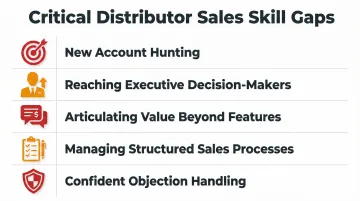
The skill gap reality compounds this problem. Distributor sellers excel at relationship building but lag other B2B sectors by 53% to 113% in critical proactive skills: new account hunting, reaching decision-makers, and selling on value. These gaps don't stem from lack of effort, they persist because these skills require deliberate practice, not passive content consumption.
Key distributor skill deficiencies:
- New account hunting and prospecting
- Reaching executive decision-makers
- Articulating value beyond product features
- Managing structured sales processes
- Handling objections confidently
Without a feedback loop, reps who struggle repeat the same mistakes while managers rely on gut instinct to identify who needs help. Training becomes obligatory rather than transformational.
The fix isn't more training, it's smarter training. Performance signals from call recordings, win/loss data, and CRM pipeline velocity surface rep-level gaps, then route each rep into only the modules they actually need.
The cost of untargeted training compounds quickly. Reps waste hours on content they don't need while the skill gaps actually causing lost deals go unaddressed.
The numbers back this up: organizations with random or informal enablement approaches experience win rates 3.1 points below average, and the U.S. Department of Labor estimates a failed hire costs around 30% of that individual's annual earnings.
The Core Training Areas Every Distributor Sales Team Needs
Before data can optimize training delivery, you need a foundational curriculum covering the non-negotiable knowledge and skills every distributor rep must have.
Product Knowledge and Competitive Positioning
Every rep needs product knowledge, but top performers go further. They position value against alternatives in ways that are specific to each buyer's situation. Training should cover:
- Core features and technical specifications
- Real customer use cases and application scenarios
- How to articulate why your product outperforms competitors in specific buyer situations
- Common misconceptions and how to address them
The difference between knowing a product and selling it is understanding the why behind each buyer's decision, not just the what of the specs.
Sales and Negotiation Skills
Most distributor teams are underdeveloped in skills that directly impact revenue:
- Prospecting and hunting new accounts - Moving beyond relationship maintenance to actively developing new business
- Delivering value-based pitches - Articulating ROI rather than listing features
- Overcoming objections - Handling price resistance, competitive alternatives, and timing concerns
- Negotiating margin - Protecting profitability without defaulting to discounting
These skills fade without regular practice. Reinforcement through roleplay and repeated coaching cycles matters far more than any single training session.
Market, Competitor, and Customer Awareness
Reps need to understand market trends, competitor positioning, and evolving customer expectations in their territory. Effective programs build this awareness through:
- How to research customer businesses before sales calls
- Competitor strengths, weaknesses, and common objections
- Industry trends affecting buyer priorities
- How to use market intelligence during sales conversations
Data Tools and CRM Proficiency
Sales reps spend 70% of their time on non-selling tasks, and only 35% completely trust their CRM data. Poor data hygiene sabotages pipeline visibility and forecast accuracy.
Distributor reps need training on:
- CRM data entry standards and hygiene
- How to use performance dashboards for self-assessment
- Pipeline management and opportunity tracking
- Call analytics and performance metrics
When reps lack this proficiency, managers fly blind, forecasts drift, pipeline gaps go unnoticed, and coaching stays reactive instead of targeted.
Compliance, Brand Standards, and Messaging
Distributors act as brand ambassadors, and inconsistent messaging or compliance gaps can damage both manufacturer relationships and market credibility. Training must cover:
- Brand messaging and positioning standards
- Industry-specific regulatory requirements
- Approved claims and prohibited statements
- When and how to escalate compliance questions
Building a Data-Driven Distributor Sales Training Program
The methodology matters as much as the content. A training system that uses real performance data to decide who needs what, and when, closes skill gaps faster than any curriculum-first approach.
Step 1, Start With a Data-Informed Needs Assessment
Training design should begin with analysis of current performance metrics, not content creation. Surface actual gaps rather than assumed ones by examining:
- Win rates by rep and by account type
- Pipeline conversion ratios at each stage
- Call recording reviews for common failure patterns
- CRM activity data (prospecting volume, meeting frequency, follow-up consistency)
- Customer feedback and lost deal reasons
These data sources, CRM pipeline data, call recordings, win/loss reports, customer satisfaction scores, and rep activity metrics, form the diagnostic foundation. The goal is to identify where training investment will return the highest ROI before a single module is built.
Step 2, Use Call Scoring and AI Coaching to Surface Rep-Level Gaps
AI-powered call analysis evaluates whether reps are asking discovery questions, articulating value, handling objections, and following a sales framework, at scale, across the entire team.
Every customer interaction becomes a data point for training decisions. Call scoring technology automatically assesses:
- Discovery question quality and depth
- Value articulation and differentiation
- Objection handling effectiveness
- Product positioning accuracy
- Closing strength and next-step commitment
Traditional training lacks this feedback loop. Continuous visibility into actual customer conversations is what makes the difference between training that's scheduled and training that's needed.
Step 3, Auto-Enroll Reps Into Targeted Micro-Learning Based on Performance Data
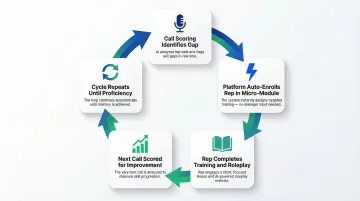
When call scoring reveals a consistent weakness, the system automatically routes that rep into a targeted micro-module, no manager intervention required across your distributor network. Pifini automates this connection between call performance and learning deployment, so the right training reaches the right distributor rep without delay.
How it works:
- Call scoring identifies a skill gap (e.g., weak discovery questioning)
- Platform automatically enrolls the rep in a focused 10-15 minute module on discovery techniques
- Rep completes training and practices in simulated roleplay scenarios
- Next call is scored to measure improvement
- Cycle repeats until proficiency is demonstrated
Step 4, Apply Spaced Learning, Not One-Day Workshops
Spaced repetition, a small, focused block of time each week on one part of the sales conversation, consistently outperforms the intensive but infrequent workshop model.
A study of 81 sellers across three distributors found 12.6% average sales growth after completing a spaced-learning program. One pipe and plumbing distributor saw 2.5x improvement in new account generation among reps who completed the week-by-week, peer-practice model.
Spaced learning structure:
- 15-20 minutes of focused learning per week
- One specific skill per week (not multiple topics)
- Peer practice sessions to apply the skill
- Manager-led reinforcement discussions
- Ongoing measurement of application in real calls
Distributed practice builds retention that a single training day simply cannot replicate.
Step 5, Make Managers the Reinforcement Layer
Training delivered in isolation, without manager involvement, rarely transfers to behavior change. Organizations with dynamic coaching (formal coaching aligned to enablement) achieve 55.2% win rates, a 19% improvement over average.
Managers need clear playbooks to:
- Run reinforcement sessions that connect training to real customer situations
- Review call scores and identify coaching priorities
- Hold reps accountable to applying what they learned
- Celebrate improvement and skill mastery
Without this layer, even well-designed training degrades within weeks, because behavior change requires repetition, not just exposure.
Sales Frameworks and Ratios Every Distributor Rep Should Know
Frameworks give structure to what reps do intuitively, and benchmarks give managers something concrete to coach against. Data-driven training works when reps can measure their own activity against known performance ratios, not just gut feeling.
The 10-3-1 Prospecting Ratio
This ratio suggests that for every 10 leads at the top of the funnel, only 3 will move to the middle stage, and ultimately only 1 will convert. Use it as a personal performance diagnostic, not a universal law.
If a rep's ratio shows strong prospecting but low meeting conversion, the data tells the manager exactly where to focus the next coaching conversation.
The 70/30 Listening Rule
Most reps talk too much, pitching features before they've understood what the buyer actually needs. The 70/30 rule corrects this: listen 70% of the time, talk 30%.
Reps can self-monitor this ratio between coaching sessions, particularly when call recordings reveal they're talking too much.
The 5 C's of Sales
Structured frameworks like the 5 C's (Connect, Clarify, Convince, Commit, Close) provide actionable conversational roadmaps:
- Connect - Build rapport and establish credibility
- Clarify - Ask discovery questions to understand needs
- Convince - Present solutions aligned to stated needs
- Commit - Secure agreement on next steps
- Close - Finalize the deal and set expectations
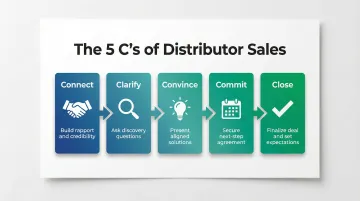
Each stage maps to the distributor sales motion. Training should reinforce each stage rather than jumping straight to product pitching.
When managers track which stage loses the most deals, Clarify, Convince, or Commit, they can stop guessing and start coaching on the specific gap that's costing revenue.
How to Coach Underperforming Distributor Sales Reps with Data
The instinct to address underperformance with generic retraining is counterproductive. Use data to diagnose the specific root cause first:
- Is the rep struggling with prospecting volume?
- With discovery conversations that uncover real needs?
- With closing and asking for the business?
- With pipeline management and follow-up consistency?
Each requires a different coaching intervention.
Data-Driven Coaching Cadence
Weekly rhythm:
- Review call scores and pipeline metrics
- Identify the one or two skill gaps most correlated with underperformance
- Assign targeted content (not a library of courses)
- Set a concrete re-evaluation checkpoint (typically 2-4 weeks)
Avoid overwhelming underperformers with too many development areas at once. Focus creates progress. That tactical structure only holds if reps actually engage with the feedback, which comes down to how you frame it.
The Psychological Component
Present performance data to reps as a tool for self-improvement, not as a performance verdict. When reps see data as diagnostic rather than punitive, they engage more openly with coaching and take ownership of the gaps.
Frame conversations around:
- "Here's what the data shows about where deals are stalling"
- "Let's focus on improving discovery questions over the next two weeks"
- "We'll measure progress with call scores and pipeline movement"
This removes manager bias from the equation, and gives reps a clear, measurable path forward rather than vague feedback to interpret on their own.
Measuring the ROI of Distributor Sales Training
Measuring ROI requires connecting training activity to revenue outcomes through specific metrics:
Leading indicators:
- Training completion rates
- Assessment and certification scores
- Call scoring improvements
- Methodology adoption rates
Lagging indicators:
- Win rates by trained vs. untrained cohorts
- Average deal size changes
- New account generation volume
- Pipeline velocity improvements
Tracking both sets of metrics is what separates programs that drive revenue from programs that just check a compliance box. Fast-growing companies are 80% more likely to achieve commercial results from sales training than slow-growing ones, because they measure these connections rigorously.
Establishing Baseline and Tracking Change
Set up a simple before/after comparison:
- Choose a cohort of reps to train
- Establish baseline metrics (current win rate, average deal size, pipeline velocity)
- Deploy training and reinforcement over 60-90 days
- Track changes in key sales metrics
- Compare against a control group or prior period
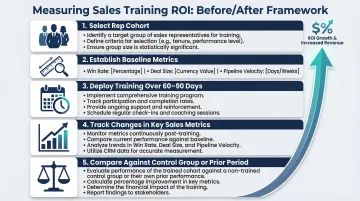
Follow this process consistently and the numbers tend to hold up. According to the Association for Talent Development, the average ROI of sales training is 353%, meaning companies earn $4.53 for every dollar invested.
Pifini automates this measurement by linking certification completions and training scores directly to CRM deal data. Sales leaders can identify which specific modules correlate with closed deals, then double down on what's working, and cut what isn't.
Frequently Asked Questions
What training should be given to a distributor sales team?
Distributor sales teams need training across product knowledge, sales and negotiation skills, market and competitor awareness, data tools/CRM proficiency, and compliance. Training should be personalized based on performance data rather than delivered as a single uniform program to all reps.
How can distributor sales training improve sales performance?
Trained reps close higher percentages of qualified leads, handle objections more confidently, and retain customers longer. These gains compound when training is continuous and tied to real performance feedback. Organizations that achieve >75% methodology adoption see win rates jump to 54.1%.
How can you use data to improve distributor sales performance?
Performance data from call recordings, win rates, pipeline metrics, and CRM activity identifies specific skill gaps at the individual rep level. This lets managers assign targeted coaching rather than generic programs, closing gaps faster and driving consistent improvement.
How do you coach underperforming distributor sales reps?
Diagnose the root cause of underperformance using data (call scoring, pipeline conversion, activity metrics) before prescribing a coaching intervention. Focused, one-gap-at-a-time coaching with a clear re-evaluation timeline consistently outperforms blanket retraining.
What are common sales rules and ratios used in distributor sales training (e.g., 3-3-3, 2-2-2, 10-3-1, 70/30)?
Ratios like 10-3-1 (prospects to meetings to deals) and the 70/30 listening rule serve as personal performance benchmarks that help reps and managers identify exactly where in the sales process improvement is needed. These frameworks work best when tracked against actual CRM data, not applied as rigid mandates.
What are the 5 C's of sales that distributors should know?
The 5 C's are Connect, Clarify, Convince, Commit, and Close. Each stage maps to the distributor sales motion: building rapport, uncovering needs through discovery, presenting aligned solutions, securing next-step commitments, and finalizing deals. This framework helps reps structure customer conversations deliberately rather than improvising.