Introduction
Picture this: a sales rep who aced every quiz, memorized every framework, and confidently recited the pitch deck to her manager. Then she froze in front of a real client, stumbling through discovery, missing obvious buying signals, and ultimately losing a winnable deal. Knowing a script is not the same as being prepared to use it under pressure.
That gap between classroom-ready and client-ready is costing organizations more than they realize. Companies spend an average of $1,283 per employee on workplace learning annually, yet 84% of sales reps still miss their quotas. Win rates and ramp times stay stubbornly inconsistent despite the investment.
The problem isn't how much organizations spend on training, it's that most training never puts reps in situations that resemble real selling. That's especially costly for teams operating through complex or partner-driven channels, where every conversation counts and mistakes are harder to catch.
Key Takeaways
- Traditional sales training delivers information but skips realistic practice, leaving reps to figure out live conversations on real prospects
- Reps pass assessments but freeze under actual selling pressure because training never closes the knowledge-to-performance gap
- AI-powered simulations create repeatable, risk-free environments where reps practice objection handling and sharpen consistent response patterns
- AI simulations go beyond static training: they deliver personalized feedback and connect learning directly to measurable revenue outcomes
- Partner and channel ecosystems suffer most, inconsistent training across resellers and distributors quietly kills pipeline at scale
The Hidden Cost of Traditional Sales Training
The financial stakes of inadequate training are massive. A bad sales hire costs up to $240,000 when factoring in salary, training investment, and lost deal value. For SaaS Account Executives, average ramp time has stretched to 5.7 months, meaning nearly half a year of payroll before a rep reaches full productivity.
The "Practicing on Real Customers" Problem
Without a safe environment to rehearse, reps inevitably experiment during live sales calls. Every mistake costs real pipeline. A rep who doesn't know how to handle a pricing objection will learn on a $50,000 opportunity, and probably lose it. This trial-by-fire approach accelerates learning for a few natural sellers but leaves the middle majority floundering.
That inconsistency compounds when training is classroom- or workshop-based. Execution varies wildly across the team: some reps thrive, most plateau, and there's no systematic way to close the gap.
The Lagging Indicator Trap
Traditional training gives managers no visibility into selling behavior until deals are already closed or lost, too late to intervene. Unlike an athlete who spots a slump after a few missed shots, sales managers often don't know a rep is struggling for a full quarter.
That blind spot is bad enough for direct sales teams. For distributed and partner-led organizations, it's worse:
- Remote reps receive inconsistent coaching
- Channel partners get infrequent, one-size-fits-all enablement
- Resellers and distributors sell with low confidence
- Training quality varies dramatically across the ecosystem
Why Traditional Sales Training Doesn't Build Real-World Skills
Traditional training operates on one flawed assumption, that delivering information creates behavior change. The evidence says otherwise.
The One-Size-Fits-All Failure
Classroom sessions and standard eLearning modules present the same content regardless of a rep's actual skill gaps. High performers disengage because they already know the material. Struggling reps fall further behind because the pace doesn't match their needs. Neither group gets what they actually need.
The Linear Scenario Problem
Training presents clean, scripted objection-handling scenarios. But real sales conversations are nonlinear. Clients interrupt, change priorities, introduce new stakeholders, and raise objections from unexpected angles. Training that simplifies reality doesn't prepare reps for reality.
The numbers back this up. The National Training Laboratory puts lecture-style retention at just 5%, while practice-based learning reaches 75%. Information delivery alone does not build durable skills.
Why Role-Play in Group Settings Fails
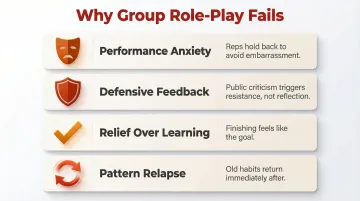
Even when training introduces practice, the format undermines the outcome. Traditional role-play in front of peers creates performance anxiety, not learning:
- Reps hold back to avoid embarrassment
- Feedback is public, which triggers defensiveness rather than reflection
- Relief at finishing replaces any motivation to internalize new behavior
- Old patterns return the moment the exercise ends
The Manager Coaching Gap
When group training falls short, the burden falls on managers, but they face their own set of constraints. Most default to broad feedback rather than identifying specific skill gaps, not because they don't care, but because they lack the behavioral data and time to intervene precisely.
The result:
- Generic advice that doesn't address root causes
- Coaching conversations that feel subjective
- Reps who don't know what specifically to improve
- Managers who can't prove coaching effectiveness
How AI-Powered Simulations Bridge the Gap
An AI sales simulation is a dynamic, scenario-based practice environment where an AI counterpart responds adaptively to the rep's choices. The AI adjusts buyer personality, raises unexpected objections, and simulates the emotional and conversational pressure of real selling.
Adaptive, Personalized Learning
Because AI analyzes a rep's responses in real time, each simulation surfaces the specific gaps for that individual. Someone who talks over the buyer hears different feedback than someone who struggles to ask for the close. This personalization is what one-size-fits-all training structurally cannot deliver.
The "Fail Forward" Loop
Reps can practice a difficult objection scenario dozens of times without risking a real deal. Each iteration builds genuine decision agility, not just script recall. When a real client deviates from expectation, the rep adjusts fluidly rather than freezing.
That same fluency carries into live conversations, which is where AI coaching extends its reach.
Real-Time Coaching and Live Call Support
Beyond practice environments, platforms like Pifini.ai extend AI coaching into live calls. The system analyzes conversations as they happen, flags gaps in real time, and routes reps into targeted microlearning after each call rather than waiting for a quarterly review.
During active calls, the AI delivers:
- Contextual content recommendations matched to the conversation
- Live coaching cues on tone and pacing
- Instant objection-handling prompts as objections arise
Behavioral Data Transforms Coaching
AI simulations generate quantitative data on every decision point:
- Where reps hesitate
- Which objections derail them most often
- How their approach evolves over time
- Talk patterns, discovery quality, and closing effectiveness
Managers coach on evidence, not instinct.
What Makes AI Sales Simulations Actually Work
Not all AI simulations deliver results. Effective platforms share specific characteristics.
Scenario Variety and Realism
Effective simulations expose reps to a wide range of customer archetypes, the skeptical CFO, the distracted IT buyer, the price-sensitive mid-market prospect. Reps build adaptability as instinct, not as a situational workaround.
Critical requirement: Scenarios must reflect the organization's actual customer profiles, not generic examples. A rep selling to healthcare compliance officers needs different practice than one selling to retail operations managers.
That context-specificity also shapes how training gets delivered. Short, focused bursts work far better than long blocks that pull reps out of their workflow.
Microlearning Integration
Sales teams are time-constrained. Effective AI simulation platforms fit practice into the flow of a normal week:
- A five-minute negotiation challenge
- A rapid discovery exercise
- A single objection-handling drill
None of these require reps to step away from pipeline activity, and that consistency compounds over time.
Gamification and Engagement Mechanics
Leaderboards, performance scores, and achievement milestones keep reps returning voluntarily, no manager mandate required. When practice feels competitive, reps engage on their own terms:
- Progress is visible, not assumed
- Competition drives consistent engagement
- Achievements offer peer recognition
- Skill mastery becomes personally rewarding
The Overlooked Problem: Training Partner and Channel Sales Teams
Partner and channel training is where traditional methods fail most dramatically.
Why Partner Training Is the Hardest Problem
Resellers, distributors, and alliance partners rarely sit in your LMS, attend your workshops, or receive manager coaching. They get a product deck and a kick-off call, then they're expected to sell on your behalf, often inconsistently and with low confidence.
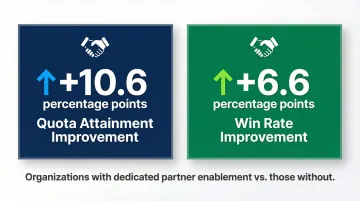
That confidence gap has real consequences. Organizations with dedicated enablement see quota attainment improve by 10.6 percentage points and win rates improve by 6.6 percentage points compared to those without, yet most partner programs still rely on delivery methods that can't reach the full ecosystem.
The Scale and Consistency Challenge
An enterprise with hundreds of channel partners cannot deliver personalized coaching to each one. Partners operate independently, across time zones, with varying levels of sales sophistication. Traditional instructor-led training reaches only a fraction of the partner ecosystem.
AI simulations address this directly:
- Deployed to partners on demand, inside their own workflow
- Delivers immediate feedback without requiring manager presence or scheduling
- Lets partners practice handling objections specific to your product
- Builds the repetition and consistency that translate into higher close rates
Connecting Training to Revenue: How to Measure What Matters
Traditional training ROI is nearly impossible to prove. Most programs track completion rates and post-training quiz scores, neither of which correlates reliably to revenue performance. Leaders know training is important but cannot prove it in board-level terms.
The Behavioral Data Advantage
Simulation platforms capture granular data on skill progression:
- Which scenarios a rep passes
- Where they stall
- How their decision patterns improve
This behavioral data can be mapped against pipeline movement, win rates, and average deal size. That connection is what turns enablement investment into a revenue argument.
How Pifini Links Training to Revenue
Pifini's Training Impact Analysis module connects certification completions and learning scores directly to measurable sales outcomes. Revenue leaders get a unified dashboard that shows exactly which training drives results, and where performance gaps are forming before they hit the pipeline.
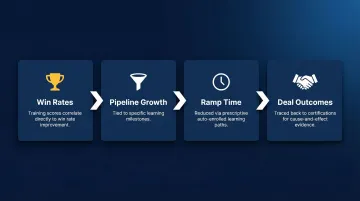
The platform tracks four core dimensions:
- Win rates improve as training scores rise, the correlation is direct and reportable
- Pipeline growth tied to specific learning milestones, not general activity
- Ramp time reduced by prescriptive learning paths that auto-enroll reps based on performance data
- Deal outcomes traced back to certifications, giving managers clear cause-and-effect evidence
At $50/user/year with no add-ons, Pifini delivers this capability alongside Digital Sales Rooms, AI Sales Roleplay, Live Call Copilot, Enterprise LMS, and Call Scoring, in one platform. Legacy alternatives like Seismic, Bigtincan, and Mindtickle charge $300–$600 per user for comparable functionality.
Frequently Asked Questions
What are the five methods of sales training?
The five common methods are instructor-led classroom training, eLearning/online modules, role-play, on-the-job coaching, and simulation-based training. AI-powered simulations build on that last method, adding dynamic personas, real-time feedback, and on-demand scalability that traditional role-play can't match.
What are common sales rules (e.g., 3-3-3, 10-3-1, and 2-2-2) used in sales training?
Sales rules like these are activity-based frameworks, calls, emails, or touchpoints per sequence, used to structure outreach and follow-up cadences. While these frameworks provide useful structure, they only deliver results when reps have practiced the actual conversations those touchpoints require.
What is an AI sales simulation, and how is it different from traditional role-play?
AI simulations use adaptive AI counterparts that respond dynamically to a rep's choices, adjusting persona, objections, and emotional tone in real time. Unlike scripted role-play, they're repeatable, scalable, and deliver personalized feedback without a human facilitator.
How long does it typically take for new sales reps to reach full productivity, and can AI training shorten that?
Industry average ramp time is often cited at 6–12 months, with SaaS AEs averaging 5.7 months. AI simulations accelerate ramp by compressing the practice cycles that would otherwise happen on real prospects, reducing time-to-productivity by weeks or months.
Can AI sales simulations be used for partner and channel sales teams, not just direct reps?
Yes. AI simulations are especially well-suited to partner ecosystems because they can be deployed on demand without requiring manager oversight, enabling consistent enablement across resellers, distributors, and alliances at scale.
How do you measure the ROI of AI-powered sales training?
Measure ROI by linking simulation performance data and certification completions to downstream revenue metrics, win rates, ramp time, deal size, and pipeline conversion, rather than relying on completion rates or quiz scores alone.