Introduction
Remote sales teams are scaling faster than ever, but new hires still face a daunting productivity gap. According to CSO Insights, new hires in complex B2B sales environments take 9.2 months to reach full productivity. Sales development reps typically ramp in around 3 months. For distributed teams, that timeline stretches even longer, without access to informal learning like shadowing top performers, overhearing successful calls, or grabbing quick coaching between meetings.
Generic learning management systems or shared Google Drives can't replicate that "hallway coaching" environment. They leave remote reps practicing in isolation, managers flying blind on performance gaps, and revenue leaders unable to connect training investments to pipeline outcomes.
The cost compounds fast. SHRM estimates replacing a bad hire can reach $240,000 in total.
This guide covers the top tools that solve both sides of that challenge. You'll find platforms that accelerate onboarding through structured learning, AI roleplay, and conversation intelligence, alongside analytics tools that tie training activity directly to deal outcomes.
Key Takeaways
- Structured learning paths, AI roleplay, and conversation intelligence compress sales ramp time significantly
- Effective stacks pair onboarding with analytics that connect training directly to deal outcomes and pipeline impact
- Top tools include Pifini.ai, Gong, Mindtickle, Highspot, and Hyperbound, each addressing different enablement layers
- When evaluating platforms, prioritize CRM integration, AI coaching capabilities, and revenue outcome correlation
- Teams managing partner or channel sales need tools that support external users, resellers and distributors, not just direct reps
Why Remote Sales Onboarding Needs Specialized Tools
The core challenge unique to remote onboarding is the practice gap. New hires miss the informal coaching moments that in-office reps naturally absorb, shadowing experienced sellers, listening to live objection handling, or getting instant feedback after a challenging call. These informal touchpoints accelerate learning in ways that video libraries or static documentation cannot replicate.
The market recognizes this gap. The global sales enablement platform market was valued at $5.23 billion in 2024 and is projected to reach $12.78 billion by 2030, growing at a 16.3% CAGR. This growth reflects organizations searching for AI-driven support that fits into daily workflows and ties learning directly to measurable sales outcomes.
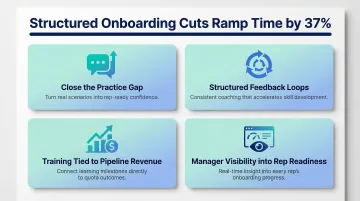
Research from the Sales Management Association shows that structured onboarding programs cut average time-to-productivity from 9.1 months to 5.7 months, a 37% reduction. The tools below were selected because they tackle both sides of that problem:
- Close the practice gap with interactive, scenario-based learning
- Replace informal coaching with structured, repeatable feedback loops
- Connect training completion to pipeline and revenue outcomes
- Give managers visibility into rep readiness, not just course completion rates
Top Tools for Remote Sales Rep Onboarding & Analytics
These platforms were evaluated based on remote-readiness, AI coaching capability, analytics depth, CRM integration, and ability to connect training outcomes to revenue performance, not just completion rates.
Pifini.ai
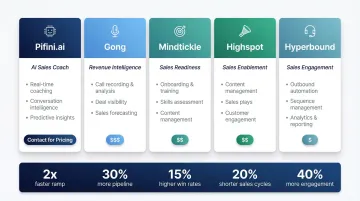
All-in-one AI-powered revenue enablement platform built specifically for partner and channel sales ecosystems. Pifini.ai combines training, content, AI coaching, and analytics in a single platform for $50/user/year, making enterprise-grade capabilities accessible for organizations that find legacy tools like Seismic or Mindtickle prohibitively expensive.
The platform is purpose-built for partner-first sales structures: it auto-enrolls resellers and distributors into targeted training when performance gaps are detected, includes live AI coaching during customer calls, and links certification scores directly to deal outcomes and pipeline growth, not just module completion.
Across 436 sessions, Pifini.ai achieved a 46.1% training success rate with an average sales performance improvement of 16.7%.
| Key Features | Enterprise LMS with prescriptive auto-enrollment, live AI sales call coaching, call scoring, gamification, microlearning, partner engagement tools, training-to-revenue analytics, and AI CAM concierge for 24/7 partner support |
| Best For | Sales leaders, channel managers, and revenue teams managing resellers, distributors, or alliances who need onboarding and performance analytics in one platform |
| Pricing | $50/user/year (flat, no add-ons or hidden costs) |
Gong
Revenue intelligence platform that turns every recorded sales conversation into a coaching and onboarding resource. New reps learn what "good" looks like by studying real calls from top performers, segmented by deal stage, objection type, or buyer persona.
Gong's analytics depth sets it apart: the platform surfaces conversation patterns, talk ratios, question quality, competitor mentions, and correlates rep behaviors with win rates. Managers get a clear, data-driven view of which new hires are on track and which need intervention. Iron Mountain cut new rep ramp time by 3 months; ComplyAdvantage reduced it by 50%.
| Key Features | Call recording, transcription, conversation intelligence, curated call libraries, deal analytics, and rep performance dashboards |
| Best For | Revenue leaders and sales managers who want onboarding grounded in real customer conversations and analytics tied to pipeline outcomes |
| Pricing | Custom pricing based on team size and modules; per-user licensing with platform fees |
Mindtickle
Comprehensive sales readiness platform combining structured onboarding curricula, AI-powered roleplay, conversation intelligence, and readiness scoring in one enterprise-grade system, widely adopted by large, distributed organizations with complex products and formal enablement functions.
Its "readiness scores" aggregate knowledge assessments, roleplay performance, and real call data into a single rep readiness index, giving enablement teams a clear signal of who is ready to sell before they go live with prospects. Janssen India saw a 50% reduction in rep ramp time; Radware compressed onboarding from 6–12 months down to 1–3 months.
| Key Features | Structured onboarding programs, AI roleplay with automated feedback, conversation intelligence, readiness scoring, and certification tracking |
| Best For | Enterprise sales teams (100+ reps) with formal enablement functions and complex, multi-stage sales cycles |
| Pricing | Custom pricing with flexible volume-based discounts |
Highspot
Sales enablement platform that layers AI-guided selling on top of content management, training, and coaching. The platform uses deal context to recommend the right content and next best actions to reps in real time during active opportunities.
Where Highspot earns its place is analytics governance: the platform tracks content usage by deal stage, buyer engagement with shared materials, and win rate by enablement activity, giving revenue operations teams a clear view of what's actually driving results across distributed teams. Baker Tilly saw a 16% win rate increase; ExtraHop achieved a 10% improvement.
| Key Features | Content management, AI-guided selling, sales training, coaching programs, certifications, and revenue analytics dashboards |
| Best For | Enterprise and mid-market teams that want unified content + training + analytics and AI-powered guidance during active deals |
| Pricing | Custom pricing tailored to capabilities, use cases, and organization size |
Hyperbound
AI sales roleplay platform focused specifically on solving the "practice gap" in remote onboarding. New reps rehearse cold calls, discovery conversations, objection handling, and demos against AI buyers before ever speaking to a real prospect.
Practice scenarios are customizable to specific products, personas, and sales methodologies, with instant AI scorecard feedback on talk ratio, question quality, and playbook adherence. That removes the bottleneck of manager-led rehearsals entirely. One customer reported 50% faster ramp time compared to previous onboarding cohorts.
| Key Features | AI sales roleplays, AI real call scoring, AI coaching, post-sales roleplays, onboarding certifications, and performance scorecards |
| Best For | Sales teams of any size that want to accelerate rep confidence and competence through unlimited, risk-free practice before live customer interactions |
| Pricing | Free tier (9 AI roleplay bots); custom tier with unlimited bots and LMS integration |
What to Look for in a Remote Onboarding and Analytics Tool
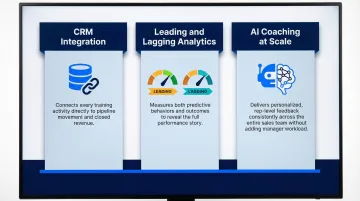
Three capabilities separate tools that actually improve sales performance from ones that just track activity:
CRM integration that connects training to revenue. The platform must link onboarding activity directly to your CRM, Salesforce, HubSpot, or Microsoft Dynamics, so managers can correlate learning progress with real pipeline and win rate. Forrester notes that enablement vendors must deliver metrics tying training activity to real-world sales outcomes, not just module completions.
Analytics covering both leading and lagging indicators. Completion rates tell you almost nothing on their own. Look for tools that measure knowledge retention, call quality scores, and roleplay performance, then connect those inputs to ramp-to-quota speed, win rates, and partner churn. Gartner frames this as two tiers: lagging indicators (deal count, win rate, average deal size) and leading indicators (lead response time, interaction quality, sales cycle time). You need visibility into both.
AI coaching that scales without adding manager workload. Remote managers can't sit in on every call. Tools with AI roleplay, live call guidance, and automated performance scoring give reps consistent, objective feedback at scale. According to Gartner, 65% of B2B sales organizations will shift from intuition-based to data-driven decision making by 2026, and the platforms enabling that shift are the ones that unite workflow, data, and AI in a single system.
How We Chose These Tools
Evaluation was based on five criteria:
- Remote-readiness: Async learning, self-serve formats, mobile access
- AI coaching capability: Roleplay, live guidance, automated scoring
- Analytics depth: Beyond completion rates to revenue outcome correlation
- CRM and tech stack integration: Native, bi-directional data flow to systems of record
- Channel sales suitability: Support for both direct and partner/reseller ecosystems
These criteria exist because a common buyer mistake is selecting tools based on feature lists alone, without verifying that analytics actually connect to deal data or that the platform scales across partner ecosystems.
The tools below cover distinct categories: all-in-one platforms, specialized practice environments, conversation intelligence layers, and revenue analytics. Start with your biggest gap, structured learning, safe practice, call insight, or pipeline visibility, and match from there.
Conclusion
Selecting the right remote onboarding and analytics tool is a revenue decision. A rep who ramps in 3 months instead of 9 creates compounding value across every hire you make. Platforms that connect learning to measurable outcomes are what separate high-performing revenue teams from those perpetually chasing quota.
Audit your current onboarding stack against the five criteria above and identify your biggest gap, structured learning, practice environments, or performance analytics. Then match the tool to that specific gap rather than defaulting to the most-recognized brand name.
For teams managing partner or channel sales who need onboarding, AI coaching, and analytics in one affordable platform, Pifini.ai covers that specific use case, onboarding, AI coaching, and analytics unified at $50/user/year with no add-ons or hidden costs.
Frequently Asked Questions
What is the difference between a sales onboarding platform and a sales analytics tool?
Onboarding platforms focus on delivering structured training, roleplay, and certifications to new reps, while analytics tools measure performance and correlate behaviors with revenue outcomes. The most effective modern platforms combine both in a single system, connecting what reps learn to how they actually perform in live customer interactions.
How long does it typically take to onboard a remote sales rep?
Average ramp time ranges from 3 months for sales development reps to reach basic effectiveness, up to 9.2 months for full productivity in complex B2B sales roles. Structured, tech-enabled onboarding programs can cut this timeline significantly, the Sales Management Association found that highly structured programs reduce ramp time from 9.1 to 5.7 months.
What metrics should I track to measure remote sales onboarding success?
Track both leading indicators (training completion, roleplay scores, knowledge check results, call quality metrics) and lagging indicators (time to first meeting, time to first close, ramp-to-quota achievement, win rate). Leading indicators predict future performance, while lagging indicators confirm whether training delivered actual business results. Both are necessary for a complete picture.
How does AI coaching improve remote sales rep performance during onboarding?
AI coaching delivers consistent, objective feedback across every rep simultaneously through roleplay simulations, live call guidance, and automated call scoring. It replaces the ad-hoc manager shadowing that remote reps miss, ensuring every rep gets the same quality of development regardless of location, without consuming manager bandwidth.
Can small or mid-sized sales teams benefit from dedicated onboarding and analytics software?
Smaller teams often benefit more than larger organizations, each rep's productivity has greater individual impact, making consistent onboarding critical. Affordable, unified platforms like Pifini.ai at $50/user/year remove the cost barrier that historically kept enterprise enablement tools out of reach for SMBs.
What should I look for in a tool if I manage channel or partner sales reps?
Most direct-sales platforms don't natively support external users like resellers, distributors, and alliances. Look for partner-specific features: multi-tenant access controls, auto-enrollment based on performance gaps, partner engagement analytics, and training-to-deal-registration correlation.