: Complete Guide](https://file-host.link/website/pifini-9bdf2g/assets/blog-images/0bc831c6-474b-48a8-a595-8a72420e59de/1776172114101296_a29accab7ca3429bb31267a4b8e52164/360.webp)
Introduction
Picture two sales reps starting on the same Monday. The first sits through a three-hour generic training deck, regardless of their actual skill gaps. The second gets an AI-curated learning path that analyzes their real calls, pinpoints where they lose deals on objection handling, and queues up targeted 5-minute modules before their next customer meeting.
Which one ramps faster? Which one closes more deals?
Most sales organizations still default to the first approach. Traditional sales training is static, one-size-fits-all, and impossible to scale across large partner ecosystems or distributed teams.
The numbers back this up. According to Salesforce's State of Sales report, only 26% of sales reps receive weekly 1:1 coaching. Meanwhile, 69% of B2B reps are missing quota, and average ramp time has stretched to 5.7 months.
This guide covers what AI personalization in sales training means, the five core ways it transforms learning delivery, how to implement it across your organization, and how to measure its direct impact on revenue.
Key Takeaways
- AI personalizes sales training by analyzing rep performance data, call recordings, quiz scores, CRM activity, and tailoring learning paths to specific skill gaps
- Core capabilities include adaptive learning paths, AI role-play simulations, real-time call coaching, automated skills gap detection, and prescriptive training enrollment
- For partner sales channels (resellers, distributors, alliances), AI personalization is the only scalable way to maintain consistent training quality across external sellers
- Implemented correctly, AI-personalized training links directly to faster ramp times, higher win rates, and improved pipeline conversion
What Is AI Personalization in Sales Training?
AI personalization in sales training moves training away from generic curriculum delivery toward adaptive learning experiences built around each individual rep. Unlike traditional programs that apply the same modules to all reps, AI personalization uses performance data, behavioral signals, and CRM inputs to tailor the learning experience, including content, pacing, format, and coaching feedback, to each individual seller's needs.
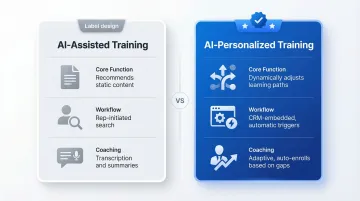
The distinction between AI-assisted and truly AI-personalized training matters:
| Feature | AI-Assisted Training | AI-Personalized Training |
|---|---|---|
| Core Function | Recommends static content or answers queries | Dynamically adjusts learning paths based on real-time performance |
| Workflow | Requires rep to initiate search/query | Embedded in CRM; triggers automatically based on deal stage and buyer signals |
| Coaching | Provides transcription and summaries | Delivers adaptive coaching that changes based on rep performance and auto-enrolls in targeted modules when gaps are detected |
The underlying technology analyzes multiple data streams simultaneously: call recordings, quiz scores, deal outcomes, and CRM activity. These inputs build a living performance profile for each rep that continuously shapes what they learn next.
That shift is producing measurable results. Gartner projects AI-driven enablement will deliver 40% faster sales stage velocity than traditional methods by 2029, which helps explain why investment is accelerating.
The global sales enablement platform market was valued at $5.23 billion in 2024 and is projected to reach $12.78 billion by 2030, growing at a 16.3% CAGR. 80% of sales organizations plan to invest in AI-powered sales enablement tools within the next two years.
Five Ways AI Personalizes Sales Training
Adaptive Learning Paths Based on Performance Data
AI continuously monitors each rep's quiz scores, module completion, CRM activity, and deal outcomes to build an individual skill profile. Rather than forcing every rep through the same sequence, the system automatically adjusts their learning path, skipping content they've mastered and routing them toward modules targeting their weakest areas.
Prescriptive enrollment is the game-changer. When a rep consistently struggles with a specific objection type or product knowledge area, AI doesn't wait for a manager to notice. It auto-assigns targeted training modules immediately, closing the gap in real time, not at the next quarterly review.
Research validates this approach. Peer-reviewed studies show that adaptive spacing based on ongoing assessments yields 33% higher learning efficiency at immediate posttest and 31% higher efficiency at delayed posttest compared to fixed schedules.
This automation is critical at scale. Manually assigning customized learning paths to hundreds of resellers isn't feasible, AI makes it possible without adding headcount.
Real-Time AI Coaching During and After Sales Calls
AI analyzes live or recorded sales calls for specific behavioral signals:
- Talk-to-listen ratio (optimal is around 57% rep talk time vs. 62% in lost deals, according to Gong's analysis of 326,000 calls)
- Keyword usage and messaging alignment
- Sentiment shifts during the conversation
- Objection handling effectiveness
- Deal-stage messaging consistency
The system delivers instant, specific coaching to the rep. Not generic feedback like "talk less," but actionable guidance like "You didn't address the budget concern raised at 12:34; here's the recommended response framework."
Pifini's platform takes this further with live AI support during customer calls. The system evaluates every interaction in real time, flags coaching opportunities, and automatically routes reps into targeted training based on what the AI identifies in their calls. This creates a tight loop between selling activity and skill development: when a rep struggles with pricing objections on Tuesday, they receive objection-handling microlearning on Wednesday.
Organizations using conversation intelligence and coaching platforms see measurable impact. Forrester TEI data indicates a 12% higher closed/won rate for companies using these tools.
AI Role-Play and Scenario Simulations
AI-powered role-play allows reps to practice handling objections, negotiating pricing, or navigating discovery conversations with a simulated AI buyer. It's available on demand, with no manager time required, at any level of difficulty or deal complexity.
Interactive simulation accelerates skill acquisition because reps learn through doing, not just watching. Practice looks like:
- Immediate feedback on every response
- Unlimited scenario repetition until confidence is genuine
- Muscle memory built for real selling situations, not slide-deck familiarity
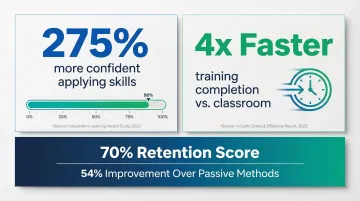
PwC research found that learners using interactive simulation-based training were 275% more confident in applying what they learned and completed training four times faster than those in traditional classroom settings. A separate study on active learning showed participants in highly interactive sessions scored 70% on retention tests, a 54% improvement over passive lecture methods.
For distributed teams and partner ecosystems, on-demand role-play eliminates the scheduling bottleneck entirely. A reseller in Sydney can practice a competitive positioning conversation at 11 PM local time without waiting for a manager to be available.
Microlearning and Just-in-Time Content Delivery
AI breaks long training programs into short, targeted microlearning modules and surfaces the right content at the right moment:
- Before a high-stakes call (competitive positioning guide)
- After a lost deal (objection handling module)
- When a rep enters a new deal stage (discovery question framework)
Learning becomes contextually relevant rather than arbitrarily scheduled. Instead of a two-day training bootcamp that reps forget within a week, they receive 5-minute modules exactly when they need them.
Adoption reflects this effectiveness. Brandon Hall Group found that 71% of companies say increasing their use of microlearning is critical to achieving business goals. Microlearning courses typically have an 80% completion rate, and studies show it can improve retention by 25-60% compared to traditional methods.
Skills Gap Identification Across Teams
AI surfaces skills gap patterns not just at the individual level but across the entire team or partner network. Sales leaders can see:
- Which objections the whole team is losing to
- Which product knowledge areas are weakest across a region
- Which partner tier is underperforming on specific competencies
This enables strategic training investments rather than reactive fixes. Instead of waiting for quarterly business reviews to reveal that your APAC partners struggle with ROI conversations, AI flags the pattern in real time, allowing you to deploy targeted training before it impacts pipeline.
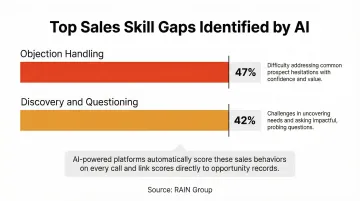
RAIN Group identifies the top sales skill gaps as objection handling (47%) and discovery and questioning (42%). AI-powered platforms automatically score these behavioral metrics on every call, linking quality scores directly to opportunity records to identify gaps proactively.
How to Implement AI-Personalized Sales Training at Scale
Start with Data Readiness
AI personalization is only as good as the data feeding it. Organizations need clean CRM data, consistent call recording practices, and baseline performance benchmarks before AI can generate meaningful personalized recommendations.
Action steps:
- Audit your CRM data quality, standardize opportunity stages, close reasons, and activity logging
- Establish consistent call recording across the team (aim for 80%+ coverage)
- Define baseline performance metrics (average ramp time, win rate by rep segment, deal stage conversion rates)
- Start with a pilot cohort of 20-30 reps to test and calibrate the system before rolling out broadly
Address Integration Requirements
AI personalization tools must connect to your existing sales tech stack, CRM, LMS, and communication tools. Coaching recommendations and learning assignments need to live inside the rep's daily workflow, not in a separate platform they have to remember to log into.
Required integrations typically include:
- CRM (Salesforce, HubSpot, Microsoft Dynamics) for deal data and activity tracking
- Communication tools (Zoom, Microsoft Teams, Gong, Chorus) for call recording and analysis
- Existing LMS or content repositories for training library access
- Identity management (Okta, Azure AD) for authentication and access control
Platforms like Pifini offer 100+ integrations across CRM, PRM, video conferencing, and APIs, simplifying deployment for extended enterprise scenarios.
Scale for Partner Ecosystems
When training extends beyond the internal sales team to resellers, distributors, and channel partners, AI personalization becomes even more critical. You cannot rely on manager-led coaching at scale across external partners.
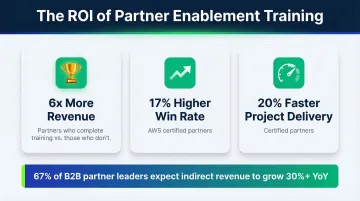
Forrester reports that 67% of B2B partner ecosystem leaders expect indirect revenue to grow more than 30% above prior year levels. Partners who complete training or certification earn 6x more revenue on average than those who do not. A Forrester TEI study of AWS Training found that certified partners achieved a 17% increased win rate, 7% richer average deal size, and 20% faster project delivery.
Purpose-built partner enablement platforms like Pifini automatically deploy personalized learning to partner networks, track training completion alongside deal performance, and reduce onboarding time without adding headcount.
At $50/user/year, that's a significant cost contrast to legacy alternatives like Seismic, Bigtincan, and Mindtickle, which charge $300–$600/user/year.
Implement Change Management
Adoption matters as much as capability. Sales leaders should:
- Communicate the direct rep benefit: faster skill development, less time in irrelevant training, better call preparation
- Involve managers in reviewing AI coaching recommendations rather than positioning AI as their replacement
- Encourage daily use as a habit built into existing workflows, not a compliance checkbox
- Share early wins, highlight reps who used AI role-play before a high-stakes call and closed the deal
Phase Implementation Strategically
Begin with one or two high-impact use cases:
- Phase 1: Pre-call prep role-play + post-call AI coaching feedback
- Measure results: Track win rate change, call quality score improvement, rep engagement
- Phase 2: Expand to adaptive learning paths and prescriptive enrollment
- Phase 3: Roll out skills gap identification dashboards for managers
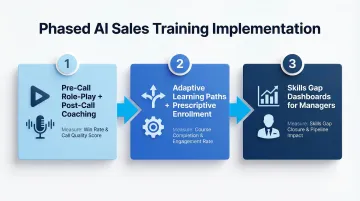
This phased approach proves ROI at each stage before you ask the organization to change everything at once.
Measuring the ROI of AI-Personalized Sales Training
The Attribution Challenge
Most organizations measure training completion rates and quiz scores, but these are leading indicators that don't tell you whether training translated to selling improvement. According to a 2025 CSO Insights study, only 29% of sales enablement teams can directly tie their programs to revenue impact. A 2024 Forrester report found that 67% of enablement leaders cite "proving ROI" as their top challenge.
The real ROI of AI-personalized training requires linking training activity to revenue outcomes, a connection traditional LMS platforms aren't built to make.
Key Metrics to Track
Focus on revenue-linked metrics, not just activity metrics:
Leading indicators:
- Time-to-productivity for new reps (target: reduce by 20-30%)
- Training completion rates for targeted modules
- Call quality scores pre- and post-training
Lagging indicators:
- Win rate change before and after AI coaching interventions
- Deal stage conversion improvement (especially early-stage to mid-stage)
- Reduction in average sales cycle length
- Decrease in manager time spent on remedial coaching sessions
Partner channel metrics:
- Certified vs. uncertified partner deal volume
- Win rate differential between trained and untrained partners
- Time-to-first-deal for newly onboarded partners
How AI Platforms Enable Better Measurement
AI-personalized platforms make measurement possible because they track what each rep learned, when they practiced, and how their call behavior changed. This creates a direct line from a specific training module or coaching intervention to a deal outcome.
Consider a rep who completes an objection-handling module on Monday and runs two AI role-play sessions the same day. On Friday, they close a deal by addressing that exact objection, flagged by call scoring. The platform connects the training event to the outcome directly, without guesswork.
The data behind this kind of measurement is compelling:
- 353% average ROI on sales training, $4.53 returned per dollar invested (ATD)
- 34% more first-year reps hit quota when post-training reinforcement is used
- Up to 30% faster new-rep ramp-up with AI coaching interventions
Common Pitfalls When Adopting AI Sales Training
Over-Relying on AI-Generated Content Without Human Review
AI can generate training scripts, role-play scenarios, and coaching notes at speed, but without human oversight, this content can contain inaccuracies, outdated competitive messaging, or generic advice that undermines rep trust.
Mitigation: Establish a review process where sales enablement owns quality control of AI-generated materials before deployment. Assign subject matter experts to validate technical accuracy and competitive positioning.
Treating AI Personalization as a One-Time Setup
AI personalization systems require continuous calibration. As products change, markets shift, and new objections emerge, the training content and skills profiles need updating. Organizations that deploy AI training and walk away will find the system drifts out of relevance within months.
Mitigation: Schedule quarterly content reviews, assign ownership for updating training modules, and monitor engagement metrics to identify content that's no longer resonating.
Ignoring Rep Adoption Data
If reps aren't engaging with AI training recommendations, the system isn't working. Track engagement signals, module completion, role-play usage, pre-call prep rates, and use them to identify friction points, not just confirm participation.
The failure rate for enterprise AI deployments underscores why this matters. An August 2025 MIT report found that 95% of enterprise GenAI pilots fail, primarily due to flawed integration rather than model quality. McKinsey's 2026 State of AI Trust report adds that 74% of organizations cite inaccuracy as a highly relevant risk, and nearly two-thirds flag security and risk concerns as the top barrier to scaling agentic AI.
Mitigation: Integrate AI deeply into existing workflows (CRM, daily rep routines) rather than using disconnected tools. Anchor AI in deterministic systems like approved playbooks and CRM data to enforce guardrails. Implement robust AI governance and human-in-the-loop oversight.
Frequently Asked Questions
How can AI be used for sales training and real-time coaching?
AI analyzes call recordings, rep performance data, and CRM insights to deliver personalized feedback, flag skill gaps, and route reps to targeted training, both in real time during calls and asynchronously through adaptive learning platforms.
How to scale a sales team with AI?
AI enables scaling by automating personalized coaching and auto-enrolling reps in relevant training without manager intervention. This extends consistent training quality across large, distributed teams and partner networks without adding headcount.
What are the benefits of AI in sales training?
Key benefits include faster rep ramp time, personalized learning paths that close specific skill gaps, on-demand role-play practice, real-time feedback on calls, and the ability to link training activity directly to pipeline and revenue outcomes.
Which AI model is best for sales?
For sales teams, a purpose-built revenue enablement platform outperforms any general-purpose AI model. Look for a solution that integrates AI coaching, an LMS, call analysis, and CRM data in one system, and trains on your company-specific data rather than generic public models.
What are the benefits of interactive training?
Interactive formats like AI role-play and simulation-based scenarios improve knowledge retention far more effectively than passive content. Reps learn through practice, get immediate feedback, and build the muscle memory needed for real selling situations.