Introduction
Most revenue teams spend months and serious money getting new agents ready, only to watch them freeze on live calls. SHRM estimates onboarding costs reach three to four times an employee's annual salary when leadership time and operational overhead are included. The time cost is just as steep: The Bridge Group reports that Account Executives now average 5.7 months to reach full productivity, while 55% of contact centers spend 6-12 weeks training before new agents handle independent interactions.
Most teams invest heavily in onboarding programs. The gap is the method: traditional training relies on static slide decks, delayed feedback loops, and gut-feel coaching, not the actual conversations agents will face on live calls.
New reps complete courses and pass quizzes, yet still struggle when confronted with real objections, compliance requirements, and complex customer scenarios.
This article explains how conversation intelligence training changes those outcomes: faster ramp times, fewer knowledge gaps, and reps who perform from day one.
Key Takeaways
- Conversation intelligence turns real call recordings into structured, personalized training for new agents
- Traditional onboarding leaves reps underprepared: infrequent feedback, 1–3% QA coverage, and skill gaps caught only after live mistakes
- Three key advantages deliver trackable ROI: 50% faster time-to-proficiency, 100% QA coverage without added headcount, and personalized learning tied to revenue outcomes
- Skipping conversation intelligence means higher error rates, inconsistent CX, and slower revenue contribution
- Continuous embedding, not one-time deployment, is what drives lasting performance gains
What Is Conversation Intelligence Training?
Conversation intelligence training uses AI to analyze real agent-customer interactions, calls, chats, and emails, and convert those insights into targeted training that closes specific skill gaps. Rather than running every new hire through the same generic curriculum, the system identifies what each rep actually struggles with in live conversations and routes them into the training they need.
This approach is most common in environments where agents must ramp quickly and handle complex conversations consistently:
- Contact centers managing high-volume inbound and outbound calls
- Inside sales teams running structured, repeatable sales motions
- Channel sales organizations onboarding resellers and distributors
- Remote or distributed teams where traditional shadowing isn't practical
The goal isn't surveillance, it's acceleration. By analyzing actual calls against proven success criteria, conversation intelligence surfaces what top performers do differently and makes those patterns replicable across the entire team.
Key Advantages of Conversation Intelligence Training
The advantages below are grounded in operational impact. Each one affects metrics that revenue leaders, sales managers, and enablement teams already track, ramp time, QA coverage, win rates, and compliance incident frequency. When implemented correctly, these advantages compound rather than operate in isolation.
Advantage 1: Dramatically Reduces Time-to-Proficiency
Conversation intelligence compresses the time between hire date and full productivity by replacing passive content consumption with active, scenario-based learning built from actual calls. Instead of memorizing scripts or watching recorded webinars, new reps internalize winning patterns by studying annotated examples of what made specific calls effective.
How it works in practice:
AI surfaces exemplary calls and highlights exactly what made them successful:
- Discovery questions that uncovered hidden needs
- Objection handling that turned resistance into agreement
- Tone and pacing that built trust
- Product positioning that differentiated from competitors
New reps don't just hear "ask better questions." They see and hear precisely which questions top performers ask, when they ask them, and how customers respond.
Why this creates measurable advantage:
A Forrester Total Economic Impact study on Gong's Revenue Intelligence Platform found that organizations reduced new hire ramp time by 50%. CSO Insights estimates that every two-month delay in reaching full productivity costs between $50,000 and $100,000 per salesperson, assuming a $2 million annual quota. For contact centers, the cost compounds the same way: weeks of delayed productivity multiplied across dozens or hundreds of new hires creates massive hidden costs.
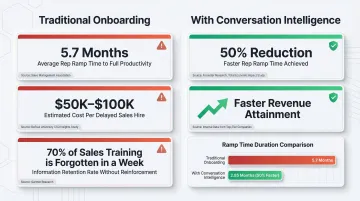
Traditional onboarding relies heavily on shadowing and nesting, which consumes valuable manager time. Sales managers average just 36 minutes per week coaching each direct report. Conversation intelligence breaks that constraint by making call libraries self-serve and always available, new reps can access the exact examples they need without waiting for a manager's calendar to open.
KPIs directly impacted:
- Time-to-first-independent-call
- Ramp time (weeks to full quota attainment)
- Training cost per new hire
- Manager hours spent on live coaching
- First-call resolution rate
When this advantage matters most:
High-volume hiring cycles, organizations with distributed or remote teams, partner and channel networks where you cannot place a trainer next to every rep, and seasonal ramp-ups that demand rapid deployment without sacrificing quality.
Advantage 2: Consistent, Scalable Quality Assurance Without Adding Headcount
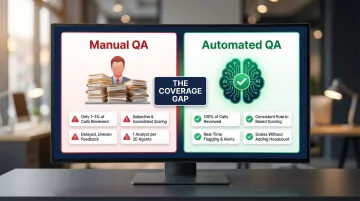
Traditional QA processes create a dangerous blind spot: most contact centers review only 1-3% of all interactions, leaving the vast majority of conversations unexamined. This statistical insignificance means compliance gaps, knowledge errors, and customer experience problems go undetected until they escalate into formal complaints or regulatory issues.
Conversation intelligence reviews every interaction automatically, creating a complete and objective performance picture for every agent. AI scores calls against consistent rubrics, compliance language, empathy markers, product accuracy, objection resolution, discovery effectiveness, removing the subjectivity that comes from different managers evaluating identical behaviors differently.
Why this creates measurable advantage:
When feedback is inconsistent, new agents calibrate to whoever reviewed their last call rather than to a shared performance standard. This fragmentation leads to wildly different customer experiences depending on which agent answers the phone.
Research from Observe.AI confirms the downstream damage: inconsistent training and QA coverage directly correlates with lower first-call resolution rates and higher customer effort scores.
As teams grow, manual QA becomes a bottleneck that forces leaders to choose between coverage and speed. A single Quality Analyst typically manages up to 20 agents, making comprehensive review impossible without linearly adding headcount. Conversation intelligence changes the equation: automated QA can evaluate up to 100% of interactions without requiring additional staff.
In regulated industries, this complete coverage dramatically reduces compliance risk. While fines vary by industry and violation, the financial exposure is severe: FINRA recently fined a broker-dealer $750,000 for failing to properly supervise and retain business-related communications, a compliance failure that automated conversation intelligence would have caught by flagging non-compliant language in real time.
KPIs directly impacted:
- QA coverage rate (% of calls reviewed)
- Feedback turnaround time
- Inter-rater reliability / scoring consistency
- First-call resolution rate
- Compliance incident rate
- Cost per QA evaluation
When this advantage matters most:
Regulated industries (financial services, healthcare, insurance) where compliance must be documented and defensible, large or geographically distributed teams where manager bandwidth is stretched thin, and organizations managing channel partners or resellers where direct oversight of rep behavior is impossible.
Advantage 3: Personalized Learning Loops That Connect Training to Revenue Outcomes
Instead of running every new agent through the same onboarding path, conversation intelligence identifies the specific gaps in each rep's actual calls and routes them into targeted training, whether that's objection handling, discovery questioning, product knowledge, or compliance language.
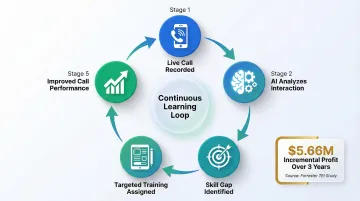
AI flags specific moments in calls where a rep missed an opportunity, used incorrect information, or struggled with a customer objection. Those flagged moments become the input for the next training intervention, creating a continuous loop between live performance and skill development.
Platforms like Pifini take this further by automatically enrolling reps into prescriptive training modules when call scoring detects performance gaps. If a rep consistently scores low on objection handling across multiple calls, the system doesn't wait for a manager to notice and manually assign training. It routes the rep into targeted objection-handling simulations immediately, while the gap is still fresh.
Why this creates measurable advantage:
Generic training treats every agent as equally deficient in every area, wasting time on skills that are already strong while leaving real gaps unaddressed. Research from the Association for Talent Development found that adaptive learners finished courses 30% faster while maintaining the same learning outcomes, satisfaction, and self-efficacy as those in traditional e-learning environments. Personalized paths fix the actual problem rather than running everyone through the same curriculum.
When training is connected to actual revenue metrics, win rates, deal size, pipeline contribution, leaders can finally demonstrate the ROI of enablement investment. Forrester's TEI study on Gong revealed that AI-driven insights improved deal win rates, leading to $5.66 million in incremental profit over three years for a composite organization. This moves enablement from a cost center measured by completion rates to a revenue driver measured by business outcomes.
KPIs directly impacted:
- Training-to-pipeline correlation
- Win rate by training cohort
- Average deal size
- Knowledge assessment scores mapped to call performance
- Time between gap identification and skill correction
- Training ROI (revenue impact per dollar spent on enablement)
When this advantage matters most:
This advantage is most pronounced in three scenarios:
- Varied seller profiles: enterprise reps, channel partners, and resellers with different product familiarity all need different paths
- High-complexity sales: where skill variance has direct, measurable revenue impact
- ROI accountability: any team where proving enablement value to leadership is a budget requirement
What Happens When Conversation Intelligence Training Is Missing or Ignored
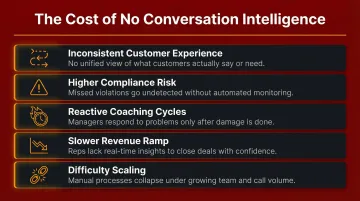
When conversation intelligence is absent, new agents spend their first weeks learning from live mistakes rather than structured insight. The downstream consequences accumulate quickly:
Inconsistent customer experiences: Each rep develops habits from whatever informal feedback they happened to receive. One might handle objections confidently while another caves to price pressure; one follows compliance scripts precisely while another paraphrases dangerously. The result: customers get fundamentally different experiences depending on which agent picks up.
Higher error and compliance risk: Without automated coverage of every call, up to 97% of non-compliant interactions remain hidden until they escalate into regulatory issues, complaints, or legal exposure. Manual sampling cannot detect patterns that only emerge across hundreds or thousands of interactions.
Reactive coaching cycles: Managers spend their time firefighting specific complaints rather than proactively developing the team against a performance baseline. Coaching happens after problems surface, not before they occur. That's remediation, not development, and it's expensive.
Slower revenue ramp: New reps take longer to reach quota, and the organization absorbs that cost with no clear picture of why. Is it discovery? Objection handling? Product knowledge? Without call data, managers rely on gut feel, and guesses rarely close the gap faster.
Difficulty scaling: As the team grows, the gap between top performers and everyone else widens because there is no consistent system for spreading what works. Top performers carry the playbook in their heads, and when they leave or get promoted, the team starts over.
How to Get the Most Value from Conversation Intelligence Training
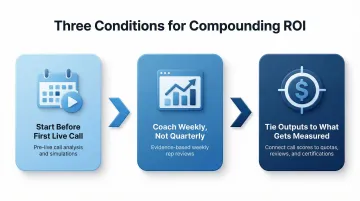
Conversation intelligence delivers the strongest outcomes when embedded as an ongoing operational practice rather than a one-time onboarding module. Three conditions unlock compounding value:
Start Exposure Before the First Live Call
New reps should encounter analyzed call examples and AI-scored simulations before their first live interaction, not after their first bad review. Pre-live exposure builds pattern recognition and reduces the anxiety of facing unfamiliar scenarios cold. Starting the learning curve before the performance curve means reps arrive at live calls with context, not just confidence they haven't yet earned.
Use Coaching Dashboards Weekly, Not Quarterly
When coaching insights sit unreviewed, skill gaps repeat and quota patterns drift. Managers should use conversation intelligence dashboards in their weekly rep reviews, not just at quarterly check-ins. Pifini makes this practical by presenting call scores, training completion, and pipeline contribution in a single view, so every coaching conversation is grounded in evidence, not recall bias or the last incident that stood out.
Tie Outputs to What Actually Gets Measured
The most effective implementations connect conversation intelligence outputs, call scores, skill assessments, training completion, directly to performance reviews, quota setting, and partner certifications. When learning is disconnected from promotions, compensation, and recognition, reps treat it as a box-checking exercise. Tie it to how performance is measured and rewarded, and adoption takes care of itself.
Conclusion
Conversation intelligence training replaces guesswork and delayed feedback with a system where every interaction generates insight and every insight drives a specific next action. Generic courses and random QA sampling cannot compete with a system that analyzes 100% of calls, identifies each rep's specific gaps, and automatically routes them into precisely the training they need.
The three advantages, faster ramp, consistent quality at scale, and personalized revenue-linked learning, do not operate in isolation. They compound: faster ramp puts revenue-ready reps in front of buyers sooner, consistent QA coverage reduces compliance incidents and smooths out the customer experience, and personalized learning accelerates skill development by keeping reps engaged in training that's directly relevant to their gaps. Together, these effects create a performance advantage that widens the longer the system runs.
Organizations that apply conversation intelligence build learning systems that improve with every call analyzed, every pattern surfaced, and every winning behavior replicated across the team. The result is an operational practice embedded in how teams hire, coach, and develop, not a one-time onboarding project, but a continuous engine for performance improvement.
Frequently Asked Questions
What is conversation intelligence training?
Conversation intelligence training uses AI to analyze real agent-customer interactions, primarily calls, but also chats and emails, and converts those insights into personalized, targeted training that closes specific skill gaps. Rather than generic courses, each rep receives training based on their actual performance deficiencies detected in live conversations.
How does conversation intelligence reduce agent onboarding time?
By replacing passive slide decks with scenario-based learning built from actual high-performing calls, agents build skills faster and retain more. Forrester research shows organizations reduced new hire ramp time by 50% using conversation intelligence platforms. Reps learn from real examples rather than abstract principles, reaching full productivity faster.
How is conversation intelligence training different from a traditional LMS?
A traditional LMS delivers the same course to every learner regardless of performance. Conversation intelligence training adapts to each agent's actual gaps, automatically enrolling struggling reps in targeted modules when call scoring detects specific deficiencies. The result is prescriptive, performance-driven development rather than static, self-directed coursework.
What KPIs are most directly impacted by conversation intelligence training?
The most directly impacted metrics are:
- Ramp time, weeks to full rep productivity
- QA coverage rate, percentage of calls reviewed
- First-call resolution rate
- Win rate and conversion rate
- Compliance incident frequency
- Revenue linkage, training completion tied to deal size and pipeline contribution
Can conversation intelligence training work for channel partners and resellers, not just direct sales teams?
Yes, it's especially effective for distributed partner ecosystems where direct oversight isn't possible. Automated call analysis and prescriptive training paths operate regardless of geography, making it a strong fit for channel networks where in-person coaching isn't practical.
How long does it take to see measurable results from conversation intelligence training?
QA coverage and feedback turnaround improvements are often visible within the first week. Ramp time and revenue impact gains typically become measurable within the first onboarding cohort, around 8-12 weeks, when coaching cycles are run consistently rather than reviewed quarterly.