Introduction
Most training programs treat every rep, reseller, and distributor identically, regardless of what they already know or where they're struggling. The result: new hires take months to reach quota, product launches underperform, and selling time gets burned on content nobody needed.
The shift is already happening. 71% of L&D professionals are now exploring or integrating AI into their work, signaling a rapid move from static LMS-based training to AI-driven personalized learning paths. Yet despite this momentum, 74% of companies report they're not keeping up with their organization's demand for new skills, even after spending $400 billion on training technology.
The gap comes down to understanding how AI personalization actually works. Sales enablement leaders, channel managers, and L&D teams frequently underutilize AI learning platforms, or choose the wrong ones, because the mechanics aren't clear: how the system identifies gaps, assigns content, and adjusts in real time based on performance.
This guide breaks down how AI learning assistants build and adjust personalized education paths, and what that means for revenue teams, channel managers, and the partners they support.
Key Takeaways
- AI learning assistants analyze behavior, performance data, and learning history to build unique training paths per user
- Personalization runs a continuous loop: collect data → detect gaps → assign paths → adjust on outcomes
- High-impact platforms auto-enroll reps into training after low call scores or failed assessments
- For channel teams, AI personalization scales targeted enablement across distributed networks without manual oversight
- Platforms linking training scores to win rates and deal velocity deliver the clearest ROI
What Is an AI Learning Assistant?
An AI learning assistant is a software system that uses machine learning and data analysis to deliver, adjust, and sequence training content based on each learner's behavior, performance, and knowledge gaps, rather than pushing a fixed curriculum.
Traditional LMS platforms track completion but don't respond to whether the learner actually understood or retained the material. They measure compliance, not competence. AI learning assistants close this gap by treating the curriculum as a dynamic, responsive system that evolves based on real performance data.
An AI learning assistant isn't a simple chatbot or basic recommendation engine that suggests courses based on popularity or enrollment patterns. True AI-driven personalization involves:
- Continuous feedback loops that update learner models in real time
- Predictive gap detection that identifies emerging weaknesses before performance drops
- Path reassignment triggered by actual performance data, not just click behavior or course ratings
That distinction has real consequences. A recommendation engine might suggest "Product Fundamentals" because similar users enrolled in it. An AI learning assistant enrolls you in "Product Fundamentals" because your call scores show you're struggling with discovery questions, and it triggers that enrollment the moment the gap is detected.
How AI Learning Assistants Personalize Education Paths
AI personalization isn't a single feature. It's a pipeline of connected stages, each feeding the next. Understanding each stage helps practitioners evaluate whether a platform delivers genuine personalization or just rebranded legacy functionality.
Learner Data Collection
AI learning assistants build learner profiles using multiple data inputs:
- Assessment scores and quiz response patterns
- Time-on-task and content completion sequences
- In sales contexts: call scores, deal stages, certification outcomes, CRM performance signals
The quality of personalization is directly tied to the richness of the data inputs. Platforms that only track course completions produce thin learner models that can't meaningfully differentiate paths. Platforms that integrate CRM data, call scoring, and behavioral signals build comprehensive profiles that enable precise path assignments.
For example, Pifini's Enterprise LMS integrates directly with CRM and call data to pull in performance signals beyond the learning system. This allows the platform to correlate training progress with actual sales outcomes, creating a learner profile that reflects both what you've completed and how well you're applying it in real situations.
Gap Analysis and Learner Modeling
Once data is collected, the AI analyzes it to identify knowledge gaps, skill weaknesses, and learning pace. This analysis builds a dynamic learner model that updates continuously, not just at the end of a course.
Gap detection takes two forms, and the difference matters:
- Reactive detection flags failure after a test or poor call performance. It's better than nothing, but the damage is already done, a lost deal, a failed certification, a blown product launch.
- Predictive detection catches a learner trending toward a gap before performance drops. The system notices patterns: declining quiz scores, rising time-on-task, hesitation in roleplay scenarios. Predictive attrition models can detect at-risk reps 14 days early with 82% accuracy, enabling proactive intervention before it's too late.
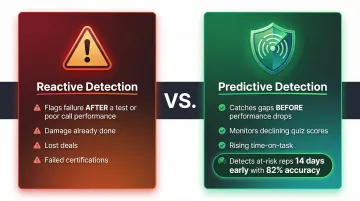
For sales teams where skills decay fast, 87% of training retention is lost within 30 days without reinforcement, predictive detection is far more valuable than reactive.
Personalized Path Assignment
The AI translates the learner model into an actual sequence of content, selecting modules, adjusting difficulty, choosing format, and setting pacing based on individual readiness signals.
Effective path assignment depends on three elements working together:
- Auto-enrollment triggers, When a rep's call score drops, a deal is lost, or an assessment reveals a product knowledge gap, a well-built AI system routes that learner into targeted remediation without manual intervention. Pifini's prescriptive learning engine does exactly this: when a user shows signs of struggle with content, roleplay, or call scoring, the system immediately assigns short, focused modules targeting specific deficiencies.
- Format matching, Not all learners absorb information the same way. Some learn better through simulations; others through microlearning or gamified modules. The AI matches format to learner preference and content type. Gamified eLearning reaches 90% completion rates versus 25% for non-gamified programs, and microlearning can improve retention by 25% to 60%.
- Role and context alignment, A channel partner selling into healthcare needs different product positioning training than an internal rep selling into manufacturing. Path assignment accounts for role, vertical, product line, and partner tier.
Continuous Feedback and Path Adjustment
Static adaptive learning assigns content once. Genuine AI personalization keeps measuring after the assignment, checking whether the gap actually closed and adjusting what comes next based on the result.
How the feedback loop works:
- Learner completes targeted training module on objection handling
- AI measures outcome through follow-up call scoring or roleplay performance
- If objection handling improves, the system moves to the next skill gap
- If performance remains weak, the system assigns alternative content or escalates to live coaching
- The learner model updates continuously based on real-world application
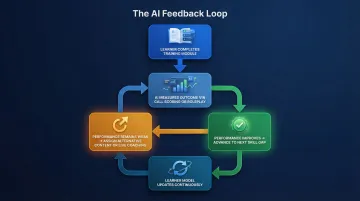
This is fundamentally different from completion-based systems. Traditional LMS platforms ask "Did they finish the course?" AI learning assistants ask "Did their performance actually improve?" The path keeps evolving based on outcomes, not just activity.
Key Benefits of AI-Personalized Learning for Sales and Partner Teams
Faster Ramp Time for New Reps and Partners
By identifying what each individual already knows at onboarding and skipping redundant content, AI learning assistants focus training hours on actual gaps, reducing time-to-competency for new hires.
The numbers are compelling:
- It typically takes 3 to 9 months for new salespeople to become fully productive, with complex B2B roles extending to 12-18 months
- AI-coached onboarding reduces ramp-up time by 28% (from 4.7 months to 3.4 months)
- 81% of B2B sales teams using AI-guided ramp plans hit 90% of quota inside 60 days, cutting time-to-quota by 67%
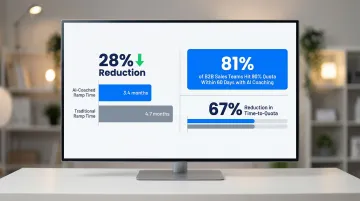
Instead of requiring every new rep to complete the same 40-hour onboarding curriculum, AI systems identify existing competencies and route each user only to training that addresses genuine gaps.
Consistent Performance Across Distributed Networks
For organizations with channel partners, resellers, and distributors across regions, AI personalization ensures every partner receives the same quality of targeted enablement, even without a dedicated trainer on site.
Manual training programs can't solve this at scale. 81% of 25,000 global partners anticipate underperforming compared to the overall market, yet most receive inconsistent, under-resourced training. AI learning assistants narrow that gap:
- Certified partners close deals 38% faster than non-certified partners
- Equipping partners with structured training cuts onboarding/ramp time by 40–52%
By delivering personalized paths automatically, AI systems ensure a partner in Singapore receives the same targeted enablement as one in São Paulo, without requiring proportional increases in headcount.

Real-Time Skill Gap Intervention
Rather than discovering a knowledge deficit at quarterly review, AI-driven platforms surface skill gaps in real time, enabling L&D and sales managers to act before the gap costs a deal.
The cost of delayed intervention is real:
- Skill gaps can lead to 20–25% lower productivity in roles affected by digital transformation
- 40–60% of new sales reps fail to achieve quota due to poor training
AI systems that integrate with call scoring and CRM data identify performance deficiencies the moment they appear, not weeks later when a manager reviews pipeline reports.
Higher Engagement Through Relevance
Learners who receive content matched to their role, level, and current gaps are far more likely to complete training and apply it. Relevance is what separates training people finish from training they abandon.
Specific mechanisms that drive engagement include:
- Personalized challenge levels that adapt to individual skill progression
- Microlearning formats delivering content in digestible bursts aligned to workflow
- Gamification elements that make progress visible and rewarding
Field sales and partner populations treat training as optional without a compelling reason to engage. AI personalization provides that reason by delivering exactly what each person needs, when they need it, not forcing them through irrelevant material.
Measurable Training ROI
The most advanced AI learning platforms connect training performance (scores, certifications, module completions) to downstream revenue outcomes: win rates, deal velocity, and pipeline contribution. That connection transforms training from a cost center into a measurable performance lever:
- Sales training delivers a 353% ROI ($4.53 per $1 invested)
- Yet 67% of enablement leaders cite "proving ROI" as their top challenge
- Only 29% of sales enablement teams can directly tie their programs to revenue impact
Pifini is built specifically to close that gap. By integrating learning data with sales performance data, organizations can see which certifications correlate with higher win rates, and model what broader training adoption would mean for revenue.
Where AI Learning Assistants Make the Biggest Impact
High-Return Organizational Contexts
AI personalization delivers the highest return in specific scenarios:
Onboarding of new sales hires or channel partners: High volume, high variability in background knowledge, and urgent need to accelerate time-to-productivity. AI-assisted onboarding achieves a 42% reduction in time-to-productivity and reduces manager workload by 70%.
Product launch training: Fast rollout timelines, high stakes for accuracy, and diverse audience knowledge levels. By 2029, sales organizations with AI-driven enablement will achieve 40% faster sales stage velocity than those using traditional approaches.
Compliance or certification maintenance: Knowledge decay is predictable, and auto-remediation is particularly valuable. AI systems can automatically re-enroll users when certifications approach expiration or when performance signals indicate skill decay.
Partner and Channel Ecosystems: The Uniquely High-Leverage Use Case
Partner and channel ecosystems represent the most compelling use case for AI learning assistants. These teams are external, often under-resourced, and expected to sell on behalf of a brand they didn't build. Traditional LMS platforms require constant manual oversight to ensure partners receive appropriate training, a model that breaks down as ecosystems grow.
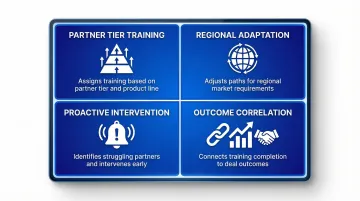
AI learning assistants scale personalized enablement across resellers, distributors, and alliances without adding headcount. That's a structural problem traditional platforms simply can't solve. The system:
- Assigns training based on partner tier and product line
- Adjusts paths based on regional market requirements
- Identifies struggling partners and intervenes proactively
- Connects partner training completion to actual deal outcomes
Where AI Learning Assistants Underperform
Even in high-leverage contexts like partner ecosystems, AI personalization has real prerequisites. Performance suffers when:
- Insufficient learner data: Without behavioral, performance, or assessment history, the system cannot build accurate learner models
- Single-format content libraries: When all content is video or text-only, the AI has no way to match delivery format to learner preference
- No connection to business outcomes: Without CRM, call scoring, or performance data integrations, the system can't measure whether training moved the needle
In these environments, personalization becomes superficial, recommending courses based on enrollment patterns rather than genuine performance needs.
Conclusion
AI learning assistants don't just deliver content, they build a continuously updated model of each learner's readiness and adjust the path accordingly. This is a fundamentally different operating principle from traditional training platforms that treat all learners the same and measure only completion.
Organizations that understand the mechanics, data collection, gap modeling, path assignment, and feedback loops, make better platform choices, set realistic adoption timelines, and connect learning investment to measurable performance outcomes.
That understanding matters now. 85% of business leaders say skills development needs will dramatically increase due to AI and digital trends. Organizations that know exactly how AI personalization works, not just that it exists, will deploy it in ways that show up in revenue, not just completion rates.
Frequently Asked Questions
What is AI-powered personalized learning?
AI-powered personalized learning is a training approach where AI analyzes each learner's behavior, performance data, and knowledge gaps to build and continuously adjust an individual content path, as opposed to a fixed course sequence everyone completes in the same order.
How does an AI learning assistant differ from a traditional LMS?
A traditional LMS tracks who completed what. An AI learning assistant uses performance data to determine what each person should learn next, adjusting paths based on outcomes, not just logging completions.
What triggers an AI learning assistant to reassign or modify a training path?
Common triggers include failed assessments, low quiz scores on specific topics, declining call performance scores, missed certification thresholds, or inactivity on key modules, any signal that indicates a gap or knowledge decay.
Can AI learning paths personalize training for channel partners and resellers, not just internal teams?
Yes. AI learning assistants are especially valuable in partner ecosystems where training must scale across distributed, external networks, personalizing content by partner tier, product line, or regional market without requiring dedicated trainers at each location.
How do AI learning assistants measure training effectiveness and ROI?
Basic metrics include completion rates and assessment scores. Advanced platforms connect certifications and training scores to win rates, deal velocity, and pipeline contribution, provided learning data is integrated with sales performance systems.
How does prescriptive learning differ from adaptive learning?
Adaptive learning adjusts content difficulty in real time based on in-session performance. Prescriptive learning proactively assigns entirely new training paths or modules based on detected performance gaps, making it better suited for closing specific skill deficiencies.