Introduction: Why Most Sales Teams Are Flying Blind on Their Best Asset
Your sales team conducts thousands of buyer conversations every month. Yet nearly all of that intelligence disappears the moment the call ends, never informing training, playbooks, or coaching.
This disconnect creates a critical blind spot. Traditional sales enablement prepares reps before conversations with content, training, and playbooks. Traditional call recording captures what happened after, storing transcripts that almost no one reviews. But neither system connects the dots in real time or creates a continuous improvement loop.
According to research, sales managers review less than 1% of all sales calls, and only 29% of sales enablement teams can tie their programs directly to revenue impact. This gap between enablement investment and measurable results costs organizations millions in lost productivity and unrealized potential.
Closing that gap requires connecting what happens in conversations to what happens because of them. This guide breaks down how conversation intelligence (CI) and sales enablement work together, turning call data into coaching, coaching into behavior change, and behavior change into measurable revenue outcomes.
Key Takeaways
- Conversation intelligence analyzes sales calls for actionable insights; sales enablement gives reps the content and training to act on them
- Together, they create a continuous improvement loop: call data reveals skill gaps, enablement fills them, results improve measurably
- AI has shifted both disciplines from post-call review to real-time coaching and prescriptive, auto-triggered training based on live performance signals
- Every revenue role benefits: SDRs ramp faster, AEs close more deals, managers coach at scale, and partners get consistent training outside the direct org
- Effective implementation means aligning CI to your skills framework, connecting it to CRM and LMS, and tying training directly to deal outcomes
What Are Sales Enablement and Conversation Intelligence?
Defining Sales Enablement
Sales enablement is the systematic process of providing revenue-facing teams, sellers, partners, and customer success, with the right content, training, tools, and coaching at the right moment to effectively engage buyers and close deals. Gartner defines it as "the process of providing the sales organization with the information, content and tools that help sellers sell more effectively."
Modern sales enablement goes far beyond onboarding decks and product training. Comprehensive programs include:
- Digital content management and sales collateral
- Guided learning paths and certifications
- Sales playbooks and messaging frameworks
- Role play simulations and practice scenarios
- Performance analytics and readiness dashboards
- Coaching tools and feedback systems
For organizations with partner and channel ecosystems, enablement extends beyond direct sales teams to resellers, distributors, and alliances. In fact, over 70% of the $5.3 trillion global technology market flows through partners, making partner enablement as strategically important as direct sales training. Yet many vendors fall into a common trap: assuming that providing access to content is the same as building the capability to sell it.
Conversation intelligence addresses exactly that gap, by turning what actually happens in sales calls into structured, actionable coaching data.
Defining Conversation Intelligence
Conversation intelligence software uses AI, machine learning, and natural language processing to automatically record, transcribe, and analyze sales conversations across phone calls, video meetings, and other customer touchpoints. G2 defines it as technology that captures unstructured data and uses embedded AI to surface insights that guide representatives and inform coaching.
CI platforms surface signals that basic call recording tools miss:
- Talk-to-listen ratios and monologue length
- Competitor mentions and how they were addressed
- Objection patterns and rep responses
- Buyer sentiment shifts throughout the conversation
- Key moment detection (pricing discussions, next steps, business impact questions)
- Rep behavior signals indicating whether a deal is advancing or stalling
The distinction matters. Call recording tools track activity and produce transcripts for reference or compliance. Conversation intelligence platforms go further, analyzing context, flagging coachable moments, and connecting behavioral patterns to deal outcomes across the entire sales tech stack.
Why Sales Enablement and Conversation Intelligence Are Better Together
Each discipline solves a specific problem in isolation. Sales enablement without CI is built on assumptions about what reps struggle with, training programs designed around what leadership thinks reps need rather than what call data proves they need. Conversation intelligence without enablement is data with nowhere to go, insights get reviewed once in a manager one-on-one and then forgotten, with no system to turn findings into improved performance.
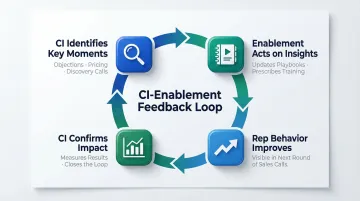
Together, they create a closed feedback loop that compounds results:
- CI identifies specific moments in actual calls where deals are won or lost, objection handling, pricing discussions, discovery depth, competitive positioning
- Enablement uses those insights to update playbooks, reinforce messaging, and prescribe targeted training
- Improved rep behavior shows up in the next round of calls
- CI confirms and measures the impact, closing the loop and proving ROI
This combination scales "A-player" behavior systematically. Instead of a sales manager manually reviewing calls and coaching one rep at a time, the CI-enablement loop identifies what top performers do differently and spreads those behaviors across the entire team.
For example, if CI reveals that your best closers spend 40% more time on discovery questions than average performers, enablement can codify that behavior into training modules and playbooks, then CI measures adoption across the team.
The integration also solves the "black box" problem in modern selling. Remote, hybrid, and partner-led sales teams operate beyond direct manager observation. CI makes every conversation visible and coachable without requiring managers to attend every call, while enablement ensures coaching translates into improved skills rather than one-off feedback.
That visibility also changes how organizations measure results. When CI data connects to enablement outcomes, revenue attribution transforms enablement from a cost center into a revenue driver, linking specific training interventions, certifications, or content usage to deal close rates, win rates, and pipeline contribution.
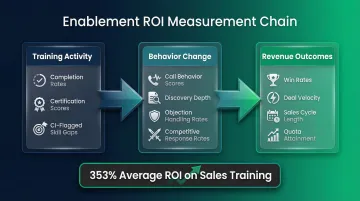
The numbers support this: organizations with formal sales enablement programs achieve win rates of 49.0%, 6.5 percentage points higher than those without. The average ROI for sales training reaches 353%, returning $4.53 for every dollar invested when properly measured and connected to outcomes.
Key Use Cases: How Each Revenue Role Benefits
SDRs and BDRs: Faster Ramp, Better Handoffs
New SDRs use CI to learn from real calls made by top performers, giving them a library of winning talk tracks, objection responses, and discovery techniques rather than role-playing hypothetical scenarios.
The cost of slow ramp is real. The average B2B SDR takes 3.0 to 3.2 months to reach quota readiness, with turnover costing organizations up to $149,000 per departure when you factor in recruitment, onboarding, and lost productivity.
CI-powered enablement compresses that timeline:
- Companies integrating AI roleplay report SDRs reaching quota readiness up to 40% faster
- Sales organizations using AI-powered coaching tools report 35% faster ramp-up for new hires
CI also flags handoff quality, ensuring context captured in a discovery call is faithfully transferred to the AE. This reduces information loss between pipeline stages and prevents AEs from restarting conversations SDRs already completed.
Account Executives: Win Rate and Deal Velocity
AEs use post-call CI analysis to identify exactly where deals stalled, whether a competitor was mentioned and not addressed, pricing concerns went unresolved, or next steps were vague, and take corrective action before the deal goes cold.
The stakes are high: between 40% and 60% of B2B deals end in "no decision" rather than going to a competitor, and 60% of B2B leads are never followed up effectively. Stalled deals rarely recover on their own.
Real-time CI guidance helps AEs stay on message during complex, multi-stakeholder calls by surfacing relevant content, case studies, or competitive battle cards at the moment they're needed. Sellers who use AI to guide their deals increase their win rate by 35%, according to research from conversation intelligence providers.
Sales Managers and Leaders: Scalable Coaching Without Call Overload
Most managers don't have a coaching problem, they have a time problem. Instead of re-listening to hours of calls, CI surfaces AI-curated highlights of the highest-priority coachable moments: deals at risk, missed objections, inconsistent messaging. Managers focus on what actually matters.
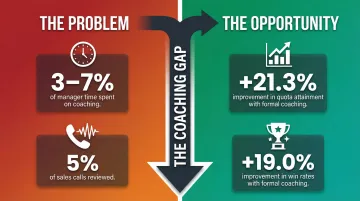
Sales managers spend only 3–7% of their week on active coaching and review roughly 5% of their team's calls, leaving the vast majority of conversations uncoached.
That gap is costly. Formal sales coaching improves quota attainment by 21.3% and win rates by 19.0%, yet most managers can't deliver it at scale without CI to do the heavy lifting.
CI also surfaces systemic patterns. If every rep loses momentum when pricing comes up, that's a team-wide training gap, not an individual coaching issue. That insight is far more actionable than reviewing calls one by one.
Enablement Teams: Connecting Learning to Real Behavior
Enablement teams use CI keyword tracking and call analytics to measure whether new training initiatives are actually changing rep behavior in the field. After rolling out a new objection-handling framework, for example, CI can track whether reps are using the updated messaging in real calls, not just passing the certification quiz.
This closes the measurement gap that has long undermined enablement credibility. Only 29% of sales enablement teams can directly tie their programs to revenue impact. Connecting CI data to training completion and certification scores gives enablement leaders the evidence to prove what works, and cut what doesn't.
Partner and Channel Teams: Extending Enablement Beyond the Direct Sales Force
Channel partners, resellers, and distributors face the same challenges as direct reps, skill gaps, inconsistent messaging, limited coaching, but operate outside the direct management chain. That distance makes CI-powered enablement more critical, not less, for maintaining quality across the ecosystem.
The scale of this challenge is growing. 67% of B2B partner ecosystem decision-makers expect their indirect revenue to grow by over 30%, yet vendors consistently struggle with the same failure mode: partners pass certifications but still struggle to execute in the field, leaving deals on the table.
Platforms designed for the extended enterprise, like Pifini.ai, address this directly by unifying CI call scoring, targeted training enrollment, and content delivery across the entire partner ecosystem, not just the internal sales team. At $50 per user per year, the economics work at scale. Consistent messaging, systematic skill development, and measurable performance improvement become achievable across every channel, not just the direct salesforce.
From Reactive to Real-Time: How AI Is Transforming Both Disciplines
The traditional CI model's core limitation is timing: insights arrive after the fact. A rep receives coaching based on a call that happened days ago, reviewing a conversation they can't change. This is valuable for long-term development but unable to influence the outcome of the deal in question.
Modern AI platforms close that gap with real-time in-call guidance. As a conversation unfolds, the system recognizes what's being discussed and surfaces what the rep needs in that moment:
- Relevant playbook content matched to the conversation stage
- Objection responses pulled from proven call patterns
- Competitive intelligence flagged when a rival is mentioned
This turns the platform into an on-call sales coach rather than a post-game analyst.
Gartner predicts that by 2029, sales organizations with AI-driven enablement functions will achieve 40% faster sales stage velocity than those using traditional approaches. That kind of acceleration reflects a broader shift: enablement moving from a reactive support function to one that guides seller behavior in real time.
That real-time shift extends beyond the call itself. AI analyzes call performance patterns, identifies where a rep is consistently underperforming, struggling with pricing objections, failing to uncover business impact, and automatically routes them into targeted microlearning or simulations. No manager needs to notice the gap first.
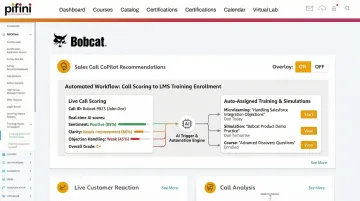
Pifini.ai's platform connects live AI call scoring directly to its enterprise LMS to auto-enroll users into training when performance gaps are detected. Instead of managers spending hours reviewing calls and manually assigning courses, the system triggers development automatically. Managers stay focused on the strategic coaching conversations that actually require human judgment.
Best Practices for Implementing Conversation Intelligence in Your Enablement Strategy
Align CI Insights to a Skills Framework
Raw call data is only useful when mapped to specific competencies, discovery quality, objection handling, competitive positioning, next step setting. Without this structure, call insights generate ad hoc feedback instead of systematic rep development.
Map CI outputs to the competencies your organization values:
- Discovery effectiveness and needs identification
- Objection handling and addressing concerns
- Product positioning and value articulation
- Competitive differentiation
- Closing strength and next step clarity
- Business impact quantification
This alignment allows you to aggregate call-level insights into competency-level trends, identifying where the team needs development and measuring improvement over time.
Define What "Good" Looks Like Before You Measure It
Before deploying CI broadly, record top-performer calls, winning discovery conversations, and best-in-class objection handling. Reps need concrete models to learn from, not just a score, and your AI scoring models need calibration anchors tied to your actual methodology.
This library serves multiple purposes:
- Establishes performance standards that CI can measure against
- Provides onboarding resources for new reps to study
- Creates examples for training modules and playbooks
- Enables calibration of AI scoring models to your methodology
Without this benchmark library, CI scores become abstract numbers rather than actionable feedback tied to observable behaviors.
Integrate CI With Your CRM and LMS to Close the Loop
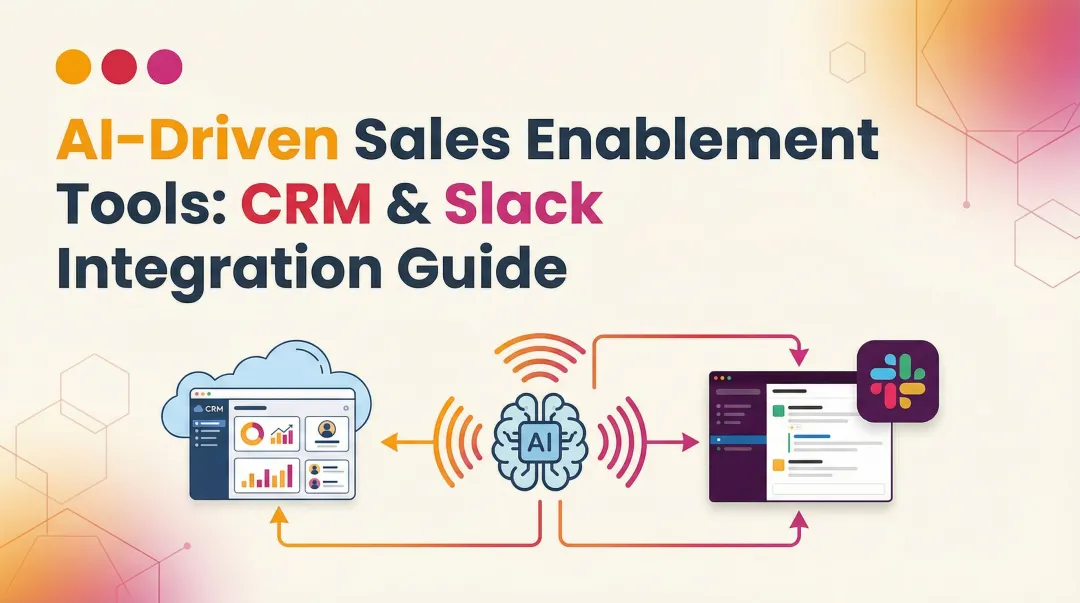
CI sitting in a silo, disconnected from the CRM, the LMS, and content management, produces insight without action. The full value is only realized when data flows between systems so that training can be tied to revenue impact and automatically triggered by performance signals.
Essential integrations include:
- CRM integration to correlate call performance with deal outcomes, win rates, and pipeline velocity
- LMS integration to auto-trigger training when CI identifies skill gaps and measure training impact on subsequent calls
- Content management integration to surface relevant materials during or after calls and track content effectiveness
Platforms like Pifini.ai deliver these integrations natively, with 100+ connections to CRM, PRM, LMS, and marketing automation tools, connecting enablement, call performance, and revenue outcomes in a single unified system.
Measure Enablement ROI Through Call Data
Track whether reps who complete a specific training module show measurable improvement in the call behaviors that training targeted. For example:
- Does discovery training increase discovery depth scores in subsequent calls?
- Does objection-handling training improve competitor mention handling rates?
- Does pricing training correlate with more confident pricing discussions and higher close rates?
Then connect those improvements to business outcomes: Do reps with higher discovery scores have better win rates? Do improved objection-handling scores correlate with shorter sales cycles?
This method transforms enablement measurement from activity tracking (completion rates, time spent) to impact measurement (behavior change, revenue correlation). The results can be significant: Highspot's implementation of just-in-time enablement resulted in a 6% increase in overall win rates, with participating reps seeing a 12% increase in multi-threading rates and a 5% increase in individual win rates.
Frequently Asked Questions
What is the difference between conversation intelligence and call recording software?
Call recording software captures audio and generates transcripts for reference and compliance. Conversation intelligence uses AI to analyze the content, context, and patterns of those conversations, surfacing coaching insights, buyer signals, and performance trends that connect directly to deal outcomes and drive systematic improvement.
How does conversation intelligence support sales rep coaching?
CI flags coachable moments automatically, where a rep missed an objection, dominated talk time, or skipped next steps, so managers can deliver specific, evidence-based feedback tied to real calls. This keeps coaching focused on high-impact behaviors rather than memory or subjective impressions.
Can conversation intelligence work for partner and channel sales teams?
Yes. CI is particularly valuable for channel ecosystems where managers can't observe partner reps directly. Partner-first platforms like Pifini.ai analyze partner calls and route insights to targeted training, ensuring consistent messaging and skills development across the ecosystem without requiring vendor attendance on every call.
What metrics does conversation intelligence typically track during sales calls?
Most CI platforms track:
- Talk-to-listen ratio and monologue length
- Filler word frequency and sentiment shifts
- Competitor mentions and objection handling
- Whether key topics (pricing, next steps, business impact) were addressed
Advanced platforms also score calls against sales methodologies and competency-specific behaviors.
How do you integrate conversation intelligence with a sales enablement platform?
The most effective integrations connect CI to the CRM (for deal context and outcome data), the LMS (to auto-trigger training based on call performance), and content management systems (to surface relevant materials during or after calls), either through native unified platforms like Pifini.ai or API-based integrations between point solutions.
How long does it take to see ROI from conversation intelligence tools?
Initial benefits like reduced note-taking time and faster manager coaching cycles are typically visible within weeks. Measurable improvement in win rates, ramp time, and deal velocity generally surfaces over a 60–90 day period once CI is integrated into regular coaching and enablement workflows. According to a Forrester Total Economic Impact study, leading CI platforms deliver payback in under 6 months.