Introduction
Sales calls contain some of the richest buyer intelligence available to any revenue team, yet research shows that 75% of sales leaders never listen to calls, and those who do review less than 1% of total conversations. This blind spot is expensive. Every unreviewed call represents lost coaching moments, undiagnosed deal risks, and messaging that never gets refined.
When managers coach from anecdote rather than evidence, reps repeat the same objection-handling mistakes and discovery calls stay shallow. Deals stall for reasons that a single reviewed recording would have caught.
Meanwhile, the voice-of-customer insights that could sharpen your messaging, inform product strategy, and accelerate partner performance sit unused in your call library.
That's what this guide fixes. It walks sales leaders, managers, and enablement professionals through a structured process for extracting key insights from call recordings, what to analyze, how to do it, and how AI makes consistent call review feasible at scale.
Key Takeaways
- Sales call analysis systematically reviews recorded conversations to improve rep performance, deal strategy, and go-to-market execution
- Most teams record calls but analyze only a fraction, leaving coaching and objection-handling improvements on the table
- A structured five-stage process covers everything from defining objectives to scoring calls and acting on findings
- High-value signals include talk-to-listen ratio, objection patterns, buyer sentiment, and competitive mentions
- AI platforms automate scoring, surface patterns, and route reps into targeted training
What Is Sales Call Recording Analysis?
Sales call recording analysis is the structured process of reviewing recorded sales conversations, discovery calls, demos, negotiations, renewals, to identify patterns, coaching opportunities, and strategic intelligence that would otherwise be lost.
Analysis involves more than archiving recordings. Each conversation gets transcribed, tagged, and scored to surface actionable data:
- Transcription, converts audio to searchable text
- Moment tagging, flags objections, pricing discussions, and sentiment shifts
- Rep scoring, evaluates behavior against a defined framework
- Pattern extraction, surfaces trends at both the individual and team level
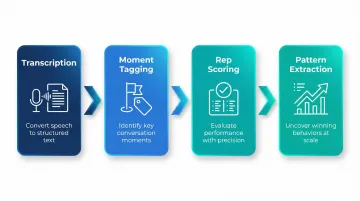
The goal is to convert every conversation into structured data that drives measurable performance improvement.
Manual vs. AI-Powered Analysis
Manual analysis relies on a manager listening to a sample of calls and providing subjective feedback. AI-powered analysis does this automatically, transcribing, scoring, and categorizing every call using natural language processing and sentiment detection.
Most modern teams use a combination: AI handles volume and consistency, while humans apply judgment to complex coaching scenarios. That matters because manual spot-checks typically cover less than 10% of activity, platforms that analyze 100% of calls give managers visibility into what's actually happening across the team.
Why Analyzing Sales Call Recordings Matters
Without systematic call review, organizations make decisions about messaging, training priorities, and deal strategy based on anecdote rather than evidence. Research shows that AI-driven conversation intelligence enables managers to shift from administrative listening to targeted behavioral coaching, measurably improving win rates and quota attainment.
Four Functions That Benefit Most
Sales managers use call data to coach reps on objection handling and discovery technique with evidence from actual conversations, not vague feedback.
Sales enablement teams build playbooks from real winning conversations, capturing the talk tracks and discovery questions that actually move deals forward.
Marketing teams use voice-of-customer language from calls to sharpen messaging, ensuring campaigns reflect how buyers actually describe their problems.
Revenue leaders spot deal risk earlier and forecast more accurately by tracking sentiment shifts, competitive threats, and next-step clarity across the pipeline.
The Partner and Channel Imperative
These benefits extend beyond direct sales teams. Organizations selling through resellers, distributors, or alliances face an even greater visibility problem: when revenue flows through partners, vendors lose direct insight into how their message is conveyed in the field.
Partner-sourced deals represent 20-50% of total revenue in many organizations, yet most vendors have no systematic way to evaluate partner call quality. Call analysis closes this gap, giving vendors the data to coach partners, standardize messaging in the field, and protect channel revenue before deals slip.
How to Analyze Sales Call Recordings: Step by Step
The value of call analysis depends on having a consistent process, not just listening to recordings when a deal goes wrong, but building a repeatable workflow that converts every call into structured data.
The most common mistake? Reviewing calls reactively (only after a loss) rather than proactively. The following framework turns call data into measurable performance improvement.
Step 1: Define What You're Analyzing For
Analysis without a defined objective produces noise, not insight. Before reviewing any recording, establish what you're looking for:
- Are you evaluating adherence to a sales methodology (MEDDIC, SPIN, Challenger)?
- Diagnosing why deals stall at a specific stage?
- Benchmarking talk-to-listen ratios across the team?
- Identifying which objections appear most frequently?
The objective shapes every subsequent step. It determines which moments you tag, which metrics you track, and which insights you act on.
Metrics tied to this step:
- Clarity of coaching focus
- Alignment between call behavior and sales process
- Consistency of rep evaluation criteria
Step 2: Transcribe and Organize Your Recordings
Searchable transcripts are the foundation of scalable analysis. Audio alone is slow to review; transcripts let teams search for specific keywords, competitor names, objection phrases, and pricing discussions across hundreds of calls simultaneously.
AI transcription tools handle this automatically. Recordings should be tagged by:
- Call type (discovery, demo, renewal, negotiation)
- Deal stage
- Rep name
- Partner organization (for channel ecosystems)
Consistent tagging makes segmented analysis possible, comparing discovery calls to demos, or benchmarking partners against direct reps across any time period.
Step 3: Review and Tag Key Moments
Identify and mark the high-signal moments in each call:
- When a prospect raises an objection
- When price is first mentioned
- When a competitor is named
- When energy shifts (positive or negative)
- When the rep asks a discovery or closing question
In manual review, managers annotate timestamps. In AI-powered review, the system detects and flags these moments automatically using natural language processing. The output: a set of labeled, reviewable clips rather than a full-length recording to scrub through.
Step 4: Score and Categorize Insights
Apply a consistent scoring rubric to each call, evaluating:
- Talk-to-listen ratio, is the rep pitching or asking?
- Question quality, open-ended and diagnostic, or surface-level?
- Objection handling, did the rep isolate, validate, and resolve the concern?
- Methodology adherence: Did the rep follow your sales framework?
- Next-step clarity: Did the call end with a specific, agreed-upon next action?
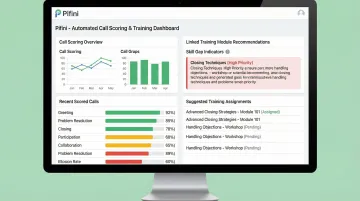
Consistency in scoring is what allows managers to compare reps, track improvement over time, and identify systemic gaps. Platforms like Pifini automate this scoring layer, evaluating every call against a defined rubric and flagging specific gaps, which then automatically route reps into targeted training modules to address those weaknesses.
Step 5: Act on What You Find
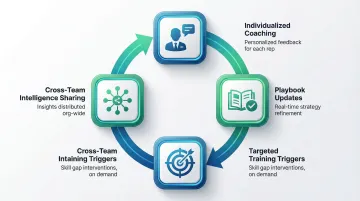
Analysis only creates value when it drives action. Define four concrete outputs:
- Deliver individualized coaching feedback to reps tied to specific call moments
- Update playbooks and talk tracks based on patterns from winning calls
- Trigger targeted training when recurring gaps appear, objection handling, discovery technique, or closing
- Share intelligence with marketing and product teams when call patterns reveal market signals
Close the loop by tracking whether coaching interventions based on call analysis actually shift behavior in subsequent calls. This creates a continuous improvement cycle rather than a one-time review.
Key Insights to Extract from Every Sales Call
Knowing what to look for is as important as having a process. These five categories of insight consistently produce the highest coaching and strategic value.
Talk-to-Listen Ratio
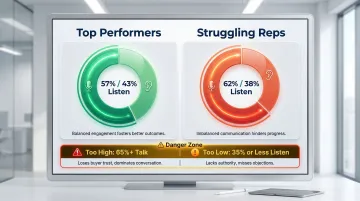
This ratio measures how much of the conversation the rep controls versus how much the prospect speaks. Gong Labs analysis of 326,000 calls found that top reps average 57% talk time on won deals, while struggling reps average 62%.
What deviations reveal:
- Too high (65%+): Rep is pitching instead of discovering; they're not asking enough questions
- Too low (35% or less): Rep may be losing control of the conversation or failing to guide the buyer
Consistency matters more than hitting a universal ratio. High performers maintain nearly the same ratio whether they win or lose, low performers swing by 10% or more between wins and losses.
Objection Patterns
Tracking objections across all calls, not just individual ones, reveals whether pricing concerns, competitive hesitations, or implementation fears are systemic issues.
When objections are handled effectively, win rates increase by nearly 30%. Aggregate objection data informs rep coaching (teaching specific handling frameworks) and product/marketing strategy (addressing recurring concerns in messaging or roadmap decisions).
Buyer Sentiment and Engagement
AI sentiment analysis detects tone shifts, enthusiasm peaks, and frustration signals throughout a call. This helps managers identify the exact moment a conversation moves in the wrong direction, enabling targeted coaching on how reps recover (or fail to recover) from those inflection points.
Sentiment data also clarifies who in the buying group is aligned, and who isn't. Deals involving multiple buyer contacts have a 130% higher win rate for opportunities over $50,000, making stakeholder-level engagement signals a direct input for multi-threading decisions.
Competitive Mentions
Systematic tracking of competitor names mentioned on calls builds a competitive intelligence database from the field. This data reveals:
- Which competitors appear most frequently
- At what deal stage they're introduced
- How effectively reps handle comparative conversations
Timing is everything: early competitive discussions increase win odds by 32-49%, while late-stage mentions signal severe deal risk. For partner channel teams, where competitive exposure is high and vendors often lack direct visibility, this call-level data fills a critical intelligence gap.
Call Outcome and Next-Step Clarity
Whether a call ends with a clearly agreed-upon next step is one of the strongest predictors of deal momentum. Close rates decline by 71% when next steps are not discussed on the first call.
Calls that conclude with vague commitments ("I'll follow up with you sometime next week") correlate strongly with stalled deals. Tracking this at scale reveals whether the problem is:
- Individual, one rep needs coaching on closing discipline
- Systemic, the team lacks a consistent next-step framework
How Pifini Helps You Turn Call Data into Continuous Performance
Pifini is a revenue enablement platform built to close the loop between call analysis and performance improvement, surfacing insights and acting on them within the same system.
Automated Call Scoring and Prescriptive Training
Pifini's AI evaluates every call against defined success criteria, scores each call, identifies skill gaps, and automatically routes reps or partners into targeted training modules, no manual manager intervention needed. Scored criteria include:
- Discovery effectiveness
- Objection handling
- Product positioning
- Closing strength
When the system detects weak objection handling, it immediately enrolls that rep into focused, short learning modules designed to close that specific gap, all within the same platform. Call data feeds directly into analytics that correlate training completion with actual call performance and deal outcomes, creating a continuous improvement cycle.
Built for Partner and Channel Ecosystems
Pifini is designed for organizations selling through resellers, distributors, and alliances, where call analysis at scale is especially difficult because selling activity happens outside the four walls of the organization. The platform gives revenue leaders visibility across the full partner ecosystem, including direct sales teams and external channel partners alike.
For vendors facing the challenge of maintaining message consistency and call quality across hundreds of channel partners, Pifini provides the infrastructure to analyze, coach, and improve partner performance across hundreds of partners simultaneously.
Unified Platform at $50/User/Year
All of these capabilities, content management, training automation, call scoring, AI coaching, and analytics, run in a single system. At $50 per user per year, Pifini is a practical alternative to point solutions or legacy competitors that charge $300–$600 per user annually.
Conclusion
Every sales call contains signals, about buyer hesitation, rep skill gaps, messaging that lands, and messaging that doesn't. Organizations that analyze these recordings systematically build a compounding advantage over those that treat them as archive files.
Sustained call analysis, where reviews happen regularly, patterns surface over time, and coaching ties directly to observed behavior, is what separates teams that improve incrementally from those that plateau. When insights flow automatically into training and rep development, recordings stop being an underused asset and start driving measurable results in win rates, deal velocity, and forecast accuracy.
Frequently Asked Questions
How to analyze recorded sales calls for insights?
Effective analysis starts by transcribing calls, tagging key moments (objections, sentiment shifts, competitive mentions), and scoring rep behavior against a defined rubric. Feed those insights back into coaching and training, ideally using AI to do this at scale across all calls, not just a sample.
What metrics should I track when reviewing sales call recordings?
Track talk-to-listen ratio, objection frequency and type, buyer sentiment, competitive mentions, and whether each call ends with a clear agreed next step. Which metrics matter most depends on your objective: coaching reps, flagging at-risk deals, or tracking competitive intel.
How does AI improve sales call analysis compared to manual review?
Manual review only covers a small sample of calls and is time-intensive. AI automatically transcribes, scores, and analyzes every call, enabling 100% call coverage, consistent scoring, and pattern detection across hundreds of conversations at once.
How often should sales managers review call recordings?
Review AI-scored or flagged calls weekly for coaching purposes. Conduct monthly cross-team reviews of aggregate patterns for playbook updates and strategic adjustments. Frequent, structured review prevents small performance gaps from compounding into pipeline problems.
How can sales call insights be used for rep coaching?
Call insights enable coaching grounded in real evidence, specific moments where a rep struggled with an objection or lost buyer engagement, rather than vague feedback. Platforms like Pifini connect call scores directly to targeted training modules, so reps are automatically routed to the skills they need most.
What is the difference between call recording and conversation intelligence?
Call recording captures and stores the audio or video of a conversation. Conversation intelligence analyzes that content, transcribing, scoring, tagging key moments, and surfacing patterns, to produce specific insights for coaching decisions, deal management, and go-to-market strategy.