Introduction
Pharmaceutical sales reps face shrinking access windows and rising stakes: HCP availability dropped from 60% to 45% in a single year, and half of reachable healthcare providers now limit engagement to three companies or fewer. Meanwhile, product portfolios grow increasingly complex, and regulatory scrutiny intensifies, yet traditional training methods were built for a world that no longer exists. Static classroom sessions and annual compliance PDFs can't prepare reps for real-time clinical objections or competitive challenges during a two-minute face-to-face call.
AI-powered training tools make learning continuous, scalable, and tied directly to field performance. These platforms extend manager support into every practice session and live call, without replacing human coaching, just reinforcing it.
TLDR:
- Traditional pharma training suffers from 84-90% information loss within 90 days due to lack of reinforcement
- AI roleplay simulations let reps practice with realistic HCP personas without risking actual relationships
- Pifini.ai connects live call coaching, LMS training, and analytics so call insights automatically trigger follow-up modules
- AI compliance monitoring flags noncompliant language in practice sessions, building audit-ready habits before reps reach the field
- Training-to-revenue analytics prove ROI by linking certification scores to win rates and deal velocity
Why Traditional Pharma Sales Training Is Falling Short
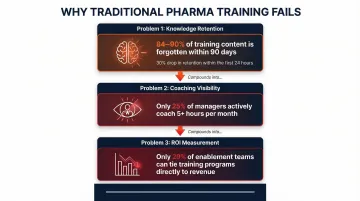
Classroom-based and static LMS training share three structural problems that compound each other. Research shows learners forget 84% to 90% of training content within 90 days, with the steepest drop, 30%, occurring in the first 24 hours. When reps complete a two-day product launch training and return to the field, the clinical nuances, competitive positioning, and objection handling strategies evaporate before they face their first HCP.
Coaching visibility is the second failure point. Only 25% of sales managers spend five or more hours monthly coaching reps, and 42.6% coach between 30-60 minutes per person per week. Without ride-alongs or objective call data, first-line managers can't identify which reps struggle with clinical articulation, objection handling, or closing until performance numbers reveal the damage months later.
ROI measurement is the third gap. Only 29% of sales enablement teams can directly tie their programs to revenue impact, and 35% of Chief Sales Officers admit they don't know what measurable improvements they're seeking from training investments.
Activity gets logged, certificates get issued, but whether any of it changes what happens in an HCP conversation stays unknown until quota numbers tell the story.
How AI-Powered Tools Transform the Way Pharma Reps Train
AI brings a foundational shift: moving from episodic training events to a continuous, adaptive learning loop embedded in the rep's daily workflow rather than separated from it. Instead of attending quarterly sessions and hoping knowledge sticks, reps practice, receive feedback, and refine skills in the same environment where they'll apply them.
Roleplay Simulations with AI-Driven HCP Personas
Large language model-powered simulators replicate specific HCP types with high accuracy. Skeptical oncologists who demand head-to-head trial data, time-pressed GPs who interrupt after 30 seconds, formulary gatekeepers focused on cost, all become practice partners available 24/7. Reps build genuine confidence handling clinical objections, pricing pushback, and competitive comparisons before risking actual prescriber relationships.
The simulations vary difficulty and surface realistic objections dynamically. Reps complete practice six times more often with AI simulation compared to roleplaying with managers or peers, and a Novartis case study showed a 59% assessment score improvement with 95% first-attempt pass rate after implementing AI sales simulators. Reps engage voluntarily because the feedback loop is immediate and the stakes feel real without consequences.
Personalized Feedback and Skill Scoring
AI evaluates each practice session across multiple dimensions: scientific accuracy, messaging clarity, tone, empathy, and compliance language. The feedback is specific and objective, not the generic "good job" that busy managers default to when reviewing ten reps in one afternoon. Reps see exactly where they lost clarity, which objection response fell flat, or when tone shifted from consultative to pushy.
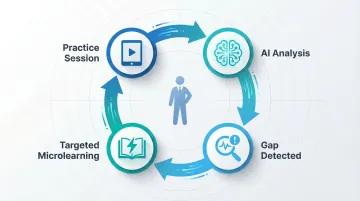
The adaptive learning loop closes the gap automatically. When AI detects a rep consistently struggling with cost objections, the system routes them into a targeted microlearning module without waiting for a scheduled review. This automation scales what great managers do naturally, spot patterns and provide relevant coaching, across hundreds of reps simultaneously.
Real-Time Coaching During Live Calls
Emerging live AI assist capabilities support reps directly during actual HCP interactions. Tools listen to conversations and surface in-the-moment guidance, relevant clinical data points, suggested objection responses, compliance alerts, without interrupting flow. When an oncologist asks about progression-free survival in a specific patient subgroup, the system instantly surfaces the exact trial data while the rep maintains eye contact and conversational rhythm.
Platforms like Pifini.ai connect live call coaching, LMS training, and performance analytics in a single workflow. When a rep fumbles a formulary access question on a live call, that gap automatically triggers a follow-up training module on payer conversations, no manager review required. The system identifies what each rep needs and delivers it at the moment the gap appears.
AI-Driven Compliance Training: Keeping Reps Audit-Ready
Compliance stakes in pharma are uniquely high. A single off-label statement can trigger regulatory penalties, the DOJ announced over $5.7 billion in False Claims Act settlements in fiscal year 2025, with Pfizer alone paying nearly $60 million for improper physician payments and speaker programs. Traditional compliance training, annual PDFs or checkbox e-learning, fails to create the behavioral habit of speaking carefully under pressure.
AI compliance simulation monitors practice conversations for noncompliant language patterns in real time. Unsupported efficacy claims, off-label references, missing risk disclosures, the system flags violations instantly and trains reps to self-correct instinctively. Rather than learning compliance rules abstractly, reps practice applying them in realistic scenarios until appropriate language becomes an automatic habit.
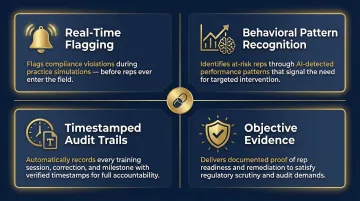
That repetition produces four concrete compliance benefits:
- Real-time flagging during practice prevents violations before they occur in the field
- Behavioral pattern recognition identifies reps who need additional intervention
- Timestamped audit trails document what was trained, scored, and corrected
- Objective evidence that reps have been equipped to handle regulatory requirements
The FDA issued over 200 enforcement letters in 2025 challenging drug advertising and promotion, underscoring how closely regulators watch promotional activity. AI systems give compliance teams the documentation they need to respond confidently to that scrutiny. Timestamped records show each rep practiced compliant messaging, received feedback on violations, and demonstrated mastery before entering the field, turning audit preparation from a scramble into a structured, repeatable process.
Personalized Learning at Scale: From Onboarding to Advanced Coaching
AI enables true personalization by building individualized learning paths based on each rep's assessment scores, practice session performance, and real-world call data. Rather than serving identical curriculum regardless of experience level, the system routes each rep into modules targeting their actual weak spots.
Onboarding Acceleration
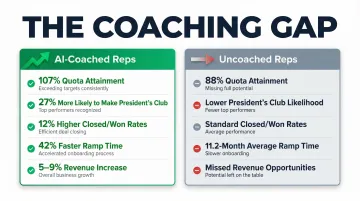
New hires ramp faster because the system identifies gaps early and deploys targeted modules. Pharma rep ramp time averages 11.2 months, but AI-assisted onboarding has shown up to 42% reduction in ramp time, with a Janssen India case study reporting 50% ramp time reduction after implementing digital learning platforms. Instead of waiting through generic training schedules, new reps focus intensively on their actual development needs.
Retention and Engagement
Medical and pharma sales turnover averages 15-22% annually, a costly problem that adaptive learning directly addresses. Reps who see training tied to their own progress stay engaged longer. Gamification, microlearning cadences, and visible skill progression create motivation, reps see their simulation scores improving, watch their call performance trending upward, and connect effort directly to capability growth.
Scaling Across Distributed Teams
AI training scales across large, geographically distributed sales forces, contract sales organizations, channel partners, and distributor reps, without hiring more trainers. One platform serves new hires in Boston, contract reps in Texas, and international distributors in Europe, each receiving paths built around their role and performance history.
From Training to Revenue: Measuring What AI Training Actually Delivers
The most valuable AI training platforms measure beyond learning completion, they connect training scores, certification milestones, and skill improvement trends to actual sales performance metrics like win rates, deal velocity, and prescription lift.
The Manager Dashboard View
Meaningful reporting gives first-line managers visibility into which reps completed specific modules, how their AI simulation scores have trended, and how those scores correlate to field performance in the same period. Rather than guessing which training matters, managers see direct evidence: reps who score 80%+ on objection handling simulations close 23% more formulary access conversations than those scoring below 60%.
Platforms like Pifini.ai surface this connection by linking certification and training score data directly to pipeline growth and deals closed. Key metrics from top-performing courses include:
- Training success rates of 46.1%
- Average performance improvements of 16.7%
- Projected annual impact in the tens of millions
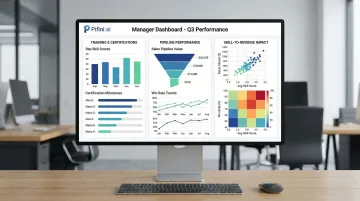
This shifts conversations from "how many people finished training" to "which training drives revenue."
Coached vs. Uncoached Comparison
Organizations can run internal analyses comparing performance metrics between reps using AI coaching intensively versus those who haven't. ZS Associates research found reps using virtual practice are 27% more likely to make President's Club. That's the kind of outcome data that builds a compelling internal business case.
When coached reps achieve quota at 107% versus 88% for uncoached peers, training budget discussions become much easier.
ROI metrics that matter:
- Win rate improvements tied to specific training modules
- Ramp time reduction for new hires completing AI-assisted onboarding
- HCP engagement frequency correlated with roleplay practice volume
- Prescription lift following product knowledge certification
- Compliance violation rates comparing AI-trained vs. traditionally trained cohorts
AI-enabled field effectiveness initiatives deliver 5%-9% revenue increases and +30% capacity for customer-focused activities, according to ZS Associates. A Forrester study on AI-powered coaching found 12% higher closed/won rates and 32% improvement in coaching productivity. Revenue leaders who anchor training investments to these numbers stop defending budgets and start expanding them.
Implementing AI-Powered Training Across Your Pharma Sales Organization
Map Critical Skill Gaps First
Before choosing a platform, training leaders should identify where rep underperformance is most costly. Is it weak clinical articulation losing access to KOLs? Poor objection handling stalling formulary approvals? Compliance risk from off-label messaging? Deploy AI systems against the highest-impact problems first, not everywhere simultaneously.
Run a Phased Rollout
Begin with a defined cohort, new hires or a single therapeutic area team. Establish baseline performance metrics (win rates, call frequency, time to first prescription). Run AI-assisted training for a defined period, then compare outcomes before expanding. This creates internal proof points and drives adoption organically when early cohorts demonstrate measurable improvement.
Critical implementation steps:
- Connect to CRM, LMS, and manager dashboards to eliminate access friction
- Define success metrics before launch, for example, 15% ramp time reduction or 10% win rate improvement
- Train first-line managers on analytics and coaching features before rolling out to reps
- Build regular reviews of training data and performance correlations into team cadences
Integration Determines Adoption
For AI training to stick, it must connect to the tools reps already use daily. Friction in access is the single biggest reason training tools go unused, when practice sessions require a separate login, adoption collapses.
Seamless workflow integration makes the difference: training prompts surfaced in CRM, simulation links in daily emails, and call scoring feeding directly to manager dashboards. Platforms that require reps to seek out training rarely get used.
Frequently Asked Questions
How is AI-powered training different from traditional pharma sales training methods?
AI training replaces static, infrequent sessions with continuous, adaptive learning using simulations and real-time feedback that respond to each rep's actual skill gaps. Rather than delivering the same content to everyone, AI personalizes paths based on assessment scores, practice performance, and field results.
Can AI tools train pharma reps on FDA compliance and regulatory requirements?
Leading AI platforms embed compliance guardrails directly into practice simulations, flagging noncompliant language in real time and generating audit trails that document rep readiness. This builds behavioral habits rather than abstract rule knowledge, making compliance instinctive under pressure.
How do AI roleplay simulations help pharma reps handle HCP objections?
AI-powered HCP personas simulate realistic objections on cost, clinical evidence, and competitive alternatives in a safe environment. Reps build confidence and fluency before facing real providers, with feedback that pinpoints exactly where each response falls short.
How long does it take to see results from AI-powered pharma sales training?
Initial skill score improvements are visible within the first few weeks of consistent use, while field performance outcomes like engagement rates and conversion typically become measurable within one to two sales cycles (approximately 60–120 days depending on therapeutic area).
How can training managers measure the ROI of AI-powered pharma sales training?
ROI is best measured by linking training scores and certification milestones to downstream metrics, win rates, ramp time for new hires, HCP engagement frequency, and prescription lift. Platforms like Pifini.ai connect these data points automatically, showing which training drives revenue rather than just completion rates.
What features should pharma companies prioritize when evaluating AI training platforms?
Prioritize compliance simulation with real-time flagging, integration with existing CRM and LMS systems, and manager dashboards that connect training scores to performance metrics. The ability to tie training outcomes directly to revenue data, win rates, ramp time, deal velocity, is what separates platforms that prove ROI from those that only track completion.