What are business acumen sales training simulation games?
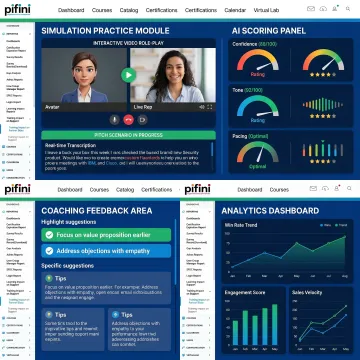
Business acumen sales training simulation games are interactive practice environments that help sellers improve commercial judgment, messaging, and decision-making. Instead of passive learning, reps work through realistic buyer scenarios, objections, and deal stages. With Pifini.ai, simulations can include AI roleplay, instant scoring, coaching feedback, and targeted follow-up training to reinforce the skills that matter most in live selling situations.
How do simulation games improve sales performance?
Simulation games improve performance by giving teams a safe place to practice high-stakes conversations before they happen with real buyers. Reps can repeat scenarios, refine responses, and receive objective feedback on tone, clarity, and objection handling. Over time, this builds confidence, reduces inconsistency, and helps managers coach more effectively using measurable data rather than subjective observations alone.
Who should use business acumen sales simulations?
These simulations are valuable for direct sales teams, channel partners, resellers, distributors, sales managers, and enablement leaders. They are especially useful for organizations that need to ramp new sellers faster, improve consistency across distributed teams, or strengthen partner readiness. Because Pifini.ai supports both internal and partner ecosystems, it works well for companies with complex go-to-market structures.
Can simulation training be customized to our sales process?
Yes. Pifini.ai supports custom roleplay scripts and scenario design so teams can reflect their own products, buyer personas, competitive pressures, and messaging frameworks. Organizations can upload playbooks, battlecards, and objection guidance to create simulations that feel relevant to actual selling conditions. This makes practice more useful and helps learners apply training directly to the conversations they handle every day.
Does Pifini.ai provide feedback during or after practice?
Pifini.ai supports both. During live calls, the Live Sales Call Copilot can provide real-time prompts, objection guidance, and content recommendations. During simulations and after calls, AI scoring evaluates performance and highlights strengths, weaknesses, and coaching opportunities. This combination helps teams improve in the moment while also building long-term readiness through structured feedback and targeted learning paths.
How is training impact measured?
Training impact is measured by connecting learning activity and simulation performance to business outcomes such as call quality, win rates, pipeline growth, and closed deals. Pifini.ai's Training Impact Analysis helps leaders see which modules, certifications, and coaching interventions are actually influencing results. That makes it easier to justify enablement investments and focus resources on the programs that move revenue forward.
Can partners and channel teams use these simulation tools?
Yes. Pifini.ai is built specifically for partner and channel ecosystems, including resellers, distributors, VARs, and alliances. Partners can access roleplay, live call support, learning paths, certifications, and AI assistance through a unified enablement experience. This helps organizations deliver the same quality of training and coaching to indirect sellers that direct teams receive, improving consistency across the entire revenue ecosystem.
What does pricing look like for the platform?
Several core Pifini.ai capabilities are positioned at $50 per user per year, with no add-ons and no hidden costs noted in the service information. That pricing includes enterprise-grade functionality such as LMS delivery, AI coaching, roleplay, call scoring, and partner enablement tools. For organizations comparing legacy platforms, this creates a lower-cost path to consolidating multiple enablement tools into one system.