Introduction
Life sciences sales teams face unrelenting pressure. HCP access windows are shrinking, interactive engagements across top global markets remain significantly below pre-pandemic levels. Clinical knowledge requirements differ by therapeutic area, regulatory compliance is non-negotiable, and field forces spanning dozens of territories give managers too few hours to coach every rep consistently.
Coaching is the primary lever separating high-performing organizations from the rest. Yet traditional models, periodic ride-alongs, subjective manager feedback, disconnected compliance training, can't keep up. When coaching breaks down:
- Performance gaps persist for weeks before anyone notices
- Selling frameworks drift apart across territories
- Compliance becomes a checkbox exercise instead of daily practice
This guide covers why traditional coaching fails in life sciences, exactly what AI coaching does and how it works, the highest-impact use cases, and a practical framework for measuring ROI.
Key Takeaways
- AI replaces infrequent, manager-dependent coaching with scalable, real-time feedback tied directly to compliance requirements
- Highest-stakes use cases: onboarding new reps, launching new products, and continuous re-certification for compliance
- Proven outcomes include faster ramp time, stronger messaging consistency, reduced turnover, and improved win rates
- ROI is measurable through ramp-time savings, manager efficiency gains, and CRM-integrated deal outcomes
- Closed-loop systems flag skill gaps, auto-route training, and tie results directly to pipeline performance
Why Traditional Sales Coaching Falls Short in Life Sciences
Life sciences is harder to coach than most industries. Reps face brief, infrequent HCP interactions where every second counts, clinical knowledge varies by therapeutic area, and regulatory constraints dictate what can and cannot be said. HCP willingness to engage frequently with pharma representatives remains near historic lows, and the percentage taking more than 12 annual calls has not recovered to pre-pandemic levels.
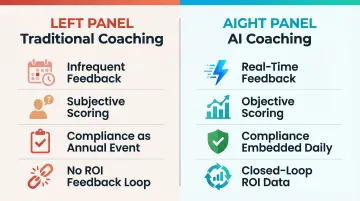
The core failure of manager ride-alongs is frequency: sales managers spend just 30 minutes per week on coaching. A typical field rep may receive one or two observed sessions per quarter, meaning performance gaps go unaddressed for weeks. In a field where a single HCP conversation can determine prescribing behavior for months, that delay has a direct revenue cost.
Inconsistency compounds the problem. When coaching quality depends on individual managers, reps in different territories develop different skills at different rates. There is a significant gap between what managers believe they're providing and what reps think they're receiving. Top performers receive more coaching in critical areas, market dynamics, competitor positioning, relationship building, than underperformers, creating a coaching equity problem that widens performance gaps rather than closing them.
Two more structural gaps make this worse:
- Compliance treated as a calendar event, annual certifications and PDF updates don't prevent non-compliant language from surfacing during a real HCP conversation, where the consequences are immediate
- No ROI feedback loop, without objective data connecting coaching activities to behavioral change and then to business outcomes, organizations cannot identify what's working, justify investment, or course-correct before it's too late
These aren't edge-case failures. They're built into how traditional coaching operates, and they're exactly what AI-driven approaches are designed to fix.
What AI Coaching Does for Life Sciences Sales Teams
On-Demand Practice With Realistic HCP Scenarios
AI-powered roleplay simulations allow reps to practice clinical conversations privately, on their own schedule, without the social pressure of a manager or peer evaluating them in real time. Research shows that AI roleplay training interventions yielded performance improvements ranging from 7% to 35%, specifically benefiting salespeople with low prior performance or high performance goals. The private, self-paced nature of AI practice enables reps to repeat difficult scenarios until mastery, something impossible with traditional manager-led roleplay that requires scheduling live sessions.
AI personas can be configured to simulate specific HCP profiles reps actually encounter, skeptical oncologists, time-pressed cardiologists, formulary committee members, giving reps targeted practice for their territory before they walk into a real meeting. Clinical conversations vary dramatically by specialty, decision-making authority, and therapeutic area, so the more territory-specific the practice, the better.
Objective, Multi-Dimensional Feedback
AI evaluates performance across verbal and nonverbal dimensions simultaneously, pacing, word choice, message sequencing, objection handling language, clinical accuracy, compliance adherence. These dimensions typically escape human observers or are assessed inconsistently due to cognitive limits and individual biases.
Consistent scoring enables meaningful benchmarking:
- Individual reps can be compared against top performers on the team
- Improvement trajectories can be tracked over time
- Managers receive data-driven evidence of where to focus coaching conversations rather than relying on memory or subjective impressions
Platforms like Pifini provide performance benchmarking across calls, tracking discovery, objection handling, product positioning, and closing strength, the core competencies that distinguish top performers.
Compliance-Embedded, Continuous Learning
AI coaching platforms embed regulatory-compliant messaging directly into practice scenarios, flagging non-compliant language in real time. Compliance becomes a daily practice, not a once-a-year certification event. That shift matters most during label updates, new indications, or any change requiring rapid retraining across a large field force.
Pifini's platform closes the loop between performance data and learning. When the system detects a gap, through call scoring, roleplay results, or content performance, it takes action automatically:
- Flags the specific skill or compliance issue
- Auto-enrolls the rep in a focused training path
- Tracks progress without manager intervention
Gaps get addressed in days, not weeks, and without requiring a manager to diagnose the problem and manually assign remediation.
Key Use Cases: Where AI Coaching Has the Biggest Impact
New Rep Onboarding and Ramp Acceleration
New sales executives take an average of 11.2 months to reach full productivity, representing substantial lost revenue. In medical device sales, a new rep can take four months of ramp time, generating only 40-60% of what a tenured rep would produce. This productivity gap translates to $140,000-$184,000 in lost revenue during the ramp period alone.
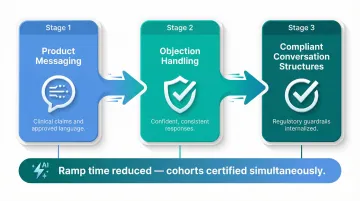
AI-guided practice from day one accelerates time to full productivity by letting reps rehearse across three high-stakes areas before their first real HCP interaction:
- Product messaging, building fluency with clinical claims and approved language
- Objection handling, working through pushback scenarios until responses are confident and consistent
- Compliant conversation structures, internalizing regulatory guardrails before they matter in the field
Reps can fail privately, receive immediate feedback, and retry until proficient, a speed of iteration impossible with traditional manager-dependent training.
AI also enables large onboarding cohorts to be certified simultaneously on product knowledge and compliance messaging without creating bottlenecks for manager capacity. During large-scale hiring surges or field force expansions, traditional models require proportional increases in manager time, AI removes that constraint entirely.
New Product Launches
Product launches are disproportionately high-stakes. Reps must rapidly internalize:
- New clinical data and study outcomes
- Approved promotional messaging and label claims
- Updated competitive positioning against established alternatives
Inconsistency during the launch window directly costs market share, yet the traditional model, a one-day meeting, a PDF deck, cannot ensure rep readiness at scale.
AI coaching can deploy updated launch scenarios across an entire field force rapidly, ensuring every rep practices the approved narrative and receives objective feedback before their first post-launch HCP conversation. This consistency eliminates the territorial variation that typically emerges when hundreds of reps interpret launch messaging differently based on their individual understanding and manager coaching quality.
The speed advantage matters: when launch windows are measured in weeks and early adoption patterns set long-term trajectory, the ability to certify an entire field force on new messaging within days rather than months creates competitive advantage.
Ongoing Re-Certification and Skill Maintenance
AI coaching prevents the knowledge decay that typically follows SKOs and training workshops by delivering microlearning and on-demand practice between major training events. Pifini's prescriptive LMS model exemplifies this: continuous skill assessment drives personalized reinforcement, ensuring reps maintain proficiency rather than losing skills over time.
Re-certification for regulatory updates, new label data, formulary changes, compliance refreshers, can be managed through AI platforms at scale, with built-in audit trails that satisfy compliance and legal review requirements. This addresses the challenge of distributed field forces where manual re-certification creates administrative burden and inconsistent completion rates.
Measuring the ROI of AI Sales Coaching
Three ROI drivers apply to every life sciences organization, and all three are measurable:
1. Ramp Time Reduction
The mean annual wage for technical and scientific sales representatives is $113,520, with benefits accounting for 28.3% of total compensation, bringing fully loaded compensation to approximately $158,000 annually or $434 per day. Industry reports indicate specialty reps average $228,000 and hospital reps $243,000 annually when including expenses and support costs.
Reducing ramp time by even 30 days saves approximately $13,000 per rep in direct costs, before accounting for revenue impact. For a 500-rep organization, this represents $6.5 million in ramp-time savings alone.
2. Rep Retention Improvement
Turnover costs range from 90% to 200% of annual salary, with direct replacement costs reaching 50-60% of salary. In medical device sales, the total cost of a single territory vacancy is estimated at $486,000 to $580,000, factoring in lost revenue, recruiting fees, training investment, ramp deficit, and competitive damage during the gap.
Reducing annual turnover from 15% to 12% in a 500-rep organization saves approximately $2.9 million annually when accounting for replacement and productivity costs.
3. Manager Time Recaptured
When AI handles baseline feedback and surfaces specific coaching gaps through data, managers stop spending time on repetitive rep check-ins. For 50 managers, recapturing 2 hours per week adds up to 5,200 hours annually, time that shifts toward deal support, territory planning, and high-stakes coaching conversations.
Building a Basic ROI Model
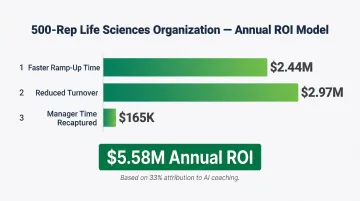
The LTEN/Atomus framework models this for a mid-sized 500-rep organization. Attributing just 33% of gains to AI coaching, the model estimates $5.58 million in annual ROI:
| ROI Driver | Estimated Annual Value |
|---|---|
| Faster ramp-up time | $2.44M |
| Reduced turnover | $2.97M |
| Manager time recaptured | $165K |
| Total | $5.58M |
This model excludes direct sales performance gains, which is where the ROI story gets more compelling. Connecting coaching data to field outcomes requires CRM integration that ties training scores to win rates, HCP call quality, sales cycle length, and prescription lift. Pifini's platform makes this connection concrete: certification completions and AI coaching scores link directly to deals closed, win rates, and pipeline growth in a single reporting view.
Metrics to Baseline and Track
Sales leaders should baseline these metrics before implementation and track post-deployment:
- Time-to-productivity for new hires
- Win rate for coached vs. non-coached cohorts
- Manager coaching session frequency and duration
- Rep retention rate
- Sales model adoption score
Without pre-implementation baselines, ROI claims are difficult to defend to leadership. Establishing these numbers before launch gives you the before-and-after comparison that turns coaching investment into a board-ready business case.
How to Implement AI Coaching in Your Life Sciences Sales Team
Preparation before platform selection determines success. Define the specific outcomes you need to move, onboarding speed, compliance adherence, objection handling scores, and establish baselines for each. Identify your highest-priority rep populations: new hires, underperformers, reps entering a new therapeutic area.
Confirm integration requirements with your CRM and LMS early. Without this groundwork, implementation becomes a technology project rather than a performance improvement initiative.
Building Adoption That Sticks
Start with a focused pilot on a single high-impact use case, new hire onboarding or a product launch, to prove value before broad rollout. This de-risks the initiative and creates internal champions who can speak to results firsthand.
From there, embed platform access directly into rep daily workflows and CRM systems. Integrating AI-driven modules into existing workflows boosted course completion rates by 48% and increased participation by 36% within 60 days. When reps don't have to context-switch, they actually use the tools.
Visible progress tracking also matters. Gamified learning increases knowledge retention by 45% compared to non-gamified programs, and completion rates improve when reps can see their advancement relative to peers and goals.
The Manager's Role in an AI-Assisted Model
AI handles consistent baseline feedback, scales practice volume, and surfaces data on where each rep struggles. That frees managers to focus their time on higher-order coaching conversations, informed by that data, instead of managing observation schedules and guessing at skill gaps.
This human-in-the-loop model outperforms either approach alone. Managers bring the strategic guidance and relationship context that no algorithm replicates; AI brings the consistency and scale that no manager can sustain across a full team.

Frequently Asked Questions
How is AI coaching different from traditional sales coaching in life sciences?
AI coaching delivers objective, on-demand, scalable feedback across every rep simultaneously, versus infrequent, subjective manager observation limited by time and geography. It continuously embeds compliance into practice rather than treating it as a separate periodic event, and provides consistent scoring that enables meaningful benchmarking impossible with human-only observation.
How does AI coaching handle compliance requirements in pharma and medical device sales?
AI platforms embed regulatory-compliant messaging directly into practice scenarios, flag non-compliant language in real time during simulations, and maintain audit-ready records of training completion and performance scores. The result: compliance becomes a daily habit built into skill development, not a once-a-year certification box to check.
How long does it take to see measurable results from AI sales coaching?
Behavioral improvements in message clarity and objection handling typically emerge within a few weeks of consistent practice, with onboarding time reductions measurable within the first cohort. Win rate impact requires CRM integration to link training data to deal outcomes, expect 3-6 months for statistically meaningful results.
Can AI coaching be customized for different therapeutic areas or product lines?
Yes, AI coaching platforms can be configured for specific therapeutic areas, approved product messaging frameworks, target HCP profiles, and competitive objection sets. Pifini's platform supports custom roleplay scripts where organizations upload industry-specific playbooks, competitor battlecards, and messaging guides to simulate real challenges, making feedback and simulations directly relevant to each rep's actual territory and portfolio.
How do you measure the ROI of AI sales coaching in life sciences?
ROI is measured through ramp time reduction, rep retention improvement, manager time efficiency, and win rate impact. Credible measurement requires pre-implementation baselines and CRM integration to connect coaching activity directly to pipeline and revenue outcomes.
What should life sciences sales leaders look for when choosing an AI coaching platform?
Prioritize platforms with life sciences-specific scenario capabilities, built-in compliance flagging, objective multi-dimensional feedback, and seamless integration with existing LMS and CRM systems. The critical differentiator is connecting training data to business outcomes, not just activity metrics, by linking certification scores and coaching data directly to deals closed.