Introduction
Channel sales leaders face a persistent problem: most enablement platforms weren't built for them. When you're managing a distributed network of resellers, distributors, and alliance partners, you need infrastructure that reflects how partner-led revenue actually works — not a retrofitted version of a direct sales tool.
The typical revenue enablement platform was designed for internal teams, with conversation intelligence calibrated to manager-to-rep coaching, readiness indexes built around corporate org charts, and licensing priced for hundreds of W-2 employees rather than thousands of external partners.
That mismatch has real consequences at scale. Mindtickle is a widely adopted platform built around direct sales coaching and conversation intelligence — effective for internal teams improving pitch quality and manager effectiveness. Pifini is purpose-built for partner and channel ecosystems, combining an enterprise LMS, AI coaching, content management, and partner-specific infrastructure in one platform.
That distinction matters when you're trying to move performance across hundreds of external sellers you don't directly manage.
Key Takeaways
- Mindtickle targets direct sales readiness with AI roleplay and conversation intelligence, but has no native partner architecture or enterprise LMS
- Pifini bundles an enterprise LMS, AI coaching, Digital Sales Rooms, and a Partner Enablement Hub into one platform at $50/user/year for channel ecosystems
- Mindtickle requires custom quotes with typical costs estimated at $360-$600/user/year; Pifini offers transparent flat-rate pricing roughly 10x lower
- Choose Mindtickle for internal direct sales teams with dedicated enablement staff; choose Pifini for reseller, distributor, and alliance networks
- The real decision comes down to fit: pick the platform built for how your organization actually sells
Pifini vs. Mindtickle: Quick Comparison
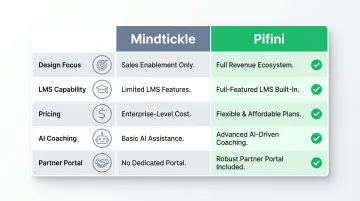
| Dimension | Mindtickle | Pifini |
|---|---|---|
| Design Focus | Internal direct sales teams | Partner and channel ecosystems (resellers, distributors, alliances) |
| LMS Capability | Sales training modules with certifications — not a full enterprise LMS | Full enterprise LMS (NetExam rebranded) with prescriptive learning, compliance tracking, and auto-enrollment |
| Pricing | Custom quote required; estimated $360-$600/user/year | $50/user/year, publicly listed |
| AI Coaching | Post-call analysis and AI roleplay simulations | Live AI coaching during customer calls + auto-enrollment into targeted training based on performance gaps |
| Partner Portal | Not native; partner enablement is a "use case," not a product feature | Native Partner Enablement Hub with co-branded portals, AI CAM concierge, and partner-specific analytics |
Mindtickle was built to manage reps inside a single company's org structure — coaching direct reports, scoring calls, tracking readiness. Pifini solves a different problem: enabling sellers you don't directly manage, across independent reseller and distributor organizations that need training, certification, and deal support at scale.
What is Mindtickle?
Mindtickle is a revenue enablement platform that combines sales training, AI roleplay, conversation intelligence (Call AI), and Digital Sales Rooms — primarily designed to improve the performance of internal, direct sales teams. Gartner classifies it under Revenue Enablement Platforms and Digital Sales Rooms, while G2 positions it in Sales Acceleration and Sales Training & Onboarding — not as an LMS.
Core capabilities include:
- Call recording and transcription to capture live sales conversations
- AI-driven roleplay scenarios for pitch practice and objection handling
- Conversation intelligence to surface buying signals and deal risks
- Coaching dashboards for sales managers to track readiness and performance
These features are optimized for a direct-selling motion where managers coach their own reps within a single organizational structure. They were not built for a channel-mediated model where external partners operate independently.
Known Limitations
User reviews across G2, TrustRadius, and Capterra reveal consistent patterns:
- Admin complexity: Bulk actions and course builds require significant upfront time; one G2 reviewer noted they export data to QlikSense because "native analytics dashboards are just okay"
- Reporting gaps: Dashboard limitations and the need for "deep reporting expertise" to pull specific insights
- System performance: Slow loading with heavy content, quiz glitches, and platform instability
- Licensing barriers: A TrustRadius reviewer stated, "We would like to see the licensing done differently... the way licensing is set up can make it hard to expand use"
- Implementation timelines: Third-party sources estimate 6-8 weeks for typical implementations with $3,000-$5,000 setup fees
These operational frictions are manageable for internal teams with dedicated enablement staff. They become cascading problems when applied to distributed partner networks where simplicity and self-service adoption are non-negotiable.
Use Cases of Mindtickle
Mindtickle fits organizations running a centralized, direct sales model — mid-to-large enterprises with dedicated enablement staff who can absorb the administrative overhead. It's commonly deployed in:
- SaaS and technology companies for onboarding internal reps and tracking conversation quality
- Financial services firms for ongoing manager coaching and readiness measurement
Cisco used Mindtickle to roll out training to 18,000 internal sellers in six weeks, which shows how the platform performs at scale when headcount, budget, and implementation resources are already in place.
When the buyer relationship stays within your sales organization and the goal is optimizing manager-to-rep workflows, Mindtickle works well. The prerequisite is having the budget and internal capacity to run it.
What is Pifini?
Pifini is an AI-powered revenue enablement platform built specifically for partner sales ecosystems. It unifies training, content, AI coaching, and revenue analytics into a single platform — connecting every customer interaction to measurable business outcomes across reseller networks, distributor hierarchies, and alliance ecosystems.
The platform's unified architecture includes:
- Enterprise LMS — rebranded NetExam with prescriptive learning paths, compliance certifications, and automated training enrollment
- Digital Sales Rooms — secure buyer collaboration hubs that centralize proposals, content, and deal timelines
- Live AI Sales Call Copilot — real-time coaching during active customer calls with prompts, objection handling support, and resource suggestions
- Post-call scoring — AI evaluation that flags performance gaps and automatically routes users into targeted training
- Partner Enablement Hub — native partner portal with co-branded experiences, multi-tier onboarding, and engagement tracking
- AI CAM/Concierge — AI-powered avatar that instantly answers partner questions about certifications, incentives, and deal registration
- Revenue analytics — connects training scores and certifications directly to pipeline growth, win rates, and deal outcomes
Partner-First Design Philosophy
Pifini was designed to solve the specific challenges channel programs face: onboarding external sellers you don't directly manage, maintaining message consistency across independent organizations, and proving training ROI across a dispersed ecosystem. That focus shapes every feature in the platform.
At $50/user/year with no hidden add-ons, Pifini delivers enterprise capabilities at 10x less than platforms like Mindtickle, Seismic, or Bigtincan — making it accessible to channel programs of all sizes without requiring multi-year procurement cycles.
Engagement Mechanics
Even the most capable platform fails if partners don't use it. Pifini addresses adoption directly with engagement mechanics built into the core product:
- Gamification — certifications, role-based scenarios, and performance tracking
- Microlearning — bite-sized modules with spaced repetition and adaptive pathways
- AI simulations — realistic buyer-seller scenarios with real-time feedback
- Personalized learning paths — automated enrollment based on call performance and skill gaps
The result is measurably higher partner participation — which is where most channel enablement programs stall out.
Use Cases of Pifini
Pifini fits organizations whose revenue runs through partner channels:
- SaaS companies with reseller and alliance networks who need unified training, content, and AI coaching
- Manufacturers distributing through dealer networks who require certification compliance and deal support
- Enterprises managing OEM or technology alliance partners who need performance-tracked enablement at scale
Channel program managers get a single platform to onboard new partners, certify them on products, track deal activity, and identify underperformers through AI-flagged call data. No separate LMS, enablement tool, or analytics dashboard required.
Pifini's customer roster includes AMD, Hexagon, Bobcat, Omron, Stanley, and ABBYY — enterprise-grade deployments across industries that rely heavily on partner and channel sales motions.
Pifini vs. Mindtickle: Which Is Better for Channel Sales?
The right choice comes down to your go-to-market architecture. If your revenue flows primarily through internal direct sales reps, Mindtickle's conversation intelligence and coaching tools may serve you well — assuming you can absorb the cost and implementation complexity. If your revenue flows through partners you don't directly manage, Mindtickle creates gaps at every stage.
The Channel Enablement Gap
Mindtickle was not built to handle multi-tier partner structures, co-branded training portals, or partner-specific certification tracking. On its subscription services page, "Partner Enablement" appears only under Use Cases — described as helping to "align messaging across revenue-generating channels." It's not a dedicated product module.
Organizations that try to run channel programs through Mindtickle typically end up bolting on separate LMS, PRM, or partner training tools — increasing cost and complexity while creating fragmented workflows that partners resist using.
LMS as a Non-Negotiable
For channel programs, a full LMS isn't optional — it's the mechanism by which you certify partners, track competency, and prove compliance. Mindtickle's own blog explicitly distinguishes its platform from an LMS, positioning itself as a "Sales Productivity Platform" focused on sales-specific skills.
That positioning creates a real gap. Certification management and compliance workflows — the core of any enterprise LMS — fall outside Mindtickle's design intent, which means channel-heavy organizations end up patching the hole with separate tooling.
Pifini includes a full enterprise LMS (built on NetExam) with prescriptive learning, automated enrollment, and compliance certification — eliminating that dependency and ensuring partners receive targeted training when AI call scoring flags performance gaps.
Cost at Channel Scale
Budget impact compounds quickly when scaling across partner ecosystems:
| Partner Users | Pifini ($50/user/year) | Mindtickle (estimated range)* |
|---|---|---|
| 100 | $5,000/year | $36,000–$60,000/year + implementation |
| 500 | $25,000/year | $180,000–$300,000/year + implementation |
| 1,000 | $50,000/year | $360,000–$600,000/year + implementation |
*Mindtickle does not publish pricing. Third-party estimates place typical costs at $360–$600/user/year; this is a directional reference, not confirmed pricing.
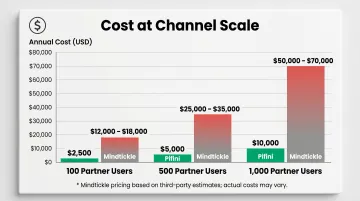
At 1,000 partner users, the cost difference could exceed $500,000 annually — budget that could be redirected into partner marketing, incentive programs, or field enablement.
Situational Recommendation
Choose Mindtickle if:
- Your primary need is internal direct sales coaching and conversation intelligence
- You have a dedicated enablement team with bandwidth to manage admin complexity
- Custom pricing and multi-month implementation timelines fit your procurement process
Choose Pifini if:
- Your revenue depends on external partners (resellers, distributors, alliances)
- You need a unified training + content + AI coaching platform with native partner architecture
- Predictable per-user pricing matters as your partner ecosystem grows
Most feature comparisons miss the point. Channel sales has different infrastructure requirements than direct sales, and a platform's architecture either reflects that or it doesn't.
Real-World Impact: How Channel Teams Win with Pifini
Channel programs routinely face the same core challenge: partner ramp time is too slow, partner-sourced pipeline is inconsistent, and it's impossible to trace which training activities are actually influencing deal outcomes. This is the exact gap Pifini was built to close.
Organizations using Pifini's integrated platform report measurable outcomes tied directly to partner enablement:
- 40% faster training completion through prescriptive learning and microlearning
- 30% higher program engagement via gamification and AI simulations
- 25% more deals registered per quarter with streamlined workflows
- Up to 94% training ROI when linking certifications to revenue outcomes
Unlike Mindtickle, which measures enablement through training completion and call scores, Pifini connects certifications and training performance directly to pipeline growth and win rates. This gives revenue leaders a tangible ROI story to bring to the CFO — not just activity metrics, but business outcomes.
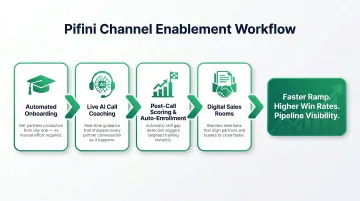
Take a manufacturing company selling through a distributor network — inconsistent product positioning, slow partner ramp, and no visibility into rep readiness. With Pifini, the program includes:
- Automated onboarding with partner-specific certification paths
- Live AI call coaching that helps distributor reps handle technical objections in real time
- Post-call scoring that flags struggling reps and auto-enrolls them into targeted training
- Digital Sales Rooms that standardize buyer collaboration and content delivery
The result: partners ramp faster, win rates improve, and sales leaders can finally see which partners are pipeline-ready — and which ones need a push.
Channel and partner sales leaders evaluating their enablement stack can see how Pifini applies to their program.
Conclusion
Mindtickle is a capable platform for organizations running a direct sales model with dedicated enablement infrastructure. For companies whose growth depends on a partner ecosystem, it creates friction that compounds quickly:
- Separate LMS tools bolted on to fill training gaps
- Custom partner portals built outside the core system
- Fragmented analytics that can't connect training to revenue
- Licensing costs that multiply unsustainably across distributed networks
Pifini was built for exactly what Mindtickle wasn't designed to handle: training, certifying, coaching, and measuring partners at scale — in a single system, at $50 per user per year. For channel-first organizations, that's not a workaround. It's the architecture your partner revenue model actually requires.
Frequently Asked Questions
Is Mindtickle an LMS?
No, according to majority analyst classification. Gartner classifies Mindtickle under Revenue Enablement Platforms and Digital Sales Rooms, while G2 lists it under Sales Acceleration and Sales Training. Mindtickle's own blog explicitly positions itself as a "Sales Productivity Platform" rather than an LMS, noting that LMS is for compliance and HR training while its platform focuses on sales-specific skills.
What is channel-first sales enablement, and why does it matter?
Channel-first enablement is built for organizations that sell through external partners — resellers, distributors, and alliances — rather than a direct sales force. Most platforms are designed for internal teams, which creates gaps in multi-tier onboarding, co-branded portals, and certification workflows for external sellers you don't directly manage.
How does Pifini support channel partners that Mindtickle doesn't?
Pifini includes native partner architecture: multi-tier partner onboarding, co-branded training portals, partner-specific certification paths, AI CAM concierge for 24/7 partner support, and engagement tracking across external networks. Mindtickle lists partner enablement as a use case only — not a dedicated product module — requiring third-party tools to replicate these capabilities.
How do Pifini and Mindtickle compare on pricing?
Pifini is publicly priced at $50/user/year with no hidden add-ons. Mindtickle requires a custom quote; third-party estimates suggest typical costs range from $360-$600/user/year with implementation fees. At 500 partner users, the annual cost difference could exceed $150,000.
Can Pifini replace both an LMS and a sales enablement platform?
Yes. Pifini combines an enterprise LMS (NetExam rebranded), content management, AI coaching, live call copilot, call scoring, and analytics in a single platform. That removes the need for separate training and enablement tools while keeping learning data connected to revenue outcomes.
Which platform is better for resellers and distributors specifically?
Pifini is purpose-built for reseller and distributor programs, with native partner architecture, an included enterprise LMS with certification workflows, and live AI coaching that helps external sellers perform like internal reps. Mindtickle requires stitching together multiple tools to reach comparable coverage.