The stakes are high. The corporate LMS market is projected to grow from $9.57 billion in 2024 to $27.43 billion by 2030, yet buyer satisfaction remains alarmingly low, only 10% of companies rate their LMS satisfaction above 7 out of 10.
What separates a true enterprise LMS from a standard solution? Scalability to support thousands of users, AI-driven personalization, multi-tenant architectures for separate partner portals, deep integrations with CRM and HRIS systems, and, most critically, the ability to link training completion directly to business outcomes like win rates, certification velocity, and revenue per trained user.
Key Takeaways
- Enterprise LMS platforms manage training at scale, covering employees, partners, and customers, with compliance, analytics, and integrations that standard tools can't match
- The 15 platforms below were evaluated on scalability, AI capabilities, partner/customer training support, pricing transparency, and integration depth
- Pifini leads for revenue-focused partner ecosystems with prescriptive learning and AI coaching, priced at $50/user/year, a fraction of legacy competitors
- Look for auto-enrollment logic, multi-tenancy, SSO/HRIS/CRM integrations, compliance tracking, and learning-to-revenue analytics when evaluating options
What is an Enterprise Learning Management System?
An enterprise LMS is a centralized software platform built to manage, deliver, and measure training programs at scale, serving internal employees, external partners, customers, and channel resellers from a single backend. Unlike standard LMS platforms, enterprise solutions support thousands of users simultaneously, offer sophisticated multi-tenant architectures (separate branded portals for different audiences), and provide advanced analytics that standard tools can't replicate.
Enterprise organizations need more than basic course delivery. The capabilities that separate enterprise platforms from standard tools include:
- Audit-ready compliance tracking tied to regulatory requirements
- Granular role-based access controls across departments and partner tiers
- Branded portals for each partner or customer segment
- Analytics that connect training completion to business metrics, sales win rates, onboarding speed, and customer churn reduction
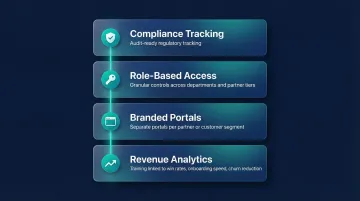
Where standard LMS platforms stop at content delivery, enterprise platforms connect learning directly to revenue outcomes.
The list below covers the 15 best enterprise LMS platforms for 2026, evaluated across employee training, sales enablement, partner training, and customer education use cases.
15 Best Enterprise Learning Management Systems in 2026
These platforms were selected based on six criteria: scalability, AI functionality, partner and customer training support, integration depth, compliance features, and overall value. The list spans use cases from sales enablement and channel training to compliance management and extended enterprise learning.
Selection criteria at a glance:
- Scalability, handles growth from hundreds to millions of learners
- AI functionality, automated recommendations, coaching, or content creation
- Extended enterprise support, partner, customer, and reseller training
- Integration depth, connects to CRMs, HRISs, and sales tools
- Compliance features, audit trails, certifications, regulatory reporting
- Value, total cost relative to capabilities delivered
Pifini
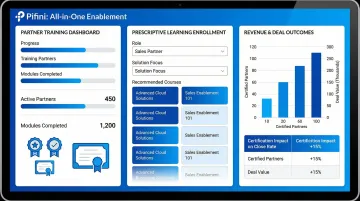
Pifini is an AI-powered revenue enablement platform built specifically for partner sales ecosystems, offering an enterprise LMS (powered by NetExam) as a core module alongside content management, AI sales coaching, and buyer engagement tools, at $50/user/year, roughly 6–12x less than platforms like Seismic and Mindtickle, which run $300–$600/user/year.
What sets Pifini apart is its prescriptive learning engine: the system automatically detects when sellers or partners struggle (via call scoring, quiz performance, or deal activity) and auto-enrolls them in targeted training, closing skill gaps before they cost deals. Customers include AMD, Blue Cross, ABBYY, Bobcat, and Hexagon.
| Best For | Partner sales ecosystems, resellers, distributors, and alliances needing to tie training directly to revenue performance |
| Key Features | Prescriptive auto-enrollment, AI sales call coaching, gamification, microlearning, certifications, multi-tenant portals, real-time learner analytics linked to deal outcomes |
| Pricing | $50/user/year as part of the all-in-one revenue enablement platform |
Docebo
Docebo is a cloud-based enterprise LMS platform built for businesses managing large-scale training across employees, customers, and partners, with strong AI capabilities, social learning features, and an extensive integration marketplace of 400+ connectors.
Docebo's Harmony AI suite powers content creation, personalized recommendations, and virtual coaching, while its multi-domain architecture lets organizations run separate branded portals for different audiences from one backend, a clear advantage for large enterprises juggling employee, customer, and partner training from one backend.
| Best For | Large enterprises managing employee, customer, and partner training across multiple business units or geographies |
| Key Features | AI authoring, social learning communities, gamification, advanced analytics, Salesforce and Zoom integrations, audit-ready compliance reporting |
| Pricing | Median ACV of approximately $40,390; multi-year commitments yield 15–30% discounts |
Absorb LMS
Absorb LMS is a versatile enterprise training platform known for its intuitive user interface, AI-powered course recommendations, and strong e-commerce capabilities, used by enterprises for onboarding, compliance, customer training, and partner enablement.
Absorb Infuse, its integrated customer experience platform, enables organizations to embed LMS content directly into existing tools (CRMs, portals, apps), which is particularly useful for extended enterprise environments where training needs to live inside partner portals or customer-facing apps.
| Best For | Enterprises needing a flexible, user-friendly LMS with strong white-labeling and the ability to embed learning into existing workflows |
| Key Features | AI authoring, customizable learning portals per cohort, e-commerce module, robust reporting, SCORM support, Salesforce integration |
| Pricing | Median ACV of approximately $20,000; pricing varies by active learner count |
Cornerstone OnDemand
Cornerstone OnDemand is a comprehensive talent and learning management platform that combines LMS, skills intelligence, and succession planning tools in one suite, designed for large enterprises and government organizations focused on internal workforce development at scale.
Its skills graph technology maps competencies across the organization, while deep integrations with Adobe Connect, Salesforce, LinkedIn, and others make it a strong choice for enterprises prioritizing long-term career development and compliance alongside training. The platform serves 7,000+ customers and 140+ million users and is FedRAMP Authorized (Moderate).
| Best For | Large enterprises and government organizations requiring integrated talent management, compliance tracking, and succession planning |
| Key Features | Skills graph, pre-built content library, compliance management, multi-language support, career development tools, real-time dashboards |
| Pricing | Quote-based with modular per-user pricing; enterprise contracts typically substantial |
iSpring LMS
iSpring LMS is a top-rated enterprise LMS recognized for its ease of use, fast deployment (courses can launch in one day), and a built-in authoring tool that enables rich course creation without a separate content tool, suited for organizations that need to cover full employee, partner, and customer training cycles without a complex implementation.
Key differentiators include 24/7 customer support, a native mobile app for offline learning, robust training automation (smart groups, automated enrollment, department structure mirroring), and 360-degree review capabilities that support performance-linked learning.
| Best For | Organizations wanting a comprehensive LMS that's fast to deploy, easy to use, and strong on both desktop and mobile with built-in content authoring |
| Key Features | Built-in authoring tool, 24/7 support, automated enrollment, smart groups, 360-degree reviews, native mobile app, HRIS/CRM/video conferencing integrations |
| Pricing | Pay-per-active-user model; pricing available upon request for custom user counts |
LearnUpon
LearnUpon is a cloud-based enterprise LMS known for multi-portal management, enabling organizations to run separate, branded learning environments for sales teams, customers, partners, and support staff simultaneously from one backend, with strong compliance tracking and automation.
Its AI-powered assessments and course recommendations, combined with consistently high customer support scores on G2 and Capterra, make it a popular choice for companies that need structured multi-audience learning without complex configuration.
| Best For | Companies needing clean, structured learning portals for multiple distinct audiences (employees, customers, partners) with minimal administrative overhead |
| Key Features | Multi-portal management, AI assessments, automated enrollments, mass user upload, extensive integration support, compliance tracking |
| Pricing | Quote-based; mid-market deployments (1,000–2,000 learners) estimated at $50,000–$80,000 annually |
360Learning
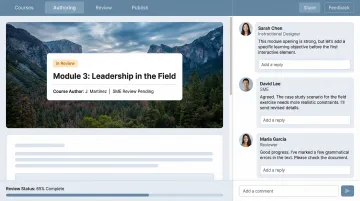
360Learning is a collaborative enterprise LMS that empowers internal subject matter experts to create, deliver, and optimize courses themselves, reducing dependency on central L&D teams and enabling faster knowledge sharing across large organizations.
Its AI-assisted authoring tools, peer feedback loops, cohort-based learning, and built-in social learning features (upvotes, in-course commenting, forums) make it the right fit when an organization wants to turn its own experts into course creators rather than routing everything through a central L&D team.
| Best For | Mid-to-large enterprises wanting to leverage in-house SME expertise for collaborative course creation and reduce centralized L&D bottlenecks |
| Key Features | Collaborative authoring, AI course creation, peer feedback, cohort-based learning, Salesforce/Slack/Teams integration, learning analytics |
| Pricing | Team plan: $8/user/month (up to 100 users); Enterprise plans custom |
SAP Litmos
SAP Litmos is a cloud-based enterprise LMS with a built-in content library covering compliance, business skills, and technical training (2,900+ courses), enabling fast deployment without the need to build courses from scratch, and deep integration with the SAP ecosystem.
Its mobile-friendly design, powerful automation for enrollments and certifications, and video-based skill assessment tools let distributed teams get up and running on compliance and skills training quickly, without waiting on custom content builds.
| Best For | Organizations already invested in the SAP ecosystem, or those needing rapid deployment with pre-loaded compliance and skills content |
| Key Features | Built-in content library (2,900+ courses), video assessments, task automation, GDPR-compliant security, customizable dashboards, SAP and HRIS integrations |
| Pricing | Quote-based; pricing available upon request |
CYPHER Learning
CYPHER Learning is an AI-powered enterprise LMS that combines LMS and LXP functionality, enabling administrators and educators to create immersive training content with AI-generated visuals and voiceovers in 50+ languages, reducing course production time significantly.
Its competency mapping, 16 assessment types, gamification, and e-commerce capabilities make it worth considering for organizations that need to produce and distribute high-volume multilingual training across global teams on tight timelines.
| Best For | Organizations needing to produce large volumes of multilingual training content quickly, with strong learner engagement mechanics |
| Key Features | AI content creation, 50+ language voiceovers, personalized learning paths, competency mapping, 16 assessment types, e-commerce, gamification |
| Pricing | Quote-based; Enhanced and Enterprise tiers available |
Adobe Learning Manager
Adobe Learning Manager (formerly Adobe Captivate Prime) is an enterprise LMS built for mid-to-large organizations, offering AI-based course recommendations, social learning via discussion boards, and a headless LMS architecture that lets companies embed learning into any external website or application.
Its deep integration with Adobe Experience Cloud, robust personalized dashboards, and gamification capabilities make it the natural choice for enterprises already invested in the Adobe ecosystem, though it carries a steep learning curve and higher price point.
| Best For | Mid-to-large enterprises already using Adobe Cloud products that want personalized learning with social collaboration and headless deployment flexibility |
| Key Features | Adobe Sensei AI recommendations, headless LMS, social discussion boards, gamification, personalized dashboards, Adobe Cloud integration |
| Pricing | Quote-based; uses monthly active user (MAU) model for floating audiences |
TalentLMS
TalentLMS is a scalable cloud-based enterprise LMS recognized for its simplicity, fast setup, and branch management capabilities that allow organizations to create separate learning portals for different teams or customer segments, all under one account.
Its gamification, white-labeling, built-in course authoring, and SSO support make it a practical starting point for companies graduating from spreadsheets or basic tools into a structured enterprise learning environment.
| Best For | Small-to-mid-market enterprises or growing organizations needing an easy-to-manage, cost-effective LMS with multi-branch portal support |
| Key Features | Branch management, gamification, white-labeling, built-in authoring, SSO, mobile learning, custom certifications, SCORM support |
| Pricing | Transparent tiers: Free plan available; Starter ~$69/month; Enterprise custom |
Seismic Learning
Seismic Learning (formerly Lessonly) is a sales-focused enterprise LMS built to improve performance for customer-facing teams, sales, marketing, and customer support, through practice scenarios, AI coaching, and skills assessments delivered via Seismic's Enablement Cloud.
Its AI-powered Role-Play Agent, interactive knowledge checks, and automated coaching workflows make it the go-to option for revenue-driven organizations that need training outcomes directly tied to sales performance metrics, at a price point that reflects its position in the enterprise tier.
| Best For | Revenue teams, sales organizations, and customer support teams needing practice-based learning tightly integrated with sales enablement content |
| Key Features | AI coaching assistant, role-play scenarios, interactive knowledge checks, skills dashboards, manager coaching tools, Salesforce integration |
| Pricing | Quote-based; often bundled with the broader Seismic suite |
WorkRamp
WorkRamp is a sales-oriented enterprise training platform that supports employee, sales team, and customer training with customizable role-based learning paths, peer mentoring, coaching boot camps, and integrations with Salesforce Service Cloud for tracking skill development against performance.
Its user-friendly interface allows managers to quickly update content as roles evolve, while ROI dashboards display the direct business impact of training programs, a useful feature for sales-driven companies where training budgets routinely need to justify themselves against pipeline outcomes.
| Best For | Sales-driven enterprises and customer success teams needing customizable role-based training with clear training ROI visibility |
| Key Features | Role-based learning paths, peer mentoring, coaching boot camps, certifications, ROI dashboards, Salesforce integration, multiple assessment formats |
| Pricing | Quote-based; pricing varies by tier (Core, Advanced, Enterprise) |
SkyPrep
SkyPrep is an intuitive enterprise LMS that emphasizes clean UX, multi-tenancy, and easy setup, enabling organizations to create separate learning sub-platforms for multiple departments, customer segments, or partner groups while managing everything centrally.
Its course builder, automation for recurring training, SCORM compatibility, and enterprise-grade security make it a solid option for organizations that need to onboard multiple learner groups quickly without pulling in the IT team for every configuration change.
| Best For | Enterprises needing to quickly launch multi-tenant training environments for distinct learner groups with minimal configuration complexity |
| Key Features | Multi-tenancy, course builder, training automation, SCORM support, enterprise-grade security, integration with cloud accounts and work software |
| Pricing | Publishes plan tiers (Lite, Enterprise); contact sales for exact enterprise pricing |
How We Chose the Best Enterprise LMS
Platforms were evaluated on six core criteria:
- Scalability to support thousands of users without performance degradation
- AI and automation capabilities for course creation and personalized enrollment
- Extended enterprise support for partners, customers, and channel resellers, not just employees
- Integration depth with HRIS, CRM, and sales tools
- Compliance and reporting features for audit-readiness
- Transparent pricing or verifiable total cost of ownership
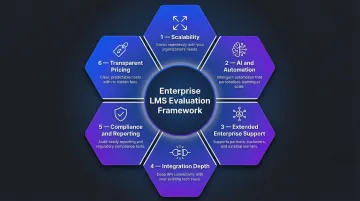
These criteria reflect a common buyer mistake: choosing an LMS based solely on employee training features, only to discover the platform can't support partner or customer training at scale. The best enterprise LMS aligns with your specific training architecture, a compliance-heavy manufacturer has different needs than a SaaS company training 500 channel resellers.
Before shortlisting vendors, map your actual training architecture first. Run structured RFP evaluations and pilot trials against your specific use case, not a generic feature checklist.
Conclusion
The right enterprise LMS for 2026 isn't the one with the longest feature list, it's the one that ties learning directly to the outcomes your organization tracks: compliance adherence, partner certification rates, sales ramp time, or revenue per trained user.
Before finalizing a decision, evaluate each platform on:
- Audience scalability, does it support employees, partners, and customers from a single instance?
- Pricing transparency, are costs predictable at scale, with no hidden add-ons?
- Tech stack integration, how cleanly does it connect with your existing CRM, PRM, and HR systems?
For organizations building or scaling a partner sales ecosystem, Pifini connects every certification and learning milestone to actual deal activity and revenue outcomes, at $50/user/year, compared to $300–$600/user/year with platforms like Seismic or Mindtickle.
Frequently Asked Questions
What is an enterprise learning management system?
An enterprise LMS is a robust software platform designed to deliver, track, and manage training at scale for large organizations, covering employees, partners, and customers, with advanced security, compliance, multi-tenancy, and analytics that go beyond what standard LMS solutions offer.
How much does an LMS platform cost?
Enterprise LMS pricing varies widely, from $8–$50/user/year for more affordable platforms to $30,000–$70,000+ annual contracts for platforms like Cornerstone or Adobe Learning Manager. Buyers should factor in implementation, integrations, and ongoing support costs beyond the license fee.
Which LMS is best for large enterprises?
The best enterprise LMS depends on your use case. Docebo and Cornerstone suit large-scale internal training; Pifini and Seismic Learning are built for revenue and partner ecosystems. Prioritize scalability, integration depth, and audience type when shortlisting.
What are the basic features and capabilities of the LMS?
Core capabilities include course creation and content delivery, user and role management, progress tracking and reporting, compliance and certification management, mobile accessibility, and integrations with HR and business systems.
What is a SaaS LMS?
A SaaS LMS is a cloud-hosted learning platform where the vendor manages hosting, updates, and security, no on-premise installation required. This makes it faster to deploy, easier to scale, and simpler to integrate globally than traditional on-premise alternatives.
What does LMS stand for?
LMS stands for Learning Management System, a software application used to create, deliver, manage, and track training programs. Enterprise LMS platforms add capabilities like multi-tenancy, advanced compliance, and cross-audience support for partners, customers, and employees at scale.