Introduction
Sales representatives lose nearly 14 hours every week hunting through scattered drives, outdated email threads, and untagged folders for the right pitch deck or case study, time that should be spent actively engaging prospects and closing deals. This administrative chaos translates directly to missed quotas. Organizations where reps spend most of their week searching for content report only 23% of time spent actually selling, compared to 34% for high-performing teams with streamlined access.
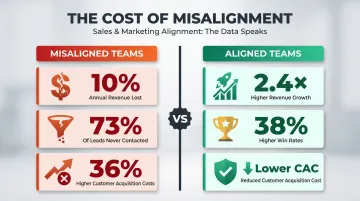
That gap is expensive. Misalignment between marketing output and sales needs costs B2B companies 10% of annual revenue. This guide covers what sales content management actually means, where most organizations break down, and how to build a centralized strategy that keeps your entire partner ecosystem, direct sellers, resellers, and distributors, consistently equipped to close.
TLDR:
- Sales reps waste 14 hours weekly on admin tasks and content searches instead of selling
- Modern buyers spend only 17% of purchase time with suppliers, and review 11-13 pieces of content on their own
- 65% of marketing content goes unused due to poor findability and relevance gaps
- Aligned sales-marketing organizations achieve 2.4x higher revenue growth and 38% higher win rates
- Effective content management centralizes assets, automates recommendations, and ties usage to revenue outcomes
What Is Sales Content Management and Why It Matters
Defining Sales Content Management
Sales content management is the strategic process of creating, organizing, storing, and distributing sales materials so reps can quickly find, personalize, and share the right asset with the right buyer at the right time.
Unlike a generic file library, it's a purpose-built system for converting active prospects, delivering contextually relevant content throughout the entire buyer journey, including post-sale engagement.
Unlike content marketing that attracts awareness-stage visitors, sales content management supports opportunities already in motion, equipping sellers with battle cards, ROI calculators, competitive comparisons, and customer proof points exactly when deal momentum depends on them.
Why Precision Content Delivery Is Critical Now
B2B buyers now enter sales conversations having already done their research. Gartner research reveals buyers spend only 17% of their total buying time meeting with potential suppliers, and when evaluating multiple vendors, each sales rep receives only a fraction of that limited attention. Furthermore, 67% to 75% of B2B buyers now prefer a completely rep-free sales experience, forcing sellers to prove value instantly through precise, self-serve content or lose the deal to a competitor who can.
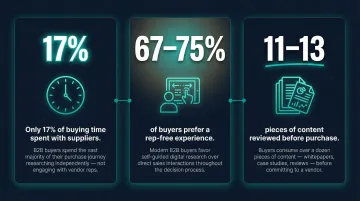
That shift puts the burden on content quality. Buyers consume between 11 and 13 pieces of content before a purchase decision, which means every asset must earn its place. The ones that advance deals do at least one of these things:
- Answer a specific question the buyer hasn't resolved yet
- Reduce perceived risk with proof (case studies, ROI data, references)
- Differentiate your position against an active competitor
The Partner Sales Ecosystem Challenge
When content management fails, the damage extends beyond internal teams. Resellers, distributors, and alliance partners operating without organized, version-controlled, accessible materials go off-script, create rogue sales collateral that contradicts brand messaging, or go silent during critical deal stages. Consistent content management keeps the entire partner ecosystem aligned on positioning, equipped with compliant materials, and confident enough to actively advance opportunities rather than escalate support requests.
Types of Sales Content: Internal vs. External
Effective sales content strategies require two distinct categories working in tandem: internal rep-facing assets that build seller capability, and external buyer-facing materials that move deals forward.
Internal Sales Content (Rep-Facing)
- Battle cards, Competitive positioning guides that arm reps with differentiation messaging, objection responses, and win themes for head-to-head vendor comparisons
- Sales playbooks - Prescriptive workflows mapping selling motions by deal type, buyer persona, or product line
- Buyer persona guides - Detailed profiles outlining pain points, priorities, and decision criteria for economic buyers, technical evaluators, and end users
- Email templates - Pre-approved outreach sequences that maintain brand voice while allowing personalization
- Objection-handling scripts - Tested responses to common pushback on pricing, implementation timelines, and competitive alternatives
Win/loss stories give reps real examples of what worked (or didn't), and help them adapt faster than any theoretical training. When embedded into coaching programs, these narratives create a feedback loop where field insights directly shape future enablement content.
External Sales Content (Buyer-Facing)
Buyer-facing assets map to funnel stages and the different stakeholders on a purchasing committee:
Awareness stage:
- Blog posts establishing thought leadership
- Whitepapers addressing industry challenges
- eBooks providing educational frameworks
Consideration stage:
- Case studies proving peer success
- Product comparison one-pagers
- ROI analyses building business cases
- Demo videos showcasing functionality
Decision stage:
- Customer testimonials and reviews
- Detailed pricing sheets
- Implementation timelines
- Security and compliance documentation
Forrester research finds that 65% of marketing-created content goes unused by sellers, and the problem isn't volume. It's poor findability, missing sales context, and a mismatch between what marketing produces (top-of-funnel thought leadership) and what reps actually need in live conversations (bottom-of-funnel proof).
How to Build a Sales Content Management Strategy
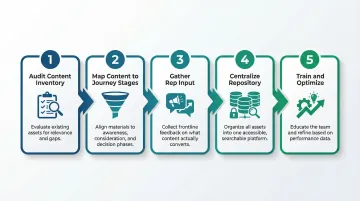
Step 1, Audit Existing Content Inventory
Before creating anything new, catalog what already exists:
- Identify which assets reps actively use versus those ignored
- Correlate content to won deals versus stalled opportunities
- Flag outdated materials, off-brand messaging, and compliance risks
- Archive assets untouched in the past 90 days
The audit tells you whether your content problem is quantity, quality, or accessibility, and which to fix first.
Step 2, Define Buyer Personas and Map Content to Journey Stages
Work cross-functionally with sales, marketing, and customer success to build detailed personas, then assign specific content types to each stage:
- Awareness: Educational content addressing broad challenges
- Consideration: Solution-specific materials comparing approaches
- Decision: Proof-based assets justifying purchase to finance and legal
- Post-sale: Onboarding guides, training resources, and expansion playbooks
When reps know exactly what to reach for based on deal stage and buyer role, content stops being a burden and starts being a selling tool.
Step 3, Gather Direct Input From Sales Reps
Your sellers know which objections go unanswered, which content falls flat in discovery calls, and what they end up building from scratch. Build a regular feedback loop so content creation is driven by real selling situations, not marketing assumptions. Useful touchpoints include:
- Monthly content reviews surfacing gaps and redundancies
- Post-win debriefs identifying which assets closed the deal
- Lost-deal retrospectives revealing where content failed to answer objections
Step 4, Centralize Content in a Single Repository
Eliminate scattered drives, siloed folders, and outdated email attachments. Establish one source of truth featuring:
- Flexible tagging by persona, stage, product, and use case
- Version control with automatic syncing across devices
- Mobile and offline access for field and partner reps
- User permissions ensuring resellers see only relevant materials
Step 5, Train Reps and Continuously Optimize
Deploying content without training reps to use it guarantees low adoption. Show sellers when and how each asset applies through:
- Role-specific onboarding highlighting key materials
- Just-in-time alerts when new content publishes
- Usage pattern tracking revealing which assets correlate with wins
- Quarterly content refreshes retiring low-engagement assets
Teams that review content performance quarterly consistently maintain higher rep adoption and shorter ramp times than those that treat launch as the finish line.
Key Features to Look for in a Sales Content Management System
Must-Have Core Capabilities
Evaluate platforms based on these foundational requirements:
Centralized repository with intelligent organization:
- Flexible folder structures and multi-dimensional tagging
- Advanced search filtering by keyword, persona, stage, and content type
- Version control preventing reps from sharing outdated materials
Access and permissions management:
- Role-based visibility (ensuring resellers only see partner-approved content)
- Mobile-optimized interface with offline access for field teams
- Content groups segmenting materials by geography, product line, or partner tier
Workflow integration:
- Native CRM integrations (Salesforce, HubSpot, Microsoft Dynamics)
- One-click content sharing from within deal records
- Automatic activity logging tracking which assets were sent to prospects
AI-Driven Content Features as Differentiators
The strongest platforms go well beyond storing and organizing files:
AI-powered recommendations surface the right asset based on:
- Current deal stage pulled from CRM data
- Buyer profile and industry vertical
- Similar won opportunities with comparable characteristics
Automated personalization merges CRM fields into templates, enabling reps to send customized one-pagers and proposals without manual editing.
Analytics tying content to pipeline outcomes reveal which assets appear most frequently in closed-won deals versus lost opportunities, informing future content investment.
Pifini: Purpose-Built for Partner Sales Ecosystems
Those AI capabilities become especially critical when managing content across partner networks. Pifini is built specifically for that context, an all-in-one revenue enablement platform for extended enterprises: resellers, distributors, and alliances operating across complex partner ecosystems. At $50 per user per year, Pifini delivers enterprise capabilities at a fraction of legacy platform costs (Seismic and Highspot average $300–$600 per user annually).
Uniquely integrated features include:
- Enterprise LMS with prescriptive learning, auto-enrolls reps in targeted training when call scoring detects performance gaps
- Digital Sales Rooms, buyer-facing hubs that track engagement and multi-stakeholder activity in real time
- AI sales roleplay simulations, prepares reps for common objections before they face them on live calls
- Live AI call copilot, delivers real-time guidance during customer conversations
- Training impact analysis, ties certification completion and content usage directly to win rates and revenue
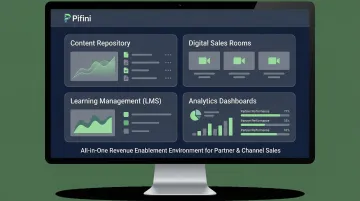
For partner-led sales teams, that means one login, one data model, and one place to measure what's actually moving the number.
Common Pitfalls of Poor Sales Content Management
Scattered, Outdated, Inaccessible Content
When materials live across email threads, personal drives, and shared folders with no version control, reps face two losing outcomes: waste hours searching for the right deck, or share outdated assets that contradict current messaging. Both erode buyer trust and create inconsistent brand experiences across customer touchpoints.
That inefficiency compounds quickly. Sellers recreating 21.3% of content entirely from scratch, because they can't locate what marketing already built, drives massive duplication and real compliance risk.
Misalignment Between Marketing Creation and Sales Needs
Marketing teams chasing lead volume produce thought leadership whitepapers and awareness-stage blog posts. Sellers trying to close deals need ROI calculators, competitive battle cards, and third-party validation. When there's no feedback loop connecting what works in conversations back to content creation, the gap widens fast.
Sales-marketing misalignment costs B2B companies an estimated 10% of revenue annually. The downstream numbers are just as stark: 73% of marketing-generated leads never get contacted by sales, and customer acquisition costs climb 36% when teams operate in silos.
Neglecting Partner and Channel Rep Needs
Misalignment between marketing and sales is damaging enough internally, partner channels feel it even harder. Direct sales teams typically receive prioritized training, premium content, and dedicated enablement support, while resellers and distributors operate as afterthoughts. Partners forced to navigate outdated portals or escalate basic questions create bottlenecks that stall deals and drive up support costs.
Effective partner content management requires more than a shared folder and a newsletter. It needs:
- Role-based access so partners see only what's relevant to them
- Automated content syncing to eliminate outdated asset problems
- Proactive alerts when new materials publish, not quarterly email roundups partners ignore
How to Measure Sales Content Performance
Internal Engagement Metrics
Track which assets your team actually uses:
- View and download rates - Low usage signals visibility problems
- Content ratings - Poor scores suggest materials need rework
- Share frequency - Identifies which assets reps trust enough to send prospects
- Time-to-find - Measures search efficiency within your repository
Post-launch silence after content releases indicates distribution failure, not seller disinterest. That internal picture only tells half the story, buyer behavior reveals the other half.
External Engagement Metrics
Modern platforms track how buyers interact with shared content:
- External view rates - Percentage of sent assets actually opened
- Time spent per asset - Reveals which materials hold attention
- Slide-level engagement - Shows which presentation sections get skipped
- Multi-stakeholder sharing - Tracks when champions forward content internally
This buyer-side data reveals what's compelling prospects to act versus what gets ignored.
Revenue Influence and Correlation
Connect content usage directly to pipeline and closed deals:
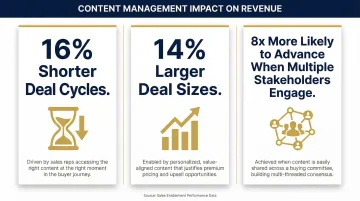
Win rate analysis - Measure which assets appear most frequently in closed-won opportunities versus lost deals. Research shows that when multiple buying committee members engage with content, deals are eight times more likely to advance and achieve 17% higher close rates.
Sales cycle impact - Organizations using guided content and enablement analytics report 16% shorter deal cycles and 14% larger deal sizes. Strategic content deployment doesn't just support deals, it shortens them.
Attribution tracking - Platforms like Pifini correlate training completion, content engagement, and call scores to revenue outcomes, giving revenue leaders the data to double down on what works and cut what doesn't.
Frequently Asked Questions
What is sales content management?
Sales content management is the process of creating, organizing, storing, and distributing sales materials in a centralized system so reps can find and share the right content with buyers at the right time, rather than wasting hours searching scattered drives.
What is a sales enablement content strategy?
A sales enablement content strategy is a cross-functional plan involving sales, marketing, and customer success that defines what content to create, who it's for, where it fits in the buyer journey, and how to measure its effectiveness through engagement and revenue metrics.
What are the most important features of a sales content management system?
Essential features include centralized storage with version control, role-based permissions, CRM integration, and content usage analytics. AI-powered recommendations and automated personalization are what separate modern platforms from legacy tools.
How is sales content management different from a regular CMS or DAM?
A sales content management system is purpose-built for revenue teams. It actively recommends content by deal stage, tracks buyer engagement with shared assets, and links content usage to outcomes like win rates and deal velocity, rather than simply storing files.
What types of sales content have the highest impact on closing deals?
Decision-stage content dominates: case studies (78% influence), demos (77%), user reviews (63%), and ROI calculators (61%), according to a 2024 content preferences survey. These formats provide third-party validation and help buying committees justify purchases to finance and legal stakeholders.
How do you keep sales content accurate and up-to-date across a partner network?
Centralized platforms with version control, automated syncing, and push notifications ensure partners always access current materials. Role-based access restricts resellers to approved content, maintaining consistency across distributed networks without manual oversight.