Introduction
Sales and partner training programs face mounting pressure to prove their impact. Organizations invest heavily in enablement, yet many struggle to connect what's taught to what actually improves on the floor. Only 30% of sales managers provide feedback within 24 hours of a call, leaving most reps operating on delayed, reactive coaching that arrives too late to change behavior.
The real value of AI feedback analysis shows up in specific, operational changes: faster rep ramp times, coaching that reaches every rep on every call, and training programs that adjust based on actual performance data. This article breaks down exactly where those changes happen in sales and partner training, and what drives them.
Key Takeaways
- AI feedback analysis continuously evaluates training interactions, surfaces performance gaps, and drives targeted improvement
- It replaces lagging manual feedback with real-time, personalized signals that help sales reps, partners, and managers act faster on what's not working
- Core advantages include real-time performance visibility, personalized training routing, and direct links between learning and revenue results
- Without it, organizations operate on assumption, training gets delivered, completion gets tracked, but behavior change goes unmeasured
- Value compounds when applied consistently, tied to clear KPIs, and connected to platforms that link learning to performance
What Is AI Feedback Analysis
AI feedback analysis is the use of artificial intelligence, including natural language processing, machine learning, and behavioral pattern recognition, to evaluate training interactions and return structured, usable insights about learner performance. In sales and partner training contexts, this applies across call scoring, roleplay evaluation, post-training surveys, quiz performance, and live coaching sessions, wherever a learner produces a signal that can be measured.
The technology evaluates multiple interaction categories simultaneously:
- Live and recorded sales calls: AI transcribes conversations, detects buyer objections, tracks talk-to-listen ratios, and flags development opportunities
- Roleplay and simulation environments: Simulates buyer personas, scores practice conversations against sales frameworks, and delivers instant objective feedback
- CRM and workflow data: Uncovers patterns that enable predictive lead scoring, deal prioritization, and pipeline forecasting
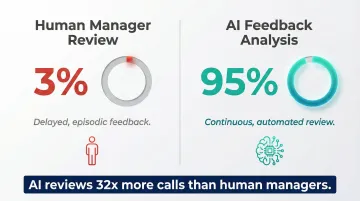
What makes AI feedback analysis worth deploying is what it enables downstream: faster correction, smarter personalization, and a direct link between training activity and performance improvement. AI can automatically review 95% of sales calls compared to the 3% human managers typically review. That visibility matters, but the real payoff comes from what it triggers: targeted interventions, personalized learning paths, and coaching conversations that would otherwise never happen.
Key Advantages of AI Feedback Analysis
The advantages below are grounded in operational impact, they describe what changes in how training is managed, not just how it is delivered. Each is tied to outcomes that sales leaders and L&D managers actually track.
Advantage 1: Real-Time Performance Visibility Across Every Learner
AI feedback analysis replaces lagging post-training reviews with continuous, real-time insight into how each rep or partner is performing across calls, assessments, and learning activities.
How it works in practice:
AI systems score interactions as they happen, flag specific gaps in objection handling, product knowledge, and messaging accuracy, and surface these insights on manager dashboards, no manual review cycles required. The result is a continuous stream of performance intelligence rather than periodic reviews tied to quarterly cycles.
Why this is an advantage:
Without real-time visibility, managers act on assumptions or wait until quota attainment data confirms what was already a lost opportunity. AI feedback surfaces issues the moment they emerge, not after they cost deals. Sales reps who receive coaching within 24 hours of a call are 2.5x more likely to improve their performance, yet only 30% of managers currently provide feedback within that critical window.
When visibility is real-time and granular, managers can intervene early, coaches can prioritize conversations, and training adjustments can happen within days instead of quarters.
KPIs impacted:
- Time-to-competency for new hires and partners
- Coaching intervention rate and quality
- Manager time spent on performance review
- Assessment completion rates
- Early identification of at-risk reps or partners
When this advantage matters most:
This has the highest impact in fast-scaling teams, distributed partner networks, and organizations onboarding large cohorts simultaneously, any environment where one-on-one coaching cannot keep pace with training volume. Pifini's platform addresses this by evaluating every call and automatically flagging gaps on manager dashboards, enabling scalable coaching without proportional headcount increases.
Advantage 2: Personalized, Automatically Routed Training That Closes Individual Gaps
AI feedback analysis identifies where each individual is falling short and triggers targeted training automatically, without requiring a manager to diagnose the gap or a learner to self-report a struggle.
How it works in practice:
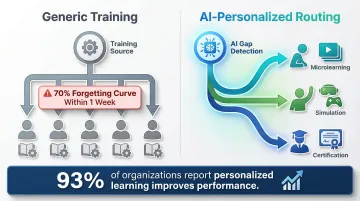
When AI detects patterns in call scores, assessment errors, or roleplay evaluations, it matches the learner to specific content, a microlearning module, a simulation, a certification path, and deploys it automatically. Pifini's platform does this natively: it evaluates every call, flags skill gaps, and auto-enrolls users into targeted training paths with no manual administrative work required.
Why this is an advantage:
Generic, one-size-fits-all training is the primary reason enablement programs fail to change behavior, learners disengage from content that isn't relevant to their actual gaps. B2B sales reps forget 70% of information within a week of training, and 87% within a month, making the timing and relevance of training interventions critical.
That's precisely why 93% of organizations report that personalized learning improves both individual and organizational performance. Personalized routing eliminates irrelevant content and focuses learning time on what will actually move performance, accelerating time-to-competency because learners aren't sitting through material they already know.
KPIs impacted:
- Training completion rates for targeted modules
- Time-to-competency
- Individual skill score improvement over time
- Learner engagement rates
- Reduction in repeated performance errors
When this advantage matters most:
This advantage is especially critical in partner ecosystems where training must serve resellers, distributors, and alliances with varying levels of product knowledge and sales maturity. Nearly 75% of channel-sourced revenue is generated by just 20% of partners, largely because generic training tracks cannot serve diverse partner populations effectively. AI-driven personalization shifts enablement from a compliance exercise to a direct driver of partner-sourced revenue, the same shift that helped Trellix reach over 90% customer training satisfaction.
Advantage 3: A Measurable Link Between Training Activity and Revenue Results
AI feedback analysis creates a feedback loop that connects what happens in training to what happens in the field, making it possible to demonstrate, with data, that a training intervention improved a specific business outcome.
How it works in practice:
AI aggregates performance signals from training, call scores, assessment results, certification completions, alongside sales performance data including win rates, deal velocity, and pipeline contribution. This enables revenue leaders to see which training activities correlate with improved outcomes and which do not.
The system tracks training success rates, individual skill improvements, and downstream business impact. For example, analysis across partner ecosystems can reveal that specific courses like "Product Fundamentals" or "Customer Objection Handling" directly correlate with higher win rates and faster deal closures.
Why this is an advantage:
Without this linkage, training ROI is theoretical, organizations know what was delivered but not whether it worked. 67% of enablement leaders cite "proving ROI" as their top challenge, and only 29% can directly tie their programs to revenue impact. AI feedback analysis shifts that conversation, connecting specific training completions to win rates, quota attainment, and partner revenue contribution, which is exactly the evidence CFOs require before approving enablement spend.
KPIs impacted:
- Training-to-pipeline correlation
- Certification rate versus deal close rate
- Win rate by training completion tier
- Partner revenue attribution
- Reduction in onboarding-to-first-deal time
When this advantage matters most:
This advantage is highest-value in organizations under pressure to justify enablement investments, during budget cycles, or in partner programs where proving the business case for training drives partner participation and leadership buy-in.
What Happens When AI Feedback Analysis Is Missing or Ignored
Relying on manual, episodic feedback cycles in sales and partner training creates compounding consequences that damage revenue outcomes and organizational efficiency. The problems don't stay isolated, they stack.
Without AI feedback analysis in place, organizations consistently run into the same four breakdowns:
- Performance gaps surface too late. By the time remediation begins, deals are already lost or partners have disengaged. Managers spend only 9% of their time developing talent due to administrative overload, far below the 36% HR expects.
- Training disconnects from outcomes. Content gets delivered and completions get tracked, but behavior change is assumed rather than measured. Over 25% of corporate learning becomes "scrap learning" that never translates into workplace performance.
- Coaching stays reactive. Without automated signals, managers firefight performance issues instead of preventing them. That reactive posture drives real costs: 75% of voluntary turnover stems from managerial issues, and teams with poor managers see 20% lower productivity and 23% lower profitability.
- Inconsistency spreads across the channel. In partner ecosystems, the absence of structured feedback means different partners receive different quality of development, creating unpredictable performance variance. A CompTIA survey found that 50% of channel firms dropped a vendor in the past year, much of it tied to inconsistent enablement and support.
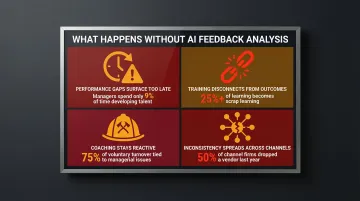
Each of these gaps is preventable. The common thread is the absence of continuous, automated feedback that connects behavior to outcomes in real time.
How to Get the Most Value from AI Feedback Analysis
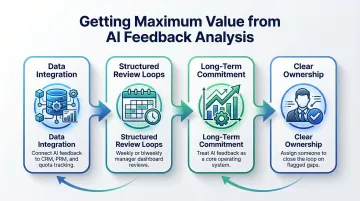
AI feedback analysis delivers its full value when integrated into training operations as a continuous system, not used as a one-time diagnostic. Three conditions consistently produce results:
Integrate with quota and revenue data. AI feedback should feed into the same system that tracks quota attainment, deal progression, and partner revenue, so that the link between training and outcomes is visible and measurable. Organizations with integrated systems can correlate training completion with specific win rate improvements and pipeline contributions, making the connection between learning activity and revenue outcomes concrete and reportable.
Build a review cadence and act on what surfaces. Feedback data that is generated but not reviewed or used goes unused and adds reporting overhead without impact. Organizations that build weekly or biweekly review loops into their training operating cadence see compounding improvement over time. Managers should treat AI-generated performance dashboards as critical operating metrics, not supplementary reports.
Commit to the system long enough for it to learn. AI feedback analysis becomes more accurate and more valuable as it processes more data. Committing to it as a long-term practice, rather than a pilot or a periodic intervention, is what allows it to surface the patterns that drive meaningful training improvement. The system learns which interventions work, which content drives results, and which performance signals predict future success. That accuracy compounds, but only with continuous data and sufficient time to optimize.
To make each condition actionable:
- Data integration: Connect AI feedback to your CRM, PRM, and quota tracking, not a separate reporting silo
- Structured review loops: Schedule weekly or biweekly sessions where managers review dashboards alongside pipeline data
- Long-term commitment: Treat AI feedback as a core operating system, not a quarterly diagnostic
- Clear ownership: Assign someone to close the loop between AI-flagged gaps and training adjustments
Conclusion
AI feedback analysis earns its place in sales and partner ecosystems because it converts raw training activity into visible, measurable performance outcomes, connecting what reps and partners learn directly to how they sell.
The advantages build on each other over time:
- Real-time visibility enables faster intervention before gaps widen
- Personalized learning routing closes skill deficiencies without wasting rep time
- Revenue-linked reporting builds the internal case for continued investment
Organizations that embed AI feedback into how training is managed and measured, rather than treating it as a one-time rollout, see sustained gains in time-to-competency, win rates, and partner revenue contribution.
The compounding effect is the point. The longer AI feedback operates inside your training ecosystem, the sharper its recommendations become, and the harder it is for performance gaps to go unnoticed.
Frequently Asked Questions
What is AI feedback analysis in sales training?
AI feedback analysis uses artificial intelligence to evaluate training interactions, calls, assessments, simulations, and return structured insights about performance gaps. It makes feedback continuous rather than episodic, replacing manual review cycles with automated scoring and personalized recommendations.
How does AI feedback analysis improve training ROI?
AI links training activity data, call scores, certifications, assessments, to business outcomes like win rates, deal velocity, and partner revenue. That connection shows which interventions produced results, shifting enablement from a cost center to a revenue driver.
Can AI feedback analysis replace human coaching in sales enablement?
AI feedback analysis complements, not replaces, human coaching by handling the diagnostic and routing work. It analyzes performance at scale, identifies gaps, and deploys targeted training automatically, so managers and coaches can focus their time on the conversations that require human judgment and relationship-building.
What metrics does AI feedback analysis typically track in sales and partner training?
AI feedback systems track a range of performance and business metrics, including:
- Call scores and skill assessment improvement
- Training completion rates for targeted modules
- Time-to-competency
- Win rate, deal velocity, and partner revenue attribution
Together, these metrics show exactly how learning translates to performance.
How does AI feedback analysis scale across a partner ecosystem?
AI evaluates every partner interaction at scale across geographies, product lines, and experience levels without requiring more coaching headcount. Automated scoring and personalized training routing deliver consistent enablement quality regardless of partner location or program size.
How quickly can AI feedback analysis show results in a training program?
Initial visibility improvements are immediate through real-time dashboards and auto-routing. Behavioral and revenue-level impact typically emerges within weeks to months depending on training volume and program consistency, with continuous improvements compounding over time as the system processes more data.