Introduction
Modern revenue teams face relentless pressure from three converging challenges: fragmented tools that don't talk to each other, rising quota expectations in competitive markets, and a widening performance gap between top sellers and everyone else. In 2023, 84% of reps missed quota. Yet sellers who effectively used AI tools were 3.7 times more likely to hit their targets. That gap is too large to ignore.
The AI sales platform market has exploded in response, projected to grow from $5.23 billion in 2024 to $12.78 billion by 2030 at a 16.3% CAGR. But rapid growth creates noise. Separating transformative solutions from overhyped point tools has become harder, especially for organizations managing partner ecosystems where resellers and distributors need different support than direct sales teams.
83% of sales teams using AI saw revenue growth in 2024, versus 66% of teams without it. The difference comes down to fit: the right platform, built for how your team actually sells. This guide breaks down what separates the best AI sales platforms from the rest, covering core capabilities, partner enablement features, pricing models, and how to evaluate options for your specific go-to-market motion.
Key Takeaways
- AI-powered sales platforms unify training, coaching, content, and analytics, cutting the cost of fragmented tool stacks by up to 32%
- Top platforms deliver live coaching, call scoring, and prescriptive learning tied directly to revenue outcomes, not just passive analytics
- Reseller and distributor networks need platforms built for partner ecosystems, not repurposed internal sales tools
- Enterprise platforms range from $300–$600/user/year: Pifini.ai delivers comparable capability at $50/user/year
- Pifini.ai, Highspot, Gong, Salesforce Einstein, and Seismic lead the 2025 market, each suited to different team structures
What Is an AI-Powered Sales Platform?
An AI-powered sales platform is a unified system that uses machine learning, automation, and real-time intelligence to help sales teams train faster, sell smarter, and close more deals. Unlike single-point tools that handle only one function, such as standalone content libraries or basic call recording, a true AI sales platform integrates multiple capabilities into a connected ecosystem.
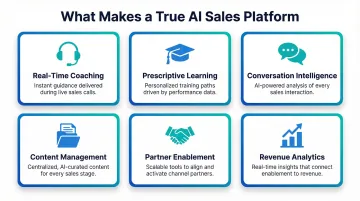
Core capabilities that separate genuine AI sales platforms from basic automation tools include:
- Real-time coaching during live customer interactions, not just post-call analysis
- Prescriptive learning that automatically enrolls reps in training based on performance gaps
- Conversation intelligence that analyzes calls, emails, and meetings to surface buyer signals
- Content management with deal-stage recommendations for the right asset at the right moment
- Partner enablement built for resellers, distributors, and alliances, not retrofitted from internal sales tools
- Revenue analytics that tie training completions to pipeline outcomes, win rates, and closed deals
The platforms evaluated in this guide were selected based on AI depth, unified architecture, partner readiness, pricing transparency, and demonstrated revenue impact. Each one does more than automate tasks, they connect learning, coaching, and content to measurable sales outcomes.
The Best AI-Powered Sales Platforms
Platforms were assessed based on AI capability depth, unified vs. fragmented architecture, partner or channel readiness, pricing transparency, and real-world performance outcomes. The goal: identify solutions that connect learning to action, coaching to performance, and enablement to measurable revenue growth.
Pifini.ai
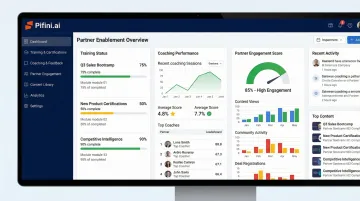
Pifini.ai is an all-in-one AI-driven revenue enablement platform built specifically for partner sales ecosystems, unifying training, content, buyer engagement, and live AI coaching in a single platform at $50/user/year. That's 10x more affordable than legacy competitors like Seismic, Bigtincan, and Mindtickle, which typically charge $300–$600/user/year.
Key differentiators include:
- Live AI Sales Call Support that delivers real-time coaching during active customer calls
- AI call evaluation that flags performance gaps and auto-enrolls users into targeted training
- Built-in enterprise LMS (rebranded NetExam) with gamification, microlearning, and simulations
Unlike platforms designed primarily for direct sales teams, Pifini.ai is purpose-built for resellers, distributors, and alliances.
| Aspect | Details |
|---|---|
| Key Features | Unified content, training, analytics, and partner engagement; AI roleplay and live call coaching; prescriptive learning with auto-enrollment; gamification and microlearning; digital sales rooms |
| Best For | Channel-led organizations, SaaS companies, enterprise teams, resellers, distributors, and alliances needing affordable, partner-first enablement at scale |
| Pricing | $50/user/year (10x lower than most enterprise competitors); enterprise LMS included with no add-ons or hidden costs |
Highspot
Highspot is a GTM enablement platform built for enterprise go-to-market teams that need unified content management, AI-guided selling recommendations, rep coaching, and real-time performance insights in one system.
Differentiators include AI role play for skill building with instant feedback on delivery and tone, AutoDocs for automated content creation from CRM-connected templates, an Initiatives Scorecard that ties enablement activity to business outcomes like win rates and pipeline, and AI agents that surface just-in-time guidance during rep interactions. Named a Leader in the 2025 Gartner® Magic Quadrant™ for Revenue Enablement Platforms, Highspot is one of the most comprehensive GTM platforms available.
| Aspect | Details |
|---|---|
| Key Features | AI-guided content recommendations, AI sales role play, digital sales rooms, AutoDocs content automation, conversation intelligence, GTM analytics and scorecards |
| Best For | Enterprise GTM teams, sales leaders, enablement managers, and revenue operations professionals needing deep analytics and unified sales execution |
| Pricing | Custom enterprise pricing; contact Highspot for a quote |
Gong
Gong is a revenue intelligence platform that captures and analyzes every customer interaction, calls, emails, meetings, to surface buyer signals, coaching insights, and deal health data that help managers forecast accurately and coach reps at scale.
Differentiators include AI-powered conversation intelligence that identifies winning behaviors and objection patterns, signal-based forecasting that draws from 300+ unique signals in historical interaction data, and deal risk alerts that give RevOps proactive visibility into pipeline health before the end of the quarter. Named the only Leader in The Forrester Wave™: Conversation Intelligence for B2B Revenue, Q4 2023, Gong is the benchmark for teams that want to act on what's actually happening in their deals.
| Aspect | Details |
|---|---|
| Key Features | Call and meeting transcription, AI conversation analysis, deal health dashboards, predictive revenue forecasting, rep coaching scorecards, CRM sync (Salesforce, HubSpot) |
| Best For | Mid-market to enterprise teams where sales leaders and RevOps need deep deal visibility, coaching infrastructure, and forecast accuracy |
| Pricing | Custom pricing; contact Gong sales for a quote (no free plan or public pricing) |
Salesforce Einstein (Sales Cloud AI)
Salesforce Einstein is the AI layer embedded within Sales Cloud, giving CRM-native teams predictive lead scoring, opportunity health indicators, AI-generated email drafts, and conversational prompts that guide reps through complex deals without leaving their existing workflow.
Differentiators include deep integration with the Salesforce ecosystem (no added integration cost), Agentforce AI agents that automate follow-ups and CRM updates in real time, and enterprise-grade security through the Einstein Trust Layer that prevents data leakage and hallucinations. For teams already standardized on Salesforce, Einstein delivers native AI without requiring a separate platform.
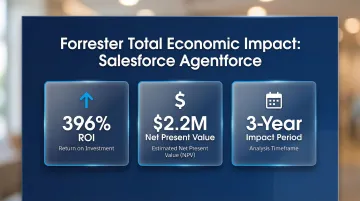
A Forrester Total Economic Impact study found that organizations deploying Agentforce saw a 396% ROI and $2.2M net present value over three years.
| Aspect | Details |
|---|---|
| Key Features | Predictive lead scoring, AI opportunity health indicators, Agentforce for automated outreach and CRM updates, AI email personalization, quoting automation, pipeline forecasting |
| Best For | Enterprise organizations already using Salesforce who want to maximize CRM-native AI without adding a separate platform |
| Pricing | Starter Suite from $25/user/month; Pro Suite from $100/user/month; Enterprise from $175/user/month (AI features available as add-ons) |
Seismic
Seismic is an AI-powered content enablement platform focused on making sure every buyer interaction uses the most relevant, up-to-date assets. It provides intelligent content recommendations, personalized collateral, and readiness tools built for large content libraries.
Differentiators include Aura AI for content tagging and smart recommendations tailored to deal stage and buyer persona, detailed analytics on content performance and engagement, and learning path tools for sales readiness, though its enterprise pricing puts it significantly above newer, unified alternatives like Pifini.ai. Named a Leader in the IDC MarketScape for Worldwide Revenue Enablement Platforms 2025 and The Forrester Wave™: Revenue Enablement Platforms, Q3 2024, Seismic is best suited to large enterprises with mature content operations and a dedicated enablement team to manage them.
| Aspect | Details |
|---|---|
| Key Features | AI content recommendations, personalized sales collateral, content analytics, sales readiness and coaching tools, digital sales rooms, integration with major CRMs |
| Best For | Large enterprise teams with complex content libraries and dedicated enablement teams focused primarily on content-led selling |
| Pricing | Custom enterprise pricing; contact Seismic for a quote (typically ranges in the $300–$600+/user/year tier) |
How We Chose the Best AI-Powered Sales Platforms
Buyers often make predictable mistakes when evaluating AI sales platforms: focusing on feature count over integration depth, choosing point solutions that don't connect learning to action, and underestimating total cost of ownership by overlooking add-on fees for LMS, coaching, or analytics modules. Forrester warns that treating revenue enablement platforms as plug-and-play appliances destroys value, success requires ongoing taxonomy maintenance, content governance, and active customer success partnerships.
Hidden TCO components often include professional services and implementation fees, add-on module fees that can increase contract value by 20-50%, and annual renewal price escalations (typically 3-7%). Fragmented systems cost an average of 32% more to maintain than integrated solutions due to duplicate data entry, manual processes, and complex license management.
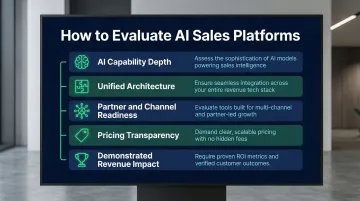
Our evaluation criteria prioritized:
- AI capability depth, real-time coaching and prescriptive learning, not just passive analytics requiring manual interpretation
- Unified architecture, single-platform solutions vs. point tools that create integration debt across multiple vendors
- Partner and channel readiness, built for resellers, distributors, and alliances, not only direct sales teams
- Pricing transparency, clear per-user pricing vs. custom quotes that obscure true costs and scale poorly
- Demonstrated revenue impact, direct linkage between enablement activity and outcomes like win rates, pipeline growth, and quota attainment
That last criterion matters more than most buyers realize. According to Highspot's 2025 State of Sales Enablement report, companies using a unified enablement platform are 42% more likely to improve win rates and 42% more likely to increase sales productivity compared to those using disconnected tools. The platforms ranked below met every criterion above, not just most of them.
Conclusion
The right AI-powered sales platform is the one that closes the gap between learning and action, between coaching and quota attainment, and between partner activity and measurable revenue. Sales teams currently use an average of 10 tools to close deals, causing 94% of organizations to plan tech stack consolidation. Fragmented systems don't just cost more. Research shows they cause companies to lose 15-20% of their potential pipeline.
Before committing to a vendor, evaluate platforms against your actual go-to-market structure, direct, partner-led, or both. The right fit depends on how your team sells:
- Channel ecosystems: Need platforms built for resellers and distributors, not just internal reps
- Salesforce-standardized teams: Benefit most from native CRM AI embedded in existing workflows
- Conversation intelligence priority: Gong delivers deep deal visibility and call analytics
- Unified GTM content and coaching: Highspot serves enterprise teams with complex enablement needs
- Large content libraries: Seismic fits organizations managing high volumes of sales assets
For revenue leaders seeking an affordable, unified platform purpose-built for partner ecosystems, Pifini.ai delivers a fully unified AI enablement platform at $50/user/year, combining training, live call coaching, digital sales rooms, and analytics in a single system. Explore the platform or request a demo to see how unified AI enablement can accelerate your partner sales performance.
Frequently Asked Questions
What is the best AI platform for sales?
There's no single "best" platform, it depends on your team structure and goals. Unified platforms combining AI coaching, training, content, and analytics (such as Pifini.ai for partner teams or Highspot for enterprise GTM) consistently outperform fragmented point solutions that don't connect learning to action or enablement to revenue outcomes.
Which AI is best for sales forecasting?
Gong and Salesforce Einstein lead this category. Gong uses 300+ signals from calls and emails to predict deal outcomes, ideal for conversation-driven teams. Salesforce Einstein generates native forecasts from CRM data, making it the better fit for teams already standardized on Sales Cloud.
Which AI tools are top rated for simulating real world sales conversations?
Highspot's AI Role Play and Pifini.ai's live AI coaching and call scoring lead the market. Both use NLP and generative AI to simulate real conversations, score rep performance on pacing and keywords, flag skill gaps, and auto-enroll users into targeted training, replacing static eLearning with adaptive practice.
Which AI is best for recommendations?
Platforms like Highspot and Pifini.ai lead here. Highspot recommends content based on deal stage and buyer persona, while Pifini.ai uses performance data to auto-enroll reps into the right training path, surfacing the right resource at the right moment without manual searching.
Can AI build me a CRM system?
AI enhances CRM systems rather than building them from scratch. Tools like Salesforce Einstein and HubSpot Breeze automate data entry, lead scoring, and activity logging within existing CRM workflows. Dedicated AI sales platforms typically integrate with or complement existing CRMs rather than replace them, augmenting human teams with intelligent automation.