Introduction
Most sales teams already have a content library. The problem is that reps can't find it mid-call, so they default to memory, miss objection handling opportunities, and lose deals that should have been winnable.
Sales managers, enablement leaders, channel partners, and front-line reps all face this same gap: the right information exists, but it doesn't surface at the right moment.
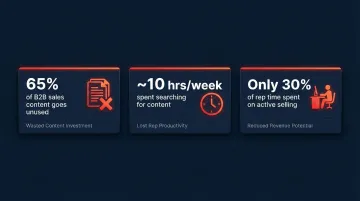
65% of B2B sales content goes unused due to relevance, accessibility, or awareness issues. Sellers spend nearly 10 hours per week tracking down content, leaving only 30% of their time for active selling. When buyers ask tough questions, about ROI, competitors, or compliance, reps who can't respond confidently lose credibility in seconds.
Fixing that gap requires more than buying a tool. This guide explains how to configure, initiate, and use real-time content recommendations in practice. You'll learn what to prepare before activation, when to trigger content, and how to make recommendations a discipline rather than a distraction.
Key Takeaways
- Real-time recommendations work when content is pre-mapped to call stages, buyer signals, and objections, not surfaced randomly
- Prerequisites: a tagged content library, defined trigger conditions, conversation intelligence, and reps trained to glance-and-act
- AI triggers recommendations automatically via keywords and intent signals, with manual override for edge cases
- Limit recommendations to one or two assets per moment; route post-call gaps directly into targeted training
When Should You Use Real-Time Content Recommendations?
Real-time content recommendations are not for every sales call. They deliver the most value during complex or multi-stakeholder conversations where reps face objections, pricing questions, compliance concerns, or competitive comparisons that require factual backup rather than intuition alone.
Appropriate scenarios include:
- Discovery calls where buyers probe technical capabilities, integration requirements, or industry-specific use cases
- Demo calls where ROI discussions or competitive positioning require precise numbers and differentiation points
- Closing calls where procurement raises objections about pricing structure, contract terms, or compliance standards
Inappropriate scenarios include:
- Short qualification calls where surfacing content disrupts the call's rhythm before rapport is established
- Calls where reps reach for content instead of listening, real-time recommendations only work when reps stay buyer-focused
Operational Context: When Scale Matters
The value of real-time recommendations scales with team size and content volume. Organizations with large partner ecosystems or distributed channel teams benefit most, rep knowledge consistency is lower, and content is harder to retain across a distributed network.
The deal complexity makes this even more pressing. Enterprise deals now involve an average of 13 decision-makers per deal, and B2B buyers use up to ten channels as part of any given purchase, double the complexity from five years ago.
For distributed channel partners, resellers, and distributors who carry multiple product lines, real-time content support becomes critical. 62% of sales leaders admit they provide their Partner Account Managers with nothing beyond basic sales training, creating knowledge gaps that real-time recommendations can fill.
What You Need Before Activating Real-Time Content Recommendations
Prerequisites for Success
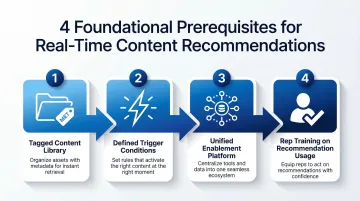
Before activating real-time content recommendations, four foundational elements must be in place:
1. A tagged, structured content library. Organize assets by use case and buyer stage. Battlecards, ROI calculators, case studies, compliance sheets, and product comparison sheets each need metadata that makes them discoverable. Unstructured libraries produce irrelevant or contradictory recommendations mid-call.
2. Defined trigger conditions. Map the keywords, phrases, competitor names, and buyer signals that should surface specific content. Without this logic, recommendations turn generic and interrupt call flow. Two examples:
- Buyer mentions a competitor by name → battlecard surfaces
- Buyer asks about ROI → calculator appears
3. A unified enablement platform with live call integration. Conversation intelligence and content delivery must connect in real time. Sellers currently use an average of 8 tools to close deals, and 42% of reps feel overwhelmed by too many systems. Separate CRM, LMS, and content platforms can't coordinate quickly enough to be useful mid-call. Pifini.ai unifies content, AI coaching, and training in one environment, closing that gap.
4. Baseline rep training on recommendation usage. Reps need to practice glancing at a recommendation and acting on it without going silent, reading aloud, or over-explaining. Structured roleplay simulations that mimic live-call scenarios, with a recommendation appearing mid-conversation, build this instinct before it matters.
How to Use Real-Time Content Recommendations During a Sales Call
Effective use of real-time content recommendations comes down to three phases: setting up before the call, surfacing content at the right moment mid-conversation, and monitoring your recommendation panel without losing conversational momentum. Each phase has specific failure points worth knowing in advance.
Setup and Preparation
Before the call begins, confirm the AI system is connected, the content library is current, and trigger mappings reflect the buyer's profile, industry, company size, and known objections from previous touchpoints. Pre-loading buyer context such as CRM notes or prior conversation summaries allows the system to prioritize more relevant recommendations.
The most common setup error: using a one-size-fits-all trigger map for all buyers. A manufacturing enterprise and a SaaS startup will trigger completely different objections, and content recommendations must reflect that segmentation.
Triggering Recommendations Mid-Call
Recommendations are initiated primarily through AI keyword detection:
- Buyer mentions a competitor by name → battlecard surfaces
- Buyer asks about ROI → ROI calculator appears
- Buyer raises compliance concerns → compliance sheet displays
Keep manual search accessible for when the AI misses context or the conversation shifts unexpectedly.
When a recommendation surfaces, the rep should acknowledge it visually, decide within seconds whether it's relevant, and either reference it verbally ("I can share a quick numbers breakdown on that") or dismiss it. Never pause the call to read a recommended asset in full.
Indicators of correct initiation:
- The rep keeps conversational pace
- The buyer does not notice a change in engagement quality
- The content referenced is specific enough to move the conversation forward rather than restart it
Monitoring and Adjusting During the Call
Reps should monitor the recommendation panel with peripheral awareness, not primary attention. When multiple assets surface at once, default to the one closest to what the buyer just said, not the most polished-looking option.
Keep the volume manageable. Effective real-time recommendations follow a few principles:
- Surface no more than one or two content pieces per call segment
- Deprioritize assets that duplicate what's already been referenced
- Flag unused recommendations post-call for follow-up, not mid-conversation
Systems that flood reps with options create decision paralysis, not confidence.
Where Real-Time Content Recommendations Have the Most Impact
High-Impact Use Cases
The highest-impact use cases are objection moments and technical deep-dives:
Objection moments:
- Competitor comparisons
- ROI challenges
- Pricing hesitation
Technical deep-dives:
- Compliance questions
- Integration specifics
- Security requirements
These are the stages where rep knowledge most commonly breaks down and where a wrong answer ends a deal. Research shows that 42.6% of B2B objections are situational (budget, timing) requiring diagnosis, and 7.9% are existing solution objections requiring factual differentiation.
Channel and Partner Sales Scenarios
In channel and partner sales, real-time recommendations are especially critical. Resellers and distributors carry multiple product lines, receive less brand-specific training than direct reps, and regularly face buyer questions that exceed their product knowledge.
The gap is well-documented: only 51% of high performers provide Partner Account Managers with specialized training. For everyone else, real-time content recommendations fill a support gap that training alone cannot close.
Best Practices for Getting Consistent Results from Real-Time Content Recommendations
Keep the Content Library Lean and Updated
A recommendation system is only as reliable as the content it draws from. Establish a quarterly content audit process where enablement teams:
- Retire outdated assets
- Flag content that is rarely surfaced as a trigger mismatch
- Promote high-performing assets to primary recommendation status
Content metadata should be standardized across the tech stack before deployment to prevent inconsistent surfacing. Stale content libraries create consistency nightmares, inadvertently submitting outdated information that undermines credibility and creates compliance issues.
Map Triggers to Buying Stages, Not Just Keywords
The same competitor name means different things in a discovery call versus a late-stage negotiation. Trigger maps should include call stage context so that surfaced content matches the conversation's depth, not just its topic.
Example:
- Early-stage discovery: Surface high-level competitive differentiation
- Late-stage negotiation: Surface detailed pricing comparison and ROI validation
Train Reps on Content-in-Context Delivery
There's a critical difference between a rep who cites a resource confidently ("Based on similar companies in your space, our ROI calculator typically shows...") versus one who reads from it mid-call. The former builds credibility; the latter breaks trust.
Research confirms that superficial auditory disfluency, such as halting speech, leads to decreased judgments of intelligence and credibility. Delivery style directly impacts buyer perception.
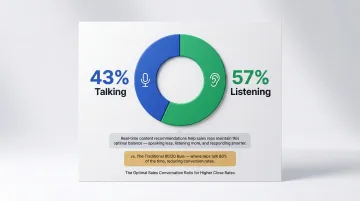
The traditional 80/20 listening rule has also been refined by data: the actual golden ratio for sales success is 43% talking to 57% listening. Real-time content recommendations support this balance. Reps can answer briefly, reference a resource, and keep the conversation moving rather than over-explaining.
Use Post-Call Gaps to Drive Targeted Training
After every call, AI systems should log which content was surfaced, which was used, and which objections went unanswered. This data should automatically route reps into relevant training modules rather than queuing them for a scheduled coaching session.
Platforms like Pifini.ai connect call performance directly to prescriptive learning paths, ensuring that a gap identified on Tuesday becomes a corrected skill by Friday. Traditional sales coaching is typically conducted after conversations have ended, limiting effectiveness, real-time systems provide immediate corrective guidance.
Avoid Using Real-Time Content Recommendations as a Replacement for Rep Preparation
The system should serve as a safety net for unexpected moments, not a substitute for pre-call research, product knowledge, and buyer-specific planning. Reps who prepare thoroughly use in-call recommendations to sharpen a point or back a claim, not to fill knowledge gaps they should have closed beforehand.
Conclusion
Real-time content recommendations only deliver value when the system behind them is deliberately built. That means a well-maintained trigger map, a clean content library, and reps trained to use surfaced assets without losing the thread of the conversation.
For distributed teams and partner networks, this matters more than anywhere else, knowledge gaps are built into how those organizations operate, not tied to any one rep. Getting the system right means every seller, regardless of tenure or location, responds to objections with the same precision.
Done well, that consistency moves the numbers that matter:
- Win rates improve when the right proof point reaches the buyer at the right moment
- Deal velocity increases when reps stop stalling to search for assets mid-call
- Partner confidence grows when resellers can represent your product as credibly as your own team
Frequently Asked Questions
What is the 3-3-3 rule in sales?
The 3-3-3 rule structures follow-up into 3 phone calls, 3 emails, and 3 social touches over 3 weeks. Pre-mapped content recommendations help reps reference the right materials at each touchpoint without breaking conversational flow.
What are the 3 C's of cold calling?
The 3 C's are Connect, Communicate, and Convert, reaching decision-makers, using discovery questions instead of pitches, and logging follow-ups to book next steps. Real-time content support keeps reps on message during the Communicate and Convert stages without fumbling for information.
What is the 80/20 rule in cold calling?
The 80/20 rule of active listening says that in any sales conversation, the rep should spend 80% of the time listening and only 20% talking. Real-time content recommendations support this balance by reducing the need to monologue, reps can answer briefly and reference a resource rather than over-explaining.
What is the 10-3-1 rule in sales?
The 10-3-1 rule holds that 10 prospects yield 3 qualified leads and 1 closed deal. Delivering the right case study or ROI data in real time during those 3 conversations improves conversion rates at each stage, shifting the ratio in a rep's favor.
What is the 2-2-2 rule in sales?
The 2-2-2 rule schedules follow-ups at 2 days, 2 weeks, and 2 months after an initial conversation. Logging which content resonated during the call lets reps personalize each of those touchpoints with materials the buyer already engaged with.