Introduction
Organizations training partner ecosystems, channel resellers, and distributed sales teams are rapidly turning to AI-powered LMS platforms, but not all adaptive learning tools are built for revenue-driven environments. The global AI in education market reached $4 billion in 2024 and is projected to grow at 36% CAGR through 2030, driven by enterprise demand for adaptive, personalized learning at scale.
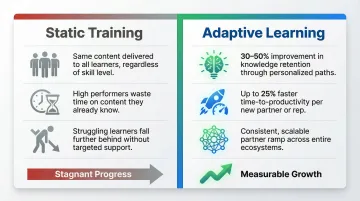
Yet most traditional LMS platforms still deliver the same training to every learner regardless of performance. High performers waste time on content they've mastered; struggling reps miss the skills they need most.
The result: inconsistent product knowledge, slower partner ramp times, and lost deals that better-prepared competitors close instead.
This guide covers the top AI-powered LMS platforms with adaptive learning paths in 2026, what makes each stand out, and how to choose the right one for your partner and sales performance goals.
Key Takeaways
- AI-powered LMS platforms use machine learning to auto-adjust learning paths based on performance
- Top platforms for 2026: Pifini.ai, Docebo, 360Learning, Cornerstone OnDemand, and Absorb LMS
- Look for prescriptive auto-enrollment, outcome-linked analytics, and extended enterprise support, most platforms only deliver one of the three
- Many "AI LMS" platforms offer static recommendations, not prescriptive enrollment that actually triggers training
- Pifini.ai delivers full adaptive learning at $50/user/year vs. $300–$600 with legacy competitors
What Are AI-Powered LMS Platforms With Adaptive Learning Paths?
An AI-powered LMS uses machine learning, natural language processing, and predictive analytics to personalize content delivery, adjust learning sequences in real time, and surface actionable performance insights. Traditional LMS platforms force every learner through the same fixed path regardless of skill level or progress, whether they're a veteran salesperson or a brand-new partner.
Adaptive learning paths work differently. The system continuously monitors learner behavior, assessment performance, and engagement signals to dynamically reroute users into targeted content. This includes:
- Prescriptive enrollment, Auto-assigning training when a learner struggles
- Branching paths, Adjusting content by role or skill gap
- Real-time difficulty adjustments, Increasing or decreasing complexity based on mastery
In partner and sales training ecosystems specifically, these mechanics translate to measurable outcomes. Research consistently links adaptive learning to 30–50% improvements in knowledge retention and up to 25% faster time-to-productivity versus static programs, gaps that compound quickly across large reseller or distributor networks.
Top AI-Powered LMS Platforms With Adaptive Learning Paths in 2026
These platforms were selected based on the depth of their adaptive AI capabilities, partner/extended enterprise functionality, analytics maturity, and suitability for revenue-focused training programs.
Pifini.ai
Pifini.ai is an all-in-one AI-driven revenue enablement platform built specifically for partner sales ecosystems, combining enterprise LMS capabilities (powered by NetExam) with AI sales coaching, content management, and real-time performance analytics for resellers, distributors, and channel alliances.
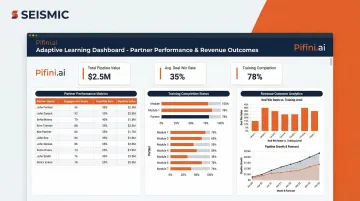
Its prescriptive adaptive learning auto-enrolls partners into targeted training when they struggle, directly connecting certification scores and training completion to deal win rates, pipeline growth, and partner adoption. Priced at $50/user/year versus $300–$600 with legacy competitors.
| Feature | Details |
|---|---|
| Key AI Features | Prescriptive auto-enrollment, AI sales call coaching, real-time roleplay and call scoring, gamification and microlearning, AI-driven learning path personalization |
| Best For | Resellers, distributors, channel partners, and enterprise revenue teams requiring a unified training + coaching + analytics platform |
| Pricing | $50/user/year (all-in-one, no add-ons) |
Pifini.ai monitors performance across CRM activity, sales call scoring, and training completion to identify gaps. When a partner underperforms, the system automatically assigns targeted courses without manual admin work. The platform tracks how training impacts deal win rates and pipeline growth, creating measurable ROI rather than just completion metrics.
Docebo
Docebo is an enterprise AI learning platform offering both LMS and LXP capabilities, designed for organizations managing training across employees, customers, and partners at scale, with extended enterprise functionality supporting separate branded portals with individual configurations.
Harmony Copilot handles AI-powered search and admin support, while the AI Creator Tool accelerates content generation and virtual coaching enables sales roleplay simulations. Auto skill assignment rounds out a feature set built for enterprises running multi-audience training programs.
| Feature | Details |
|---|---|
| Key AI Features | Harmony Copilot, AI Creator Tool, virtual sales coaching/role-plays, auto-tagging, personalized content recommendations |
| Best For | Enterprises managing employee, partner, and customer training under one platform with advanced AI content and analytics needs |
| Pricing | Available upon request; typically $300–$500+ per user/year for enterprise deployments |
Docebo's strength lies in its multi-audience architecture. Organizations can create separate learning environments for internal teams, channel partners, and customers, each with custom branding, content libraries, and analytics dashboards.
360Learning
360Learning is a collaborative AI-powered LMS built on Microsoft Azure OpenAI, particularly strong for sales enablement and upskilling programs, with an AI Companion, AI-powered course creation, and QGen for automated question generation from video and text content.
One-click AI translation across 60+ languages, personalized learning path recommendations via SkillsGPT, and customizable AI output settings for brand and compliance make it well-suited to global teams with fast-moving content needs.
| Feature | Details |
|---|---|
| Key AI Features | AI Companion chat, QGen (auto question generation), SkillsGPT for skills ontology, one-click translation in 60+ languages, AI-powered personalization |
| Best For | Collaborative learning, sales enablement, and upskilling programs, especially for global teams needing AI-assisted content localization |
| Pricing | Starts at $8/user/month (approximately $96/user/year) |
360Learning excels at rapid content creation. Subject matter experts can upload product documentation or sales presentations, and the AI automatically generates quizzes, assessments, and microlearning modules. This cuts time-to-deployment significantly for new product training.
Cornerstone OnDemand
Cornerstone OnDemand is a mature enterprise talent and learning platform whose Galaxy AI draws on a large proprietary dataset of labor market data and learning activity, with a Skills Graph mapping over 53,000 skills across 250 million roles and adaptive learning path capabilities for large-scale workforce training.
Key differentiators include:
- Galaxy AI for content curation and talent matching
- Immerse Companion for AI-driven role-play and coaching scenarios
- Compliance monitoring dashboards for tracking regulatory training at scale
These capabilities make Cornerstone a strong fit for enterprises managing complex multi-role training tied to skills-based workforce planning.
| Feature | Details |
|---|---|
| Key AI Features | Galaxy AI (content curation, talent matching), Immerse Companion (AI virtual coaches), Skills Graph, AI visual search, AI fluency playlists |
| Best For | Large enterprises focused on skills-based talent development, compliance training, and workforce planning across multiple roles and geographies |
| Pricing | Quote-based modular pricing; available upon request |
Cornerstone's Extended Enterprise functionality supports unlimited branded microsites, allowing channel managers to create distinct, localized training environments for different distributors, franchisees, or partner tiers. Each portal can support customized branding, pricing, and promotions while maintaining data segregation.
Absorb LMS
Absorb LMS is a cloud-based AI-powered LMS designed for organizations needing high configurability across multiple training use cases, including partner enablement and customer education, with an Absorb Intelligence suite that automates admin workflows and personalizes learning through its Absorb Skills and Absorb Adapts modules.
Standout capabilities include:
- Create AI, generates full courses with interactive elements from a single prompt
- Absorb Skills, maps role-specific competencies and surfaces learning gaps automatically
- AI-ranked search, surfaces the most relevant content based on learner behavior
For organizations that need both configurability and adaptive intelligence across diverse use cases, Absorb delivers on both fronts.
| Feature | Details |
|---|---|
| Key AI Features | Create AI (course generation), Intelligent Assist (admin AI), Absorb Skills (upskilling + gap identification), Absorb Adapts (AI-ranked content), Intelligent Quiz Creation |
| Best For | Organizations requiring a highly configurable LMS with AI personalization for diverse learning use cases including partner and customer training |
| Pricing | Available upon request; typically starts around $800/month for small deployments |
Absorb Skills automatically identifies competency gaps by comparing current performance against role requirements, then recommends targeted learning pathways. The platform's AI-ranked search ensures partners find the most relevant training content based on their role, region, and previous learning activity.
How We Chose the Best AI-Powered LMS Platforms
Platforms were evaluated on how deeply AI is embedded in the learning experience, specifically whether they support true adaptive path logic that auto-adjusts based on real-time performance, not just static recommendations.
A common mistake buyers make: equating "AI features" with genuine adaptive learning. Many tools offer content suggestions but don't dynamically reroute learners based on performance signals.
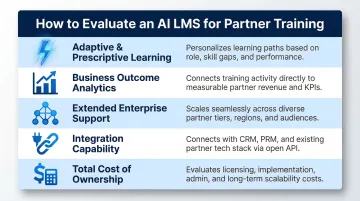
Core evaluation criteria:
- Adaptive and prescriptive learning, Auto-enrollment triggered when performance gaps are detected, not manual course recommendations
- Business outcome analytics, Training activity linked to deal win rates, pipeline growth, and revenue metrics, not just completion rates
- Extended enterprise support, Multi-portal architecture for training partners, customers, and employees with separate branding and data segregation
- Integration capability, Direct connections to CRM, PRM, HRIS, and sales tools to pull performance data and trigger learning pathways
- Total cost of ownership, Full pricing visibility, including add-on costs for AI features, advanced analytics, or additional user tiers
Platforms that require manual admin work to assign remedial training, or that limit AI to course authoring, were deprioritized. The platforms that made this list detect gaps and act on them without waiting for an admin to intervene.
Conclusion
The right AI-powered LMS functions as performance infrastructure, detecting skill gaps, routing training automatically based on results, and tying learning activity directly to measurable business outcomes.
When evaluating platforms, focus on three areas:
- Scalability: Does the system support partner ecosystems at the size you need?
- Prescriptive logic depth: Can it detect a struggling learner and automatically assign targeted training without manual intervention?
- Full-platform cost: Factor in total ownership, not just per-seat price
Before committing, verify AI personalization claims against real use cases in a demo environment. Ask vendors to show, not describe, how the system responds when a learner falls behind.
If connecting training to pipeline and partner performance is the priority, Pifini.ai brings prescriptive adaptive learning, AI sales coaching, and real-time analytics into a single platform at $50/user/year, built specifically for revenue teams and channel organizations.
Frequently Asked Questions
Can AI provide personalized learning experiences?
Yes, AI personalizes learning by analyzing each learner's behavior, performance data, and skill gaps to adjust content, pacing, and path in real time based on engagement and mastery, not static course assignments.
What is the integration of AI in LMS?
AI is embedded in LMS platforms through machine learning for adaptive recommendations, NLP for content search, and predictive analytics for identifying at-risk learners. Automation then handles enrollment triggers and workflow management, cutting manual admin work while improving outcomes.
What are the trends for LMS in 2026?
Key 2026 trends include:
- Prescriptive auto-enrollment that assigns training when learners struggle
- Agentic AI for autonomous workflow management
- AI virtual coaching and roleplay simulations
- Tighter LMS-CRM integration linking training directly to sales outcomes
What are the 4 types of AI learning?
The four primary AI learning model types in LMS platforms are: the learner model (tracks individual performance and behavior), the domain model (organizes content structure), the adaptation model (sequences content based on gaps), and the instructional model, which shapes how feedback and coaching reach the learner.
What features should I look for in an AI LMS for partner training?
Look for:
- Extended enterprise support with multi-portal configurations for different partner tiers
- Prescriptive auto-enrollment triggered when partners underperform
- Analytics linking certification to revenue metrics like deal win rates
- CRM integration connecting training data directly to deal activity and pipeline
How do adaptive learning paths improve sales team performance?
Adaptive paths cut ramp time by targeting individual skill gaps rather than delivering uniform training, and improve retention through spaced reinforcement. They also create measurable links between training completion and outcomes like win rates and quota attainment.