Introduction
Channel partners represent a massive but often undertrained revenue engine. More than 70% of global B2B technology revenue flows through indirect channels, exceeding $3.4 trillion in total addressable IT market value. Yet while companies invest heavily in internal sales enablement, their external partner ecosystems, responsible for the majority of that revenue, are frequently left behind with outdated PDFs, scattered webinars, and inconsistent messaging.
The consequences are measurable. Untrained partners take longer to close deals, generate more support escalations, and erode customer trust before your team even knows there's a problem.
According to research by Evoque, certified partners close deals 38% faster than non-certified partners, with partner-attributed deals showing a 2.8x higher win rate and 32% larger deal sizes on average. Structured training isn't a nice-to-have; it's a direct lever on revenue.
This guide breaks down the top partner training platforms for 2026, what separates them, and the selection criteria that matter most for channel-led revenue teams.
Key Takeaways
- Partner training platforms are purpose-built for external audiences, resellers, distributors, and VARs, not internal employees
- Top 2026 platforms tie AI personalization and certification automation directly to sales outcomes via CRM-integrated analytics
- Choose based on program complexity, tech stack fit, and whether you need a standalone LMS or a unified training-and-sales platform
- Top platforms: Pifini.ai, Docebo, WorkRamp, Channeltivity, and Skilljar
- Key criteria: scalability, certification workflows, partner-facing usability, revenue-linked analytics, and transparent pricing
What Is a Partner Training Platform?
A partner training platform is specialized software built to onboard, certify, and continuously educate external audiences, resellers, distributors, VARs, and affiliates, rather than internal employees. It's outward-facing by design and must function without the captive audience dynamic an internal LMS enjoys.
Three tools often get conflated with partner training platforms, here's how they differ:
- Internal LMS: Built for HR compliance and employee development with mandatory training for a captive, IT-supported audience
- PRM (Partner Relationship Management): Manages deal registration, lead distribution, and partner relationships
- Partner Training Platform: Sits at the intersection, delivering external-facing training, certifications, and revenue-linked analytics while integrating with both LMS and PRM systems
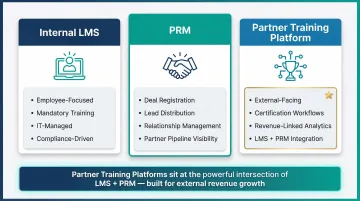
Forcing an internal LMS to handle partner training typically fails at scale, weak permissioning, poor external UX, and no revenue correlation expose the gap quickly. In 2026, the right platform needs to go beyond course hosting: think certification workflows, tiered partner access, AI-assisted coaching, and direct links between training completion and pipeline outcomes.
Top Partner Training Platforms for 2026
Platforms were evaluated on partner-specific design, AI capabilities, certification and automation depth, analytics tied to revenue outcomes, integration ecosystem, and total cost of ownership, not just feature count, drawing on real-world proof points such as how LP Building Solutions transformed its partner and contractor training and how McElroy University set the standard for distributor networks.
Pifini.ai
Pifini.ai leads this list as the platform purpose-built for partner revenue teams. The platforms that follow each serve distinct use cases within the channel enablement space.
Pifini.ai is an AI-powered revenue enablement platform built specifically for partner sales ecosystems, unifying training, content management, AI coaching, buyer engagement, and analytics into a single platform at $50 per user per year. Enterprise customers include AMD, Bobcat, Hexagon, and Omron.
Its partner-first architecture includes an enterprise-grade LMS (built on NetExam) with prescriptive learning that auto-enrolls partners into targeted training when performance gaps are detected. Live AI coaching and call scoring flag knowledge gaps in real time during customer interactions, linking training directly to win rates and pipeline growth. The Craig Weiss Group named Pifini Learn a Top 10 Learning System in 2025.
| Best For | Channel-led revenue teams, resellers, distributors, and alliances that need an all-in-one platform connecting training to sales outcomes | | Key Features | AI coaching + call scoring, prescriptive LMS with auto-enrollment, gamification, microlearning, simulations, certifications, content management, buyer engagement analytics | | Pricing | $50 per user per year |
Docebo
Docebo is an enterprise-grade learning management platform widely adopted by global organizations managing large, multi-tiered partner networks across multiple regions. It supports multilingual catalogs, multi-tenant structures for segmenting partner groups, and deep CRM integrations, making it a reliable choice for programs with complex organizational requirements.
Docebo stands out through its AI-augmented content discovery engine, which surfaces the most relevant training for each partner based on role and behavior. Its automation engine handles enrollment triggers, certification renewals, and reminders at scale without manual intervention.
FintechOS used Docebo to launch a global partner academy in just 9 weeks, registering over 400 users who completed an average of 5–7 courses each. Docebo earned 51 G2 badges in the Winter 2024 Awards cycle, including Leader in Corporate LMS and Customer Education.
| Best For | Enterprise organizations with global reseller or distributor networks requiring multi-tenant architecture and advanced automation | | Key Features | AI-based content recommendations, multi-tenant portals, custom learning paths, CRM and SSO integrations, granular reporting, certification management | | Pricing | Custom enterprise pricing; contact Docebo for a quote |
WorkRamp
WorkRamp is an LMS that unifies internal sales training and external partner enablement in one platform, useful for channel organizations that otherwise run these programs through separate tools.
Its clean interface reduces friction for both admins and partner learners. AI-driven features include automated captions and translation for global programs, file-to-guide conversion, and roleplay simulations that let partners rehearse sales scenarios before engaging real customers.
Quantum Metric used WorkRamp to launch Quantum Metric University, building over 50 product training paths, awarding 1,000+ certifications in the first year, and training 74% of its customer and partner base. WorkRamp was named a G2 Leader in Spring 2023 across Corporate LMS, Customer Education, and Sales Training and Onboarding.
| Best For | Organizations wanting a single platform for both internal sales enablement and partner training, with strong AI-assisted content creation | | Key Features | AI roleplay simulations, automated translation and captions, unified internal + external LMS, certification and learning path management | | Pricing | Contact for quote; typically starts around $25,000/year |
Channeltivity
Channeltivity is one of the few platforms designed exclusively for channel partner programs, blending LMS functionality with partner relationship management in a single system rather than requiring separate integrations.
Its fully modular design allows organizations to deploy only the channel tools they need, and its native integrations with HubSpot and Salesforce mean deal registration, partner activity, and training completion share a common data layer. Samsung utilized Channeltivity to rapidly build a global enterprise partner channel, signing up 250 global partners in only 6 months.
| Best For | Mid-to-large channel programs that want partner training tightly integrated with deal registration, lead management, and CRM workflows | | Key Features | Integrated PRM + LMS, unlimited multiformat course creation, HubSpot and Salesforce integrations, modular channel tools | | Pricing | Starts at $1,899/month |
Skilljar
Skilljar connects partner training directly to CRM workflows, making it a strong fit for organizations where deal registration, account management, and partner communication already run through Salesforce or HubSpot.
Skilljar's strength lies in its deep CRM integration that allows teams to sync partner training progress directly with sales data, enabling revenue leaders to answer questions like "do certified partners close larger deals?" Zywave relaunched Zywave University using Skilljar, resulting in a 51% increase in users, a 71% increase in course registrations, and a nearly 200% increase in product usage as a result of partner training. Skilljar is recognized as a G2 Fall 2025 Leader in Customer Education.
| Best For | SaaS companies, VARs, and technical reseller programs where partner training must be tightly connected to CRM-driven sales workflows | | Key Features | Deep CRM and customer experience platform integrations, custom-branded partner portals, certification and exam tools, detailed engagement analytics | | Pricing | Custom pricing; on the higher end, contact Skilljar for enterprise quotes |
What to Look for in a Partner Training Platform
The single most important distinction is partner-specific UX. Platforms built for internal employees assume a captive, IT-supported audience. Partner platforms must be mobile-first, easy to access without IT help, and intuitive enough that busy resellers will actually use them voluntarily. Low adoption is the most common reason partner training programs fail.
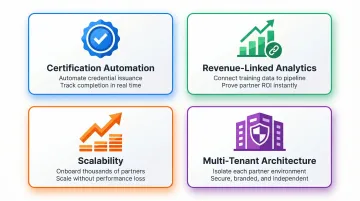
Beyond UX, every serious partner training platform should deliver on four criteria:
- Certification automation: Issues, tracks, and expires certifications automatically; auto-enrolls partners when skill gaps are detected; sends renewal reminders before they lapse. Manual certification management breaks down fast as programs scale.
- Revenue-linked analytics: Connects course completion and certification status to deal velocity, win rates, and partner-sourced pipeline. Native CRM integration or API access makes this correlation possible, without it, training ROI is nearly impossible to prove.
- Scalability: Supports segmented learning paths, multilingual content delivery, and separate branded portals for different partner tiers, without performance slowdowns or exponential cost increases.
- Multi-tenant architecture: Keeps data, branding, and access controls cleanly separated across partner types, regions, and product lines as your program grows.
Research shows certified partners close deals 38% faster and generate partner-attributed deals that are 32% larger, with a 2.8x higher win rate compared to non-certified partners. That performance gap makes the platform's ability to scale and enforce certification critical, not optional.
How We Chose the Best Partner Training Platforms
Each platform was assessed across five dimensions:
- Partner-first design, external UX, permissioning, and white-label branding
- AI and automation depth, from content delivery to coaching and scoring
- Certification and compliance capability, structured paths, exams, and audit trails
- Analytics tied to business outcomes, not just completions, but revenue impact
- Total cost of ownership, including hidden fees for external learner seats, storage, and integrations
One mistake that trips up buyers: evaluating platforms on internal employee training demos rather than testing the actual external partner experience. The two can look identical in a sales call and perform very differently in practice.
The key differentiator that separated top picks from the rest: the ability to connect training completion directly to revenue outcomes, not just track completions. Platforms that can't make that link are LMS tools wearing partner enablement clothing.
Conclusion
The right partner training platform directly affects revenue. It reduces partner ramp time, accelerates deal velocity, enforces brand consistency, and gives channel leaders the data to prove training ROI. Implementing a centralized digital partner portal can reduce partner ramp-up time to full productivity by up to 50%.
Evaluate platforms against your actual partner program complexity, a fast-growing mid-market SaaS company with 50 resellers has different needs than a global enterprise with 5,000 partners across 20 countries. When shortlisting, prioritize:
- Scalability, can it grow with your partner tier and volume?
- Automation, does it reduce manual admin for channel managers?
- Revenue linkage, can it tie training completion to pipeline and deal outcomes?
If those three criteria matter to your program, Pifini.ai is worth a close look. It unifies training, content, and analytics in one AI-powered platform at $50 per user per year, a fraction of what Seismic, Bigtincan, or Mindtickle charge for comparable functionality. See how it stacks up against the alternatives.
Frequently Asked Questions
What is the partner certification process?
Partner certification typically involves completing a defined learning path, passing an assessment or exam, and receiving a digital credential. Top platforms automate issuance, track expiration, and trigger renewal reminders so program managers don't handle this manually.
What makes a good training partner?
A good training partner delivers clear, role-specific content, maintains consistent certification standards, keeps training aligned with product updates, and provides channel managers with data showing how training correlates with partner sales performance.
Which certification is most in demand?
Demand varies by industry, but sales readiness certifications (covering product positioning, objection handling, and competitive differentiation) and technical implementation certifications are consistently the highest-priority for partner programs, especially in SaaS, technology, and complex hardware sectors.
What are the key features of an LMS?
Core LMS features include:
- Course creation and hosting
- Learner progress tracking
- Certification and assessment tools
- Enrollment automation and reminders
- Analytics dashboards
- CRM or HR system integrations
Core LMS features include:
- Course creation and hosting
- Learner progress tracking
- Certification and assessment tools
- Enrollment automation and reminders
- Analytics dashboards
- CRM or HR system integrations
For partner programs, external user permissioning, white-labeling, and multi-tenant support are additional critical requirements.
What is the difference between a partner training platform and an internal LMS?
An internal LMS is built for employees with mandatory, IT-managed training. A partner platform serves external audiences who choose whether to engage, so it prioritizes branded portals, partner-tier segmentation, and revenue-linked analytics that standard internal LMS tools don't offer.
How do you measure the ROI of partner training?
Connect training data (completion rates, certification status, time-to-certification) with CRM data (deal size, win rate, time-to-first-revenue) to calculate ROI. The core questions: do certified partners close larger deals, and how quickly do newly onboarded partners generate their first revenue? Native CRM integration makes this correlation straightforward.