
Introduction
Most sales forecasts still miss their targets, not because the forecasting method is wrong, but because the data feeding it is incomplete and the process is reactive. 55% of mid-market companies regularly miss quarterly revenue forecasts by more than 10%, and fewer than 25% of sales organizations achieve forecast accuracy above 75%. The problem isn't the spreadsheet. It's the gap between what reps remember to log and what actually happened in the conversation.
Inaccurate forecasts create a chain reaction across the business:
- Resource planning misses the mark
- Quota-setting reflects optimism instead of actual capacity
- Partner programs invest in the wrong channels
- Board-level reporting loses credibility
65% of B2B sales organizations are shifting from intuition-based to data-driven decision making by 2026. Predictive sales analytics has become a strategic priority, not just a technical upgrade.
This guide covers what predictive sales analytics is, how it works under the hood, what benefits it delivers, and how sales and revenue leaders can start building a reliable forecasting foundation.
Key Takeaways
- Predictive sales analytics uses machine learning and historical data to score deal probability and forecast revenue with measurable confidence, not stage-weighted guesswork
- Accuracy depends on three data layers: CRM structure, buyer engagement signals, and conversation data, the highest-signal source most teams still lack
- AI-powered forecasting surfaces at-risk deals earlier, improves rep coaching, and enables proactive resource and partner planning
- Most implementations stall at the data layer: incomplete CRM fields, missing conversation capture, and manual entry gaps sink accuracy before the model ever runs
- Getting started means auditing your current data, automating capture, and running a focused pilot, no data science team required
What Is Predictive Sales Analytics (And How It Differs from Traditional Forecasting)
Predictive sales analytics is the practice of using historical data, statistical models, and machine learning to assign probability scores to deals, identify pipeline risks, and generate forward-looking revenue forecasts. Unlike traditional reporting on what already happened, predictive analytics tells you what's likely to happen next, and why.
Predictive vs. Traditional Forecasting: The Core Difference
Traditional forecasting works like this: reps assign deal stages, managers roll up probabilities, and forecasts reflect what the team believes will happen. This method leans on backward-looking averages and subjective inputs. It rarely adapts to real-time changes like a new competitor entering mid-quarter or a buyer going silent for three weeks.
40% of sales leaders cite seller subjectivity as the greatest threat to forecast accuracy, and fewer than half of deals close as originally predicted.
Predictive forecasting starts with data, not belief. The model ingests deal age, activity cadence, buyer engagement, conversation signals, and market factors, then continuously recalculates win probabilities as conditions shift. It learns which patterns convert to closed revenue, not what reps remember to log.
Three outputs separate predictive from traditional:
- Probability-weighted forecast ranges instead of single-number estimates
- Deal-level win scores that focus coaching on the right opportunities
- Velocity decay alerts that flag stalling deals before quarter-end
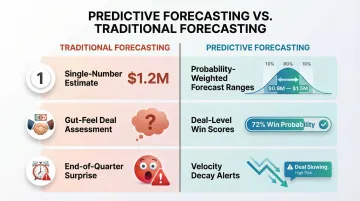
These outputs give sales leaders and managers better raw material for their calls, predictive analytics sharpens judgment rather than replacing it. That distinction matters most in channel-heavy or partner-led ecosystems, where rep data entry is inconsistent and subjective inputs compound quickly across the pipeline.
The 3 Data Layers That Power Accurate AI Forecasting
Predictive models produce outputs that match the quality of their inputs. Most implementations fall short not because the algorithm is wrong, but because the data feeding it is incomplete. Poor data quality costs organizations an average of $12.9 million annually, and 47% of newly-created data records contain at least one critical error.
Layer 1: CRM Data (The Baseline)
CRM data is the structural foundation: deal stage, close date, deal amount, contacts involved, and activity count.
Its limitation: This layer depends on reps entering it, and reps are inconsistent. Missing close dates, blank fields, and activity logs that show a meeting happened but not what was discussed make CRM data alone insufficient. Sales reps waste approximately 27% of their time dealing with inaccurate CRM records, and data duplication affects 10-30% of business records.
Layer 2: Buyer Engagement Data (The Behavioral Signal)
Engagement data is the behavioral layer. It tracks email response times, meeting frequency, the number of stakeholders involved, and whether prospects are engaging with shared content.
This layer captures what people do, not what reps enter. It often shows a prospect going cold before any CRM stage change reflects it. The average B2B buying decision now involves 13 internal stakeholders, making multi-threading essential for deal success.
Layer 3: Conversation Data (The Highest-Signal Input)
Most teams are missing the highest-signal input available: what actually gets said on calls.
Conversation data captures the signals no CRM field can replicate:
- Objections raised and whether they were resolved
- Decision-maker involvement and economic buyer presence
- Committed next steps (or the absence of them)
- Competitive mentions and budget discussions
A rep may update the CRM to say "demo complete, moving to proposal." Conversation data might reveal an unresolved budget objection and no economic buyer in the room. Those two versions of the same deal carry very different close probabilities.
Capturing this layer requires automation, not manual note-taking. Platforms like Pifini score AI sales calls in real time and flag coaching gaps, generating conversation-level signals as a byproduct of rep activity. Deal intelligence flows automatically into forecasting models without depending on reps to update records.
Key Benefits of Predictive Sales Analytics for Revenue Teams
The value becomes real when predictive signals change how reps prioritize, how managers coach, and how revenue leaders allocate resources.
Earlier Risk Detection Before Deals Slip
In a traditional process, deal risk surfaces when a rep moves it to next quarter or drops it from forecast. Predictive models flag risk signals in real time:
- A deal stalling beyond its expected stage window
- A buyer who has gone silent
- A late-stage deal where the economic buyer has never appeared on a call
This gives sales managers a window to intervene before the miss, not after.
Smarter Prioritization for Reps and Managers
Probability scoring allows reps to focus their time on deals most likely to close, and identify the 5-8 deals that need a targeted action to move forward, rather than reviewing 30 deals with equal urgency.
This is particularly valuable in partner-led sales where reps manage multiple accounts and reseller relationships simultaneously.
More Accurate Resource and Capacity Planning
Forecast accuracy downstream affects every resource decision:
- Hiring plans and territory assignments
- Inventory and partner program investments
- Marketing spend and budget allocation
When a forecast is based on probability-weighted data rather than pipeline optimism, the decisions built on it carry less risk, and finance, marketing, and leadership can plan with greater confidence.
Data-Driven Coaching and Performance Insights
Predictive analytics does more than forecast; it surfaces which behaviors correlate with winning. If reps who involve three stakeholders by the second meeting win at double the rate, that's a coaching signal.
Managers can build specific, evidence-backed coaching playbooks rather than offering generic advice. Organizations that embed forecast coaching into their sales process increase overall forecast accuracy by up to 15%.

Proactive Alignment Across Sales, Finance, and Partners
A shared predictive model gives sales, finance, marketing, and channel partners the same forward-looking view of the pipeline.
That shared baseline cuts the back-and-forth over conflicting data and reduces last-minute forecast revisions before board reviews.
Common Challenges of Implementing Predictive Sales Analytics
Incomplete CRM Data
84% of data and analytics leaders say their data strategies need an overhaul to reach AI goals. Inconsistent rep updates are usually the root cause, and the fix isn't better rep discipline.
Automate data capture at the source instead. When meeting notes, call summaries, and CRM fields update from actual conversations, the completeness gap closes on its own.
Adoption Resistance from Reps and Managers
Teams distrust model outputs that contradict what a rep believes about their deal. The key is positioning predictive scores as a second opinion, not an override.
Build trust gradually with these steps:
- Share early examples where the model flagged a risk that turned out to be real
- Run pilot pipeline reviews where model risk scores sit alongside rep assessments
- Let reps push back on scores, and use those debates to refine the model
Thin Historical Data
New teams, new products, and new market segments all face the same problem: not enough deal history to train a reliable model.
Richer per-deal signals, especially conversation data, compensate for low volume. Ten deals with full conversation data teach a model more than 50 deals with bare CRM entries. Treat model output as probabilities, not guarantees. Teams that treat high-probability deals as committed forecasts build fragile pipelines.
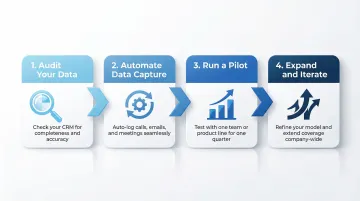
How to Build Your Predictive Forecasting Foundation: A Step-by-Step Approach
Step 1: Audit your data before selecting tools. Pull a sample of recent closed deals and check how many have complete CRM data, attached meeting notes, and conversation records from calls. The gaps in that sample are the gaps your predictive model will inherit. You don't need 100% data purity to start; you need to know where your floor is.
Step 2: Automate data capture at the source. This is the step most teams skip and the one that matters most. Automating meeting notes, CRM sync, and call logging ensures your data reflects what actually happened, not what someone remembered to enter.
Platforms like Pifini score AI sales calls and auto-surface coaching gaps as part of daily selling activity. That process generates conversation-level data as a natural byproduct, feeding more reliable forecasting inputs without adding to rep workload.
Step 3: Run a pilot on a segment of your pipeline. Apply predictive scoring to one team or one product line for one quarter. Compare the model's predictions against your traditional forecast. Track where they align and where they diverge. Those divergence points are where rep optimism and deal reality separate, and closing that gap is what forecast accuracy is built on.
Step 4: Expand and iterate based on outcomes. After the pilot, review which deals the model got right that the team got wrong, and vice versa. Adjust inputs, add new data sources as adoption grows, and extend the model to additional teams or segments. Predictive forecasting improves as your data grows. The goal is a model your team trusts enough to use alongside their own judgment, not instead of it.
Frequently Asked Questions
What is predictive sales analytics?
Predictive sales analytics uses machine learning, historical deal data, and behavioral signals to score deal probability and forecast future revenue. It shifts teams from backward-looking reports to forward-looking predictions grounded in what actually drives closed revenue.
What is sales pipeline forecasting?
Sales pipeline forecasting is the process of predicting future revenue based on the opportunities currently in the pipeline. It incorporates deal stage, velocity, win rates, and engagement data to estimate how much revenue will close in a given period.
What are the steps of forecasting?
The key steps include:
- Collect and aggregate CRM and engagement data
- Identify patterns from historical deal outcomes
- Score active deals by probability
- Aggregate deal-level scores into a revenue forecast
- Refine the model continuously as new outcomes come in
How can I improve sales forecasting accuracy?
Automate CRM and conversation data capture to reduce manual entry gaps, segment win rates by rep, product, and segment rather than using blended averages, and layer engagement and conversation signals into your model beyond basic stage probabilities.
How do I forecast a sales pipeline?
Pipeline forecasting involves assigning probability weights to each deal based on stage, velocity, and engagement signals, then aggregating those weighted values to project expected revenue. AI-assisted models adjust probabilities dynamically as new data flows in.
Why does pipeline analytics matter for sales operations?
Pipeline analytics anchors downstream revenue decisions, from quota-setting and territory design to hiring, to a reliable data foundation. Without it, organizations react to missed targets after the quarter ends instead of course-correcting while they still can.