Introduction
Sales reps spend 60% of their time on non-selling tasks, juggling an average of 8 tools just to close a single deal. The cost of this inefficiency is staggering: traditional enablement approaches, static training decks, fragmented content libraries, and post-call coaching, leave reps unprepared when buyers ask tough questions.
81% of sales teams are now investing in AI, and the payoff is measurable. By 2029, organizations using AI-driven enablement will achieve 40% faster sales stage velocity than traditional methods.
The gap comes down to scale. AI agents handle what human enablement managers can't: real-time coaching during customer calls, adaptive training paths tied to performance gaps, and automated content delivery that surfaces the right battle card at the right deal stage.
This guide reviews five AI agents built specifically for sales enablement, not outbound automation or prospecting bots, but platforms that make existing sellers more effective through training, coaching, and readiness intelligence. Each review includes a framework for evaluating the right fit based on integration depth, partner ecosystem support, real-time coaching capability, and total cost of ownership.
Key Takeaways
- AI agents automate training, content delivery, and coaching so reps spend less time hunting for resources and more time selling
- The best platforms link learning to outcomes, tracking how training impacts win rates, ramp time, and deal velocity
- Key selection criteria: CRM integration depth, real-time vs. post-call coaching, partner/channel support, and transparent pricing
- Legacy platforms run $300–$600/user/year; newer platforms match their core capabilities at a fraction of that cost
- Five tools reviewed: AI coaching, content management, in-workflow enablement, sales readiness, and partner ecosystem platforms
What Are AI Agents for Sales Enablement?
AI agents for sales enablement are software systems that autonomously handle enablement tasks, surfacing content mid-call, coaching reps during live conversations, personalizing training paths based on skill gaps, and tracking performance.
Unlike traditional sales tools that require manual setup and ongoing oversight, these agents operate independently once configured, making enablement decisions in real time.
This category is distinct from AI agents built for outbound prospecting or SDR automation. The difference matters:
- Outbound AI agents generate leads, automate cold email sequences, and fill the top of the funnel
- Enablement AI agents make your existing sellers more effective, coaching reps on what to say, when to say it, and how to back it up
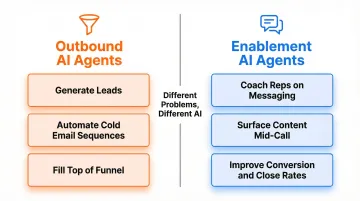
One fills the pipeline. The other converts it.
In 2026, the best platforms combine multiple agent types, content intelligence, coaching analysis, and adaptive learning, into unified systems. The breakdown below covers the top five platforms worth a close look.
The Best AI Agents for Sales Enablement in 2026
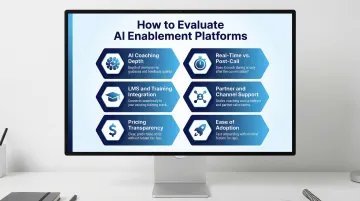
Each tool below was evaluated on AI depth, real-time coaching capability, learning integration, partner/channel support, pricing transparency, and ease of adoption, the factors that actually determine whether a platform moves the needle.
Pifini.ai
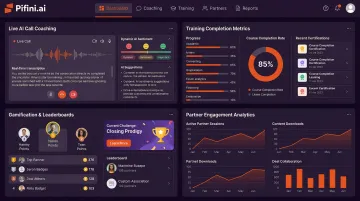
Pifini is an AI-powered revenue enablement platform purpose-built for partner sales ecosystems. It unifies training (via enterprise LMS), content management, AI coaching, and buyer engagement analytics in a single platform at $50/user/year, making it the most affordable all-in-one option compared to legacy competitors priced at $300-$600/user/year.
Where Pifini pulls ahead of the field:
- Live AI Sales Call Support surfaces relevant content and messaging guidance during active customer calls, in real time
- Auto-enrollment kicks in when call scoring detects performance gaps, turning coaching insights into immediate training action
- Gamification and microlearning drive 40% faster training completion and 30% higher program engagement across partner networks
- Readiness-to-revenue insights link training certifications directly to deal outcomes and pipeline data, ROI visibility most platforms don't offer
| Criteria | Details |
|---|---|
| Key Features | Live AI call coaching, enterprise LMS, gamification, microlearning, call scoring, content management, partner engagement analytics, and prescriptive auto-enrollment into training |
| Best For | Sales leaders, channel managers, and revenue teams managing resellers, distributors, or partner ecosystems who need one platform for training, content, and AI coaching |
| Pricing | $50/user/year (all-in-one, no hidden add-ons for LMS or AI coaching) |
Gong
Gong is a leading revenue intelligence platform that uses AI to analyze every sales call, email, and meeting, turning conversation data into coaching insights, deal health scores, and forecast signals. The platform records and transcribes interactions automatically, building a database of what works and what doesn't across your entire sales organization.
Gong's AI surfaces specific rep behaviors that correlate with won deals, talk ratios, objection handling patterns, topic coverage, enabling managers to deliver evidence-based coaching at scale. Its deal risk flags and pipeline forecasting are among the strongest available for large enterprise teams.
The results back it up: Experian increased win rates by 25% using Gong's AI insights, and Iron Mountain cut new-hire ramp time by 3 months.
| Criteria | Details |
|---|---|
| Key Features | Conversation intelligence, deal health scoring, AI coaching recommendations, forecast analytics, and CRM auto-logging |
| Best For | Enterprise revenue teams and sales managers who want deep visibility into why deals are won or lost and scalable coaching based on real call data |
| Pricing | Not publicly listed; requires platform fee plus per-user licenses, suited to large teams with significant investment capacity |
Mindtickle
Mindtickle is an AI-powered sales readiness platform focused on onboarding, role-play simulation, and skill certification, designed to ensure reps are prepared before they ever engage a buyer. The platform combines learning management, content delivery, and practice environments in one system.
Its AI role-play engine lets reps practice objection handling and discovery conversations against virtual buyers, with automated scoring on tone, accuracy, and messaging. Readiness scores tie directly to CRM performance data, helping enablement teams pinpoint which training gaps are hurting pipeline.
Customer outcomes: Cisco increased average deal sizes by 31% and saved over 6,000 hours of manager time using AI Role-Plays, while Janssen India cut new rep ramp time in half.
| Criteria | Details |
|---|---|
| Key Features | AI role-play simulations, skill certification, onboarding paths, readiness scoring, content management, and CRM performance correlation |
| Best For | Enablement teams and sales managers who need to systematically prepare large or distributed sales forces before and during ramp |
| Pricing | Not publicly listed; positioned as enterprise-tier investment with flexible pricing editions |
Highspot
Highspot is an AI-powered sales enablement platform that helps reps find, personalize, and deliver the right content at every stage of the buyer journey, combining a content hub with guided selling playbooks and buyer engagement analytics.
Highspot's AI recommends specific assets based on deal stage, industry, and buyer persona, then tracks how buyers interact with shared content (views, time spent, forwards) and feeds that intent data back to reps as actionable signals. Its guided selling framework maps playbooks to CRM stages so reps always know what to do next.
Results from customers: Allianz Trade achieved a 20% increase in quota attainment and a 10% improvement in win rates, while HSBC improved content findability by 83%.
| Criteria | Details |
|---|---|
| Key Features | AI content recommendations, buyer engagement analytics, guided selling playbooks, CRM integration, and content governance |
| Best For | Marketing and enablement teams supporting larger direct sales organizations that need content utilization data and rep adherence to messaging frameworks |
| Pricing | Not publicly listed; contact sales for custom pricing, positioned as enterprise solution with per-user licensing |
Spekit
Spekit is an in-workflow AI enablement agent that delivers just-in-time training, content, and knowledge directly inside the tools reps are already using, CRM, email, Slack, so reps get answers without breaking their workflow.
Spekit's AI sidekick listens to conversations and automatically surfaces relevant playbooks, battle cards, or pricing details mid-call or mid-email. Its AI-powered content management system keeps sales content governed and current, so reps never work from outdated materials.
New hires can ask questions contextually inside their actual tools rather than hunting through documentation. Scholastic cut onboarding time by 67% and surfaced answers 60% faster; Employment Hero reduced SDR ramp time by 25%.
| Criteria | Details |
|---|---|
| Key Features | In-workflow AI assistant, AI-powered CMS, contextual content surfacing, deal rooms, onboarding learning paths, and Salesforce/HubSpot/Slack integrations |
| Best For | Sales enablement managers and revenue ops teams who want AI-delivered guidance embedded in rep workflows without requiring reps to switch tools |
| Pricing | Not publicly listed; personalized plans available upon request, generally suited for mid-to-large sales organizations |
How We Chose the Best AI Agents for Sales Enablement
Tools were assessed on measurable outcomes, ramp time, win rate, content adoption, and coaching consistency, not just feature count. The common mistake buyers make is choosing platforms based on brand recognition or UI polish rather than fit with their sales motion and team structure.
Specific factors that made the shortlist:
- Depth of AI coaching vs. surface-level automation, Does the platform provide real-time guidance or just post-call transcripts?
- Real-time vs. post-call enablement, Can reps get help during customer conversations or only after?
- LMS and training integration, Does the platform automatically enroll reps in targeted training based on performance gaps?
- Partner and channel support, Can the platform scale to resellers, distributors, and indirect sellers?
- Pricing transparency, Are costs publicly listed, or do you need to schedule demos to get basic pricing?
- Ease of adoption without dedicated admin overhead, Can teams deploy quickly without hiring enablement operations specialists?
No single set of criteria applies equally to every team. The best tool for a direct enterprise sales team will differ significantly from the best tool for a company managing channel partners or resellers. With 94% of sales teams using partner selling and approximately 70% of customer IT spending flowing through partners, buyers should weight partner ecosystem support heavily if that's your go-to-market motion.
Conclusion
AI agents for sales enablement have moved from "nice to have" to table stakes in 2026. The platforms worth buying go well beyond task automation, they tie learning directly to pipeline, surface coaching at the moment reps need it, and give leadership a clear line of sight from training activity to closed revenue.
Evaluate tools against your actual sales motion, direct, partner-led, enterprise, or SMB. The right platform provides unified visibility across training, content, and performance rather than adding yet another silo to an already fragmented stack.
The most effective enablement teams prioritize platforms that:
- Integrate with existing CRM and communication tools without friction
- Deliver coaching in context, when reps are actively selling
- Prove ROI by linking learning completion to win rates and pipeline growth
For organizations managing partner sales ecosystems and looking for an enterprise-grade AI enablement platform without the enterprise price tag, Pifini.ai delivers live AI coaching, prescriptive learning, and partner engagement analytics at $50/user/year, a fraction of what Seismic or Mindtickle charge for comparable capabilities. Explore the platform to see how a unified approach connects your enablement investment directly to revenue results.
Frequently Asked Questions
What is an AI agent for sales enablement?
An AI sales enablement agent is software that autonomously handles enablement functions, surfacing content, coaching reps during calls, assigning training, and tracking readiness, without requiring manual oversight from enablement teams. Once configured, these agents make real-time decisions so sellers get the right support at the right moment.
How do AI agents improve sales enablement outcomes?
AI agents cut ramp time through personalized onboarding, surface relevant content at each deal stage, and coach reps during live calls. Because they link training activity directly to deal outcomes, enablement ROI becomes measurable, tracked through win rates, deal velocity, and time-to-productivity.
What is the difference between an AI sales agent and an AI sales enablement platform?
AI sales agents often refer to outbound automation tools, SDR bots that generate leads, send prospecting emails, and book meetings. AI sales enablement platforms focus on making existing sellers more effective through training, content delivery, and coaching. Both categories use AI but solve different problems in the revenue cycle: agents handle top-of-funnel automation, while enablement platforms sharpen mid-funnel and closing performance.
How do AI agents support partner and channel sales enablement?
AI enablement agents built for partner ecosystems auto-enroll resellers in targeted training, deliver certified product knowledge at scale, and track partner performance across deals. Channel sellers get the same real-time coaching as direct reps, so messaging stays consistent whether a deal runs through your team or a reseller.
What should I look for when evaluating AI agents for sales enablement?
Key criteria include integration with existing CRM and communication tools, whether coaching is real-time or only post-call, whether training is linked to deal outcomes, partner/channel support if applicable, and total cost of ownership including hidden fees for LMS, analytics, or AI add-ons. Prioritize platforms that offer transparent pricing and don't require significant administrative overhead to deploy.
Will AI agents replace sales enablement managers?
AI agents automate the execution layer of enablement, content delivery, training enrollment, call scoring, but they can't replace the strategic judgment and culture-building that human enablement leaders provide. What AI does is absorb the repetitive work, so managers spend their time on program design, high-impact rep coaching, and cross-functional alignment that actually moves revenue.