
Introduction
The average outbound connect rate has dropped below 5% in most B2B sales environments, meaning reps burn through 20+ dials just to reach one prospect. Spam filters, caller ID blocking, and sheer inbox fatigue have made the connected call a scarce resource.
Most teams respond by dialing more. The smarter response is understanding why calls aren't connecting in the first place.
Connect rate, the percentage of outbound calls that result in a live conversation, is the threshold metric for everything else in the sales funnel. No connection means no pitch, no discovery, and no deal. Call analytics turns that invisible problem into a measurable one, giving sales and revenue leaders the data needed to fix it systematically.
Key Takeaways
- Call analytics reveals why certain calls connect, timing, rep behavior, and call quality, not just how many were made
- Timing patterns, rep behaviors, and call quality signals become measurable and actionable
- Teams without analytics chase volume instead of fixing root causes behind missed connections
- Metrics like connect rate, talk-to-listen ratio, and best-time-to-call data drive smarter outreach
- AI-powered platforms detect low connect rates and automatically route reps into targeted coaching to fix them
What Is Call Analytics and Why Connect Rates Matter
Call analytics is the process of capturing, transcribing, and analyzing data from sales calls to reveal patterns that affect outcomes, from whether a call connects at all to whether it closes. Unlike a standard reporting tool, it functions as a diagnostic system, telling teams not just how many calls were made, but why some connected and why the rest didn't.
Connect rate is the first hurdle in the sales funnel. If reps can't get a prospect on the line, nothing downstream matters. The numbers tell a clear story:
- Average B2B outbound connect rate runs 5–10% across most teams
- Verified mobile direct-dial data pushes this to 18–22% when contact data is accurate
- 84% of sales reps missed quota in 2024, and poor connect rates are a significant driver
That gap between top-performing connect rates and the average isn't random. It's traceable.
Call analytics turns that traceable gap into something actionable. Instead of guessing why calls go unanswered, it shows which reps, call times, and messaging patterns consistently produce live conversations, and which don't.
Key Advantages of Call Analytics for Optimizing Connect Rates
These advantages are operational and measurable, each one directly shifts whether your dials end in real conversations or voicemails.
Timing Intelligence That Puts Reps in Front of Prospects at the Right Moment
Call analytics tracks when outbound calls are most likely to result in a live answer, broken down by industry, persona, geography, and lead source. This gives teams a data-backed calling schedule instead of gut instinct.
By aggregating historical data across hundreds or thousands of dials, analytics platforms surface time-of-day and day-of-week patterns that predict successful connections. Calls made between 4:00 PM and 5:00 PM are 71% more effective than those between 11:00 AM and 12:00 PM, and Tuesday and Wednesday account for 44% of all demos booked from cold calls.
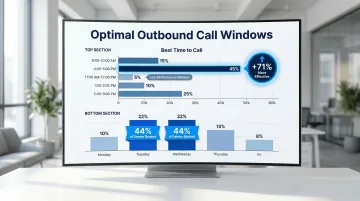
Even modest timing improvements compound across a full team's daily dials. Reps dialing at peak windows spend less time on fruitless attempts and more time in actual conversations, fewer wasted dials means better productivity per hour.
This advantage carries the most weight in high-volume outbound environments, teams covering multiple time zones, and channel sales organizations where reps reach prospects across diverse geographies.
KPIs impacted:
- Connect rate
- Dials-to-conversation ratio
- Rep productivity (conversations per hour)
- Pipeline generation rate
Behavioral Pattern Recognition That Identifies What Actually Drives Connections
Call analytics reveals which rep behaviors, opening lines, call cadences, and follow-up frequencies are statistically linked to prospects picking up and staying on the line. This turns top-performer instincts into replicable playbooks.
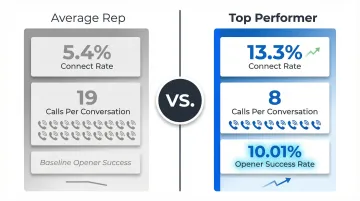
By analyzing transcripts, call durations, and outcome data across the entire team, analytics surfaces the patterns behind successful connections. Opening a cold call with "How have you been?" drove a 10.01% success rate, 6.6x better than baseline openers. Stating the reason for a call increases success rate by 2.1x.
Without this data, managers guess why certain reps outperform. Top-quartile reps connect with 13.3% of prospects versus the 5.4% average, an average rep needs 19 calls to land one conversation; a top performer needs just 8. Reps who know what works in the first few seconds are far less likely to lose the connection before it begins.
This matters most during rep onboarding, new messaging rollouts, and in channel/partner environments where distributed teams need consistent outreach standards.
KPIs impacted:
- Connect rate by rep
- Call-to-meaningful-conversation ratio
- Script adherence score
- Prospect engagement rate
Proactive Coaching Loop That Closes the Gap Between Poor Connect Rates and Skill Gaps
Call analytics doesn't just surface the problem, it pinpoints which skill or behavior gap is causing it and triggers the right training intervention before the pattern becomes a performance crisis.
AI-powered platforms score calls against defined benchmarks, detect when a rep's connect rate drops, flag the behavioral signals causing it (such as too-long openers, wrong timing, or poor personalization), and route that rep into targeted coaching, without a manager reviewing every call manually.
Pifini's call scoring evaluates every call across four dimensions: discovery, objection handling, product positioning, and closing strength. When gaps are detected, automated feedback loops route users directly into the Enterprise LMS for prescriptive training. Struggling reps are enrolled into focused learning modules targeting the specific weakness, no manual triage required.
Reactive coaching (reviewing calls after a bad quarter) is simply too slow. Reps coached weekly hit quota at 76%, compared to 56% for monthly coaching and 47% for quarterly coaching. As teams grow, manual call review becomes impossible, automated analytics-to-coaching pipelines are the only way to sustain consistent performance management at scale.
KPIs impacted:
- Time-to-improvement per rep
- Coaching touchpoint frequency
- Connect rate recovery rate
- Training completion rates tied to call performance
This advantage is most critical for scaling sales teams, managers overseeing distributed or partner-led forces, and organizations with high rep turnover where fast ramping determines revenue momentum.
Key Connect Rate Metrics to Track With Call Analytics
Tracking the right metrics separates useful analytics from noise. Focus on metrics that most directly signal connect rate health:
Core Connect Rate Metrics:
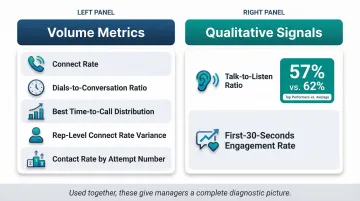
- Connect Rate: Calls resulting in a live conversation over 2 minutes, divided by total outbound dials attempted
- It takes 18 or more dials to connect with a prospect, track your dials-to-connect ratio to benchmark against that
- Best time-to-call distribution: time-of-day and day-of-week patterns when live answers peak
- Contact rates drop 63.2% after seven attempts, eight dials is the recommended cutoff before moving on
- Rep-level connect rate variance: surfaces performance gaps across the team before they compound
Qualitative Signals:
Beyond call volume metrics, qualitative signals matter too:
- Talk-to-Listen Ratio: Closed deals average 57% rep talk time; lost deals average 62%, a small shift in listening habits drives measurable win rate impact
- First-30-Seconds Engagement Rate: How quickly a rep establishes value; the earliest predictor of whether a call will hold or drop
Volume metrics show where capacity and timing are breaking down. Qualitative signals show how reps are executing once they get someone on the line. Used together, they give managers a complete picture of what to fix, and where to start.
What Happens When Connect Rate Analytics Are Ignored
Teams without call analytics don't just miss improvement opportunities, they actively make decisions based on wrong assumptions. They blame lead quality when the problem is call timing. They increase dial volume when the problem is rep behavior. They treat symptoms while root causes remain invisible.
Compounding consequences include:
- Inconsistent connect rates across the team with no way to diagnose why
- Managers defaulting to volume-based pressure instead of fixing root causes
- Reps repeating ineffective patterns because no one can see what's happening on calls
- Rising cost-per-connection as wasted dials accumulate
A 5% connect rate problem affecting one rep is a coaching conversation. Undetected across a 50-person team, it becomes a pipeline leak. A drop from 8% to 6% connect rate on 200 daily dials costs a rep 80 conversations and 12 meetings per month.
Multiply that across an entire team, and the cumulative impact becomes a quota-missing crisis, but without analytics, it stays invisible until the quarter closes.
How to Get the Most Value from Call Analytics
Call analytics delivers compounding returns when three conditions are met:
- Data is captured consistently across every rep and channel (no cherry-picking calls to review)
- Insights are reviewed on a regular cadence rather than crisis-driven
- The data is acted upon, routed into coaching, script updates, or timing adjustments, rather than just filed in dashboards
Meeting all three conditions requires more than a recording tool. Analytics siloed from training and CRM data produces reports, not results. When call scoring connects to learning content and pipeline data, each call informs the next: gaps trigger targeted training, timing patterns reshape outreach schedules, and coaching becomes evidence-based rather than anecdotal. Pifini's platform builds this unified layer by connecting call scoring directly with its Enterprise LMS, automatically enrolling reps into targeted learning paths when gaps are detected.
Start with a small number of high-signal metrics, connect rate, dials-to-conversation, and optimal call timing, before expanding your tracking. Master those fundamentals first, then layer in additional signals as the team builds the habit of acting on data.
Conclusion
Call analytics is critical for connect rates not because it adds more data, but because it replaces guesswork with a clear view of what's working, what isn't, and exactly what to change. When teams act on call timing data, behavioral patterns, and coaching signals together, every rep interaction becomes a source of compounding insight, fewer missed connections, faster adjustments, and measurable improvement over each quarter.
Sales teams that build call analytics into their ongoing workflow, not just a quarterly review, move faster, coach smarter, and close the gap between activity and results. The difference between average and high-performing connect rates often isn't effort. It's the feedback loop.
Frequently Asked Questions
What is a good sales connect rate benchmark?
Outbound B2B connect rates typically range from 5-10%, with verified mobile direct-dial data pushing this to 18-22%. Results vary by industry and lead source, so compare against your own historical baseline before chasing industry numbers.
How does call analytics identify the best time to call prospects?
Platforms aggregate historical call outcome data by time of day, day of week, and rep activity to surface patterns that correlate with live answers. This reveals optimal calling windows based on actual connection rates, not assumptions.
What is the difference between connect rate and conversion rate in sales?
Connect rate measures calls resulting in a live conversation, while conversion rate measures calls resulting in a desired outcome like a booked meeting or closed deal. Connect rate must improve before conversion rate can, you can't convert a conversation that never happened.
Can call analytics help reduce calls being marked as spam?
Yes. Analytics can flag patterns like excessive call frequency to the same number or off-peak calling that increase spam-marking risk. Adjusting cadence based on these insights protects phone reputation and improves answer rates.
What metrics should sales managers track alongside connect rate?
The most actionable companion metrics are dials-to-conversation ratio, talk-to-listen ratio, call attempt frequency before connection, and rep-level connect rate variance. Together, these reveal both capacity and quality issues.
How does AI improve sales connect rates specifically?
AI analyzes patterns across thousands of calls to surface timing, behavioral, and messaging signals that humans can't detect at scale. Those insights feed directly into automated coaching workflows, so underperforming reps get targeted guidance before gaps compound into pipeline loss.