: Complete Guide](https://file-host.link/website/pifini-9bdf2g/assets/blog-images/ab89a5d3-1dd5-41fc-a86a-bf67688e0a66/1776172357942023_201c455b4e9a49bf9c1024b915cc4983/360.webp)
Introduction
Sales training is one of the highest-leverage investments a company can make, yet most traditional programs fail to stick. Research from Gartner reveals that B2B sales reps forget 70% of training information within a week and 87% within a month. This staggering knowledge decay renders one-time training events nearly useless, wasting organizational resources and leaving reps unprepared for customer conversations.
Generative AI is reshaping how that problem gets solved. Training becomes adaptive and continuous, triggered by rep behavior, deal outcomes, and performance gaps rather than a calendar invite. This guide covers what generative AI in sales training actually means, how it's being deployed across real workflows, implementation strategies, and the risks worth watching.
Key Takeaways
- GenAI transforms sales training from one-size-fits-all events into adaptive, personalized learning experiences
- Key applications span AI roleplay simulations, real-time call coaching, automated content creation, and prescriptive learning paths
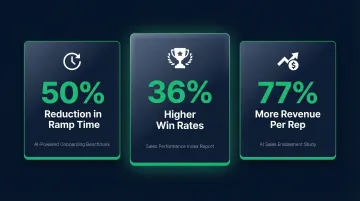
- Teams using AI-powered coaching report 36% higher win rates compared to peers
- Ramp times drop by up to 50% with AI-driven enablement
- Critical risks include AI hallucinations, data privacy concerns, and over-reliance without human oversight
- The strongest platforms tie training completion directly to win rates, pipeline growth, and revenue outcomes
What Is Generative AI in Sales Training?
Generative AI in sales training refers to large language models that generate training content, simulate buyer conversations, analyze rep performance, and personalize learning paths. Unlike traditional scheduled sessions with uniform content, AI enables on-demand, individualized training that updates continuously based on real sales data.
How GenAI Differs from Traditional Training
Traditional programs deliver scheduled sessions, generic content, and manual coaching reviews. Managers spend 30% to 60% of their time on administrative tasks, leaving only 10% to 40% for actual coaching. The result: 41% of reps report they are never or rarely coached.
GenAI changes this by providing continuous, personalized learning that adapts to individual rep performance without consuming manager time.
Why the Timing of Training Matters
The forgetting curve is real and expensive. Based on the Ebbinghaus Forgetting Curve, humans lose roughly 50% of newly learned information within an hour and up to 70% within 24 hours without reinforcement.
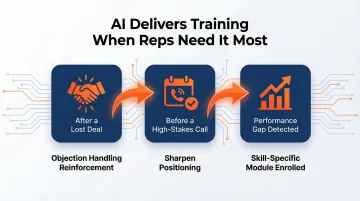
AI-driven spaced reinforcement addresses this directly, delivering learning at the moments reps actually need it:
- After a lost deal, to reinforce objection handling
- Before a high-stakes customer call, to sharpen positioning
- When performance data surfaces a specific skill gap
Key Use Cases: How Generative AI Is Transforming Sales Training
Personalized Learning Paths and Auto-Enrollment
AI analyzes individual rep performance data, call scores, quiz results, deal outcomes, to identify specific skill gaps and automatically enroll reps in targeted training modules. This removes the burden from managers who lack time to manually diagnose weaknesses across their teams.
Prescriptive learning in action:
After a rep loses a deal due to poor objection handling, the system automatically enrolls them in the relevant module before their next customer interaction. Learning happens at the moment of need, not on a quarterly schedule.
Pifini's platform works on this principle, evaluating every call, flagging gaps, and routing reps into targeted training paths so improvement stays continuous.
AI-Generated Training Content
Enablement teams can feed existing sales collateral, call transcripts, and product documentation into GenAI to rapidly create scenario-based modules, product knowledge assessments, and objection-handling playbooks.
81% of revenue enablement teams now use AI to create sales content, up from just 28% in 2024. What used to take weeks of instructional design now happens in days, and content updates continuously as products, pricing, or messaging evolves.
Microlearning and Gamification
AI supports microlearning by breaking complex skills into short, targeted learning moments that fit between calls and meetings. Microlearning boosts knowledge transfer by 17% and can increase long-term retention by up to 80% compared to traditional formats.
Gamification dramatically improves completion:
- Traditional eLearning: 25% completion rate
- Gamified eLearning: 90% completion rate
Gamification elements (leaderboards, certification badges, point systems) paired with AI personalization increase engagement and healthy competition, particularly valuable for distributed partner ecosystems.
Call Analysis and Performance Insights
AI reviews recorded sales calls to surface patterns that inform training priorities:
- Objections reps consistently fail to handle
- Filler word frequency and talk-to-listen ratios
- Competitor mentions and how reps respond
- Buyer sentiment shifts across the conversation
Managers can query AI to get aggregate team insights, "What are the lowest-performing competencies across my team this quarter?", without manually reviewing hours of recordings. Teams using AI-powered coaching can coach 3x faster because the data does the diagnostic work upfront.
AI-Powered Roleplay and Real-Time Coaching: The Training Game-Changer
AI-Powered Roleplay and Real-Time Coaching: How It Works in Practice
AI roleplay simulations allow reps to practice live sales conversations with an AI that plays the buyer persona, throws realistic objections, and responds dynamically based on the rep's answers. This gives reps a safe, repeatable environment to build confidence before real customer interactions.
Automatic Evaluation and Real-Time Guidance
AI scores roleplay submissions on messaging accuracy, objection handling, discovery questions, and tone, providing specific, actionable feedback without requiring manager time. This solves the most common coaching bottleneck: managers can't review every rep interaction.
During live calls, AI surfaces in-the-moment prompts and battle cards, helping reps navigate objections, competitive comparisons, or pricing discussions as they happen, not after the fact in a debrief.
Immediate Remediation and Continuous Improvement
Reps who struggle on real calls are automatically flagged and routed into targeted training right after the call, closing the gap between performance issue and skill development. Pifini takes this further by evaluating every call, flagging gaps, and auto-enrolling reps into the right training paths, so improvement becomes a system, not a one-time event.
Measurable Impact
Companies using AI-powered roleplay see consistent, measurable gains. Case studies show:
- 50% reduction in ramp time for new hires
- 60% of reps hitting metrics in 5 months versus 9% pre-AI implementation
- Ramp time reduced from 6-12 months to just 1 month for complex solutions
These ramp gains translate directly to revenue. Organizations deeply leveraging AI generate 77% more revenue per representative compared to those that don't.
How to Implement Generative AI in Your Sales Training Program
Start by Diagnosing Where Training Breaks Down
Before adding AI tools, map where training currently fails. Is it slow onboarding ramp time, inconsistent messaging across reps, or low completion rates? Difficulty training distributed partner networks? The use case should drive tool selection, not the reverse.
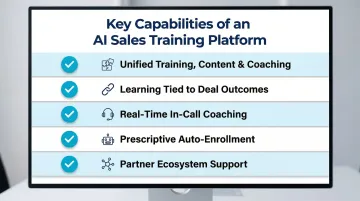
Key Capabilities to Look for in an AI Training Platform
- Unified training, content, and coaching in one system
- AI that connects learning to deal outcomes, certifications linked to win rates
- Real-time coaching during live calls
- LMS with prescriptive auto-enrollment that routes reps into training based on performance gaps
- Partner ecosystem support for resellers and distributors
Pifini's revenue enablement platform covers all of these in a single system built for both direct sales teams and partner ecosystems, priced at $50 per user per year, compared to $300–$600 for legacy platforms like Seismic and Mindtickle.
Scale Training Across Your Partner Ecosystem
For organizations with resellers, distributors, or alliances, AI-driven platforms solve a problem traditional LMS tools can't: training non-direct employees at scale. Partners can access personalized, on-demand content anytime, and their progress is tracked with the same rigor applied to internal reps. The result is consistent buyer experiences across your entire go-to-market organization.
Connect Training to Revenue Outcomes
An AI training platform that can't show which certifications correlate to higher win rates or shorter sales cycles isn't an enablement tool, it's an expensive content library. 55% of organizations are unable to effectively drive their go-to-market initiatives, and 29% still rely on multiple disconnected tools. Businesses with well-integrated enablement tech stacks are 42% more likely to increase sales productivity.
Ensure your implementation plan includes a reporting framework that links enablement activities to pipeline and deal performance.
Risks and Limitations of Generative AI in Sales Training
The Hallucination Threat
AI can generate confident-sounding but inaccurate product information, objection responses, or compliance-sensitive claims in training content. Global business losses attributed to AI hallucinations reached $67.4 billion in 2024.
Mitigation requires:
- Human subject matter expert review of all AI-generated training materials before deployment
- Retrieval-Augmented Generation (RAG) to ground outputs in enterprise knowledge
- Strict prompt engineering and human-in-the-loop verification
Data Security and Privacy
Feeding call transcripts, CRM data, and proprietary sales playbooks into AI tools triggers strict regulatory scrutiny. Under GDPR and the EU AI Act, AI models trained on personal data cannot be considered anonymous if personal data can be extracted from the model's parameters.
Before deploying any AI training tool, organizations need to address several compliance obligations:
- Establish a lawful basis under GDPR (such as legitimate interest) before processing personal data
- Apply technical safeguards like pseudonymization (replacing identifiable fields with tokens) and data minimization
- Honor CCPA/CPRA opt-out rights for US consumers regarding data sale or sharing
- Loop security teams into vendor evaluation, not after selection, but before
Over-Reliance Without Human Oversight
AI coaching delivers detailed execution feedback, but manager coaching is still required to build salespeople's self-efficacy and confidence. The two work best together, AI handles the data-intensive analysis, while managers handle the human development work AI can't replicate.
As Harvard Business School professor Karim Lakhani notes, "AI won't replace humans, but humans with AI will replace humans without AI." Reps need mentorship, relationship-building, and strategic guidance, areas where manager involvement remains irreplaceable.
Frequently Asked Questions
How can generative AI be used in sales training?
GenAI covers the full training lifecycle through several distinct capabilities:
- Generates personalized training content based on rep role and skill level
- Simulates buyer conversations for realistic roleplay practice
- Analyzes sales call performance to surface coaching insights
- Auto-enrolls reps in targeted modules based on identified skill gaps
- Delivers real-time in-call coaching prompts during live conversations
This shifts training from scheduled events to continuous, adaptive learning.
What are the main benefits of AI-powered sales training?
Faster rep ramp time (up to 50% reduction), more consistent skill development at scale, reduced manager coaching burden, and the ability to link training completion and scores to actual revenue outcomes like win rates and pipeline growth. Teams using AI-powered coaching report 36% higher win rates.
How does AI roleplay work in sales training?
AI roleplay uses conversational AI to simulate a realistic buyer persona, respond dynamically to the rep's inputs, and score the interaction on key criteria like messaging accuracy, objection handling, and discovery questioning. This gives reps unlimited low-stakes practice without requiring manager time for evaluation.
Can generative AI replace human sales coaches and managers?
No. AI augments but does not replace human coaches, it handles time-consuming tasks like reviewing roleplays and scoring calls so managers can focus their limited coaching time on the reps and situations that need it most. Strategic mentorship and relationship-based development still require human judgment.
How do you measure the ROI of AI-driven sales training?
Connect training metrics (certification rates, roleplay scores, module completion) directly to business outcomes (win rates, ramp time, quota attainment) using a platform that bridges LMS and CRM data. The average ROI of sales training is 353%, companies earn $4.53 for every dollar invested.
What should organizations look for when choosing an AI sales training platform?
Prioritize platforms that offer unified training, content, and coaching in one system; prescriptive learning that auto-enrolls reps based on performance gaps; real-time in-call coaching; partner ecosystem support; and transparent pricing with no hidden costs. The ability to connect training completion to revenue outcomes, win rates, ramp time, deal size, is what separates true enablement platforms from basic LMS tools.