Introduction
Many sales leaders assume they've done "sales enablement" because they've run training sessions. But conflating the two creates a dangerous gap: reps who know how to sell in theory but lack the right tools, content, and context when a real deal is on the line.
Misaligning investment between the two produces predictable damage: stalled deal cycles, inconsistent messaging across teams and partner channels, and poor win rates. 69% of B2B sales reps missed quota in 2024, with average attainment stuck at just 43.14%. Training completion wasn't the issue. Execution was, and execution requires more than training can deliver alone.
Key Takeaways
- Sales training builds foundational skills through structured programs, objection handling, product knowledge, negotiation
- Sales enablement equips reps with tools, content, and real-time support for live buyer conversations
- The real gap: training builds capability, but enablement determines whether it shows up when it counts
- High-performing revenue teams treat both as interconnected systems, not separate initiatives
- For partner-led organizations, aligning training and enablement across the ecosystem is where revenue is won or lost
Sales Enablement vs. Sales Training: Quick Comparison
| Aspect | Sales Training | Sales Enablement |
|---|---|---|
| Purpose | Build foundational skills and knowledge | Equip reps to execute consistently in real sales situations |
| Primary Focus | Knowledge transfer, skill development, certification | Content delivery, coaching, buyer engagement, performance support |
| Timing/Scope | Episodic, defined curriculum with start and end dates | Continuous, scales with headcount, product changes, market shifts |
| Ownership | L&D or HR | RevOps, dedicated enablement function, or sales leadership |
| How Success Is Measured | Completion rates, quiz scores, ramp time, certification attainment | Win rates, deal velocity, pipeline coverage, content utilization, revenue |
| Scalability | Requires recurring cohorts and instructor resources | Scales via platforms, automation, and just-in-time delivery |
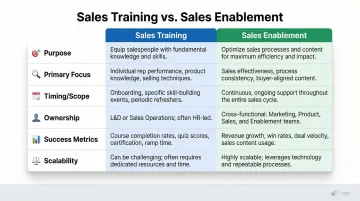
Treating these as an either/or decision is the most common mistake organizations make. In practice, training builds the foundation, enablement puts it to work.
What is Sales Training?
Sales training is a structured, instructional approach to building the skills and knowledge sales professionals need to perform. It's delivered through defined programs, onboarding courses, workshops, certification tracks, role-play simulations, and e-learning modules, with clear start and end points.
Core benefits include:
- Structured onboarding reduces average ramp time by 3.4 months, cutting time-to-productivity from 9.1 months to 5.7 months
- Reps who complete training enter buyer conversations with higher early-stage conversion rates and fewer stalled deals
- Teams develop consistent language around product value, positioning, and differentiation
Modern Training Formats
Sales training has evolved well beyond the traditional classroom. Today's programs blend formats to match how reps actually learn:
- Instructor-led training, live sessions best suited for complex product training and certification
- Self-paced e-learning and microlearning, bite-sized modules for foundational knowledge and compliance requirements
- AI-powered role-play simulations, adaptive practice environments that can reduce ramp time by up to 60%
- Peer coaching, collaborative learning that reinforces best practices across the team
- Certification programs, formal credential validation with proctoring and psychometric analytics
Use Cases of Sales Training
Training delivers the most value in a handful of specific scenarios:
- New hire onboarding, structured 30-60-90 day plans that accelerate time-to-first-deal
- Major product launches, equips teams to sell new offerings before they're in front of buyers
- Skill refreshers, targets underperformance in specific areas, such as declining objection handling scores
- Sales methodology rollouts, rolls out MEDDIC, Challenger, or SPIN frameworks across the full team
- Compliance or process changes, ensures teams understand new requirements before they affect deals
Illustrative scenario: A SaaS company onboards a cohort of new SDRs using a structured 30-60-90 day training plan. Week one covers product knowledge and value propositions. Week two introduces objection handling frameworks. By week six, reps practice demo delivery through AI role-play simulations. The result: ramp time drops from 120 days to 72 days, and initial conversion rates improve by 25%.
What is Sales Enablement?
Sales enablement is the operational system that keeps reps effective before, during, and after every deal. Unlike a one-time training event, it runs continuously, delivering the right content, coaching, and context at each stage of the buyer journey.
Core benefits include:
- Higher win rates: Organizations with mature enablement programs achieve 49% higher win rates on forecasted deals
- Shorter sales cycles: Real-time guidance accelerates deal progression
- Consistent performance across distributed teams: Enablement scales execution without centralized oversight
- Stronger buyer experience: Reps deliver the right message at the right stage
Common Enablement Activities and Tools
These benefits don't happen by accident, they're built on a specific set of tools and programs:
- Content libraries and playbooks mapped to buyer journeys and deal stages
- Battle cards and competitive intelligence for real-time objection handling
- CRM-integrated assets delivered directly inside the rep's workflow
- AI-powered live call coaching that provides in-the-moment guidance
- Performance analytics dashboards linking content usage to revenue outcomes
- Partner enablement programs supporting channel and reseller ecosystems
Key Components of Sales Enablement
The tools above only work when they're organized into a coherent structure. Functional enablement programs rest on five core pillars:
- Managed sales content library: Version-controlled, searchable resources organized by buyer persona and deal stage
- Training reinforcement and just-in-time learning: Microlearning modules triggered by performance gaps
- Coaching and feedback loops: Real-time call scoring and manager coaching cues
- Buyer engagement tools: Digital sales rooms and proposal platforms that track buyer interactions
- Performance analytics tied to revenue outcomes: Dashboards linking content usage, training completion, and win rates to revenue
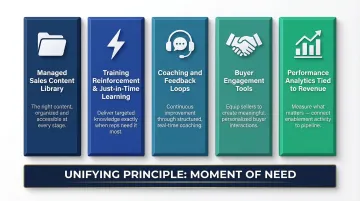
What unifies all five pillars is the "moment of need" principle, the core distinction between enablement and training. Training happens before the sale. Enablement functions in real time, putting the right resource, message, or coaching cue in a rep's hands exactly when they need it during a live conversation.
Key Differences Between Sales Enablement and Sales Training
Scope and Timeline
Training is episodic, it has a defined curriculum, a cohort, and a completion date. Enablement is continuous, it scales with headcount, product changes, market shifts, and buyer behavior.
Organizations that invest only in periodic training see short-term skill gains followed by long-term execution gaps. Reps forget 70% of training within a week without reinforcement, creating the "knowing-doing gap" where knowledge acquisition fails to translate to field execution.
Measurement and Accountability
Training and enablement are measured by entirely different standards:
| Training Metrics | Enablement Metrics |
|---|---|
| Completion rates | Win rates |
| Quiz scores | Deal velocity |
| Certification attainment | Pipeline coverage |
| Ramp time | Content utilization & revenue |
Using training metrics alone creates a blind spot. Completion doesn't equal execution. A rep who passes a certification exam may still struggle to handle objections or position value during live calls.
Ownership and Cross-Functional Alignment
Training is typically owned by L&D or HR. Enablement is owned by revenue operations or a dedicated enablement function, in close partnership with sales leadership and marketing.
39.4% of enablement functions now report to RevOps, while only 5.2% report to Marketing. When these owners operate in silos, the knowing-doing gap widens. Organizations with unclear ownership see 65% of sales content created by marketing go unused by sales teams.
Buyer Alignment
Sales training is often built around generic skill development and internal scenarios. Sales enablement resources are explicitly mapped to real buyer journeys, personas, and deal stages, giving reps the right message for the right buyer at the right moment.
In complex, multi-stakeholder B2B sales cycles, the gap shows up directly in closed-lost reports. A rep trained on product features can still lose a deal without the competitive battle card, ROI calculator, or case study the buyer needs at that specific stage.
Partner and Channel Context
Partners face that same buyer alignment problem, only amplified. In partner-led ecosystems, the gap between training and enablement is especially costly. Partners receive product training at onboarding but rarely get the ongoing enablement, co-branded assets, competitive battle cards, deal-stage playbooks, and live coaching support, needed to represent the brand confidently at scale.
Certified channel partners earn 6x more revenue than those who don't complete training. Yet 4 out of 5 new partners leave a program without selling anything, highlighting the failure of treating onboarding as a one-time event.
When to Use Sales Training, Sales Enablement, or Both
When to Prioritize Sales Training
Focus on training when:
- New hire and partner onboarding: Structured learning accelerates ramp time
- Major product or methodology launches: Teams need foundational knowledge before execution
- Identified skill gaps: Objection handling scores declining across a segment
- Compliance or process changes: Knowledge transfer is required
When to Prioritize Sales Enablement
Focus on enablement when:
- Complex or rapidly-changing sales environments: Reps need real-time guidance
- Distributed or partner-led teams: Consistent execution is required without centralized oversight
- High-volume deal flow: In-the-moment support drives velocity
- Training hasn't improved win rates: Reps know how to sell but lack execution tools
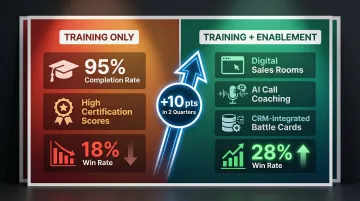
Real-world example: A global SaaS company invested heavily in sales training, achieving 95% completion rates and high certification scores. Yet win rates stagnated at 18%. After layering enablement infrastructure, Digital Sales Rooms, AI call coaching, and battle cards integrated into CRM, win rates jumped to 28% within two quarters. Training built their knowledge base; enablement converted it into consistent execution.
Why the Best Revenue Organizations Treat Training and Enablement as One System
High-performing revenue teams run training and enablement in parallel, with each reinforcing the other. Platforms like Pifini eliminate the need to stitch together separate tools by unifying training (with a full enterprise LMS), AI-powered live call coaching, sales content, and performance analytics in one platform built specifically for both direct and partner sales teams.
At just $50 per user per year, Pifini delivers enterprise capabilities at roughly 10x lower cost than alternatives like Seismic, Bigtincan, and Mindtickle ($300–$600/user/year), making a unified platform viable for organizations at any stage.
Explore Pifini's revenue enablement platform to see how training and enablement work together to improve win rates and rep performance.
Frequently Asked Questions
Is sales enablement the same as sales training?
No. Training is one component within a broader enablement strategy. Training builds skills through structured programs, while enablement provides the ongoing tools, content, and support reps need to apply those skills in real sales situations.
What are the key components of sales enablement?
The five core pillars are: a managed content library, training reinforcement and just-in-time learning, coaching and feedback loops, buyer engagement tools, and performance analytics linked to revenue outcomes. Each pillar supports reps at a specific point in the selling motion.
What are the 5 C's of sales?
The 5 C's typically refer to Competence, Confidence, Consistency, Creativity, and Customer Focus. Sales training builds these capabilities; enablement sustains them in day-to-day selling.
What are the 7 types of training?
The commonly recognized formats are instructor-led, e-learning/online, on-the-job, coaching/mentoring, role-play simulation, microlearning, and blended learning. Most modern enablement programs combine several of these formats based on role and learning stage.
Who owns sales enablement in an organization?
Ownership typically sits with a dedicated enablement team or revenue operations, in close collaboration with sales leadership, marketing, and L&D. In smaller organizations, this responsibility is often shared or held by the sales manager directly.
How do you measure the ROI of sales training and enablement?
Training ROI is measured by completion rates, assessment scores, and ramp time. Enablement ROI is measured by win rates, deal velocity, pipeline coverage, and content utilization.