Introduction
Despite having access to more customer data than ever before, most sales teams still forecast inaccurately. According to Gartner's 2024 research, 72% of sales organizations report forecast accuracy below 80%. The root cause? Traditional forecasting relies on CRM activity data (meetings logged, emails sent, stage changes) and subjective rep assessments rather than analyzing what's actually happening in sales conversations.
Legacy forecasting tells you what happened, a deal moved to negotiation, a discovery call occurred, but not why or what comes next. Conversational intelligence (CI) closes that gap by analyzing language patterns, buyer sentiment, and talk-time ratios inside actual sales calls, surfacing deal risk weeks before it shows up in your pipeline.
This article covers what CI is, how it improves forecast accuracy at a mechanical level, and what a CI-driven forecasting process looks like in practice, one capable of pushing accuracy above 85%.
Key Takeaways
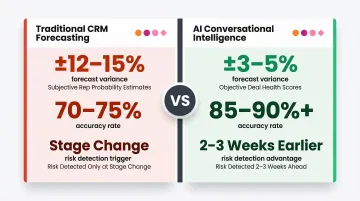
- Traditional forecasting averages 70-75% accuracy due to reliance on lagging CRM data and subjective rep inputs
- CI analyzes sales calls, emails, and meetings to surface deal risk signals weeks before stage-based methods catch them
- Accuracy improves by tracking sentiment shifts, stakeholder disengagement, urgency language changes, and competitive threats
- Better conversation data creates a compounding loop: sharper forecasts drive targeted coaching, which drives stronger win rates
Why Traditional Sales Forecasting Falls Short
The CRM Data Trust Problem
Only 35% of sales professionals completely trust their CRM pipeline data. CRM records are only as accurate as the reps who update them, and most update sporadically, optimistically, or not at all.
The downstream effect is measurable: 68% of companies see more than 10% variance between forecasted and actual revenue. Rep accountability gaps (57%) and CRM data quality issues (44%) top the list of causes.
The Manual Forecast Burden
Data quality is only part of the problem. Research from Forrester estimates that reps and managers spend approximately 2.5 hours per week just managing the sales forecast, time pulled directly from revenue-generating work.
Reps already dedicate only 28–30% of their week to actual selling. The remaining 70% goes to administrative tasks, and forecast reporting is a significant piece of that burden.
The Missing Diagnostic Layer
All of this effort still produces a revenue number, not a diagnosis. Traditional forecasts report totals without revealing which deals are at risk, why the pipeline shifted, or what action to take next.
That's the gap conversational intelligence fills. By surfacing why deals progress or stall, it gives sales leaders the context to intervene before a forecast misses, not after.
What Is Conversational Intelligence in Sales?
Conversational intelligence is the practice of capturing, transcribing, and analyzing sales conversations across channels, calls, video meetings, emails, using AI and natural language processing (NLP) to extract meaningful signals about deal health, buyer sentiment, and engagement patterns. According to Forrester's 2023 definition, CI uses NLP to "capture unstructured data from spoken, written, and video conversation channels between buying and selling groups" and surfaces insights that guide representatives, inform coaching, and support decision-making.
CI vs. Activity-Based Analytics
Activity-based tools count what happened, a call was made, an email was opened. CI understands what was said and meant. That distinction has direct consequences for forecast accuracy. Detecting that a competitor was mentioned is activity tracking. Understanding whether that mention signals a risk (active competitive evaluation) or validation (buyer doing due diligence) requires context analysis, a distinction that changes how a deal should be forecast.
Signals CI Captures That CRM Misses
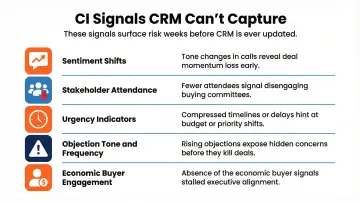
Conversational intelligence identifies signals invisible to traditional CRM systems:
- Sentiment shifts in buyer language across multiple interactions
- Stakeholder attendance shifts and declining engagement across meetings
- Urgency indicators (concrete timelines vs. vague language like "we're still evaluating")
- Objection tone and frequency that signal deal risk before reps update stage
- Economic buyer engagement levels and multi-threading evidence
When these signals feed into the forecast model, deal risk surfaces weeks before a rep manually flags it, giving revenue leaders time to act, not just report.
How Conversational Intelligence Improves Sales Forecasting Accuracy
Sentiment and Buyer Language Analysis
CI uses NLP to detect shifts in buyer language across multiple interactions. When a buyer moves from "we need this by Q3" to "we're still evaluating our options," that sentiment change is caught weeks before any CRM stage update occurs. These early warnings give revenue teams a more accurate signal of deal risk or acceleration.
Urgency indicators are extracted from conversations and fed into forecast models as weighted signals:
- Concrete timelines and deadline language
- Budget references and approval process questions
- Competitive mentions or stall language
This replaces static stage probability percentages that assign the same confidence to every deal at a given pipeline stage, regardless of actual buyer behavior. Predictive AI can detect deal stall risks 2-3 weeks earlier than reactive CRM stage changes.
Stakeholder Engagement and Deal Health Signals
CI tracks stakeholder participation patterns across calls and meetings. Key signals include:
- Economic buyers joining or dropping off calls
- Champion response times lengthening (a risk signal)
- New technical stakeholders appearing (positive) or going silent (a warning)
Participation patterns like these are more predictive of close probability than CRM activity counts.
Multi-threading signals from conversations (evidence of multiple decision-makers versus a single contact) serve as a leading indicator of deal solidity. Multi-threading boosts win rates by an average of 130% in deals over $50K, yet the average B2B buying committee now includes 8-13 stakeholders. A deal with only one consistently engaged stakeholder is a forecast risk that activity data alone cannot surface.
Removing Forecast Bias with Objective Deal Scoring
Reps naturally assign optimistic probability estimates to deals they're emotionally invested in, the "happy ears" problem. Managers often accept inflated assessments to protect pipeline coverage. Research shows that salespeople are three times more likely to overstate than understate forecasted performance, with 80% of firms still relying on subjective judgment.
CI replaces this subjectivity with objective deal health scores derived from actual conversation patterns, comparing current signals against historical data from similar deals that closed or fell through. Predictive AI forecasting models reduce forecast variance from ±12-15% (traditional CRM) to ±3-5%.
Pifini.ai's AI call analysis and real-time buyer engagement insights surface these signals during and immediately after customer conversations, so sales managers can adjust forecast risk in the moment, not after the weekly pipeline review.
Key Benefits of CI-Powered Sales Forecasting
Earlier Risk Identification
CI-based forecasting identifies at-risk deals significantly earlier than activity-based systems because sentiment and engagement signals degrade before deal stages change. The operational impact is clear: managers have time to intervene with coaching, executive escalations, or deal restructuring rather than discovering problems at quarter-end when it's too late to recover.
Reduced Forecast Prep Time
CI automates the collection and interpretation of deal intelligence that managers currently spend hours extracting manually. Organizations using AI-driven forecasting tools like Gong Forecast cut forecasting time by 40%. Some implementations reduce forecast generation from 4-5 hours of manual work to under 30 minutes. This recaptures time for coaching and revenue-generating activities.
Stronger Cross-Functional Alignment
CI gives sales, finance, and executive leadership a shared, evidence-based view of pipeline health, not just a revenue number, but a documented rationale for why specific deals are categorized as commit versus upside versus at-risk. This transparency eliminates the forecast negotiation dynamic where finance applies arbitrary discounts to sales projections they don't trust.
A Coaching-to-Forecast Feedback Loop
CI creates a direct feedback loop between rep performance and forecast accuracy:
- AI evaluates call quality and flags performance gaps
- Reps are routed into targeted training based on specific weaknesses
- Improved rep execution produces better conversation outcomes
- Higher-quality deal signals flow into forecasting models
- Forecast accuracy improves over time
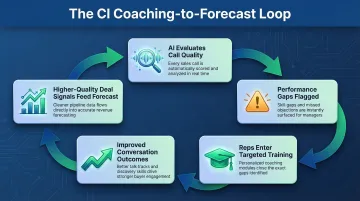
Pifini connects this loop end-to-end: when AI detects performance gaps during call analysis, the platform auto-enrolls reps into targeted courses through prescriptive learning, linking skill development directly to pipeline outcomes.
Better Pipeline Health Visibility for Sales Leaders
CI enables sales leaders to move from reactive management (explaining why the quarter was missed) to proactive performance management (identifying and intervening on at-risk deals weeks in advance). A 15% forecast accuracy improvement delivers a 3% pre-tax profit improvement, directly impacting investor confidence, resource allocation, and competitive advantage.
How to Build a CI-Driven Forecasting Process
Start with Conversation Data Capture
Before CI can improve forecasts, every customer-facing conversation must be consistently captured and centralized. This requires:
- Call recordings integrated with your phone system or conferencing tools (Zoom, Microsoft Teams, Webex)
- Automatic meeting transcription for video calls
- Email integration to capture written correspondence and response patterns
- CRM connectivity linking conversation data to specific deals and contacts
Coverage gaps undermine the entire CI signal layer. If only 60% of customer conversations are captured, the forecast model operates on incomplete information.
Define the Signals That Matter for Your Sales Process
Not all conversation signals are equally predictive across different sales motions. Teams should identify and prioritize the specific signals most correlated with their win rates:
- Enterprise deals: Economic buyer attendance on calls, multi-threading across departments, formal procurement language
- Transactional sales: Pricing discussion timing, urgency language, decision timeline clarity
- Technical sales: Champion engagement frequency, technical stakeholder involvement, proof-of-concept participation
Configure your CI tools to weight these signals appropriately rather than applying generic scoring models.
Once signals are configured, the next step is routing those insights into the workflows where forecast decisions actually get made.
Connect CI Insights to Forecast Workflows and Rep Development
CI only improves forecasting when insights flow directly into forecast reviews and coaching processes. Integration points include:
- Flagged deal risks feeding directly into weekly pipeline reviews with specific conversation evidence
- Conversation quality scores feeding into individual rep coaching plans with targeted improvement areas
- Training outcomes linking back to deal performance metrics to measure enablement ROI
Pifini's Training Impact Analysis dashboard makes this connection measurable. It shows a 46.1% training success rate and 16.7% average performance improvement across users, with a projected annual revenue impact of $58.6 million from top-performing courses, giving revenue leaders a direct line from enablement spend to pipeline outcomes.
Frequently Asked Questions
How to improve sales forecasting accuracy?
Improve forecast accuracy by replacing subjective rep inputs with objective AI-driven deal scoring, incorporating conversational intelligence signals (sentiment, stakeholder engagement, urgency language), and building a consistent forecast review cadence grounded in real pipeline evidence. Focus on CRM data quality and eliminate bias through data-driven assessments.
How can AI improve sales forecasting accuracy?
AI improves accuracy by analyzing patterns across thousands of historical deals to identify which signals predict outcomes, detecting sentiment and engagement changes in real-time conversations that humans miss, and removing "happy ears" bias from rep probability estimates. This surfaces at-risk deals weeks earlier, giving managers time to course-correct before the quarter closes.
Which sales forecasting method is most accurate?
Conversational intelligence-driven forecasting consistently outperforms activity-based ML and weighted pipeline methods. By analyzing contextual deal signals, buyer sentiment, stakeholder engagement, urgency language, rather than counting activities or applying static stage probabilities, it achieves 85-90%+ accuracy versus 70-75% for traditional methods.
What is a good sales forecast accuracy percentage?
Industry research places average forecast accuracy at 70-75% for organizations using manual or activity-based methods, while best-in-class teams using AI and conversational intelligence achieve 85-90%+. Consistent accuracy above 80% marks the threshold for reliable operational planning and investor confidence.
What are the key sales forecasting accuracy metrics?
Core metrics to track:
- Forecast vs. actual variance, measured by rep, team, and region
- Pipeline coverage ratio and deal stage conversion rates
- Forecast category movement, commit, upside, and best case
- Average time per deal stage
Conversational intelligence adds leading indicators on top of these: sentiment score and stakeholder engagement rate signal deal health before it shows up in stage data.